

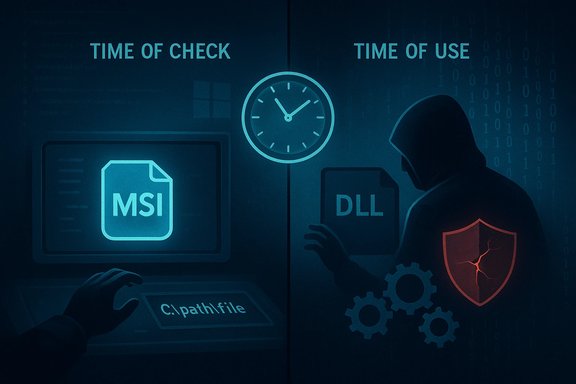
A time‑of‑check/time‑of‑use (TOCTOU) race condition in the Windows Installer service has been cataloged as CVE‑2026‑20816 and is being treated as a high‑priority local elevation‑of‑privilege (EoP) vulnerability that can allow an authorized local account to escalate to administrative or SYSTEM privileges if successfully exploited.
Windows Installer (msiexec and related services) is one of the operating system’s privileged, inbox components. It is responsible for installing, repairing, and removing software packages and therefore routinely performs actions that require elevated rights — modifying system files, changing registry keys, installing services and drivers, and interacting with kernel resources. That design makes the component an attractive target for post‑compromise privilege escalation, and a race condition in such a path is particularly dangerous because it can be converted into deterministic escalation primitives by adversaries who already have local code execution.
Microsoft’s Security Update Guide lists CVE‑2026‑20816 (the MSRC entry requires JavaScript to render full details in a browser), confirming the existence of the advisory and that vendor updates have been issued to address the issue. Independent vulnerability trackers and vendor advisories that mirror Microsoft’s record classify the defect as a TOCTOU race condition that can lead to local privilege escalation.
This advisory summarizes the known facts in the public record, explains realistic exploitation models, and provides an operational playbook for administrators and defenders. Where precise technical details (KB numbers, PoC code, or low‑level exploit mechanics) are absent from vendor advisories, those items have been flagged as unverifiable and must be confirmed directly through Microsoft’s Security Update Guide and the Microsoft Update Catalog before operational action.
Source: MSRC Security Update Guide - Microsoft Security Response Center
 Background
Windows Installer (msiexec and related services) is one of the operating system’s privileged, inbox components. It is responsible for installing, repairing, and removing software packages and therefore routinely performs actions that require elevated rights — modifying system files, changing registry keys, installing services and drivers, and interacting with kernel resources. That design makes the component an attractive target for post‑compromise privilege escalation, and a race condition in such a path is particularly dangerous because it can be converted into deterministic escalation primitives by adversaries who already have local code execution.Microsoft’s Security Update Guide lists CVE‑2026‑20816 (the MSRC entry requires JavaScript to render full details in a browser), confirming the existence of the advisory and that vendor updates have been issued to address the issue. Independent vulnerability trackers and vendor advisories that mirror Microsoft’s record classify the defect as a TOCTOU race condition that can lead to local privilege escalation.
What the record actually says
- Nature of the flaw: time‑of‑check/time‑of‑use (TOCTOU) race condition — a non‑atomic validation followed by a privileged operation that can be manipulated in the small window between check and use.
- Component: Windows Installer (msiexec / installer service code paths), an inbox privileged component used across client and server SKUs.
- Attack vector: Local — an attacker must be able to run code on the host (local execution required).
- Privileges required to trigger: Low (a standard/authorized local account may be sufficient to reach the vulnerable path, per public triage metadata).
- Impact: Elevation of Privilege (attacker can potentially obtain SYSTEM‑equivalent privileges), rated high by public trackers and vendor metadata.
Why a TOCTOU in the Installer is serious
Race conditions become exploitable primitives when the privileged path examines or validates a resource (file, handle, path, token) and then later uses that same resource without re‑validating or taking appropriate synchronization locks. In installer code paths those primitives are especially powerful for three reasons:- The installer already runs privileged operations (file installs, registry changes, service/driver installs), so any misdirection can cause privileged behavior to operate on attacker‑controlled inputs.
- Installer flows commonly handle temporary files, repair/advertising flows, and per‑user components that can be coerced by local processes — giving attackers multiple practical attack surfaces to trigger a timing window.
- Attackers with a local foothold (phishing, malicious software, or a sandbox escape) can repeatedly trigger the vulnerable endpoint, making timing races feasible to win with automation or targeted engineering.
Verified technical details and what remains unconfirmed
What is verifiable now:- Microsoft has recorded CVE‑2026‑20816 in its Security Update Guide, marking it as a Windows Installer elevation‑of‑privilege issue.
- Public trackers and vendor mirrors classify the defect as a TOCTOU race and rate the impact as local EoP with high severity in operational terms.
- The pragmatic attack surface is local, timing‑dependent, and often chained from a prior local foothold or unprivileged process.
- The precise exploitation steps, function names, internal offsets, or a public proof‑of‑concept (PoC) are not published by Microsoft in the advisory text; vendor disclosures intentionally omit low‑level exploit mechanics during coordinated disclosure. Treat any third‑party technical reconstructions as hypotheses until corroborated by Microsoft diffs or reputable independent researchers.
- Vendor KB numbers and exact per‑SKU build mappings can be rendered in the MSRC update interface but may require interactive access to extract the correct KB for each Windows build; those mappings must be validated against the Microsoft Update Catalog before deploying.
Practical exploitation scenarios (evidence‑based hypotheses)
The public advisories are concise; however, the attack patterns below are realistic given the vulnerability class and historical incidents. These are defensive hypotheses — not step‑by‑step exploit recipes.- Shortcut/repair abuse: An attacker crafts per‑user installer data or a shortcut that causes the privileged installer to validate one path and later act on a different, attacker‑controlled target during the TOCTOU window. This can cause privileged file replacement or code execution.
- Search‑path / handler substitution: If the installer validates a signed artifact and later loads a handler (DLL/COM) from a search path that includes user‑writable locations, an attacker can swap the handler in the gap between check and load.
- Handle/token swapping: The privileged service may accept a handle or impersonation token from a client and later use it without revalidating; a racing process can replace the resource before use and trick the privileged code into operating on attacker data.
Enterprise impact and prioritization
Who is most at risk:- Administrative workstations, jump boxes, and bastion hosts where standard user processes and elevated operations coexist.
- Build servers, CI/CD agents, and developer machines that regularly execute arbitrary binaries and process untrusted artifacts.
- Multi‑user systems (VDI, RDS hosts) where one user escalating privileges can affect other users’ environments.
- Public triage places the issue in the high severity range (CVSS v3.x vectors commonly reflect local attack vector with low privileges required and high impact). Exact scoring strings vary between trackers; confirm the CVSS vector when mapping to enterprise risk policies.
- This vulnerability is not wormable by itself (it requires local access), but it is highly valuable to attackers as the escalation step in multi‑stage campaigns (initial access → local EoP → lateral movement/persistence). Enterprises should therefore treat vulnerable endpoints as critical to patch.
Detection, hunting, and telemetry guidance
Because vendor advisories are intentionally terse, defenders should focus on behavioral telemetry rather than brittle IOCs. Recommended hunts and detection signals:- EDR/SIEM queries for unusual msiexec.exe parent/child relationships where the parent process is a non‑standard application or a user session process. Watch for msiexec spawning PowerShell, cmd.exe, or unsigned module loads from user directories.
- Service Control Manager (SCM) events showing unexpected installer service crashes, restarts, or faulting modules correlated with user session activity.
- Endpoint alerts for local processes attempting token duplication, scheduled task creation immediately following msiexec activity, or sudden service/driver installations by non‑admin contexts.
- File system telemetry: repeated attempts to write to ProgramData, %TEMP%, or other installer‑related locations followed by privilege escalation behaviors.
Mitigation and remediation playbook
Primary remediation: apply Microsoft’s security update for CVE‑2026‑20816 as provided in the Security Update Guide and Microsoft Update Catalog. Confirm KB→SKU mappings for each Windows build before mass deployment. Microsoft’s Update Guide is the authoritative source for per‑SKU packages and servicing prerequisites. Short‑term mitigations where patching is delayed:- Restrict who can install or repair MSI packages on critical endpoints (policy‑based block, application allow‑listing).
- Enforce least privilege: remove unnecessary local admin rights and restrict installer execution to managed deployment channels (SCCM/ConfigMgr, Intune).
- Temporarily limit write permissions to common installer temporary directories only if it’s safe and thoroughly tested; these changes can break legitimate installs.
- Increase endpoint telemetry (ASR rules, EDR logging levels) and tune hunts for msiexec anomalies until patches are applied.
- Confirm applicability for each build via MSRC and the Microsoft Update Catalog.
- Stage in a pilot ring with representative applications and workflows to identify compatibility regressions.
- Expand to high‑value assets (admin workstations, build servers, bastions) within 24–72 hours.
- Complete mass deployment and monitor for post‑patch anomalies; coordinate Known Issue Rollback (KIR) policies if Microsoft documents any compatibility regressions.
Risk analysis — strengths and limitations of public information
Notable strengths:- Microsoft’s Update Guide entry establishes the canonical fact that CVE‑2026‑20816 exists and that vendor updates address it. Having a vendor acknowledgement raises confidence that the vulnerability is real and actionable.
- Independent vendors and vulnerability aggregators reproduce the core attributes (TOCTOU race, local EoP), which helps defenders prioritize remediations even when technical detail is limited.
- Vendor advisories intentionally withhold low‑level exploit details; this reduces immediate weaponization risk but also leaves defenders without precise detection signatures. Expect PoCs from researchers after patches appear.
- Automated KB→CVE mapping in third‑party trackers can be incorrect or incomplete. Enterprises must confirm the exact KB packages from Microsoft’s Update Guide and the Microsoft Update Catalog rather than rely on a single aggregator.
- Hardening updates to installer behavior have historically caused compatibility pain (unexpected UAC prompts, repair failures). Patch deployments must therefore be staged and tested especially in environments with custom installers or legacy software.
Practical checklist for Windows administrators (prioritized)
- Confirm: look up CVE‑2026‑20816 in Microsoft’s Security Update Guide and note the KB/package mapping for each OS build in your estate.
- Pilot: install the package in a representative pilot ring; validate installer workflows and UAC behavior.
- Patch‑priority: deploy to high‑value assets (admin workstations, build servers, RDS/VDI hosts) within 24–72 hours.
- Compensate: where immediate patching is impossible, restrict installer execution, enforce application control, and limit local admin rights.
- Hunt: tune EDR/SIEM for msiexec anomalies and collect forensic evidence if exploitation is suspected.
Conclusion — what defenders must do now
CVE‑2026‑20816 is a privileged component TOCTOU flaw in Windows Installer that Microsoft has acknowledged in its update guide. The public triage indicates a local elevation‑of‑privilege with high operational impact: an attacker who gains a local foothold could use this vulnerability to obtain SYSTEM‑level rights and fully compromise a host. Immediate, pragmatic action is required: validate the MSRC KB mappings for your OS builds, stage and test the vendor fixes in a pilot ring, and then prioritize deployment to high‑value endpoints. Where patching cannot be immediate, apply compensating controls — restrict installer execution, enforce least privilege, and ramp up EDR hunts for installer‑related anomalies. Finally, remain mindful that the vendor’s concise disclosure means detection should rely on behavior rather than brittle IOCs, and expect further technical write‑ups once patches and diffs are public.This advisory summarizes the known facts in the public record, explains realistic exploitation models, and provides an operational playbook for administrators and defenders. Where precise technical details (KB numbers, PoC code, or low‑level exploit mechanics) are absent from vendor advisories, those items have been flagged as unverifiable and must be confirmed directly through Microsoft’s Security Update Guide and the Microsoft Update Catalog before operational action.
Source: MSRC Security Update Guide - Microsoft Security Response Center
