

Microsoft’s advisory for CVE-2026-21517 confirms a local Elevation of Privilege (EoP) vulnerability in the Windows App (macOS-targeted) installer components that can allow a low‑privilege user or process to obtain administrative or SYSTEM‑equivalent rights on a vulnerable host. The vendor record and multiple community analyses describe two practical exploitation primitives—(1) signed script substitution in extension/uninstall workflows and (2) a time‑of‑check to time‑of‑use (TOCTOU) race against updater/loading paths that enables DLL or handler hijacking—making this a high‑priority patch for endpoint and enterprise defenders. as long trusted several installer and updater components to perform privileged operations on behalf of users. When those components validate artifacts (signatures, manifests, file paths) in one context and later use those artifacts in another without atomic checks, an attacker with local capabilities can exploit the gap. CVE‑2026‑21517 is one of a string of such EoP issues affecting installer/update flows (including App Installer, Windows Installer, and Microsoft AutoUpdate on macOS historically) and is significant because it converts a local foothold into full host compromise. Microsoft’s Security Update Guide lists the CVE entry and maps it to vendor fixes; independent reconstructions from multiple security teams reproduce the two main exploitation patterns described above.
Why this matters: installer/updater codle placement, registry changes, driver/service installation—so any misdirection here becomes a powerful escalation primitive. Attackers typically chain an initial low‑privilege foothold (phishing payload, malicious process in a user session) with a local EoP to gain persistent, system‑level control. CVE‑2026‑21517 sits squarely in that high‑impact, local‑attack category.
Key points:
Attack model:
High‑value telemetry signals:
Source: MSRC Security Update Guide - Microsoft Security Response Center
Why this matters: installer/updater codle placement, registry changes, driver/service installation—so any misdirection here becomes a powerful escalation primitive. Attackers typically chain an initial low‑privilege foothold (phishing payload, malicious process in a user session) with a local EoP to gain persistent, system‑level control. CVE‑2026‑21517 sits squarely in that high‑impact, local‑attack category.
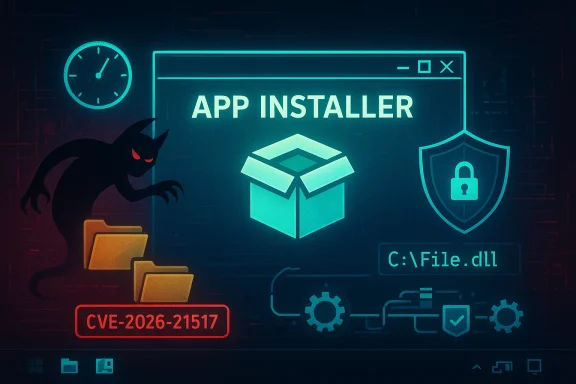 What the public record confirms (and what remains unconfirmed)
- Confirmerded CVE‑2026‑21517 in its update guide. Vendor updates addressing the issue are available through Microsoft’s normal security servicing channels; organisations should use the MSRC mapping to identify exact KBs for each SKU.
- Confirmed: The vulnerability class is local Elevation of Privilege. The pragmatic attack surface rand benefits from timing or writable‑directory weaknesses.
- Reconstructed and corroborated by independent researchers: two complementary exploitation classes—signed PowerShell/uninstan and TOCTOU DLL/handler hijacking—have been documented and lab‑reproduced by multiple-party writeups. These add confidence beyond the vendor acknowledgement.
- Not (yet) publicly verifiable: fully detailed exploit code, exact function offsets, and a public proof‑of‑concept (PoC) from the vendor. Microsil mechanics during coordinated disclosure; treat third‑party PoCs as hypotheses until they are reproduced and responsibly disclosed.
Technical analysis: two practical exploitation primitives
1) Signed script substitution in extension / uninstall flows
Many modern installer and extension management flows search a set of directcripts (for example, uninstall helpers or extension lifecycle scripts) and execute them under elevated contexts. If the parent or search directories are writable by non‑privileged users, an attacker can place an attacker‑controlled script—signed with a valid certificate or reusing a signing trust weakness—and trigger the uninstall/extension action to run that script with elevated rights.Key points:
- The attack depends on the installer trusting a script artifact based solely on a signature or presence in a known path without more atomic provenance checks.
- Attackers can exploit writable directories to perform signed script substitution (placing a malicious, but apparently signed, script that will be executed by an elevated process).
- Practical triggers include user‑facing uninstall flows, extension management APIs, or UI actions that escalate to privileged processes.
2) TOCTOU race against updater / loader paths (DLL hijack)
A classic TOCTOU scenario arises when a privileged process validates an artifact (for instance, the updater executable or package signature) and then spawns another process or loads depepath that can be modified by an attacker in the small window between validation and use.Attack model:
- Privileged component validates signatures/manifests in one process.
- It spawns an updater or helper that loads DLLs or handlers from a directory that ordinary users can write to.
- A malicious local process races to replace or inject a forged DLL/handler in that directory between check and load.
- The updater loads the attacker‑controlled DLL, and code runs with elevated privileges.
Real‑world exploitation vectors observed in community analysis
Community analyses and incident triage records show several practical follow‑on actions that attackers combine with CVE‑2026‑21517‑style primitives:- Using legitimate signed bundles (AppX/AppxBund t lull users into acceptance; then exploiting installer logic to escalate privileges.
- Chaining regsvr32 or similar living‑off‑the‑land binaries to reduce artifacts and evade straightforward signature checks.
- Leveraging browser‑launched ms-appinstaller: URIs (ms‑appinstaller
 and crafted landing pages to push a user into launching AppInstaller flows in the user session, then exploiting local OUs to escalate. Blocking the ms‑appinstaller protocol has been recommended as an immediate mitigation in past App Installer tors highlight that social engineering plus legitimate OS features can still be weaponized into high‑fidelity local escalation chains.
Enterprise impact and prioritization
Who should prioritize patching first:- Administrative workstations and jump boxes where users have both elevated workflows and interactive sessions. Compromise heremplications.
- DevOps/build servers, CI/CD agents, and developer machines that routinely process untrusted artifacts or run unsigned code as part I and multi‑user hosts where one user’s escalation could affect other sessions.
- The flaw is not remotely exploitable by itself; an initial local foothold is required. However, this makes it a highly valuable escalation primitive in multi‑stage campaigns (initial access → local EoP → lateral movement). Enterprises should treat vulnerable endpoints as critical to patch due to the high operational impact.
- Public triage places similar installer/updater EoP vulnerabilities in the High CVSS range due to low required privileges and high impact on confidentiality/integrity/availability. Confirm exact CVSS vectors from Microsoft’s advisory when building risk reports.
Detection, telemetry, and hunting guidance
Because vendor advisories typically avoid low‑level exploit must focus on behavioral telemetry:High‑value telemetry signals:
- Unexpected launches of AppInstaller.exe or msiexec.exe with nonstandard parent processes (e.g., browser parent or user session daemons).
- msiexec or AppInstaller spawning PowerShell, cmd.exe, or regsvr32 shortly after ivity. These chains often indicate post‑install actions by attackers.
- DLL loads from user‑writable locations or ProgramData paths that aren’t normally used by the product. Monitor module load events and correlate with process creation.
- File system activity: rapid writes to installer temporary directories, repeated attempts to create ogramData/%TEMP% following a user trigger.
- Network anomalies: following observed AppInstaller exploitation activity in prior incidents, defenders reported unusual outboundquery strings and Set‑Cookie payloads used as covert command channels—hunt for odd cookie activities and nonstandard HTTPS patterns if you suspect active abuse.
- Isolate the host to prevent lateral C2 beaconing.
- Collect memory, process dumps, and relevant event logs focusing on msiexec/AppInstaller/regsvr32/PowerShell ph for AppX/AppxBundle artifacts and recent file writes to installer directories.
- Preserve EDR telemetry for post‑incident triage and root‑cause analysis.
Short‑term mitigations when patching is delayed
If immediate patching is not possible, apply compensating controls that reduce attack surface and le the ms‑appinstaller protocol at scale (where feasible) to prevent ms‑appinstaller: URI launches from web content; this was recommended in earlier App Installer incidents.- Enforce application‑control policies: use AppLocker or Windows Defender Application Control (WDAC) to restrict AppX/AppXBUNDLE installations to trusted administrators or allowed publishers. Create eosoft.DesktopAppInstaller_8wekyb3d8bbwe if appropriate.
- Block non‑admin installs: enable Group Policy settings such as BlockNonAdminUserInstall to reduce successful social engineering installs.
- Limit who can run msiexec or AppInstaller with privileged arguments using local policies and application control.
- Tighten ACLs on installer temporary dearch/load paths—only after careful testing to avoid breaking legitimate installs. Misapplied ACL changes can disrupt legitimate workflows.
- Increase endpoint telemetry and EDR sensitivity for installer/uptime events and tune hunts for msiexec/AppInstaller spawning PowerShelchildren.
Recommended patch and rollout strategy
- Confirm applicability: use Microsoft’s Security Update Guide to map CVE‑to‑KB for every Windows build in your environment—do not rely solely on third‑party aggregators. The vendor KB→SKU mapping is authoritative.
- Pilot: aresentative pilot ring with diverse software to detect compatibility regressions (especially installer‑heavy workloads).
- Prioritize: roll updates to admin workstatioervers, and multi‑user hosts within 24–72 hours after successful piloting.
- Monitor: after deployment, monitor for post‑patch anomalies (unexpected UAC prompts, installer failures) and be readRollback (KIR) mechanisms if Microsoft documents regressions.
- Reconcile: confirm patch installation with configuration management tools and update incident playbooks to include the new telemetry hunts described above.
Risk analysis: strengths and limitinformation
Strengths:- Vendor acknowledgement in the MSRC Update Guide moves CVE‑2026‑21517 from rumor to actionable fact; this gives defenders a canone KB mappings and servicing notes.
- Independent writeups and community reproductions of the two primary exploitation classes (signed script su DLL hijack) increase confidence in the practical risk model.
- Microsoft’s coordinated disclosure intentionally omits exploit mechanics, so detection guidance must emphasize bIOCs. Expect PoCs and more detailed technical analyses to appear post‑patch.
- Third‑party CVE/K‑mapping databases sometimes disagree; enterprises must verify MSRC Update Guide and Microsoft Update Catalog before mass deployment. Automated feeds can mislabel or omit per‑SKU packages.
- Hardening installer behavior can cause compatibility pain (unexpected UAC prompts, repair failures). Plan phased rollouts and pilot testing.
- Confirm CVE applicability and exact KB mapping in Microsoft’s Security Update Guide for every Windows build in your estate.
- Stage the vendor update inting critical applications.
- Deploy to high‑value and high‑risk endpoints first (admin workstations, bastions, build servers).
- Apply compensating controls if patching is delayed: Block ms‑appinstaller, enforce AppLocker/WDAC polnAdminUserInstall, and tighten installer directory ACLs after testing.
- Tune EDR and SIEM hunts listed above and collect forensic artifacts if exploitation is suspected.
Conclusion
CVE‑2026‑21517 is a textbook exampinstaller and updater code paths demand atomic validation, least‑privilege file placement, and robust access control. Microsoft’s advisory conty and provides the normal vendor fixes; independent research corroborates practical exploitation patterns—signed script substitution and TOCTOU updater/DLL hijack—that make this a tion for endpoints that accept AppX/AppInstaller or otherwise rely on the affectefenders should prioritize vendor patches, strengthen application control and ACL hygiene where safe, andrts toward behavioral telemetry that exposes msiexec/AppInstaller abuse and suspicious post‑install activity. The vulnerability rewards rapid, coordinated response: confirm KB→SKU mappings via Microsoft’s Update Guide, pilot carefully, and deploy quickly to high‑value assets while hunting for the behavioral signals described above.Source: MSRC Security Update Guide - Microsoft Security Response Center
