

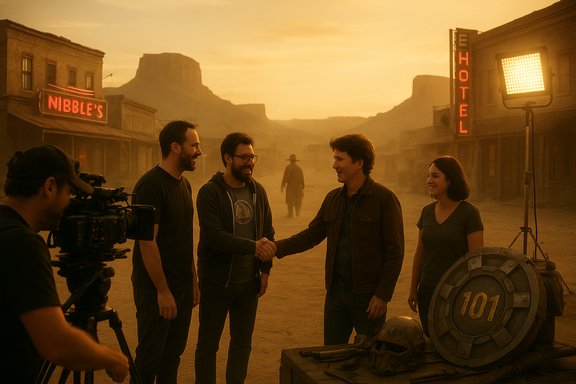
Todd Howard has moved to quash a persistent piece of Fallout fandom lore: Bethesda does not hate Obsidian’s Fallout: New Vegas, and the studio’s public gestures make that fact hard to deny. In a wide-ranging interview tied to the imminent debut of Prime Video’s Fallout Season 2 — which shifts the show’s action to New Vegas — Howard specifically praised Obsidian, confirmed the developer visit to the show’s set, and framed the long-running “Bethesda vs New Vegas” narrative as fan faction theatre rather than studio reality.
Season 2’s release creates a rare opportunity: a mainstream, high-profile celebration of New Vegas that both honors and reinterprets the game. The healthiest outcome for the franchise will be continued mutual respect between studios, careful handling of canonical questions, and an industry conversation that privileges nuance over factional storytelling. If Howard’s words and the studios’ actions are any guide, that nuanced future is both possible and, for the moment, visible.
Source: Windows Central https://www.windowscentral.com/gami...as-misconception-that-bethesda-hates-the-rpg/
 Background
How New Vegas arrived — and why it still matters
Fallout: New Vegas was released in October 2010 and developed by Obsidian Entertainment under publication from Bethesda Softworks. The project came after Bethesda’s Fallout 3 and during the team’s preparation for The Elder Scrolls V: Skyrim; Bethesda approached Obsidian to handle the Mojave-set RPG because of Obsidian’s pedigree in complex, choice-driven role-playing games. Over time, New Vegas acquired a reputation for dense faction systems, branching quests, and consequential dialogue — features that many players feel sharpened the franchise’s RPG core. New Vegas’ release was rough at launch — bugs and technical issues were widely reported — but the game’s writing, faction mechanics, and freedom of choice have aged into a celebrated legacy. Across fan polls, editorial roundups, and enduring forum discussions, New Vegas consistently appears in conversations about the “best” Fallout title. That reputation is a frequent driver of debate among players, and it’s also the root of the misconception Howard addressed: passionate players can morph into conspiracy-like narratives when preferences harden into perceived tribalism.What Todd Howard actually said — and why it matters
The quote and its context
Speaking with PC Gamer about the show and New Vegas’ place in franchise memory, Todd Howard was emphatic: Bethesda invited Obsidian developers to the Season 2 set, and he praised the studio’s recent productivity and quality. Howard’s phrasing — “Huge respect to the folks at Obsidian. Had them out to the set to see [Fallout Season 2], and they've had an incredible year…” — is as much public reassurance as it is goodwill. Howard also pushed back on the notion that Bethesda keeps New Vegas “at arm’s length.” He framed that idea as fan-driven talk: developers choosing to work together, offering mutual respect, and celebrating each other’s craft is plainly inconsistent with the “shunning” narrative. His comments arrived at an especially visible moment: Prime Video’s Season 2 leans heavily on New Vegas as a setting, ensuring Obsidian’s legacy remains part of the franchise’s mainstream cultural footprint.Why the reassurance matters to players
Howard’s statements do three practical jobs: they correct a widely repeated misconception, they affirm Obsidian’s creative importance within the Fallout tapestry, and they provide breathing room for fans anxious about canon and continuity. More than anodyne PR, the remarks signal that Bethesda values the creative contributions of partners and former collaborators — even after major studio consolidations placed both developers under Microsoft’s broader umbrella.The origin and persistence of the “Bethesda hates New Vegas” myth
Simple causes: gaps in references, fandom fragmentation
The rumor that Bethesda resents New Vegas didn’t spring fully formed from a single event. It rose from a mix of conditions that often feed franchise myths:- Long gaps between direct references to New Vegas in Bethesda-developed games created a sense of omission.
- New Vegas’ distinct design philosophy (strong emphasis on dialogue and faction choice) contrasted with Bethesda’s later technical and systems direction, making side-by-side comparisons feel adversarial.
- Fan debates about “which Fallout is best” became loud and persistent online, and online tribes amplify simple narratives.
Why disinformation spreads faster than nuance
Odds are good that the myth continued because it’s narratively satisfying: drama sells. When two studios appear to be on different creative paths, the simplest explanation for fans is interpersonal friction. That story is more emotionally resonant than the mundane truth — which is usually “multiple studios made different creative choices across different projects.” Howard explicitly reframed the story as healthy fan “factions,” not studio grudges.The TV show and canon: translation versus player agency
How Season 2 treats New Vegas’ multiple endings
One of the thornier issues when adapting games like New Vegas is how to handle divergent player endings. The TV creators and studio leads appear intent not to canonize one single outcome from the game. Instead, producers describe a “fog of war” approach that preserves multiple interpretations — a way to keep the integrity of the original player experiences without forcing a single definitive timeline onto the franchise. That approach mitigates a primary source of fan anxiety: the fear that the show will overwrite personal playthroughs.Risks and trade-offs for adaptation
Adapting a branching RPG into a linear narrative has real creative trade-offs:- The show must create credible consequences while avoiding alienation of players whose choices differ.
- Overly literal translations of faction outcomes risk collapsing the game’s key strength — player agency.
- Overly vague adaptations might disappoint viewers seeking specific game referents.
Obsidian’s 2025 — momentum, not resentment
A banner year for Obsidian
Howard’s shout-out to Obsidian referenced a tangible fact: 2025 was a heavy release year for the studio. Obsidian shipped Avowed earlier in the year, released Grounded 2 into early access, and launched The Outer Worlds 2 in the fall. Those three major releases reasserted Obsidian’s position as one of Xbox’s most prolific first-party studios since Microsoft’s 2018 acquisition. Far from evidence of resentment, that output is the basis for Howard’s praise.Why Microsoft ownership changes the dynamics — but not the feelings
Microsoft’s acquisition of Obsidian (2018) and ZeniMax/Bethesda (2021) restructured the business landscape: both studios now sit within the Xbox/Game Pass ecosystem. That corporate realignment changes strategic choices — platform strategies, subscription windows, and release coordination — but it doesn’t automatically create creative antagonism. If anything, shared ownership makes collaboration logistically simpler and increases the likelihood of cross-studio acknowledgement. Howard’s on-record invitation for Obsidian to visit Season 2’s New Vegas set is a vivid example.Why fans persist in seeing conflict — the psychology and the platform reality
Fan identity, nostalgia, and value signaling
Long-running franchises attract intense identity investment. Fans use favorites like New Vegas to signal values — a preference for hard RPG mechanics, for thorny moral ambiguity, or for finely tuned writing. When the studio that developed the series’ other leading entries pursues an alternative design path, some fans interpret that as betrayal. That’s not evidence of studio conflict; it’s a social phenomenon where disagreement escalates into perceived enmity.Platform moves complicate perceptions
Changes to availability and platform strategy fuel mistrust. For example, when high-profile releases migrate to Game Pass or when certain editions appear on different storefronts, fans sometimes interpret those moves as economic calculations that devalue legacy titles. In reality, platform decisions are driven by corporate strategy, licensing, and distribution logistics — not personal resentment between development teams. The presence of Fallout titles on Game Pass, and the inclusion of New Vegas on Game Pass cloud options for certain subscription tiers, underscores that distribution decisions are strategic rather than spiteful.Critical analysis: strengths, opportunities, and genuine risks
Notable strengths revealed by Howard’s comments
- Transparent goodwill: Howard publicly acknowledging Obsidian and inviting its developers on set is a high-visibility display of mutual respect that reduces conspiracy fuel.
- Creative continuity without heavy-handed canonization: The show’s “fog of war” stance preserves the game’s multiplicity of outcomes while still engaging with New Vegas visuals, factions, and tone.
- Cross-studio momentum: Obsidian’s strong release slate in 2025 demonstrates a healthy first-party studio pipeline that benefits Xbox Game Pass and raises the profile of narrative-driven RPGs.
Real risks that remain
- Perceived canonical overreach: If future media or official games retroactively assert a single New Vegas outcome, that could revive player anger. The show’s current approach reduces this risk, but the franchise’s long arc means the threat lingers.
- Mismatch between fan memory and adaptation choices: Fans who deeply love obscure quest beats or character arcs may feel the TV version glosses or misses what made the game special. That dissonance is inevitable in any adaptation.
- Commercial decisions misread as cultural betrayal: Platform exclusivity, Game Pass windows, and pricing controversies can be (and often are) reframed by fans as evidence of bad faith; those narratives are sticky and often resist correction. Recent high-profile pricing and release discussions across Xbox titles show how quickly economic choices can inflame communities.
What this means for the future of Fallout media and games
Short-term: Season 2’s role as a cultural touchstone
Prime Video’s Season 2 will likely serve as the cultural moment that either cements or softens Old New Vegas narratives. Its explicit nods to multiple endings and the visible inclusion of New Vegas locales work to celebrate the game’s legacy rather than erase it. Todd Howard’s public posture reinforces that message at the corporate-studio level: this is a shared franchise, not a battlefield.Mid-term: collaboration or co-existence?
Both studios now operate inside the same corporate tent, but each retains distinct creative identity. Obsidian’s 2025 output demonstrates that the studio is allowed — and encouraged — to ship distinctive games that aren’t necessarily direct continuations of Bethesda’s design language. That creative pluralism is healthy for the franchise: it allows multiple visions to coexist and fuels fan debate in ways that can strengthen the IP rather than weaken it.Long-term: canon, continuity, and player agency
The most durable tension will persist around canon. New Vegas’ branching narratives are central to its appeal; any future game or adaptation that attempts to collapse those branches into a single, unilateral timeline risks alienating a passionate base. The wiser path for future developers and media producers is the one Season 2 seems to be taking: honor multiple truths, preserve player agency in spirit if not letter, and treat fan experiences as valid. That’s a sustainable model for a franchise built on player choice.Practical takeaways for players, content creators, and industry watchers
- Players: Treat the “Bethesda hates New Vegas” narrative as debunked by leadership comments and observable cooperation; your playthroughs and memories remain valid. If concerned about canon, watch Season 2 with the presumption that it will not forcibly overwrite player choices.
- Content creators and journalists: Be cautious when translating fan tribalism into fact. Studio relationships are often collaborative and multi-layered; sensationalist framings can misrepresent the true dynamic between creative teams. Howard’s PC Gamer interview is a useful primary source for context.
- Industry watchers and executives: Microsoft’s stewardship of multiple studios creates both efficiency and expectation. Cross-studio respect, visible in gestures like set visits, is valuable currency; avoid letting corporate coordination crowd out the creative identities that make each studio unique.
Final verdict: a myth corrected, but the conversation continues
The claim that Bethesda hates Fallout: New Vegas has always been more a piece of fandom lore than an evidence-based conclusion. Todd Howard’s public remarks — backed by studio visits, a New Vegas-focused Season 2, and Obsidian’s strong release slate in 2025 — make the myth hard to sustain. What remains worth watching is not whether studios admire one another, but how future projects treat the hard-earned legacy of player-driven narratives.Season 2’s release creates a rare opportunity: a mainstream, high-profile celebration of New Vegas that both honors and reinterprets the game. The healthiest outcome for the franchise will be continued mutual respect between studios, careful handling of canonical questions, and an industry conversation that privileges nuance over factional storytelling. If Howard’s words and the studios’ actions are any guide, that nuanced future is both possible and, for the moment, visible.
Source: Windows Central https://www.windowscentral.com/gami...as-misconception-that-bethesda-hates-the-rpg/
