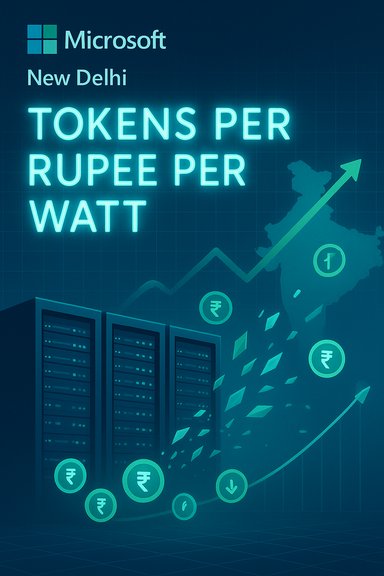
When Microsoft CEO Satya Nadella stood on a Delhi stage and distilled a provocative metric — “tokens per rupee per watt” — he did more than coin a catchy phrase; he framed a data‑centre–centric lens for how nations might measure their readiness for the AI era. That formula ties three concrete variables — the volume of AI tokens processed, the cost denominated in local currency, and the energy consumed — into a single, operationally useful shorthand that Nadella argued could correlate with broad socioeconomic outcomes such as GDP growth. His remarks accompanied Microsoft’s headline-making $17.5 billion investment in AI and cloud infrastructure in India, a commitment the company and multiple news outlets have documented as its largest in Asia and a central plank of a push toward sovereign, population‑scale AI.
Microsoft’s December announcements in New Delhi tied together three themes that are now inseparable across enterprise IT and public policy: hyperscale compute expansion, data sovereignty, and the economics of AI consumption. The company described a multi‑year plan to expand Azure regions in India, offer sovereign cloud options, and scale skilling programs that promise to train millions of workers. That investment complements Microsoft’s broader product and governance moves — notably in‑country processing for Microsoft 365 Copilot interactions — designed to make advanced AI services viable for regulated industries and government customers. This feature unpacks Nadella’s “tokens per rupee per watt” proposition, verifies the technical and commercial claims tied to Microsoft’s India commitment, and offers a critical analysis of the metric’s potential usefulness and blind spots. It cross‑references public statements with corporate announcements and independent technical benchmarks, flags claims that are plausibly aspirational rather than proven, and drills into the energy, cost and governance trade‑offs that every CIO, policymaker, and infrastructure investor will need to weigh.
If nations treat compute as infrastructure in the classic sense — a utility whose benefits require distribution, oversight, and integration with human systems — then tokens per rupee per watt can become a measurable lever for inclusive growth. Treated as a slogan or marketing metric, it risks obscuring the harder work of making AI actually useful, accountable, and sustainable.
Source: The Economic Times Token per rupee per watt to correlate with GDP growth: Satya Nadella - The Economic Times
 Background / Overview
Microsoft’s December announcements in New Delhi tied together three themes that are now inseparable across enterprise IT and public policy: hyperscale compute expansion, data sovereignty, and the economics of AI consumption. The company described a multi‑year plan to expand Azure regions in India, offer sovereign cloud options, and scale skilling programs that promise to train millions of workers. That investment complements Microsoft’s broader product and governance moves — notably in‑country processing for Microsoft 365 Copilot interactions — designed to make advanced AI services viable for regulated industries and government customers. This feature unpacks Nadella’s “tokens per rupee per watt” proposition, verifies the technical and commercial claims tied to Microsoft’s India commitment, and offers a critical analysis of the metric’s potential usefulness and blind spots. It cross‑references public statements with corporate announcements and independent technical benchmarks, flags claims that are plausibly aspirational rather than proven, and drills into the energy, cost and governance trade‑offs that every CIO, policymaker, and infrastructure investor will need to weigh.The “Token Factory” formula — what Nadella actually said
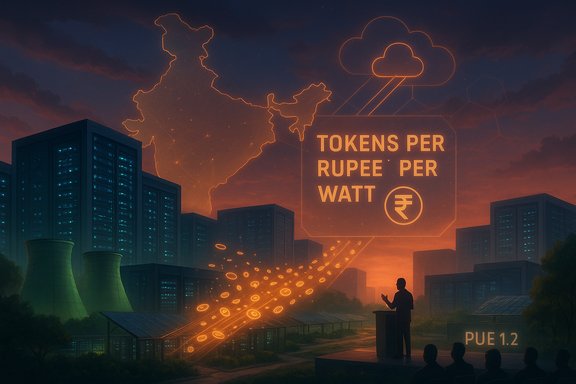
Nadella described the computing infrastructure and data centres that serve AI models as “token factories” and offered a neat algebraic yardstick: tokens per rupee per watt. The point was simple: if a country can generate more useful model tokens for each unit of currency spent and unit of power consumed, those tokens — the raw material of model learning and inference — will translate into improvements in health, education, public service delivery and private-sector competitiveness. The quote and context were reported by multiple Indian and international outlets and reflected Microsoft’s framing of compute as a national capability. Two immediate clarifications are required. First, tokens are the unit of text consumed or produced by language models — not a monetary instrument — and they scale with both model complexity and user demand. Second, Nadella’s claim is an empirical hypothesis, not a proven law: it ties measurable engineering metrics (compute and energy efficiency) to broad macroeconomic outcomes (GDP growth). That correlation is plausible but not automatic, and the relationship will depend on how effectively token‑level compute translates into productive services that reach citizens and firms.What Microsoft is investing in — the $17.5 billion commitment
Microsoft’s announcement of a $17.5 billion investment to expand cloud and AI infrastructure in India is a headline figure that combines expanded data centre capacity, sovereign cloud offerings, partner and skilling programs, and product localization. Microsoft’s own release and independent reporting confirm the commitment and describe an expanded India South Central cloud region, sovereign public and private cloud offerings, and targeted work with government platforms such as e‑Shram and National Career Service (NCS). Multiple reputable outlets independently reported the size and scope of the investment. Why this matters: capital commitments of this magnitude are rare and indicate both confidence in local market scale and a strategic bet on long‑term regulatory and procurement alignment. For enterprises and states, the promise of nearby GPU capacity and sovereign-ready cloud primitives reduces latency, simplifies compliance postures, and makes high-frequency AI workloads — the ones that generate lots of tokens — practically deployable at scale.Data sovereignty, Copilot and local processing
One of the most tangible policy shifts embedded in Microsoft’s messaging is the operational commitment to in‑country processing for Microsoft 365 Copilot interactions. Microsoft published that Copilot interactions (prompts and responses) will be processable inside national borders for a set of initial countries — India among them — with in‑country options rolling out to 15 countries across 2025–2026. This is not just data‑at‑rest residency; it is an operational routing promise for inference workloads. Microsoft’s product blog and regional press materials describe how this option improves governance, reduces cross‑border exposure, and lowers latency for regulated customers. Practical note: in‑country processing is offered as a customer‑electable option, often targeted at government and regulated enterprises. It reduces one vector of cross‑border risk but does not eliminate domestic lawful‑access, nor does it automatically guarantee feature parity or infinite local capacity. Microsoft’s documentation and follow‑up reporting emphasize a choice model, and procurement teams should request enforceable contract schedules and capacity attestations rather than relying solely on marketing timelines.Energy, efficiency and the real cost of tokens
The crux of Nadella’s metric is energy efficiency: how many tokens can you produce per watt-hour for a given cost? This requires unpacking three technical layers — model architecture and size, hardware and system efficiency, and data centre facility efficiency.- Model and software: modern inference stacks (quantization, optimized runtimes like vLLM or TensorRT‑LLM, and sparse/MoE architectures) reduce energy per token dramatically compared with early LLM deployments. Benchmarks show per‑token energy can vary from under one joule per token (on optimized H100 or newer stacks) to several joules per token on older hardware and naïve runtimes. Recent community and academic benchmarks document large variability and clear efficiency gains from newer generation GPUs and optimized inference engines.
- Hardware: GPU generations matter. NVIDIA H100 and later class GPUs deliver far better joules-per-FLOP ratios than older V100/A100 hardware. Specialized accelerators and custom LPUs can further change the economics but are currently less ubiquitous than mainstream GPU fleets. Vendor claims and independent tests suggest modern systems can reduce energy-per-token by an order of magnitude relative to earlier baselines under certain workloads.
- Data centre PUE and facility overhead: Power Usage Effectiveness (PUE) remains a primary facility‑level lever. Hyperscalers routinely report PUEs in the ~1.1–1.2 range for new builds; the industry average sits higher. Every incremental reduction in PUE directly improves tokens produced per watt since less energy is consumed by cooling, power conversion, and other overheads. Leading operators report aggressive PUE improvements tied to free cooling, liquid cooling, and AI‑driven facility optimization.
Does “tokens per rupee per watt” meaningfully correlate with GDP growth?
Nadella’s central contention — that a national capability to produce tokens economically will correlate with GDP growth — is attractive because it ties a measurable engineering metric to an economic outcome. There are three reasons the relationship is plausible:- Scale: economies that host abundant low‑latency compute can incubate high‑frequency digital services (e.g., real‑time translation, telemedicine agents, education personalization) that multiply productivity across sectors.
- Diffusion speed: nations that adopt and operationalize AI broadly capture early productivity gains, per historical evidence that fast adopters often outpace inventors in economic impact.
- Sovereignty and trust: local processing and sovereign cloud make regulated digital transformation projects feasible, unblocking public sector modernization and enterprise adoption.
- Institutional capacity to embed AI into public goods and regulation.
- Skills and workforce readiness to build and operate AI‑enabled services.
- Distributional effects: where compute concentrates, and how benefits are shared.
- Complementary infrastructure: broadband, trusted identity, payments, and data ecosystems.
Notable strengths of Nadella’s framing
- Operational clarity: the metric forces practitioners to think in units that map from engineering (tokens, watts) to finance (rupees) and ultimately to impact.
- Focus on efficiency: it foregrounds sustainability and the economics of scale — areas where hyperscalers already compete and innovate.
- Policy alignment: by equating token economics with outcome potential, Microsoft connects infrastructure investments with public sector missions (health, education, employment platforms) that can justify large capital outlays.
Key risks and blind spots
- Measurement complexity: useful tokens are not the same as raw tokens. A high token throughput that drives low‑value or hallucinated outputs yields little economic benefit. Mechanisms to measure the quality and downstream impact of token processing remain immature.
- Energy and environmental externalities: expanding token production without decarbonized grids risks raising emissions. Data centre PUE improvements attenuate but do not eliminate absolute energy growth when scale multiplies.
- Sovereignty as theatre: in‑country processing reduces some cross‑border exposure but does not obviate domestic lawful access or the need for contractual attestation. Capacity constraints can still force cross‑border fallbacks that breach procurement expectations.
- Concentration and competition: hyperscale investments can crowd out local operators and create lock‑in if procurement decisions prioritize a single cloud provider without competitive guardrails.
Practical implications for enterprises and governments
For CIOs, procurement officers, and ministry technocrats, the “tokens per rupee per watt” idea suggests three operational actions:- Map token economics to business outcomes. Quantify how many inference tokens a critical workflow consumes and translate that to incremental revenue or social value.
- Require enforceable sovereign‑cloud SLAs. Accept marketing timelines only with attested capacity, GPU SKU inventories, and fallback conditions documented in procurement contracts.
- Invest in efficiency and demand shaping. Use retrieval‑augmented generation, prompt engineering, quantization, and batch inference to reduce token volumes while preserving utility.
- Transparent procurement frameworks that prioritize multi‑cloud options and local capacity development.
- Energy and carbon accounting rules for AI infrastructure, tying data centre expansion to renewable procurement and PUE transparency.
- Skills and diffusion programs that link compute to measurable service outcomes (e.g., targeted pilots for health or agriculture that measure real impacts).
Recommendations — converting tokens into prosperity
- Establish outcome metrics that sit above token counts. Track service‑level KPIs (time‑to‑service, job placements from NCS, clinical outcomes) that link token consumption to social returns.
- Build sovereign landing zones with independent audit. Public bodies should demand independent attestations of in‑country processing, capacity headroom, and fallbacks.
- Incentivize energy‑efficient AI design. Grant programs or tax incentives for systems that demonstrably reduce joules per useful token will drive better long‑term economics.
- Require transparent PUE and carbon reporting for new hyperscale builds. This ensures national energy planners can reconcile data centre growth with grid decarbonization goals.
Conclusion
Satya Nadella’s “tokens per rupee per watt” formulation is a useful provocation: it reframes national AI preparedness as an interplay of compute scale, financial affordability, and energy efficiency. Microsoft’s concurrent $17.5 billion commitment to India and the operational push to enable in‑country Copilot processing make the idea operationally relevant to governments and enterprise buyers. Multiple independent sources confirm Microsoft’s investment and the company’s in‑country processing timelines, while technical benchmarks demonstrate that energy per token is a variable that can be improved dramatically with modern hardware and software optimizations. Yet important caveats remain. Token throughput is necessary but not sufficient for socioeconomic impact. Data‑centre metrics must be married to governance, skills, service design, and environmental stewardship. Policymakers and technology leaders who adopt Nadella’s formula as a planning tool should pair it with enforceable procurement terms, outcomes‑based measurement, and demand‑side strategies that ensure tokens are converted into verifiable value rather than invisible consumption.If nations treat compute as infrastructure in the classic sense — a utility whose benefits require distribution, oversight, and integration with human systems — then tokens per rupee per watt can become a measurable lever for inclusive growth. Treated as a slogan or marketing metric, it risks obscuring the harder work of making AI actually useful, accountable, and sustainable.
Source: The Economic Times Token per rupee per watt to correlate with GDP growth: Satya Nadella - The Economic Times