Microsoft Bets $17.5B in India to Scale Copilot Across Frontier Firms

  • Thread Author
Microsoft’s surprise stagecraft in Bengaluru this month has rewritten the enterprise AI playbook: Satya Nadella announced that Microsoft is pairing a US$17.5 billion, multi‑year investment in India’s cloud and AI infrastructure with coordinated strategic partnerships with Cognizant, Infosys, TCS and Wipro — and that each partner will deploy over 50,000 Microsoft Copilot licences, a program Microsoft says will collectively surpass 200,000 Copilot seats and accelerate the move from isolated pilots to production‑grade, agentic AI at scale.

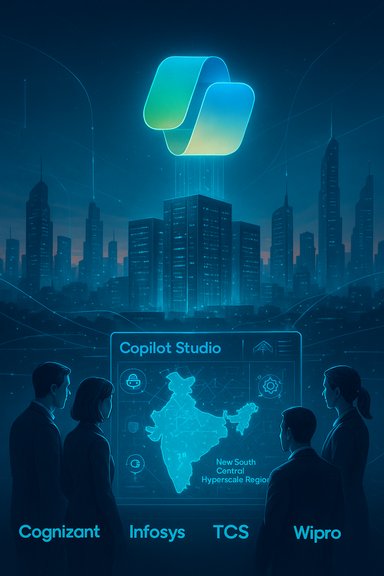
Futuristic cityscape with a glowing Copilot Studio logo above a holographic map of India.Background / Overview​

The announcements bundle three tightly coupled strategic plays: hyperscale infrastructure and sovereign‑ready cloud capacity, partner‑led enterprise seat deployments of Microsoft 365 Copilot and related Copilot variants, and large‑scale skilling programs to prepare workforces for human+agent workflows. Microsoft framed the move as a means to enable “AI diffusion at population scale,” emphasizing in‑country Copilot processing, a new India South Central hyperscale region slated to go live in mid‑2026, and sovereign cloud offerings for regulated workloads. Why this matters: the combination of local compute capacity, partner delivery muscle, and enterprise subscriptions is intended to remove three primary barriers enterprises face when scaling AI: latency and inference costs, regulatory and procurement friction, and workforce readiness. If executed, it could convert Copilot and agentic AI from point solutions into core operational infrastructure for large organizations.

What Microsoft Actually Announced​

Microsoft’s public materials and Nadella’s stage remarks described a composable enterprise stack and a partner playbook designed for agentic AI:
  • A US$17.5 billion investment in India across calendar years 2026–2029 for datacenters, sovereign‑ready services, and skilling programs — described by Microsoft as the company’s largest Asia investment.
  • A claim that Cognizant, Infosys, TCS and Wipro will each deploy more than 50,000 Microsoft Copilot licences, producing an aggregate deployment exceeding 200,000 seats. Microsoft presented the four firms as “Frontier Firms” that will embed agentic AI into internal operations and client deliveries.
  • Product surfaces and governance primitives to support agentic systems: Microsoft 365 Copilot (productivity layer), Copilot Studio (authoring/orchestration for agents), and Azure AI Foundry (model catalogue, routing, and governance). Microsoft also emphasized in‑country processing for Copilot to address data residency and regulated workloads.
These are not incremental product updates — Microsoft positioned them as a coordinated platform + partner + infrastructure play that attempts to solve operational and procurement hurdles that have slowed enterprise adoption of model‑driven automation.

The License Numbers — Commitment vs Immediate Activation​

The headline metric — >50,000 Copilot licences per partner / >200,000 total — is impactful and has been widely repeated in press briefings and media reports. Independent coverage corroborates the companies named and repeats the numbers. Caveat and verification: the per‑partner “50k+” figure originated in Microsoft’s on‑stage messaging and partner statements. Public filings and partner disclosures contain some verifiable previous purchases that make the headline plausible — for example, Cognizant previously disclosed a purchase of 25,000 Microsoft 365 Copilot seats as part of its 2024 partnership with Microsoft — but granular, auditable breakdowns of the new per‑partner totals, activation timelines and whether each licence is internal or client‑facing were not uniformly published at announcement time. Treat the headline as a substantial commercial commitment and roadmap rather than an immediate inventory of fully activated seats.

Company‑by‑Company Snapshot​

Cognizant — “Client Zero” and scale‑out engineering​

Cognizant is presented as an early adopter and engineering testbed for Copilot. The company previously purchased 25,000 Microsoft 365 Copilot seats and has made large investments in training developers on GitHub Copilot, which underpins the credibility of its role as a Copilot builder for client solutions. Cognizant’s leader framed the company’s mission as turning AI infrastructure investments into measurable business value. Key points:
  • Prior verified purchase of 25,000 Copilot seats provides an anchor for the larger roll‑out claims.
  • Cognizant positions itself to operationalize Copilot across verticals and client engagements as an industrialization partner.

Infosys — Topaz Fabric™, Cobalt®, and multi‑agent workflows​

Infosys emphasised integration of Microsoft’s Intelligence Layer with its own Topaz Fabric™ and Infosys Cobalt® offerings. The company described a structured, platformed approach to infuse agents into workflows and create measurable transformation for clients. Infosys frames these capabilities as part of its strategic shift to an “AI‑first” operating model.

TCS — democratization, personalized AI coaches, and large internal enablement​

TCS reported company‑wide programs such as giving employees access to a personalized AI coach, democratizing tools like GitHub Copilot and M365 Copilot, and running a global AI hackathon that engaged hundreds of thousands of employees — evidence of a broad internal skilling and adoption posture. TCS’s own press materials document a global hackathon with over 281,000 participants, which the company says accelerates an AI‑first culture.

Wipro — Microsoft Innovation Hub and industry IPs​

Wipro announced a three‑year strategic partnership and launched a Microsoft Innovation Hub at its Partner Labs in Bengaluru, claiming tens of thousands of employees upskilled on Microsoft Cloud and GitHub technologies and an intent to deploy 50,000+ Copilot licences across workflows and client solutions. Wipro highlights industry‑specific IP under its Wipro Intelligence™ banner.

What “Agentic AI” Means for Enterprises​

Microsoft’s framing of agentic AI describes systems that go beyond single‑turn assistants and instead:
  • Plan tasks over multiple steps,
  • Orchestrate tools and services,
  • Persist state across interactions, and
  • Take initiative within preconfigured guardrails.
Practically, this enables multi‑step workflows such as autonomous ticket triage that researches incidents, assigns owners, drafts remediation steps, and follows up — with observability and human‑in‑the‑loop checkpoints. Copilot Studio and Azure AI Foundry are pitched as the operational surfaces to author, route, and govern those agents.
Benefits Microsoft and partners emphasize:
  • Faster knowledge‑worker productivity via contextual drafting and summarization.
  • Developer velocity through GitHub Copilot and agent‑led testing/CI orchestration.
  • Scaled client delivery via vertical accelerators and managed services.

Technical and Operational Implications​

Infrastructure and sovereignty​

Local hyperscale regions reduce inference latency and permit in‑country processing of Copilot interactions — a crucial enabler for regulated sectors (banking, healthcare, government) that have stringent data residency requirements. Microsoft explicitly included Sovereign Public Cloud and Sovereign Private Cloud constructs in the announcement as compliance and procurement enablers.

Governance, observability and model routing​

Agentic systems require new operational controls: identity for agents, least‑privilege access to systems, policy enforcement, model lineage, telemetry, and explainability/audit trails. Microsoft positions Azure AI Foundry and Copilot Studio as the governance surfaces, but enterprises will still need to codify policies and instrument agents as if they were production software.

Cost profile and commercial plumbing​

Copilot is sold as an add‑on to Microsoft 365, with published list pricing in prior rollouts (historly around $30 per user per month for enterprise tiers) and newer SMB business SKUs priced lower (Copilot Business announced at $21/user/month for up to 300 users). Large internal and client seat deployments change the economics: persistent inference, managed agent hosting, and professional services can drive significant Azure consumption beyond licence fees. Procurement teams must examine total cost of ownership — licence plus inference, model‑hosting, security, and change management.

Strengths of Microsoft’s Partnered Approach​

  • Scale and speed: Working through the four largest IT services firms compresses time‑to‑market for enterprise agentic implementations and leverages teams that already manage global transformation programs.
  • Integrated platform + infrastructure: Combining Copilot, Copilot Studio, Azure AI Foundry, and local hyperscale regions reduces the engineering lift customers would face to build their own agent infrastructure.
  • Sovereign and regulatory posture: In‑country Copilot processing and sovereign cloud constructs materially lower barriers for regulated industries to procure LLM‑based services.
  • Workforce readiness at scale: Big internal skilling programs, hackathons, and “client zero” testbeds accelerate the creation of reusable IP, vertical accelerators and documented playbooks.

Risks and Unresolved Questions​

  • Opaque seat accounting: The headline “50k+ seats per partner” is a strategic, on‑stage commitment; public, auditable schedules showing activated seats, seat types (internal vs client), and timelines are not uniformly available yet. Procurement and audit teams should demand activation metrics.
  • Governance and operational risk: Agentic systems can take actions on behalf of users. Without robust guardrails, observability and human verification, agents introduce new failure modes that could cascade across ERP/CRM/finance systems.
  • Vendor concentration and lock‑in: Heavy adoption of Microsoft’s stack plus partner‑built accelerators increases migration cost and raises questions about portability and interoperability with multi‑cloud or hybrid model strategies.
  • Economics of inference and long‑tail costs: Licence headlines understate the ongoing inference and model‑hosting costs that can dominate cloud bills for agentic workloads. Enterprise TCO analyses must include expected model usage patterns, retention of conversational context, and storage/telemetry costs.
  • Safety and compliance: Large roll‑outs need reproducible evidence for accuracy metrics, hallucination rates, data handling practices, and legal accountability of agent actions. Independent audits and SLAs covering model behavior will be essential.

Practical Guidance for CIOs and IT Leaders​

Enterprises should treat agentic AI adoption as a program requiring engineering rigor, not a shallow feature flip. Recommended pragmatic approach:
  • Pilot with measurable KPIs: Start with high‑value, low‑blast‑radius workflows and measure time saved, error reduction, and customer impact.
  • Insist on activation evidence: Require partners to provide seat activation schedules, telemetry dashboards, and cost forecasts tied to usage patterns.
  • Codify governance: Define audit trails, approval workflows for agent actions, drift detection, and escalation playbooks for aberrant behavior.
  • Apply least privilege: Agents should have the narrowest permissions required and only use elevated rights with human approval.
  • Plan for portability: Negotiate contractual escape clauses, data export guarantees, and model portability options to reduce lock‑in risk.
These steps will help convert vendor momentum into repeatable, auditable business outcomes.

How the Market and Ecosystem Are Reacting​

Industry press and independent analysts have quickly echoed Microsoft’s framing: the combined news of a large India infrastructure pledge and four partner deployments has been described as a turning point in moving Copilot from experimentation to enterprise backbone. Media and analyst pieces consistently repeat the licence counts and emphasize the sovereignty angle, while cautionary reporting highlights the need for verification of activation metrics and governance practices. TCS’s internal mobilization — a global hackathon involving more than 281,000 employees — is a concrete signal of skilling scale that will be required if partners are to realize large internal seat deployments and generate client‑facing accelerators. Cognizant’s prior purchase of 25,000 Copilot seats in 2024 provides historical validation that large seat buys are occurring and are not purely rhetorical. Still, the step from purchase to meaningful adoption across client projects remains an execution challenge.

What to Watch Over the Next 6–18 Months​

  • Activation and utilization metrics: Are the headline seats activated and producing measurable productivity gains? Partners and Microsoft should make activation telemetry available to customers under NDA or via audit reports.
  • Governance standards and third‑party audits: Will independent audits emerge to measure agent safety, hallucination rates, and data governance?
  • Pricing and TCO transparency: As enterprises begin pilot-to-scale conversions, visibility into Azure inference consumption and managed‑service fees will determine economic viability.
  • Interoperability and escape strategies: Standards or tooling that enable multi‑cloud agents or model portability will reduce vendor lock‑in risk.

Bottom Line​

Microsoft’s coordinated announcement — a US$17.5 billion infrastructure bet in India paired with partner commitments to roll out Copilot and agentic AI through Cognizant, Infosys, TCS and Wipro — is a strategic move to convert Copilot from a productivity add‑on into a foundational enterprise capability. The combination of local hyperscale capacity, in‑country Copilot processing, and partner delivery muscle materially lowers several adoption barriers, and the partners’ large skilling efforts create a plausible pathway to scale. At the same time, the most load‑bearing claims — notably the per‑partner “50,000+” licence figures and the aggregate >200,000 seat count — should be treated as directional, strategic commitments until independent activation data and contract‑level details are disclosed. Enterprises and procurement teams should respond with disciplined pilots, contractual safeguards, and governance requirements that convert vendor marketing into verifiable outcomes.

Quick Reference — Key Facts Verified Across Sources​

  • Microsoft announced a US$17.5 billion investment in India for cloud, AI infrastructure, sovereign solutions and skilling covering calendar years 2026–2029.
  • Microsoft said Cognizant, Infosys, TCS and Wipro will each deploy over 50,000 Microsoft Copilot licences, a claim repeated in multiple press outlets; this would total more than 200,000 licences. Treat the figure as a partner commitment pending audits and seat‑activation detail.
  • Cognizant previously purchased 25,000 Microsoft 365 Copilot seats (public disclosure in 2024), lending credibility to large seat buys.
  • TCS ran a global tcs^{AI} hackathon with over 281,000 participants — cited in TCS’s press materials and independent reporting — demonstrating large‑scale internal mobilization.
  • Microsoft’s Copilot price context: historical enterprise list pricing was widely reported at ~$30/user/month; Microsoft has also introduced Copilot Business SKUs and promo pricing (e.g., Copilot Business at $21/user/month for SMBs), underlining that licence price is only part of the TCO.

Adopting agentic AI at enterprise scale is no longer primarily a technology question — it is an operational transformation with procurement, legal, security, and workforce dimensions. Microsoft’s new stack and partner commitments create a credible pathway to scale, but the moment of truth will be measurable activation, robust governance, transparent economics, and independent evidence of outcomes. The next year will show whether this coordinated push yields durable productivity dividends — or merely a high‑stakes wave of licensed promise.

Source: Communications Today Microsoft,Cognizant, Infosys, TCS and Wipro strike AI partnerships | Communications Today
 

Wipro’s three‑year strategic partnership with Microsoft crystallizes a new phase of enterprise AI adoption: a co‑engineered program that pairs Wipro’s industry IP and delivery muscle with Microsoft’s cloud, Copilot family and agent orchestration stack to accelerate large‑scale Copilot and agentic AI deployments across multiple verticals.

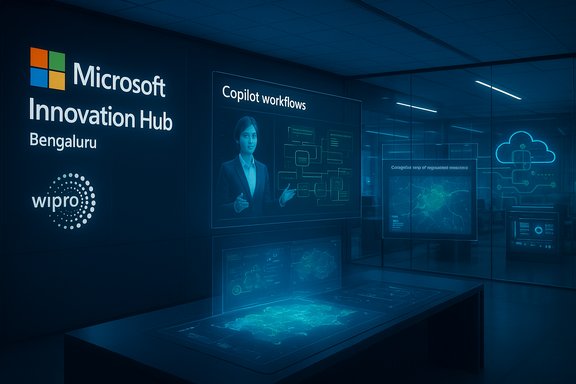
Microsoft Innovation Hub Bengaluru showcases Copilot workflows with holographic dashboards.Background​

The announcement came amid a larger Microsoft push in India that included a headline US$17.5 billion investment in cloud and AI infrastructure, sovereign‑ready capabilities and skilling across calendar years 2026–2029. That investment is being presented as the platform layer for partner‑led scaleouts intended to move enterprises from pilot projects to production‑grade, agentic AI workflows. Microsoft framed four major IT services firms — Cognizant, Infosys, TCS and Wipro — as “Frontier Firms” that will each deploy more than 50,000 Microsoft Copilot licenses, producing a combined footprint Microsoft says will exceed 200,000 seats. Wipro’s component of that announcement is a formal three‑year collaboration that includes the launch of a Microsoft Innovation Hub inside Wipro’s Partner Labs in Bengaluru, integration of Microsoft’s platform stack into Wipro’s Wipro Intelligence™ offerings, and significant internal Copilot deployments and upskilling programs.

What the partnership actually includes​

The public materials and partner statements lay out a multi‑pronged pact whose components are both strategic and tactical.

Core platform and product integrations​

  • Microsoft Azure as the cloud and data platform backbone for hosting models, vector stores, and inference workloads.
  • Microsoft 365 Copilot for knowledge‑worker augmentation and workflow automation.
  • GitHub Copilot to accelerate engineering productivity and code generation.
  • Azure AI Foundry and Copilot Studio for model routing, governance, agent orchestration and lifecycle management.
  • Integration of Wipro’s industry frameworks and IP — referred to publicly as Wipro Intelligence™ and specific accelerators for banking, supply chain and wealth management — to produce vertical copilots and pre‑packaged solutions.

Co‑innovation and the Innovation Hub​

A physical Microsoft Innovation Hub will operate inside Wipro’s Partner Labs in Bengaluru to host joint R&D, prototyping sprints and immersive client workshops. The stated objective is to co‑develop vertical copilots, test agent designs in scenario labs, and move validated patterns more rapidly into productized offerings and customer engagements. Wipro positions this hub as a bridge between its global Innovation Network, its GitHub Center of Excellence and Microsoft platform expertise.

Scale, skilling and ‘Customer Zero’ practice​

Wipro has publicly stated plans to deploy more than 50,000 Microsoft Copilot licenses internally and to upskill north of 25,000 employees on Microsoft Cloud and GitHub technologies as part of a “Customer Zero” strategy that converts internal proofs into packaged client offerings. Microsoft’s messaging treats the 50k‑per‑partner figure as a coordinated benchmark for partner scale. Independent coverage confirms the headline numbers originate in Microsoft’s on‑stage announcements. Treat those figures as commitments and staged rollouts rather than instant, fully activated seat counts.

Why this matters: strategic logic and market timing​

Two dynamics make this partnership noteworthy for enterprise CIOs and procurement teams.
First, platform + partner is the operational template for rapid industrialization of AI. Hyperscalers provide compute, models, governance primitives and platform services; systems integrators supply vertical connectors, regulatory expertise and the delivery capacity needed to operationalize agents across complex ERP, CRM and core transaction systems. The Wipro–Microsoft tie‑up is a textbook example of that model.
Second, Microsoft’s India investment and in‑country processing options for Microsoft 365 Copilot reduce procurement and regulatory friction for regulated customers. By offering sovereign‑ready clouds and local Copilot processing, Microsoft explicitly targets banking, healthcare and public sector workloads that otherwise balk at cross‑border inference. That sovereign dimension is central to the commercial calculus for large enterprises and governments.

Technical architecture and operational implications​

Wipro’s delivery playbook must integrate several technical layers to make agentic systems reliable, auditable and cost‑effective.

Data fabric, identity and governance (must‑have)​

Agents require consistent, governed access to enterprise data. That means:
  • Robust data pipelines and catalogues to supply timely context and reduce hallucination risk.
  • Identity and access policies (Entra/AD integration) for least privilege control and safe agent actions.
  • Observability, audit logs and provenance records to support compliance and incident investigations.
Azure AI Foundry and Copilot Studio provide primitives for model routing and versioning, but the systems integrator still needs to build the data connectors, DLP policies and runbooks that turn platform capability into production control.

Agent orchestration and model routing​

Enterprise agents are rarely single‑model, single‑tool constructs. Proper agentic deployments use:
  • A model catalogue with routing rules to choose specialized and constrained models where appropriate.
  • A registry of agents with declarative manifests, permissions and operator roles.
  • Human‑in‑the‑loop checkpoints for high‑risk decisions.
Azure AI Foundry and Copilot Studio are designed to host these orchestration functions, but effective governance depends on disciplined cataloguing and standardized agent templates.

Cost model realities​

Large Copilot seat counts signal license commitments but hidden costs accumulate:
  • Inference compute and GPU capacity for real‑time agents.
  • Vector store and retrieval costs for RAG patterns.
  • Development and integration engineering (connectors, CI/CD, testing).
  • Ongoing model monitoring and retraining.
Enterprises must forecast TCO beyond seat fees and structure pilots that measure inference spend and integration lift as first‑class line items.

Commercial and go‑to‑market implications​

Wipro gains several practical advantages from the pact.
  • Faster productization: Vertical accelerators that combine Wipro IP with Microsoft platform features can shorten the journey from pilot to packaged product.
  • Co‑sell and market access: Being a named Frontier Firm amplifies co‑selling opportunities with Microsoft and signals preferential status to large accounts.
  • Proof‑point leverage: Internal “Customer Zero” deployments reduce client adoption friction by providing demonstrable case studies.
For Microsoft, partnering with Wipro deepens enterprise traction for Microsoft 365 Copilot, Azure agent services and GitHub Copilot, while also creating a recurring revenue stream from Azure inference and platform services. For customers, the attraction is access to packaged, managed AI workloads rather than bespoke, high‑cost, one‑off integrations.

Strengths and opportunities​

  • Integrated stack advantage: Microsoft’s control over identity, productivity apps and cloud reduces integration friction and lowers operational complexity for many enterprise projects.
  • Partner delivery scale: Wipro’s global delivery network and vertical IP accelerate time‑to‑value by supplying pre‑built connectors and tested domain logic.
  • Sovereign readiness: In‑country Copilot processing and sovereign cloud options materially expand the addressable market among regulated industries and governmental customers.

Risks, blind spots and governance concerns​

The scale of ambition also amplifies several risks that require explicit mitigation.

Unverified activation vs. announced commitments​

The headline “50,000+ Copilot licenses per partner” figure should be treated as a commercial commitment rather than an instantaneous, fully activated seat count. Microsoft presented the numbers on stage; independent, audited activation schedules are not uniformly published across all partners. Enterprises and investors should expect implementation timelines rather than immediate seat activation.

Governance and systemic risk​

Agentic AI introduces systemic risk at scale: a failure in a widely deployed agent template or a governance gap can propagate erroneous actions across thousands of workflows. Mitigations include independent audits, human‑approval gates for critical actions, continuous model monitoring and clear SLA and liability clauses in customer contracts.

Data residency and compliance nuance​

Microsoft’s in‑country processing is a critical capability, but in practice sovereignty is a multi‑layer problem: connectors, logs, third‑party services and backups must all be accounted for. Simply processing prompts locally is necessary but not sufficient to meet complex regulatory regimes. Enterprises must demand end‑to‑end compliance mapping for each use case.

Vendor lock‑in and portability​

Packaged vertical copilots that embed proprietary connectors and model routing can create migration friction. Procurement contracts should include clauses that preserve portability, access to raw telemetry and exportable models/data where feasible. Otherwise, customers risk platform entrenchment that raises long‑term switching costs.

Implementation checklist for CIOs and procurement teams​

Enterprises evaluating Wipro‑Microsoft offerings (or similar hyperscaler+SI packages) should demand measurable deliverables and concrete protections.
  • Define clear business outcomes: tie pilot KPIs to revenue, cycle time or accuracy metrics.
  • Ask for an activation schedule: specific seat counts, timelines and rollout gates for the claimed Copilot deployments.
  • Require governance artifacts: agent registries, audit trails, model cards, and role‑based approval flows.
  • Validate sovereign readiness end‑to‑end: ensure connectors, logs and backups meet data residency and regulatory requirements.
  • Review cost models: include inference, storage, and engineering run rates in TCO and require ongoing cost telemetry.
  • Contract portability protections: export rights for trained embeddings, vector stores and action logs; contractual SLAs for model behavior and incident response.
These practical steps convert strategic promises into verifiable outcomes and reduce the chance that scale becomes a liability rather than an advantage.

Competition and market context​

Microsoft’s partner play is not unique in principle: other hyperscalers are advancing their own agent marketplaces, sovereign cloud options and service partner programs. But Microsoft’s integration from productivity apps down to cloud identity and AI services gives it a distinctive go‑to‑market edge for knowledge‑work use cases. Systems integrators that align tightly with a major hyperscaler gain speed but must balance that with multi‑cloud and client lock‑in concerns. The strategic choice for most large enterprises will be hybrid: adopt vendor‑packaged solutions for certain functions while retaining portability and vendor diversification where strategic risk is high.

Financial and commercial realism​

Public reporting and partner statements make clear the potential revenue opportunity: Copilot seat licenses and Azure inference can become substantial recurring revenue streams. However, materiality depends on activation velocity, enterprise willingness to pay for managed services, and the ability of SIs to convert internal proof points into sellable, auditable products.
Enterprises should therefore model three scenarios when considering offers based on these partnerships:
  • Conservative: slow seat activation, staggered pilots, heavy engineering lift.
  • Base: committed seat rollouts with moderate inference spend and templated connectors.
  • Aggressive: rapid activation across functions, high inference spend and broad commercialization.
Structuring commercial pilots with staged pricing, success milestones and joint risk sharing can align incentives and shift the burden of early engineering to the provider.

Regulatory and geopolitical considerations​

Microsoft’s US$17.5 billion India investment and the in‑country Copilot processing announcement are explicitly geopolitical moves as much as commercial ones. They respond to sovereignty concerns while simultaneously building a local anchor for hyperscaler services. Regulatory scrutiny of dominant cloud providers and licensing terms remains active in many jurisdictions; enterprises should expect increased attention to portability, interoperability and privacy rules, and negotiate contracts with those possibilities in mind.

Final assessment and practical takeaways​

Wipro’s three‑year partnership with Microsoft is a consequential and pragmatic pathway for organizations that want ready‑built vertical copilots, rapid managed deployments and strong platform integration. The strengths are clear: pre‑built IP, co‑innovation facilities, and platform depth from Microsoft. The risks are equally real: activation vs. announcement gaps, governance and compliance complexity, and potential vendor lock‑in.
For enterprise leaders, the correct posture is disciplined optimism:
  • Treat partner seat figures and infrastructure commitments as credible signals but require documented activation schedules and measurable pilot outcomes.
  • Insist on robust governance — model cards, agent registries, audit trails and human‑in‑the‑loop constraints — before permitting agents to act on decision‑critical processes.
  • Build procurement levers for portability and cost transparency, and forecast inference and operational expenses as part of any TCO calculation.
If executed with technical rigor and contractual clarity, the Wipro‑Microsoft initiative can shorten the path from experimentation to measurable, industry‑specific AI outcomes. If executed without those guardrails, scale will magnify both operational costs and systemic exposure. The next 6–18 months of rollouts and published activation metrics will determine whether this pact becomes a template for durable enterprise AI transformation or a high‑profile set of staged commitments.
Wipro’s public positioning — the Innovation Hub, Wipro Intelligence™, and the GitHub Center of Excellence — aligns operationally with Microsoft’s platform suite, creating a credible delivery vector. Still, prudent customers will demand evidence: documented use cases, audit records, and transparent economics before committing core operations to agentic AI at the scale now being proposed.

Source: scanx.trade Wipro Partners Microsoft for AI-Powered Enterprise Transformation
 

Wipro and Microsoft have launched a three‑year strategic partnership anchored by a new Microsoft Innovation Hub inside Wipro’s Partner Labs in Bengaluru, a collaboration that pairs Wipro’s consulting‑led, engineering‑and‑IP driven delivery model with Microsoft’s cloud, Copilot family and agent orchestration stack to accelerate enterprise adoption of agentic AI across finance, retail, manufacturing, healthcare and airports.

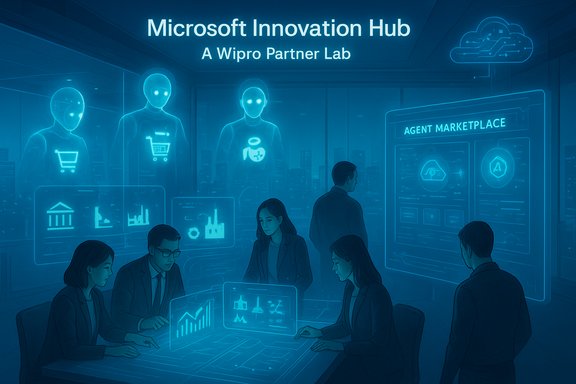
Microsoft Innovation Hub: a Wipro partner lab with holographic displays and collaborative teams.Background / Overview​

The announcement is part of a broader Microsoft push into India that includes a headline US$17.5 billion investment for cloud, AI infrastructure, sovereign‑ready services and skilling across calendar years 2026–2029. Microsoft framed the investment and partner pacts as a program to drive “AI diffusion at population scale” and to make India a strategic hub for production‑grade enterprise AI. Wipro’s public materials describe a three‑year co‑innovation pact with Microsoft that will:
  • Establish the Microsoft Innovation Hub at Wipro’s Partner Labs in Bengaluru to host immersive workshops, rapid prototyping sprints and client co‑innovation sessions.
  • Integrate Wipro’s Wipro Intelligence™ suite and vertical IP (NetOxygen, Wealth AI, Falcon Supply Chain) with Microsoft technologies — notably Azure, Microsoft 365 Copilot, GitHub Copilot, and Azure AI Foundry — to co‑develop industry‑specific copilots and AI agents.
  • Commit to large internal scale targets including the deployment of over 50,000 Microsoft Copilot licences inside Wipro and the upskilling of more than 25,000 Wipro employees on Microsoft Cloud and GitHub technologies as part of a “Client Zero” strategy.
Independent reporting by major outlets corroborates the headline investment and the broad partner strategy; Microsoft’s India initiative and the framing of several systems integrators as “Frontier Firms” were publicly announced by Microsoft leadership during recent India events.

What the partnership actually is​

A stack + IP + physical runway​

At its core, the alliance is less a single product and more a layered delivery model: Microsoft supplies the cloud, model orchestration and Copilot family; Wipro supplies vertical semantics, industry accelerators and delivery capacity.
  • Platform layer: Azure for cloud, data fabric and sovereign‑ready hosting; Azure AI Foundry / Copilot Studio for agent authoring, model routing, provenance and governance.
  • Productivity and engineering layer: Microsoft 365 Copilot for knowledge‑worker augmentation and enterprise workflows; GitHub Copilot for developer productivity and code generation.
  • Verticalization and delivery layer: Wipro Intelligence™, plus IP accelerators (NetOxygen, Wealth AI, Falcon Supply Chain) that provide domain models, connectors and pre‑built processes to shorten integration to ERPs, core banking systems and manufacturing execution systems.
  • Co‑innovation runway: the Microsoft Innovation Hub inside Wipro Partner Labs — a physical and virtual space for prototypes, scenario labs, governance reviews and demonstrations connected to an Agent Marketplace where vetted agents and copilots can be catalogued and trialed.

Client Zero and GTM​

Wipro positions the internal deployments and skilling programs as a “Client Zero” play: by adopting Copilot and agent tooling at scale internally, Wipro intends to convert operational lessons into productized offerings and packaged go‑to‑market solutions for customers. This is a classic systems integrator move—internal adoption shortens time‑to‑market for external sales.

Why the Innovation Hub matters​

The Innovation Hub is being billed as both a technical accelerator and a commercial instrument. Practically, it functions as:
  • A lab for end‑to‑end scenario testing: inject enterprise data, simulate workflows, validate agent behavior, and test governance guardrails before production rollout.
  • A showroom for risk‑averse buyers in regulated industries (banking, healthcare, airports) who need demonstrable compliance, provenance and low‑latency / sovereign processing options.
  • A catalog and marketplace staging area where Wipro can present pre‑built agents out of its Agent Marketplace for customers to evaluate and license.
That mix of technical proof and buyer‑facing visibility is important: in regulated sectors procurement decisions often hinge more on governance evidence and auditability than on model bench performance.

Technical architecture and operational readiness​

The pieces enterprises will see​

The expected integration pattern includes:
  • Data fabric and vector stores hosted on Azure for retrieval‑augmented generation (RAG).
  • Identity and access controls using Microsoft Entra / Azure AD for least‑privilege agent execution.
  • Observability, telemetry and audit trails via Purview, Azure Monitor and Copilot Studio/Azure AI Foundry for model provenance and policy enforcement.
  • CI/CD pipelines and developer enablement using GitHub, with a GitHub Center of Excellence to standardize secure, Copilot‑assisted development.
Enterprises should note this is not turnkey: model orchestration, data pipelines, connectors to legacy systems, and MLOps all require significant engineering investment even when built on platform primitives. The hub reduces friction but does not eliminate core integration work.

Governance and controls​

Microsoft’s enterprise Copilot and Azure AI tooling provide governance primitives—data scoping to tenant permissions, encryption in transit and at rest, model‑routing policies, and audit logging. Wipro’s narrative emphasizes “enterprise readiness” and client‑zero hardening, implying production deployments will be configured to use these controls. That said, implementing human‑in‑the‑loop controls, policy testing, and incident response remains the buyer’s responsibility.

Scale, skilling and economics​

The headline numbers​

Wipro’s announcement and Microsoft’s partner messaging place public emphasis on two measurable targets:
  • Deploying over 50,000 Microsoft Copilot licences internally at Wipro.
  • Upskilling more than 25,000 Wipro employees on Microsoft Cloud and GitHub technologies.
Microsoft also publicly announced a multi‑year, US$17.5 billion investment in India to expand AI infrastructure and skilling programs, giving the partner pacts a larger infrastructure and sovereign‑capability context.

The commercial math​

Beyond headline seat counts, enterprise TCO will include:
  • Per‑user Copilot license fees (enterprise licensing tiers vary and materially affect recurring costs).
  • Azure consumption for inference, vector indexing, storage and GPU cycles.
  • Engineering and professional services for integration, governance testing, and MLOps.
  • Ongoing AI Ops and security operations to monitor agents, model drift and incidents.
This means the economics of migrating a process from manual to agentic AI rarely stops at subscription fees; infrastructure and operational costs often dominate early production budgets.

Strengths: where this play can win​

  • Speed to market through vertical IP: Wipro’s NetOxygen, Wealth AI and Falcon Supply Chain accelerators reduce domain engineering effort and create reusable templates for industry copilots.
  • Visible client runway: The Innovation Hub is a physical demonstration space that helps reduce procurement friction for conservative buyers who require proof of governance and integration.
  • Platform depth and sovereign options: Microsoft’s major India investment and expanded hyperscale regions improve options for local data residency, lower latency and sovereign deployment patterns—important for regulated workloads.
  • Large internal skilling commitment: Training 25,000+ staff creates a substantial bench of people familiar with Microsoft Cloud and GitHub tooling, which helps delivery scale once internal proofs translate to client projects.

Risks and open questions​

Activation vs purchase​

Public licence counts are meaningful signals but do not equal active, production usage. Large seat purchases can remain unactivated or used for pilot testing rather than delivering measurable business outcomes. Enterprises and procurement teams should demand activation metrics and usage dashboards tied to payment milestones. This caveat is echoed in multiple analyses of recent partner announcements.

Vendor concentration and lock‑in​

Deep integration with a single hyperscaler and a dominant SI creates concentration risk. Portability of agents, data exportability and IP ownership of vertical connectors should be explicitly negotiated. Contracts must include clear portability clauses, code escrow or model retraining responsibilities if the hyperscaler relationship changes.

Operational complexity and hidden costs​

Agentic AI requires mature data engineering, governance roles (model risk managers, AI auditors), and dedicated MLOps staffing. Many organisations underestimate this operational lift, leading to stalled rollouts after initial pilots. The Innovation Hub reduces discovery friction but doesn’t eliminate post‑pilot engineering work.

Sovereignty vs utility tradeoffs​

Microsoft’s promise of in‑country Copilot processing and sovereign‑ready clouds addresses regulatory concerns, but actual availability, latency profiles and integration details depend on specific region rollouts (for example, new hyperscale availability zones slated in mid‑2026). Buyers should validate region availability and contractual SLAs before committing sensitive workloads.

Competitive and market context​

Microsoft’s partner strategy places several large Indian SIs (Cognizant, Infosys, TCS, Wipro) as “Frontier Firms,” each expected to deploy tens of thousands of Copilot seats and to package agentic AI for customers. This is a deliberate ecosystem play: hyperscalers build platform primitives while systems integrators provide vertical IP and delivery scale. The result is a marketplace where packaged vertical copilots and agent marketplaces will become standard procurement items for large enterprises. Other hyperscalers and clouds are not idle. AWS, Oracle and others are pushing their own agent marketplaces and enterprise model governance tooling, meaning procurement decisions still come down to technical fit, pricing, regulatory posture and supplier relationships. This competitive dynamic will shape pricing and feature sets over the next 12–24 months.

Practical guidance for enterprise buyers​

When evaluating Wipro‑Microsoft offerings, procurement and architecture teams should insist on concrete, verifiable evidence and contractual protections:
  • Activation proof: Require dashboards that show active Copilot usage, successful agent invocations, and measured business outcomes before milestone payments.
  • Measurable KPIs: Bind a portion of professional services and license fees to defined ROI metrics (cycle time reductions, error rate improvements, or revenue uplift) rather than delivery checkboxes.
  • Data sovereignty and exportability: Ensure contracts specify how data is stored, processed and exported; demand portability guarantees and clear IP terms for connectors and agent logic.
  • Security and audit commitments: Ask for runbooks that show human‑in‑the‑loop checkpoints, audit trails, incident response processes and third‑party audit options.
  • SLAs for region availability: If sovereign or low‑latency processing is required, include explicit SLAs tied to hyperscale region availability and failover behavior.
  • Governance and lifecycle management: Require an agreed roadmap for model retraining, lifecycle ownership, model provenance and decommissioning of agents.
These steps protect buyers from headline risk and ensure collaboration results in durable, auditable outcomes.

Strategic implications for Wipro and Microsoft​

For Wipro, the partnership is a bet on productization: convert internal Copilot‑driven use cases into packaged services that can be sold globally. If Wipro succeeds, it will capture higher‑margin IP revenue and strengthen its co‑sell position inside the Microsoft ecosystem. For Microsoft, the deal expands enterprise traction for the Copilot family and validates larger investments in in‑country processing and sovereign‑ready architectures. Together, the two parties aim to shift the enterprise AI market from isolated pilots to production‑grade, agentic workflows.

What to watch next​

  • Activation evidence: in the coming quarters, the most telling data will be active Copilot sessions, agent invocation volumes, and real, tracked customer ROI rather than simply license counts. Watch for case studies that report measurable metrics.
  • Hyperscale region rollouts: Microsoft’s India South Central region and related availability zones are scheduled to expand in 2026; their exact timing affects sovereign processing options and latency for enterprise customers.
  • Marketplace momentum: whether Wipro’s Agent Marketplace grows a catalog of reusable, industry‑certified agents that customers can license and adapt will determine how quickly sales scale beyond bespoke projects.
  • Competitive responses: other hyperscalers and systems integrators will respond with their own packaged offerings and pricing pressure; the market will evolve quickly as vendor ecosystems compete for enterprise engagements.

Conclusion​

The Wipro‑Microsoft three‑year partnership and the opening of the Microsoft Innovation Hub in Bengaluru represent a credible, well‑resourced attempt to industrialize enterprise copilots and agentic AI by combining Wipro’s vertical IP and delivery capacity with Microsoft’s platform and governance tooling. The announcement’s strengths are clear: vertical accelerators, a physical co‑innovation runway, and large scale skilling and seat commitments that, if activated, can shorten the path from pilot to production. At the same time, headline numbers—50,000 Copilot licences and 25,000 trained employees—are public commitments that need verification through activation metrics, usage dashboards and measurable business outcomes. Contracts must be carefully structured to mitigate concentration risk, confirm sovereign processing options, and bind economics to demonstrable results. The true test of this alliance will not be lab demos or seat counts but the speed and reliability with which co‑developed agents deliver auditable, repeatable value in regulated, mission‑critical environments. When procurement teams and CIOs assess offers coming out of the Innovation Hub, they should demand evidence of activation, insist on governance-ready architectures, and negotiate portability and KPI‑tied commercial terms. Done right, the Wipro‑Microsoft playbook could accelerate enterprise AI from experimental to operational scale; done poorly, it risks producing large, under‑utilized license portfolios and a deeper dependence on a single platform.

Source: Rediff MoneyWiz Wipro & Microsoft AI Partnership: Innovation Hub Launch
 

Microsoft used a high‑profile stop on its India AI tour to announce a coordinated, enterprise‑scale push that pairs a US$17.5 billion infrastructure and skilling commitment with strategic partnerships that will put Microsoft 365 Copilot into the operations of four global IT services firms — Cognizant, Infosys, TCS and Wipro — where Microsoft says each partner will deploy over 50,000 Copilot licenses, a coordinated program the company says will collectively surpass 200,000 Copilot seats and accelerate what it calls the era of agentic AI.

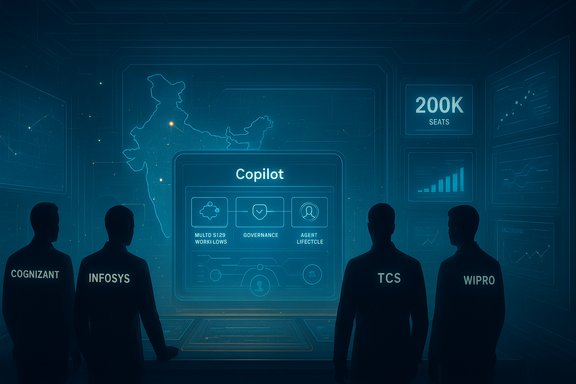
Silhouetted tech staff in a futuristic control room viewing a central Copilot dashboard.Background: why this announcement matters​

Microsoft framed the move as more than a marketing push: it is an attempt to convert Copilot from an add‑on productivity assistant into a production‑grade intelligence layer that can plan, act, and persist across multi‑step workflows — what the company and partners describe as agentic AI. These agentic systems are presented as a new class of software that can initiate tasks, orchestrate services, and drive decisions inside regulated enterprise environments when paired with governance and identity controls. The announcement bundles three strategic levers:
  • A large partner activation engine (four of the largest systems integrators committing significant Copilot footprints).
  • A major regional infrastructure and sovereignty investment (US$17.5 billion for cloud, datacenters, in‑country processing and skilling across calendar years 2026–2029).
  • Product-level plumbing to operate agents in enterprise contexts (Microsoft 365 Copilot, Copilot Studio, Azure AI Foundry and associated governance surfaces).
Taken together, Microsoft wants to remove three key barriers to AI at scale: procurement friction, data residency and latency concerns, and the lack of large scale adoption channels that translate pilots into production.

What Microsoft actually announced (the facts)​

Microsoft’s public statements and the partner messaging on stage included three concrete headline items:
  • Each of Cognizant, Infosys, TCS and Wipro will deploy more than 50,000 Microsoft Copilot licences, creating a combined footprint that Microsoft says will exceed 200,000 seats. This figure was repeated in Microsoft’s press materials and widely reported by independent outlets in India and beyond.
  • Microsoft committed US$17.5 billion to expand cloud and AI infrastructure, skilling and operations in India across calendar years 2026–2029, including new hyperscale capacity and in‑country processing options for Copilot. This is presented as Microsoft’s largest investment in Asia.
  • Product and governance primitives were highlighted as the operational backbone for agentic AI: Microsoft 365 Copilot (productivity/knowledge layer), Copilot Studio (agent authoring and orchestration), Azure AI Foundry (model catalogue, routing and governance) and new identity/agent lifecycle controls that tie agents to directory identities and audit trails.

Note on verification​

The per‑partner “50k+” figure originated in Microsoft’s on‑stage messaging and partner briefings. Independent press organizations corroborated the headline numbers, but the exact breakdown of activated seats, billing schedules, and activation timelines were not uniformly published at the time of the announcement. Treat the per‑partner totals as large public commitments and program goals rather than uniformly provisioned, immediate seat activations in every case.

Company-by-company snapshot: what each partner said they’re doing​

Cognizant​

Cognizant has been positioned by Microsoft as a “client zero” and major early adopter, with prior public purchases anchoring its role. The company is expected to use Copilot internally and to deliver Copilot‑based solutions to clients as part of customer engagements. Prior disclosures show Cognizant has already made material Copilot purchases, which makes the larger program plausible — though staging and activation cadence remain to be published.

Infosys​

Infosys has tied Copilot to its internal platforms — notably Topaz Fabric™ and Infosys Cobalt® — seeking to operationalize multi‑agent workflows and build verticalized AI platforms for clients. Infosys’ messaging emphasized embedding Copilot into operating models and delivery pipelines.

TCS (Tata Consultancy Services)​

TCS described democratizing Copilot across functions like sales, HR and finance, and offering “personalized AI coaches” internally to tens of thousands of employees after broad skilling efforts. Microsoft was a partner in a TCS global hackathon that the company highlighted as evidence of scale and readiness.

Wipro​

Wipro announced a three‑year partnership that includes a Microsoft Innovation Hub at Wipro Partner Labs in Bengaluru, a 50,000+ seat Copilot deployment ambition, and upskilling programs (Wipro reported thousands of employees trained on Microsoft Cloud and GitHub technologies). Wipro is positioning Copilot as part of its Wipro Intelligence™ suite for industry workloads.

The technical architecture Microsoft is selling for agentic AI​

Microsoft presented a stack intended to make agents auditable and manageable in enterprise settings. Key components include:
  • Microsoft 365 Copilot — the knowledge‑worker layer embedded in Outlook, Word, Excel, PowerPoint and Teams.
  • Copilot Studio — an authoring and orchestration surface for multi‑step agents, with tenant catalogs and lifecycle controls.
  • Azure AI Foundry — a model catalogue plus routing layer that can select models by cost, latency and capability and provide governance primitives.
  • Agent identities and Entra integration — agents appear as directory‑bound identities with lifecycle and access controls so actions are logged and can be audited.
  • In‑country processing / sovereign options — local inference and processing options intended to satisfy regulatory and procurement constraints for sensitive workloads.
This combination is expressly intended to treat agents as production software — with inventories, review cycles, least‑privilege access, and runtime guardrails — rather than as experimental chatbots.

Commercial economics: licensing, pricing and operational costs​

Microsoft’s Copilot pricing has multiple flavors depending on target customer and license type. Recent Microsoft partner materials show new SMB‑focused Copilot Business SKUs priced at US$21 per user per month (for up to 300 users), introduced to accelerate small and medium business adoption; enterprise Copilot list pricing has been widely reported at roughly US$30 per user per month for Microsoft 365 Copilot add‑ons. These add‑on fees typically sit on top of existing Microsoft 365 licenses; additional costs for model inference, provisioned compute (SCUs) and storage should also be anticipated in large‑scale deployments. Two commercial realities to keep in mind:
  • Inference and agent execution can introduce variable cloud costs that are not fully captured by per‑user Copilot list prices; many enterprise deals include metering, provisioned SCUs, or other capacity arrangements. These can materially affect total cost of ownership at the scale Microsoft and its partners describe.
  • Large license commitments in press briefings are often staged across internal vs client‑facing seats, promotional pricing windows, and renewal or upsell cycles. Procurement teams should demand clear activation schedules, usage‑based cost caps, and SLAs for in‑country processing where compliance depends on locality guarantees.

Security, governance and operational risk — what to watch​

Agentic AI accelerates productivity potential, but it also raises distinct operational risks that require new controls.
  • Agents as attack surface: Agents that can act across systems introduce new threat vectors (prompt injection, malicious plans that call APIs, data exfiltration). Industry researchers and security vendors have already flagged vector classes where poor design or lax governance can convert simple inputs into operational breaches. Enterprises must treat agents like production software with least‑privilege access, runtime monitoring and human authorization gates.
  • Auditability and provenance: Agent actions must be logged, traceable to an identity, and linked to model/version metadata and decision context. Without clear provenance, remediation and compliance become impractical.
  • Cost‑predictability: Autonomous agents that execute tasks continuously or on schedules can create unbounded inference spend unless explicit caps or metering controls are in place.
  • Model choice and routing: Using multiple model providers and a model router (as in Azure AI Foundry) improves capability selection but increases complexity for governance and model‑lineage tracking.
  • Regulatory and data residency risk: Promises of in‑country processing and sovereign cloud are meaningful for regulated industries, but they require contractual SLAs, attestation and independent verification to be credible for auditors and procurement teams.
Security researchers have already warned that agentic systems need carefully designed guardrails; the fix is not a single patch but a disciplined blend of design, least‑privilege, lifecycle controls, and synchronous runtime inspection. Enterprises that move fast without these elements risk converting productivity gains into costly incidents.

Strategic strengths of Microsoft’s approach​

  • End‑to‑end stack: Microsoft is selling a full stack (apps + agent authoring + model routing + cloud) that lowers integration work for CIOs and delivery teams, accelerating the path from pilot to production.
  • Partner delivery scale: Systems integrators like Cognizant, Infosys, TCS and Wipro have global delivery footprints and long relationships with enterprise customers; using these partners as adoption channels can compress adoption timelines and provide vertical accelerators.
  • Sovereignty and regional investment: A multibillion investment in local datacenters, in‑country Copilot processing and skilling addresses three practical barriers to wide deployment for regulated buyers.

Principal risks and open questions​

  • Activation vs commitment: Public statements of “50k+ seats each” are powerful signals but require independent verification. The next 6–18 months should produce audited activation dashboards, customer case studies and partner‑level usage metrics. Until then, treat the headline figures as program commitments rather than uniform, live seat activations.
  • Governance maturity: The tooling Microsoft described attempts to solve agent governance, but buyers must confirm that governance features are mature, usable and auditable at scale — not just marketing checkboxes.
  • Economic unpredictability: Large agent deployments change cost dynamics; inference, routing, and runtime execution can create runaway spend if not contractually capped.
  • Concentration and lock‑in: Embedding agentic workflows into Microsoft apps, identity and Azure cloud deepens technical lock‑in. Organizations should evaluate portability and exit mechanics as part of procurement.
  • Human oversight and workforce change: Replacing tasks with agents changes job designs; enterprises must invest in supervisory roles, agent engineering, model ops and retraining for impacted employees.

Practical playbook for CIOs and procurement teams​

  • Start narrow: run outcome‑led pilots with explicit KPIs (time saved, error reduction) before scaling horizontally.
  • Require auditability: contractually demand agent‑level logs, model lineage, identity binding and independent attestations for in‑country processing.
  • Control costs: include inference spend caps, provisioned SCU limits and transparent metering reporting in supplier contracts.
  • Govern by design: enforce least‑privilege for agents, segregate read vs write agent roles, and require human‑approval gates for write actions.
  • Upskill supervisors: invest in “agent engineers”, model ops teams, and human‑in‑the‑loop supervisors before broad rollouts.
  • Verify activation: require partner activation dashboards and early customer references as a condition for renewal or expansion.

Wider implications: an industry inflection or a headline wave?​

Microsoft’s coordinated package — partners + platform + infrastructure — is a plausible route to industrialize agentic AI at enterprise scale. If partners turn commitments into verified activations, with governance artifacts and cost transparency, this could materially shift how large organizations operate and how IT delivery is structured.
However, the move also centralizes power: it accelerates vendor lock‑in, concentrates agent governance decisions inside a particular commercial ecosystem, and raises systemic questions about auditability and cost control. Whether this becomes a durable transformation or a high‑cost, marketing‑heavy initiative will depend on evidence: proportionate adoption metrics, public case studies with measured outcomes, and the emergence of independent certifications or third‑party audits for agent governance.

Conclusion​

Microsoft’s announcement that Cognizant, Infosys, TCS and Wipro will each deploy more than 50,000 Microsoft Copilot licences — coupled with a US$17.5 billion India investment and a full‑stack agent infrastructure pitch — is one of the clearest signals yet that large vendors are intent on moving agentic AI from pilot to production at scale. The combination of platform breadth, partner delivery muscle and a regional sovereignty play makes the initiative strategically credible.
At the same time, this is an inflection point that demands rigorous, early evidence of activation, auditable governance, cost predictability and contractual safeguards. Treat headline seat counts and partnership proclamations as the start of a process — not the end — and insist on measurable, verifiable outcomes before committing to enterprise‑wide rollouts.

Source: Ahmedabad Mirror 4 big tech firms join Microsoft to accelerate adoption of agentic AI
 

Back
Top