

Tom’s Guide’s redesign is more than a cosmetic refresh. It is a clear signal that Future’s consumer-tech portfolio is leaning harder into expert-led shopping advice, faster decision-making tools, and formats designed for the way people actually consume tech coverage in 2026. For Windows Central readers, the change matters because it strengthens the shared Future ecosystem around product discovery, reviews, and commerce — and that can influence everything from how devices are compared to how buyers make upgrade decisions. The biggest headline is the new Leap-O-Meter, but the broader story is about a site trying to become less like a news feed and more like a decision engine.
Tom’s Guide has long been one of Future PLC’s most important consumer-tech brands, and its remit has only widened over time. The site now spans phones, laptops, TVs, smart home gear, fitness, entertainment, and deals coverage, backed by a broad bench of editors and specialists. That breadth gives the redesign strategic weight, because any change to Tom’s Guide’s homepage affects how a massive audience encounters reviews, guides, shopping advice, and expert opinions.
The new version is positioned around a simple promise: help users “upgrade your life” by connecting them with experts and practical information. That phrase is doing a lot of work. It suggests a shift away from just surfacing articles and toward guiding the entire purchase journey, from curiosity to confidence to checkout. In other words, Tom’s Guide is trying to compress the time between “I saw a gadget” and “I know whether I should buy it.”
This matters in a market where attention is fragmented and shopping behavior is increasingly assistance-driven. Readers do not just want specs; they want shortcuts, comparisons, real-world context, and a sense of whether an upgrade is truly worth it. Tom’s Guide is betting that a redesigned front page, quick expert takes, video snippets, and purchase guidance can deliver that answer faster than a traditional editorial layout.
It also fits the larger Future PLC strategy. Future has spent years building a commerce-forward network across tech and enthusiast brands, and the Tom’s Guide overhaul is a textbook example of how that network can be tuned for conversion without abandoning editorial expertise. The interesting question is whether this makes the site more useful, more influential, or merely more efficient at steering readers toward upgrades. The answer may be all three.
Tom’s Guide is also leaning into vertical video, with “quick takes” pulled from its TikTok presence. That is a notable editorial choice because it turns social-first material into on-site value rather than treating social as a separate channel. In practical terms, it gives Tom’s Guide a way to repurpose expert commentary in a format that feels native to mobile audiences.
The trade-off is that a more streamlined interface can also flatten discovery. A homepage designed around utility may be excellent at helping a reader make a decision, but it can be less effective at encouraging slower, more exploratory reading. The success of the redesign will depend on whether Tom’s Guide can preserve depth while making the surface experience feel lighter.
It also plays well with the realities of consumer tech. Many upgrades are incremental, and many buyers overestimate how much they need a new model. A tool that says, in effect, “this is a meaningful jump” or “this is probably not worth it” could save users money while increasing trust in the brand. Trust is the key word here, because tools like this only work when readers believe the scoring system is fair.
Still, the direction is sensible. Readers increasingly want decision support, not just information, and a tool like this can bridge the gap between review content and shopping intent. If Tom’s Guide gets the formula right, it could become one of the brand’s most memorable features.
From a practical standpoint, stronger Tom’s Guide shopping tools can benefit Windows Central readers indirectly. If Tom’s Guide becomes better at evaluating phones, tablets, smartwatches, TVs, and other non-Microsoft products, Windows Central can point readers to a more robust external benchmark ecosystem. That makes comparisons sharper and keeps the coverage network more authoritative overall.
That is where the strategic significance lies. Tom’s Guide is not just trying to look modern; it is trying to align editorial presentation with business goals in a way that still feels useful. If that sounds familiar, it is because many digital publishers are attempting the same thing, but few have the scale and brand equity to pull it off as convincingly.
The emphasis on live Q&A and community interaction also suggests a more participatory model. Instead of treating expertise as a one-way broadcast, Tom’s Guide wants to make it a conversation. That should deepen loyalty if executed well, though it will also demand more editorial labor and tighter moderation standards.
If Tom’s Guide can show its work more clearly, it can strengthen the credibility of its buying advice. That may not always translate into immediate clicks, but it can improve long-term audience retention, which is often worth more in a crowded market. In media, trust compounds.
That also creates opportunities for more informed cross-pollination. If Tom’s Guide is strong on phones, smartwatches, TVs, and home tech, Windows Central can position Microsoft products inside a wider competitive frame. That benefits readers who are trying to make real purchase choices, not just follow platform loyalty.
In that sense, the redesign is good news for Windows Central’s audience even if the site itself is not changing. Better sibling sites make the whole network smarter. And in the long run, smarter networks tend to win more trust than isolated, one-topic outlets.
The competitive question is whether Tom’s Guide can become a habit rather than just a destination. If readers return for quick answers, upgrade scores, and expert commentary, the site gains a stronger recurring role in their buying process. That is a better position than being a place people only visit when search traffic brings them there.
For enterprise audiences, the lesson is narrower but still relevant: decision support wins. Whether the reader is buying a phone, a laptop, or office hardware, the content that wins is the content that simplifies evaluation without sacrificing trust. That is a useful reminder for any publisher trying to connect expertise to commerce.
The real test will be whether the site can maintain editorial depth while increasing speed and commercial relevance. That balance is hard, but it is also where the most durable media brands are built. Useful is not enough; it must also feel credible, human, and consistent.
Source: Windows Central "Upgrade your life with the new Tom's Guide": Our sister site is upgrading, and this is what it means for you
 Overview
Tom’s Guide has long been one of Future PLC’s most important consumer-tech brands, and its remit has only widened over time. The site now spans phones, laptops, TVs, smart home gear, fitness, entertainment, and deals coverage, backed by a broad bench of editors and specialists. That breadth gives the redesign strategic weight, because any change to Tom’s Guide’s homepage affects how a massive audience encounters reviews, guides, shopping advice, and expert opinions.The new version is positioned around a simple promise: help users “upgrade your life” by connecting them with experts and practical information. That phrase is doing a lot of work. It suggests a shift away from just surfacing articles and toward guiding the entire purchase journey, from curiosity to confidence to checkout. In other words, Tom’s Guide is trying to compress the time between “I saw a gadget” and “I know whether I should buy it.”
This matters in a market where attention is fragmented and shopping behavior is increasingly assistance-driven. Readers do not just want specs; they want shortcuts, comparisons, real-world context, and a sense of whether an upgrade is truly worth it. Tom’s Guide is betting that a redesigned front page, quick expert takes, video snippets, and purchase guidance can deliver that answer faster than a traditional editorial layout.
It also fits the larger Future PLC strategy. Future has spent years building a commerce-forward network across tech and enthusiast brands, and the Tom’s Guide overhaul is a textbook example of how that network can be tuned for conversion without abandoning editorial expertise. The interesting question is whether this makes the site more useful, more influential, or merely more efficient at steering readers toward upgrades. The answer may be all three.
What Changed on Tom’s Guide
The most visible change is the homepage itself, which now looks dramatically different and is organized around a stream of quick insights from the editorial team. That format is clearly designed to make the site feel more alive and more immediate. Instead of treating the homepage as a static directory of stories, Tom’s Guide is making it act like a living editorial surface.A homepage built for scanning
The redesign appears to favor rapid consumption over deep browsing. Visitors can skim shorter updates, jump into videos, and move quickly to shopping guidance without needing to dig through layers of navigation. That is an important change because modern readers often arrive from search or social with one question and little patience.Tom’s Guide is also leaning into vertical video, with “quick takes” pulled from its TikTok presence. That is a notable editorial choice because it turns social-first material into on-site value rather than treating social as a separate channel. In practical terms, it gives Tom’s Guide a way to repurpose expert commentary in a format that feels native to mobile audiences.
- The homepage is now more feed-like than magazine-like.
- Quick insights are central rather than supplemental.
- Vertical video is now part of the editorial experience.
- The layout favors speed and clarity over long exploration.
- The new experience is designed to reduce decision fatigue.
Why that matters for users
For readers, the upside is obvious: less friction, faster answers, and more visible expert context. If the average visitor can get a sense of whether a product is worth exploring in a few seconds, the site is doing its job better. That is especially true for high-volume categories like phones, laptops, TVs, wearables, and deals where product churn is constant.The trade-off is that a more streamlined interface can also flatten discovery. A homepage designed around utility may be excellent at helping a reader make a decision, but it can be less effective at encouraging slower, more exploratory reading. The success of the redesign will depend on whether Tom’s Guide can preserve depth while making the surface experience feel lighter.
The Leap-O-Meter Strategy
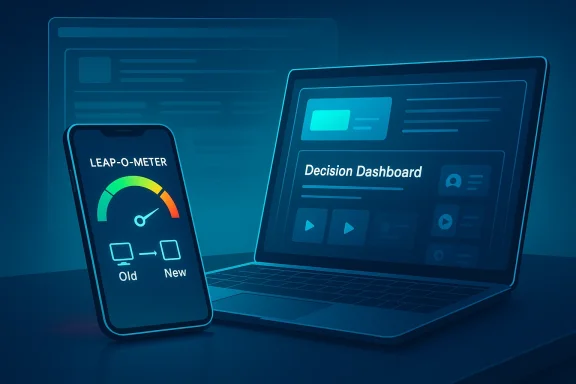
The most distinctive new feature is the Leap-O-Meter, a tool meant to score how much benefit a user would get from upgrading from one device to another. That makes the redesign feel less like a branding exercise and more like a product decision system. It also reinforces Tom’s Guide’s core commercial proposition: help readers avoid bad purchases and identify genuinely worthwhile upgrades.Turning advice into a product
The Leap-O-Meter is smart because it packages editorial judgment into something interactive. Rather than reading a long comparison article and mentally translating it into a decision, users can input what they own and what they’re considering, then get a quick verdict. That is a much more direct path from information to action, and that is what commerce-minded media wants.It also plays well with the realities of consumer tech. Many upgrades are incremental, and many buyers overestimate how much they need a new model. A tool that says, in effect, “this is a meaningful jump” or “this is probably not worth it” could save users money while increasing trust in the brand. Trust is the key word here, because tools like this only work when readers believe the scoring system is fair.
- The Leap-O-Meter is designed to simplify upgrade decisions.
- It combines product comparison with editorial guidance.
- It could reduce buyer’s remorse by discouraging weak upgrades.
- It may become a high-value entry point for affiliate commerce.
- Its credibility will depend on transparent, consistent scoring.
The danger of oversimplification
A score is only helpful if it reflects real-world nuance. Some products are easy to compare numerically, but others depend heavily on personal use cases, ecosystem lock-in, or subjective preferences. The Leap-O-Meter will need to avoid becoming a gimmick that reduces complex buying choices to a single simplified number.Still, the direction is sensible. Readers increasingly want decision support, not just information, and a tool like this can bridge the gap between review content and shopping intent. If Tom’s Guide gets the formula right, it could become one of the brand’s most memorable features.
Why Future PLC Cares
This redesign is not happening in a vacuum. Future PLC has spent years building a family of high-traffic brands that can share audience insights, editorial expertise, and monetization infrastructure across related but distinct niches. Tom’s Guide is one of the clearest examples of how that strategy works at scale.Shared DNA with Windows Central
Windows Central and Tom’s Guide are siblings under the Future umbrella, but they serve overlapping and complementary audiences. Windows Central is deeper in Microsoft, Windows, and Xbox, while Tom’s Guide covers a wider consumer-tech universe, including competing ecosystems and categories beyond Microsoft’s core world. That creates a useful division of labor.From a practical standpoint, stronger Tom’s Guide shopping tools can benefit Windows Central readers indirectly. If Tom’s Guide becomes better at evaluating phones, tablets, smartwatches, TVs, and other non-Microsoft products, Windows Central can point readers to a more robust external benchmark ecosystem. That makes comparisons sharper and keeps the coverage network more authoritative overall.
- Tom’s Guide covers a wider consumer-tech market.
- Windows Central covers Microsoft’s ecosystem more deeply.
- Shared expertise can improve comparison coverage.
- Stronger cross-brand signals can improve audience trust.
- Future benefits when its properties reinforce one another.
The commerce layer underneath
Future’s media model has long emphasized helping readers choose products, not just consume content. That makes redesigns like this especially important because homepage architecture can shape affiliate performance, newsletter signups, and repeat visits. A cleaner, more decision-oriented site can be a more effective commerce machine without necessarily looking like one.That is where the strategic significance lies. Tom’s Guide is not just trying to look modern; it is trying to align editorial presentation with business goals in a way that still feels useful. If that sounds familiar, it is because many digital publishers are attempting the same thing, but few have the scale and brand equity to pull it off as convincingly.
Expert Access as a Differentiator
One of the redesign’s strongest themes is the idea of bringing readers closer to the site’s experts. That may sound like marketing language, but it reflects a real advantage in tech publishing: readers trust people who can explain products clearly and give a grounded opinion about whether they are worth the money.Why expertise still matters
In an era of AI summaries, recycled news, and generic shopping lists, human expertise is a competitive moat. Tom’s Guide has a visibly deep bench of editors and specialists, and the redesign appears designed to make that expertise easier to reach. That is a smart move because readers increasingly want not just content, but accountability.The emphasis on live Q&A and community interaction also suggests a more participatory model. Instead of treating expertise as a one-way broadcast, Tom’s Guide wants to make it a conversation. That should deepen loyalty if executed well, though it will also demand more editorial labor and tighter moderation standards.
- Expert names are part of the product, not just bylines.
- Live answers can increase user confidence.
- Community features can build repeat traffic.
- Strong editorial personalities can improve brand memorability.
- Expertise is increasingly a trust signal in tech media.
The trust premium
There is a subtle but important distinction between being informative and being trusted. The redesign seems designed to close that gap by surfacing editors, their opinions, and the logic behind recommendations more prominently. That is particularly valuable in shopping content, where readers often suspect that affiliate incentives may influence the recommendation.If Tom’s Guide can show its work more clearly, it can strengthen the credibility of its buying advice. That may not always translate into immediate clicks, but it can improve long-term audience retention, which is often worth more in a crowded market. In media, trust compounds.
What It Means for the Windows Central Audience
For Windows Central readers, the Tom’s Guide redesign is relevant even if they never visit the site directly. Many buying decisions now cross platform and cross ecosystem, which means readers want trustworthy coverage not only of Windows hardware but also of rival devices, accessories, TVs, wearables, and home tech. A stronger Tom’s Guide expands the reference map.Better comparison context
When Windows Central covers a new Surface device, Xbox accessory, or Microsoft-adjacent gadget, readers often want to know what else is in the category. A broader Future ecosystem helps supply that context. The more precise Tom’s Guide becomes at explaining upgrade value, the better the shared reader journey becomes across brands.That also creates opportunities for more informed cross-pollination. If Tom’s Guide is strong on phones, smartwatches, TVs, and home tech, Windows Central can position Microsoft products inside a wider competitive frame. That benefits readers who are trying to make real purchase choices, not just follow platform loyalty.
- Readers get a broader competitive benchmark.
- Microsoft products can be compared against stronger rivals.
- Shopping guidance becomes more ecosystem-agnostic.
- Cross-site expertise can reduce redundant coverage.
- The audience gains a more complete picture of the market.
The broader editorial payoff
There is also a cultural benefit. A stronger Tom’s Guide can help normalize the idea that Windows Central is part of a larger, interconnected tech publishing network rather than a siloed outlet. That matters because modern readers often jump between brands depending on the category they are researching. The best publishers make that movement feel seamless.In that sense, the redesign is good news for Windows Central’s audience even if the site itself is not changing. Better sibling sites make the whole network smarter. And in the long run, smarter networks tend to win more trust than isolated, one-topic outlets.
The Competitive Landscape
Tom’s Guide is not redesigning itself in a vacuum; it is operating in a brutal consumer-tech media environment where attention is scarce and shopping intent is highly monetizable. Competitors range from big editorial tech sites to commerce-first publishers, and many of them are trying similar tactics. The real challenge is not inventing a new model, but making one that readers actually keep using.Standing out in a crowded field
A homepage refresh alone would not be enough to move the needle. The reason this redesign is notable is because it combines presentation, community, expert access, social video, and shopping utility into a single package. That mixture is more distinctive than any one element on its own.The competitive question is whether Tom’s Guide can become a habit rather than just a destination. If readers return for quick answers, upgrade scores, and expert commentary, the site gains a stronger recurring role in their buying process. That is a better position than being a place people only visit when search traffic brings them there.
Consumer versus enterprise implications
This is primarily a consumer story, but it has indirect enterprise implications. Better consumer-tech publishing influences market perception, product discovery, and brand comparison across the entire hardware ecosystem. Vendors care about this because independent coverage still shapes demand, even when buyers are not in a formal procurement cycle.For enterprise audiences, the lesson is narrower but still relevant: decision support wins. Whether the reader is buying a phone, a laptop, or office hardware, the content that wins is the content that simplifies evaluation without sacrificing trust. That is a useful reminder for any publisher trying to connect expertise to commerce.
- Competitors are also racing toward decision tools.
- Social-first video is becoming normalized in editorial workflows.
- Readers reward clarity more than volume.
- Commerce and editorial are increasingly intertwined.
- The winners will be the brands that feel most useful, not just most visible.
Strengths and Opportunities
The redesign’s biggest strength is that it matches product design to user intent. People visit tech sites to decide what to buy, what to skip, and what to wait for, and Tom’s Guide is now surfacing tools and formats that directly support those behaviors. If the execution holds up, this could become one of the most commercially effective relaunches in Future’s portfolio.- More direct decision-making through tools like Leap-O-Meter.
- Stronger expert visibility and editorial credibility.
- Better alignment with mobile-first and social-first consumption.
- A cleaner path from discovery to affiliate commerce.
- Greater synergy with Windows Central and other Future brands.
- Higher potential for repeat visits through utility-driven content.
- A more modern homepage that can adapt to changing audience habits.
Risks and Concerns
The redesign is promising, but it also raises familiar risks for modern tech media. Any site that leans harder into commerce must guard against the perception that recommendations are being optimized for clicks rather than readers. That perception can erode trust quickly, especially if a scoring tool feels opaque or overly promotional.- The Leap-O-Meter could oversimplify nuanced buying decisions.
- More commerce emphasis may invite skepticism about objectivity.
- Feed-style homepages can reduce serendipitous discovery.
- Over-reliance on video may alienate some long-form readers.
- Community features require ongoing moderation and editorial care.
- A fast-moving surface experience can hide deeper journalism.
- The redesign may work better for some categories than others.
Looking Ahead
The next phase will be less about the relaunch itself and more about whether readers adopt the new habits Tom’s Guide is trying to create. A great homepage gets attention; a great utility layer gets repeat use. If the new experience genuinely saves time, clarifies upgrades, and helps users avoid bad buys, it could become central to how the audience thinks about the brand.The real test will be whether the site can maintain editorial depth while increasing speed and commercial relevance. That balance is hard, but it is also where the most durable media brands are built. Useful is not enough; it must also feel credible, human, and consistent.
- Watch whether the Leap-O-Meter becomes a staple or a novelty.
- Watch how prominently expert voices are integrated across the site.
- Watch whether the redesign improves engagement on mobile.
- Watch for more cross-brand synergy with Windows Central and other Future titles.
- Watch whether Tom’s Guide expands its comparison and shopping tools further.
Source: Windows Central "Upgrade your life with the new Tom's Guide": Our sister site is upgrading, and this is what it means for you
Last edited:
