

Rockstar’s catalogue reads like a who’s who of modern open-world design, cinematic storytelling, and headline-grabbing controversy — and narrowing it down to ten definitive entries is both a pleasure and a responsibility. Below you’ll find a curated, critical ranking of the Top 10 best Rockstar Games of all time, selected for their design ambition, cultural impact, technical achievement, and staying power on PC and consoles. Where relevant I verify release dates, review scores, and sales milestones using multiple industry sources, and I flag claims that are disputed or hard to verify.
Rockstar Games was founded in December 1998 and quickly established itself as a studio willing to push the boundaries of scale, tone, and adult-oriented storytelling in games. The company grew into an umbrella of studios — Rockstar North, Rockstar San Diego, Rockstar Toronto and others — and has produced genre-defining series such as Grand Theft Auto and Red Dead while also experimenting with different formats and tones in titles like Bully, L.A. Noire, and Midnight Club. Rockstar’s in-house RAGE (Rockstar Advanced Game Engine) is central to many of its modern releases and underpins the technical evolution visible across the studio’s catalog.
Our ranking balances critical consensus (Metacritic and major reviews), commercial performance (reported sales milestones), cultural imprint, and long-term community engagement. For commercial and critical claims I cross-checked aggregator pages and Take-Two/industry reports so each major factual claim is supported by at least two independent sources when possible. Where concrete figures are absent or proprietary, I flag that explicitly.
This list should serve as both a guide for players who want to experience Rockstar’s high points and a critical lens for readers interested in how large-scale game development, monetization, and culture intersect. The games above are not just the “best Rockstar games” by sales or review score alone — they’re the titles that pushed the studio’s ambitions forward, defined genres, or pioneered techniques that other developers still adopt today.
Enjoy the worlds. Keep a critical eye on business models. And if you go back to any one of these games, notice the small systems — the weather, the NPC routines, the bit of dialog tucked into a corner — because Rockstar’s best work is often in the details.
Source: Sportsdunia Top 10 Best Rockstar Games of All Time
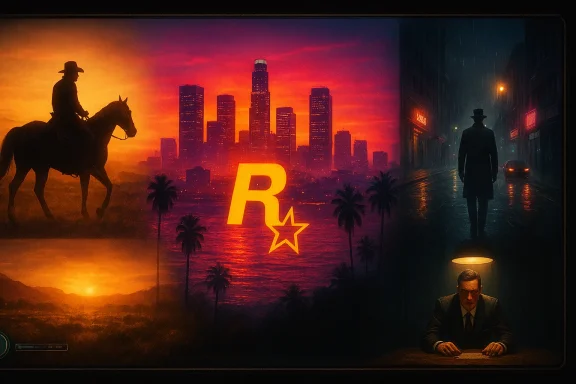 Background / Overview
Rockstar Games was founded in December 1998 and quickly established itself as a studio willing to push the boundaries of scale, tone, and adult-oriented storytelling in games. The company grew into an umbrella of studios — Rockstar North, Rockstar San Diego, Rockstar Toronto and others — and has produced genre-defining series such as Grand Theft Auto and Red Dead while also experimenting with different formats and tones in titles like Bully, L.A. Noire, and Midnight Club. Rockstar’s in-house RAGE (Rockstar Advanced Game Engine) is central to many of its modern releases and underpins the technical evolution visible across the studio’s catalog.Our ranking balances critical consensus (Metacritic and major reviews), commercial performance (reported sales milestones), cultural imprint, and long-term community engagement. For commercial and critical claims I cross-checked aggregator pages and Take-Two/industry reports so each major factual claim is supported by at least two independent sources when possible. Where concrete figures are absent or proprietary, I flag that explicitly.
Methodology: How we ranked these Rockstar titles
- Critical reception: aggregate Metacritic scores and contemporaneous reviews.
- Lasting influence: how the game changed design conventions, modding communities, or online ecosystems.
- Commercial success: reported unit sales or franchise milestones (Take‑Two/Statista/major outlets).
- Technical or narrative innovation: novel engines, systems, or storytelling methods (MotionScan, Euphoria, RAGE).
- Cultural footprint: memes, controversies, and mainstream media attention.
1. Grand Theft Auto V (2013) — The living, breathing money machine and design benchmark
Why it’s here
GTA V is the obvious frontrunner: it married three-dimensional acting, a sprawling Los Santos sandbox, and a live service (GTA Online) that kept the title commercially dominant for more than a decade. The game regularly surfaces at the top of “best of” lists because of its production polish, multiple protagonists that shift perspective mid-play, and a persistent multiplayer economy that continues to draw players. GTA V’s Metacritic reception sits in the highest tier, and the title’s longevity is unprecedented: it has sold well into the hundreds of millions of units across platforms.Strengths
- Massive, highly detailed world with layered systems.
- Tight blend of cinematic missions and emergent gameplay.
- GTA Online: a revenue engine that also extended community life and player-created content.
Risks / caveats
- Dependence on GTA Online made the single-player experience a secondary long-term revenue driver.
- Ongoing controversy over monetization and in-game economies.
- PC ports and platform transitions occasionally produced technical headaches on launch.
2. Red Dead Redemption 2 (2018) — Rockstar’s greatest narrative and technical leap
Why it’s here
Red Dead Redemption 2 represents Rockstar at its most ambitious in terms of fidelity, simulation, and narrative scope. Its attention to small moments — how horses react, how NPC routines unfold, how weather affects traversal — set a new bar for open-world simulation. The game’s critical reception matched its ambition, earning universal acclaim and near-perfect aggregator scores. Sales milestones also put RDR2 among the biggest releases of the last decade.Strengths
- Unmatched environmental simulation and NPC AI fidelity.
- A mature, character-driven story that rivals cinematic dramas.
- Technical achievement: animation, lighting, and world-state persistence.
Risks / caveats
- Long, slow pacing that doesn’t suit players seeking twitch action.
- Red Dead Online’s support has been inconsistent compared with GTA Online, causing backlash from multiplayer-focused players.
- RDR2’s complexity produced performance tuning challenges on older hardware at launch.
3. Grand Theft Auto: San Andreas (2004) — The genre-marker that expanded the sandbox
Why it’s here
San Andreas is the Grand Theft Auto entry that broadened the definition of what an open world could be: RPG-lite progression, city-to-country traversal, vehicle variety, and story scale that spanned gang dynamics and family ties. It’s a touchstone for many players who grew up with Rockstar’s early 2000s vision and remains a high-water mark on PlayStation 2-era Metacritic charts.Strengths
- Ambitious map and mission variety for its generation.
- Strong soundtrack and period atmosphere.
- The blend of customization, RPG systems, and sandbox mischief.
Risks / caveats
- Aging control schemes and technical limitations show up on modern systems without community fixes.
- The “Hot Coffee” controversy (a separate but related San Andreas episode) affected public perception and led to ratings/legal fallout, an early example of Rockstar’s culture of controversy.
4. Grand Theft Auto IV (2008) — Rockstar’s dark, grittier reinvention
Why it’s here
GTA IV shifted Rockstar into modern realism, with a darker story about Niko Bellic’s disillusionment and a Liberty City that felt more grounded than the series’ prior satirical tone. Critics placed the title extremely highly; its Metacritic score historically tops many of Rockstar’s releases. The game reworked driving and physics systems to more realistic ends and offered a narrative maturity that influenced story-driven open worlds thereafter.Strengths
- Mature, character-driven writing and enhanced physics systems.
- A believable urban sandbox with dense street-level detail.
- High critical acclaim and strong influence on subsequent open-world storytelling.
Risks / caveats
- The realism-first design aggravated players who preferred the more arcade-like mechanics of earlier entries.
- PC launches and patches historically had compatibility and optimization issues.
5. Red Dead Redemption (2010) — Western storytelling remastered for the modern era
Why it’s here
The original Red Dead Redemption (2010) distilled cowboy fiction into an open-world action drama and introduced many design elements that Red Dead Redemption 2 would later expand. Its combination of scale, narrative weight, and online elements made it a breakout success and an influential title in narrative-driven single-player experiences. Sales and chart performance at release underscored Rockstar’s cross-genre reach.Strengths
- Tight pacing and iconic moments in a Western setting.
- Mature protagonist and moral dilemmas uncommon in AAA open-world titles at the time.
Risks / caveats
- Some fans criticized Rockstar’s reduced focus on post-launch online support compared with GTA Online.
- Technical limitations of the PS3/Xbox 360 era show their age on PC and modern consoles without remasters.
6. Grand Theft Auto: Vice City (2002) — Style, music, and ’80s atmosphere perfected
Why it’s here
Vice City is the series’ neon-soaked tribute to 1980s Miami and pop culture. The game elevated Rockstar’s ability to weave licensed music, period-accurate aesthetics, and comedic-but-cruel storytelling into a single package. Critics praised its atmosphere and soundtrack; the title remains one of the highest-rated PS2 games ever on Metacritic.Strengths
- One of the most iconic soundtracks and era-capturing game worlds Rockstar produced.
- Strong mission design and character-driven set-pieces.
Risks / caveats
- As with other early entries, control schemes and technical fidelity look dated without modern remasters.
- The title’s satire and content occasionally trigger cultural sensitivity debates in hindsight.
7. L.A. Noire (2011) — Innovation in performance capture and interrogation design
Why it’s here
L.A. Noire is an outlier: a detective game that prioritized facial performance and interrogation mechanics, built on MotionScan facial-capture technology to read micro-expressions and truthfulness. While some gameplay elements (chases, shootouts) are less sophisticated than Rockstar’s best, the title’s ambition — marrying forensic nuance to an open-world detective story — earns it a high place on this list.Strengths
- MotionScan: a novel approach to facial fidelity that influenced performance capture discussions in the industry.
- Strong period atmosphere and investigative design.
Risks / caveats
- MotionScan’s split-capture method occasionally led to mismatches between body and face animation for minor characters.
- Gameplay pacing and interrogation predictability divide players; the tech was impressive but unevenly integrated.
8. Max Payne 3 (2012) — Brutal, cinematic action with Rockstar polish
Why it’s here
Max Payne 3 represents Rockstar’s best take on a linear, cinematic shooter: tight gunplay, signature “bullet time,” and a grim, adult narrative. It’s less a sandbox and more an auteur action piece — and it succeeds on those terms, with solid reviews for pacing, combat systems, and production values. An important note: the Max Payne franchise’s origins are with Remedy Entertainment, but Rockstar’s in-house studio shepherded the third title to completion with modernized tech and a distinctly darker tone.Strengths
- Excellent gunplay mechanics married to cinematic choreography.
- Mature, noir-influenced storytelling with high production value.
Risks / caveats
- Not a sandbox — players craving open-world freedom won’t find it here.
- The franchise’s split development lineage can cause confusion over canonical tone.
9. Bully (2006) / Bully: Scholarship Edition — Heart, satire, and overlooked charm
Why it’s here
Bully (later reissued as Bully: Scholarship Edition on newer platforms) is one of Rockstar’s most underrated titles: a school-set open world that mixes juvenile mischief, social sim mechanics, and pointed satire. It’s less controversial than its headline-grabbing siblings, and critics have praised its humor and structure. Despite legal and ratings hurdles at launch, Bully retains a loyal following and demonstrates Rockstar’s ability to shape open-world design around smaller-scale, character-focused stories.Strengths
- Unique subject matter and tone.
- Tight mission loops and memorable supporting cast.
Risks / caveats
- Platform support has been spotty; modern ports have experienced technical problems on some systems.
- Periodic controversies over content occasionally complicate re-releases.
10. Midnight Club 3: DUB Edition (2005) — Rockstar’s best arcade racer
Why it’s here
Midnight Club 3 is Rockstar’s standout in racing: open-city street racing, customization, licensed cars, and a strong soundtrack. While not as narrative or culturally explosive as GTA or Red Dead, it’s a high-water mark for arcade-style racers with a focus on urban tuning culture. The game holds strong Metacritic scores and remains fondly remembered by fans of the genre.Strengths
- Fast, accessible arcade racing with deep customization.
- Strong soundtrack and city design.
Risks / caveats
- Niche appeal compared to Rockstar’s blockbuster franchises.
- Multiplayer infrastructure on original platforms is defunct, making modern competitive play dependent on remasters or community servers.
Quick takes: notable omissions and close calls
- Manhunt: A cult favorite for fans of horror and stealth, but its gruesome premise and narrower appeal keep it off the top ten.
- Grand Theft Auto III: Historically ground-breaking and deserving of recognition, but in a top ten for a studio that has repeatedly redefined open worlds, it’s edged out by later technical and narrative leaps.
- Midnight Club: Los Angeles (and other racing entries) and smaller experiments like Table Tennis and Smuggler’s Run have value — they just don’t match the cultural footprint of the ten above.
Strengths across Rockstar’s catalogue
- Bold narrative ambition: Rockstar repeatedly marries mature themes and cinematic structure with interactive systems.
- Engine and technical investment: RAGE and in-house toolchains allowed Rockstar to scale fidelity across non-trivial open worlds.
- Market dominance balanced with editorial risk: Rockstar’s willingness to court controversy and satirize American culture made for headlines — and big sales.
Potential risks and ongoing issues
- Centralization of revenue on persistent services (GTA Online) raises long-term sustainability questions for single-player-first projects.
- Technical and quality-of-life issues on PC ports have been a recurring complaint, particularly for older titles reissued on modern OSes.
- Workplace culture, union disputes, and internal management decisions have created public relations challenges in recent years; those risks can tangibly affect product cadence and public trust.
- The scale of modern Rockstar projects has created long development cycles; while this can yield refined products, it also risks market timing and player expectations for sequels.
What this ranking means for PC players and readers now
- If you want the definitive Rockstar sandbox: pick up GTA V for the full modern experience (single-player + GTA Online) and Red Dead Redemption 2 for narrative and environmental simulation. Both titles remain benchmarks for what Rockstar can achieve.
- For a focused, narrative shooter with excellent combat choreography: Max Payne 3 remains the best pick from Rockstar’s non-sandbox catalogue.
- If you cherish era-capturing atmospheres and soundtracks, re-visit Vice City and San Andreas — they still define how Rockstar marries music to gameplay.
- For experimental tech and design lessons, L.A. Noire offers a unique case study in facial performance capture and interrogation mechanics. Its MotionScan work changed industry expectations for facial fidelity even if the integration wasn’t flawless.
Final verdict
Ranking Rockstar’s top ten is as much about acknowledging technical milestones as it is about celebrating games that changed players’ lives. From the ubiquitous, long-lived spectacle of Grand Theft Auto V to the carefully observed, elegiac sweep of Red Dead Redemption 2, Rockstar has repeatedly shown an appetite for scale and craft few studios match. But the company’s future success depends on addressing the trade-offs its model creates: balancing blockbuster live services with the singular creative focus that made its best single-player games timeless.This list should serve as both a guide for players who want to experience Rockstar’s high points and a critical lens for readers interested in how large-scale game development, monetization, and culture intersect. The games above are not just the “best Rockstar games” by sales or review score alone — they’re the titles that pushed the studio’s ambitions forward, defined genres, or pioneered techniques that other developers still adopt today.
Enjoy the worlds. Keep a critical eye on business models. And if you go back to any one of these games, notice the small systems — the weather, the NPC routines, the bit of dialog tucked into a corner — because Rockstar’s best work is often in the details.
Source: Sportsdunia Top 10 Best Rockstar Games of All Time
