

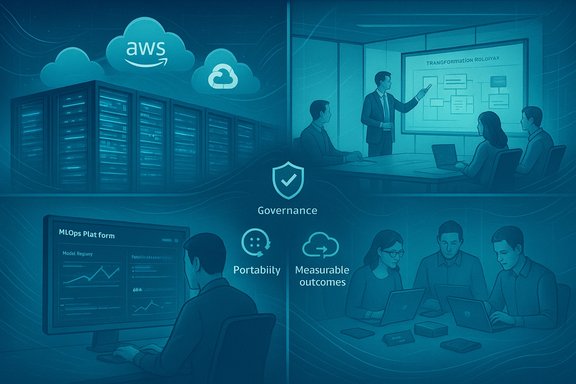
Analytics Insight’s roundup of the “Top 50 Information Technology (IT) Firms in the US” captures more than a ranking — it’s a snapshot of an industry reshaped by generative AI, cloud scale, and the services required to turn model prototypes into repeatable business outcomes.
Background / Overview
The United States remains the epicenter of corporate IT innovation, hosting hyperscale cloud providers, global consultancies, specialist ML platforms, and nimble engineering boutiques that together form the vendor ecosystem enterprises must navigate. Analytics Insight’s Top 50 list groups this diverse landscape into practical archetypes: hyperscalers that supply raw compute and managed model hosting, consulting houses that package transformation at scale, and specialist vendors that productize model lifecycle and domain-specific solutions. This editorial framing is echoed in independent analyses that use procurement‑focused criteria — enterprise readiness, governance capabilities, and measurable outcomes — to judge vendor relevance.The list is less about prestige and more about operational capability: can a vendor provide the compute, governance, and delivery muscle to take AI from pilot to production in regulated, latency-sensitive environments? The answer drives inclusion on the Top 50 and should guide IT leaders during shortlist and procurement phases.
The Big Three: Hyperscalers that Define the Stack
Amazon Web Services (AWS) — scale, breadth, and bespoke silicon
AWS continues to dominate as the default platform for large‑scale ML training, model hosting, and managed MLOps. Its breadth — from low‑level compute, networking and storage to managed services like SageMaker and Bedrock — makes it the pragmatic choice for organizations that need an end‑to‑end platform and global reach. Analytics Insight and subsequent vendor analyses emphasize AWS’s role as the backbone for many enterprise ML pipelines.- Key verified claim: AWS reported segment sales of roughly $30.9 billion in Q2 2025, underscoring the raw commercial scale underpinning its cloud and AI business.
- Massive global footprint and a very broad service catalog.
- Mature MLOps tooling (SageMaker Pipelines, Model Monitor).
- Custom silicon (Trainium, Inferentia) that can reduce TCO for some workloads.
- AWS’s modular building blocks require integration work; enterprises should budget for systems integration and engineering.
- Pricing complexity, egress fees, and region-specific resource constraints can create unexpected total cost of ownership (TCO). Industry reporting noted capacity constraints for the newest GPU families in 2025, a practical risk when planning large training runs.
Microsoft Azure / Microsoft Cloud — integration and productized AI
Microsoft’s differentiated play is productization: bundling Azure infrastructure with Microsoft 365, Copilot, GitHub, and enterprise governance tools that accelerate adoption inside Windows‑centric organizations. The Top 50 inclusion of Microsoft reflects this strategic advantage: Azure provides a shorter path from pilot to seat‑based monetization for enterprises already invested in Microsoft technologies.- Key verified claim: Microsoft reported that Azure surpassed $75 billion in annual revenue, with Microsoft Cloud showing strong year‑over‑year growth — figures Microsoft publicly disclosed as Azure moved past the $75B milestone.
- Tight identity and governance integration (Azure AD / Entra).
- Hybrid and on‑prem options for regulated industries via Red Hat/OpenShift and Azure Arc.
- Productized end‑user experiences (Copilot for Microsoft 365) that speed value capture.
- Seat‑based licensing and deep integration raise vendor‑lock concerns; buyers must design exit and portability clauses.
- Rapid capacity expansion to support AI can stress regional availability for top‑end accelerators — validate regional GPU/accelerator SLAs before committing major workloads.
Google Cloud (Vertex AI) — data centricity and TPUs
Google Cloud has positioned itself as the developer’s choice for data‑centric ML programs. Vertex AI’s integration with BigQuery, Google’s Gemini/large‑model stack, and TPU‑backed training pods make it especially attractive for analytics‑first organizations. Analytics Insight’s coverage places Google Cloud among the top firm group because its technical stack suits teams that prioritize feature engineering, data fabrics, and efficient training.- Key verified claim: Google Cloud revenue reported in 2025 reached the mid‑teens of billions (public reporting around $15.1–$15.2 billion in notable quarters), reflecting strong enterprise uptake of Vertex AI and cloud infrastructure.
- Deep integration with Google’s research and TPU hardware.
- Strong developer tooling for data pipelines and model lifecycle.
- Competitive pricing and performance for certain ML workloads.
- Historically smaller enterprise sales footprint in some regulated sectors compared with Microsoft and AWS; integration with legacy on‑prem stacks can require additional effort.
Global Consultancies and Systems Integrators — transformation at scale
Analytics Insight’s Top 50 highlights a second pillar of the market: consultancies that convert cloud/AI technology into business processes. Firms like Accenture, Deloitte, IBM Consulting, Cognizant, TCS, Infosys and Wipro are prominent because they marry domain expertise, delivery scale, and project governance. These companies do not compete on raw compute; they compete on program delivery, vertical accelerators, and the ability to guarantee change across enterprise processes.Why buyers shortlist consultancies:
- They provide cross‑discipline squads that combine strategy, data engineering, and systems integration.
- They maintain large delivery pools and industry playbooks (banking, healthcare, telco) that reduce risk for regulated workloads.
- They often supply packaged IP (SynOps, Omnia, BaNCS, Cobalt) that speeds time to value.
- Large transformation contracts are long and expensive; outcomes depend on organizational change management and contract clarity.
- Many consultancies report large AI staffing numbers and “AI‑related revenues” without independently auditable breakdowns — those headline figures should be negotiated and validated in vendor diligence.
Specialist Platforms and Scale‑Ups — productized model operations
The Top 50 also includes specialist ML and platform vendors that serve targeted enterprise needs: DataRobot (automated ML + agent orchestration), Palantir (high‑assurance operational AI), Scale AI (labeling and RLHF pipelines), Snowflake (data cloud and vector search integrations in many cases), and niche players like Glean (enterprise search + synthesis). These firms are selected for platform depth and measurable ROI in discrete pieces of the AI lifecycle.Strengths:
- Focused product roadmaps with strong MLOps and governance capabilities.
- Often easier to pilot and faster to implement for specific use cases than large consultancies.
- For some categories (labeling, evaluation, knowledge search), specialist firms can deliver a direct ROI multiplier by improving model data quality or information access.
- Platform fit must be validated against enterprise constraints: data residency, latency, latency‑sensitive inference, and integration with in‑house toolchains.
- As vendor products evolve quickly, buyer diligence should require operational references, sample telemetry, and agreed KPIs (latency, throughput, error budgets).
Engineering Boutiques and Product Shops — speed and tailored integrations
Smaller engineering firms (for example AscentCore, Markovate, Xorbix, ScienceSoft, 10Pearls, and Slalom) are well represented in the Top 50 because they deliver bespoke integrations, rapid POC‑to‑production pipelines, and verticalized agents. They are invaluable for organizations that need productized features — a claims processing agent, a sales intelligence assistant, or an internal Copilot tuned to proprietary corpora.Why they matter:
- Speed: boutique teams often move faster than global consultancies.
- Flexibility: easier to negotiate IP, portability, and data‑use clauses.
- Cost efficiency: lower overhead for targeted pilots.
- Public claims of ROI percentages or client counts are often sourced from case studies rather than audited reports; independent verification and staged delivery contracts are essential. Analytics Insight explicitly flags these claims as needing verification.
Core Trends Shaping the Top 50
1. Agentic AI and the rise of the digital coworker
Agent orchestration — systems that coordinate tools, APIs, and human fallback to perform multi‑step tasks — is central to vendor differentiation. Vendors are competing on agent orchestration, tool connectors, and enterprise‑grade escalation and auditability rather than raw LLM quality alone. Analytics Insight’s coverage places vendor strength in this category as a determining factor for inclusion.2. Capacity, hardware and regional constraints
Demand for GPUs and specialized accelerators drove 2024–2025 procurement cycles and continues to shape vendor differentiation. AWS, Microsoft and Google reported materially high cloud revenues tied to AI growth during 2025 quarters, while analysts and reporters flagged supply and capacity constraints for the newest GPU families. This dynamic affects both cost and project timelines for large model training.3. Governance, explainability and regulatory readiness
Several Top 50 firms emphasize governance features — model lineage, factsheets, and human‑in‑the‑loop review frameworks — because regulated industries now demand audit trails for model decisions. IBM’s watsonx and Microsoft’s Purview-like toolchains exemplify vendor efforts to embed explainability and compliance into the AI lifecycle.4. Seat‑based monetization vs. platform monetization
A strategic distinction among the Top 50 is whether a vendor captures value via seat‑based products (Copilot‑style subscriptions) or platform/meters (per‑inference / per‑training hour). Microsoft’s seat model accelerates adoption in Windows‑centric organizations, while hyperscalers and specialist platforms often monetize through compute and managed services. Each approach has procurement implications for budgeting and lock‑in.Practical Buyer Checklist — how to evaluate Top 50 vendors
- Define the outcome, not the technology. Translate business metrics (reduced handle time, faster claims processing, lower mean time to repair) into measurable model KPIs.
- Require technical proofs-of‑value that exercise your production constraints: target latencies, regional data residency, throughput, and scale tests.
- Insist on exportability and portability clauses for embeddings, vector stores, and model artifacts; avoid proprietary traps that prevent migration.
- Validate accelerator capacity and regional SLAs for heavy GPU workloads before signing multi‑year commitments. Public cloud providers have documented regional capacity limits that can affect timelines.
- Include governance KPIs and audit rights: model lineage exports, retraining cadence, and human‑in‑the‑loop exception handling.
- Stage payment milestones to production KPIs: accuracy, uptime, cost per inference, and security posture.
- Standardize on container and model formats (ONNX, TorchScript).
- Use managed model registries and experiment tracking across staging and production.
- Track embedding spend and implement batching/deduplication for RAG scenarios.
- Layer guardrails: safety filters, data policies, and a human escalation queue for low‑confidence outputs.
Critical Analysis: Strengths and Risks of the Top 50 Approach
Notable strengths
- The Top 50 composition accurately reflects a necessary market balance: hyperscalers supplying backbone infrastructure; consultancies providing the delivery teams; specialists and boutiques closing gaps with productized platforms and fast engineering.
- Inclusion criteria prioritize enterprise readiness and measurable outcomes rather than hype, which is a pragmatic orientation for procurement teams.
- The list highlights practical shortlists: enterprises should pair hyperscale capacity with niche vendors that address data quality, orchestration and compliance.
Principal risks and blind spots
- Overreliance on vendor‑reported metrics: many headline claims (AI‑related revenue, “number of AI staff”) are company disclosures and not independently auditable; treat them as directional unless audited evidence is provided. Analytics Insight and follow‑up analysis both caution readers to validate such claims.
- Vendor lock‑in risk is real: seat‑based products and managed services can entrench dependencies. The recommended countermeasures are contractual portability requirements and staged exit plans.
- Capacity and supply constraints: enterprise programs that require top‑tier GPUs should validate regionally available accelerator capacity and plan for the possibility of capacity-driven schedule slips or premium pricing. Industry reporting in 2025 confirmed these supply pressures.
- Security and hallucination risk: deploying LLMs into business processes without robust detection, red‑teaming, and human escalation creates compliance exposure; governance and red‑team cycles must be part of launch plans.
Flagging Unverifiable or Cautionary Claims
Several Top 50 entries include vendor case studies with ROI percentages and client counts. While useful, these are often drawn from marketing material or single case examples and therefore should be treated as illustrative rather than definitive. Analytics Insight’s reporting and independent editorial checks both recommend requesting production telemetry, client references, and audited KPIs during procurement to confirm vendor claims.What to Watch Next (Signals that will reshape the Top 50)
- The pace of hyperscaler data‑centre expansion and GPU supply will influence who can reliably host large model training and inference at scale. Watch public capex announcements and quarterly capacity disclosures from AWS, Microsoft, and Alphabet.
- Maturation of agent orchestration platforms — vendors that can offer secure, auditable, and easily integrable agent frameworks will gain share.
- Regulatory pressure on explainability, data residency and AI audit trails will favor vendors that bake governance into product lifecycles.
- Consolidation within specialist platforms as hyperscalers and consultancies continue to acquire capabilities or partners to close feature gaps.
Conclusion
Analytics Insight’s Top 50 list is best read as a practical map for procurement rather than a static leaderboard. It highlights the four essential vendor archetypes that enterprises must combine to succeed: hyperscale infrastructure, consulting delivery, specialist platforms, and agile engineering boutiques. Strategic procurement means matching vendor archetype to the mission: choose hyperscalers for scale, consultancies for transformation, specialists for domain‑specific problems, and boutiques for fast, tailored integrations. Across all choices, insist on verified KPIs, governance, and portability to avoid lock‑in and unexpected TCO. The Top 50 offers a starting point — the real work for IT leaders is turning that shortlist into a defensible, measurable, and secure production deployment.Source: Analytics Insight Top 50 Information Technology (IT) Firms in the US
