

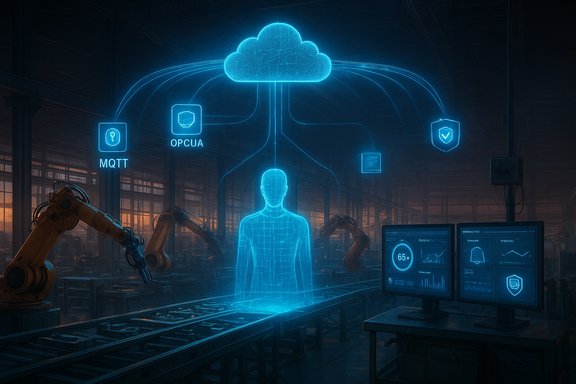
Enterprise IT leaders choosing an industrial automation and control platform in 2025 face a familiar paradox: the technology that can deliver the most dramatic efficiency, safety, and sustainability gains is also the one that increases their attack surface, operational complexity, and vendor-relationship risk if adopted without a deliberate strategy. ET CIO’s roundup of the “7 Best Industrial Automation and Control Systems for Enterprises in 2025” crystallizes that paradox by privileging platforms that combine cloud-scale data orchestration, edge computing, AI-driven insights, and broad protocol support — but the practical work of implementation still falls to CIOs who must balance interoperability, security, and total cost of ownership.
Background / Overview
Industrial automation and control systems (IACS) have evolved from isolated programmable logic controllers (PLCs) and monolithic distributed control systems (DCS) into layered stacks that include edge runtimes, cloud data services, AI/analytics engines, digital twins, and service orchestration. The global IACS market — estimated at roughly USD 228.9 billion in 2025 per ET CIO’s market snapshot — is being driven by three converging forces: OT–IT integration, edge-to-cloud analytics, and AI-assisted operations. Those trends create a new buyer profile for CIOs: one that must evaluate platform-level capabilities (data modelling, asset hierarchy, secure connectivity), operational primitives (edge runtime, container support, device management), and enterprise features (role-based access, auditability, vendor SLAs). Why this matters now:- The pace of Industry 4.0 adoption is increasing expectations for near-real-time decisioning and predictive maintenance.
- Legacy OT devices remain in service for decades, forcing hybrid architectures where cloud-native services must coexist with constrained PLCs and proprietary protocols.
- Security and governance must be first-class: CISA advisories in 2024–2025 repeatedly show that ICS vulnerabilities are a systemic enterprise risk and not an OT-only problem.
How ET CIO chose the seven platforms (selection criteria)
ET CIO’s list focuses on platforms that CIOs will encounter most frequently during enterprise digital transformation programs in 2025. The selection criteria, interpreted from the review, include:- OT–IT integration: native support for industry protocols (OPC UA, MQTT), asset modelling, and cloud connectors.
- Edge capabilities: ability to run analytics and compute at the plant edge (containerized runtimes, device management).
- AI and analytics: built-in or easily integrable ML/AI for predictive maintenance and anomaly detection.
- Enterprise governance: RBAC, audit trails, lifecycle management, and vendor support.
- Scalability and commercial models: support for multi-site rollouts, pay-as-you-go or modular licensing, and third‑party partner ecosystems.
The 7 platforms — summary and verification
Below are the seven platforms ET CIO recommends, followed by a technical confirmation and practical guidance for CIOs evaluating each option.Microsoft Azure IoT for Manufacturing
- What ET CIO claims: Edge-to-cloud data foundation, OPC UA/MQTT support, predictive maintenance and digital twins.
- Verified facts: Microsoft’s Azure Industrial IoT portfolio centers on open standards (OPC UA), Azure IoT Edge, Azure Digital Twins, and tight security primitives (Azure Defender for IoT, Azure Sphere). The platform is explicitly positioned for OT–IT convergence and supports hybrid topologies via Azure Arc and AKS. These capabilities are consistent with Microsoft’s published Industrial IoT materials.
- Strengths:
- Broad ecosystem and partner validation for enterprise use.
- Familiarity for teams already standardised on Microsoft stack (Azure AD, AKS).
- Rich analytics and digital twin toolchains.
- Watchouts:
- Requires Azure engineering expertise to implement correctly.
- Cost and telemetry retention can grow rapidly in large-scale, high-frequency telemetry scenarios.
Scry AI — Concentio / Concentio Cortex
- What ET CIO claims: AI-first analytics and anomaly detection with digital twin support and governance.
- Verified facts: Scry AI’s Concentio Cortex is an AI engine designed for time-series and visual data that advertises 25+ prebuilt AI models, edge-to-cloud deployments, and explainability/traceability features. Vendor materials and recent press indicate active positioning in utilities, drone-based inspections, and manufacturing analytics.
- Strengths:
- Specialized for sensor + visual data fusion; useful when video analytics matter.
- Built-in data-quality pipelines to reduce false positives in ML workflows.
- Watchouts:
- Smaller vendor footprint — validate enterprise SLAs and support model for mission-critical production.
- Expect integration work with incumbent historians and asset registries.
Siemens Industrial Edge
- What ET CIO claims: Real-time edge processing, containerised app support, centralised edge management.
- Verified facts: Siemens Industrial Edge is an edge runtime + management suite that runs containerized apps (Docker), provides an Industrial Edge Management plane, a marketplace for apps, and is purposely built to integrate with Siemens automation hardware (SIMATIC) while supporting third-party cloud connectors. Independent industry analysis confirms the focus on container orchestration, app lifecycle control, and device management.
- Strengths:
- Tight integration with Siemens automation stack and validated edge device support.
- Strong device/app lifecycle governance — useful in regulated manufacturing.
- Watchouts:
- Best value when your estate already includes Siemens automation; integration costs increase otherwise.
- Containerization reduces variability but introduces a new operational surface (orchestration, container security).
AWS IoT SiteWise
- What ET CIO claims: Industrial data modelling, SiteWise Edge, real-time KPIs and asset hierarchies.
- Verified facts: AWS IoT SiteWise provides asset modelling, SiteWise Edge for on-prem processing (metrics and transforms), and APIs for metrics, dashboards and ingestion to other AWS services. Recent AWS updates continue to expand SiteWise’s asset model features and edge-first processing semantics. This validates ET CIO’s summary.
- Strengths:
- Mature, scalable data modelling for enterprises already using AWS.
- Edge-first capability that can compute metrics locally and reduce cloud egress.
- Watchouts:
- Heavy AWS dependency for integration flows; cross-cloud scenarios require careful architecture.
- Asset modelling works well at scale, but data governance (naming conventions, standard metrics) must be enforced.
IBM Maximo Application Suite (MAS)
- What ET CIO claims: Enterprise asset management (EAM), predictive maintenance, integration with IoT data.
- Verified facts: IBM Maximo MAS remains a market-leading EAM/APM solution with modules for Maximo Monitor, Maximo Predict, and Maximo Health. IBM emphasizes AI-driven asset intelligence for reducing downtime and prescriptive maintenance; product pages and industry write-ups corroborate these claims.
- Strengths:
- Deep EAM capabilities and maturity for large asset-heavy enterprises.
- Strong AI + analytics for predictive maintenance once properly instrumented.
- Watchouts:
- Implementation timelines and integration complexity can be significant.
- Licensing and AppPoints-based models require careful total-cost-of-ownership analysis.
Emerson Plantweb Digital Ecosystem
- What ET CIO claims: Deep diagnostics, predictive reliability, integration with Emerson instruments and third-party devices.
- Verified facts: Emerson’s Plantweb is a broad digital ecosystem that combines sensing, DeltaV control, AMS diagnostic tools, Plantweb Insight/Advisor, and recent partnerships (notably AspenTech asset optimization). The platform emphasizes sensing, predictive diagnostics, and enterprise-wide optimization; these characteristics are reflected in Emerson press releases and industry coverage.
- Strengths:
- End-to-end process industry pedigree — excellent for continuous-process plants (chemicals, oil & gas).
- Integration with Emerson’s field instrumentation and established diagnostics tools.
- Watchouts:
- Best fits process industries; discrete manufacturers should evaluate ROI carefully.
- Vendor consolidation (emergent partnerships) require diligence on roadmap alignment.
TCS Connected Universe Platform
- What ET CIO claims: Enterprise-wide OT–IT unification, verticalized modules, and microservice architecture.
- Verified facts: TCS positions the Connected Universe as a containerized, edge-capable IIoT platform with plug-and-play analytics modules (predictive maintenance, golden batch, energy management). TCS public materials and analyst placements confirm the platform’s use in large managed-service projects and its flexible cloud/on-prem deployment options.
- Strengths:
- Strong systems-integration and services layer — useful if your program favors managed-delivery, rapid piloting, and consulting-led transformation.
- Verticalized accelerators reduce time-to-value for specific process use-cases.
- Watchouts:
- As a services-led platform, costs and reliance on vendor delivery teams can be significant.
- Validate intellectual property ownership and portability of models and configurations at contract time.
Cross-checks, security context, and interoperability notes
The ET CIO selection emphasises modern connectivity and analytics, but the operational realities of industrial estates force additional considerations.- Protocol and device coverage: OPC UA and MQTT are now baseline expectations for vendor-neutral integration; verify the platform’s driver/connector coverage for your PLC families (Allen‑Bradley, Siemens, Modbus variants). Siemens, Azure, and AWS explicitly advertise OPC UA support, while specialized connectors and partner adapters fill many gaps.
- Edge runtime and containerization: Siemens Industrial Edge and many cloud-led solutions support containerized apps (Docker, sometimes orchestrated via Kubernetes). Containerization helps reproducible deployments but shifts responsibilities to teams who must secure container images, manage runtime updates, and monitor resource usage. Independent analysis highlights container orchestration as a core operational control for shopfloor apps.
- Governance and certificates: Modern IACS architectures require PKI-based device identity and certificate lifecycle management. Some industrial middleware projects (e.g., Kepware consolidation efforts) explicitly moved to stronger default cryptographic settings and API-based certificate management — a practical sign that vendors are raising the baseline for secure deployment. Confirm certificate import/export APIs and automated renewal capabilities for any shortlisted product.
- ICS advisories and vulnerability posture: Multiple consolidated advisories from national authorities (including CISA) in 2024–2025 underscore the frequency and severity of ICS vulnerabilities across vendors. These advisories routinely call out remote-exploitable flaws in gateways, HMIs, radios, and PLC communication modules — all components that your chosen platform must integrate with. Treat vendor mitigations and timeline commitments as procurement-grade requirements.
Practical implementation roadmap for CIOs
Adopting any of the seven platforms should be framed as a program, not a project. A pragmatic, staged approach reduces risk and accelerates value capture.- Discovery and inventory (Day 0–14)
- Build a canonical asset registry (device types, firmware, network paths).
- Tag business-critical assets, safety-critical controls, and compliance-scope devices.
- Pilot and proof-of-value (Day 15–60)
- Select a constrained pilot line or plant with a clear KPI (OEE, downtime reduction).
- Test edge-to-cloud pipelines, latency, data models, and core AI use-cases with real telemetry.
- Security, segmentation, and hardening (parallel)
- Place an OT security baseline into procurement (device isolation, least privilege, logging, MFA).
- Require detailed vendor answers: supported cipher suites, certificate lifecycle, agent upgrade paths, and vulnerability disclosure policies.
- Scale and governance (Month 3–12)
- Formalize change windows, rollout rings, configuration automation for edge images.
- Integrate platform events and telemetry into your SIEM and ITSM for end-to-end audit trails.
- Continuous improvement
- Monitor model drift for AI-led predictions, maintain a rollback plan for edge updates, and run periodic red-team / ICS-specific pen tests.
Strengths and risks: a critical assessment
The ET CIO seven-platform list is practical and aligned to modern enterprise needs, but each choice presents trade-offs.- Strengths across the set:
- Composability: These vendors allow CIOs to pick best-in-class building blocks (edge + cloud + AI + EAM).
- Scalability: Hyperscaler platforms and modular enterprise suites are designed to support multi-site rollouts.
- Industry focus: Emerson and Siemens retain deep process- and automation-domain expertise, while IBM and TCS bring proven enterprise management and delivery models.
- Common risks and gaps:
- Security and supply-chain exposure: CISA advisories show the exposure of telemetry radios, proprietary gateways, and management consoles. Platforms that integrate widely should be evaluated for their exposure and vendor patching cadence.
- Hidden integration costs: The more your estate mixes PLC families, custom HMIs, and legacy historians, the more integration engineering you’ll buy.
- Vendor lock-in vs. portability: Commercial offerings vary: hyperscalers favor cloud-native lock-ins; SI vendors favor appliance/ecosystem lock-ins; integrators favor services contracts. Negotiate data portability and model export clauses.
- Operational maturity: Containerization and edge orchestration introduce IT skills requirements that many OT teams do not have. This skills gap is an often-underestimated risk.
Platform-by-platform procurement checklist (short)
When you shortlist a vendor, require concrete answers to the following:- Does the product support OPC UA, MQTT, Modbus, and your PLCs out-of-the-box?
- Can edge workloads be containerized and managed centrally, with role-based access and audit logs?
- Are certificate management APIs available and automatable for device identity rotation?
- What is the vendor’s vulnerability disclosure and patch timeline for critical CVEs?
- How does data residency and retention work for your regulatory footprint?
- What are the billing drivers (per-device, per-MB telemetry, compute-hours, or fixed tiers)?
Short profiles — what each platform is best for (quick reference)
- Microsoft Azure IoT for Manufacturing — Best for organisations already standardised on Azure who need an enterprise-grade digital twin and integrated security stack.
- Scry AI (Concentio) — Best for hybrid visual + sensor analytics use-cases where AI-driven inspection, drone imagery, or video analytics are central.
- Siemens Industrial Edge — Best when close coupling to Siemens automation and deterministic edge runtimes is required; strong for regulated manufacturing.
- AWS IoT SiteWise — Best for asset modelling at cloud scale with local edge metric processing for enterprises standardised on AWS.
- IBM Maximo Application Suite — Best where mature EAM/APM workflows, long-term asset governance, and advanced APM are the primary goals.
- Emerson Plantweb Digital Ecosystem — Best for process industries prioritising sensing, diagnostics, and integrated optimization.
- TCS Connected Universe Platform — Best for CIOs seeking a platform-plus-services delivery model, rapid vertical accelerators, and managed-scale rollouts in multi-plant programmes.
Final recommendations — what every CIO should demand
- Treat IACS procurement like enterprise software: require SLAs, security attestations, documented upgrade paths, and data portability clauses.
- Insist on a guarded pilot before wide rollout to validate claims about “zero downtime” or “no reboots.” Marketing claims often hide operational caveats.
- Make certificate and identity lifecycle automation a procurement must-have. Manual PKI management at scale is an operational liability.
- Bake monitoring and SIEM integration into the deployment plan; assume adversaries will look for misconfigured gateways and exposed HMIs first. CISA advisories validate this attack vector prioritisation.
- Invest in cross-skilling: create an “edge ops” competency bridging OT practitioners and platform engineers (Kubernetes/container lifecycle, secure boot, image scanning).
Conclusion
ET CIO’s 2025 roundup captures a pragmatic truth: the vendors that will shape the next phase of industrial automation are those that combine edge-first execution, cloud-scale analytics, and AI-driven workflows — but success for enterprises hinges on integration discipline, explicit security controls, and realistic expectations about operational complexity. The seven platforms listed present strong choices for different enterprise priorities: hyperscaler-led scale (Azure, AWS), domain-specialized depth (Emerson, Siemens), asset governance (IBM Maximo), AI-driven analytics (Scry AI), and service-centric delivery (TCS). Choosing among them requires a rigorous pilot, contract-level security assurances, and a credible plan to operationalize containerized edge software and lifecycle management across plants.Industrial transformation delivers value only when platforms are paired with the right governance, hardened operational practices, and realistic procurement terms — and in 2025 the smartest CIOs will prioritize those operational controls as aggressively as they prioritize new feature checkboxes.
Source: ET CIO 7 Best Industrial Automation and Control Systems for Enterprises in 2025
