

Creative Assembly’s long-running Total War series is stepping into the grimdark future: Total War: Warhammer 40,000 was revealed at The Game Awards 2025, and unlike any mainline Total War before it the title is being built for PC and consoles — PlayStation 5 and Xbox Series X|S — with actor David Harbour announcing the game on stage and confirming he’ll appear in the cast.
Total War has historically combined a turn‑based grand strategy map with massive real‑time battles; the Warhammer spin‑offs expanded the series’ scale and fantasy spectacle on PC only. Creative Assembly’s announcement at The Game Awards signals two major shifts at once: a move from Warhammer Fantasy into the far future of Warhammer 40,000, and the studio’s first explicit push to ship a mainline Total War title across consoles at launch. The reveal trailer teases galaxy‑spanning conflict — Space Marines, Astra Militarum (Imperial Guard), Orks, and Aeldari are explicitly shown or referenced — and Creative Assembly’s marketing copy promises a new campaign model where factions contest multiple planets rather than a single contiguous map. That planetary scale is being pitched as a core design change intended to make Total War: Warhammer 40K feel galactic in scope. Creative Assembly also used its 25th Anniversary communications to outline broader studio plans: a new engine evolution called Warcore, an early pre‑production reveal for Total War: Medieval III, and a major expansion for Total War: Warhammer III titled Lords of the End Times coming in Summer 2026. Those headlines contextualize the 40K announcement as part of a multi‑pronged relaunch of the franchise rather than an isolated project.
From an IP perspective, migrating from Warhammer Fantasy to Warhammer 40,000 opens darker, gun‑heavy mechanical design spaces: ranged combat, armored vehicles, orbital assets, and faction asymmetries that lean into apocalypse and attrition mechanics. Creative Assembly will need to balance tabletop authenticity with accessible Total War gameplay systems. Early press materials emphasize fidelity to the milieu alongside customization features for army creation.
Source: Windows Central https://www.windowscentral.com/gaming/pc-gaming/total-war-warhammer-40k-game-awards-2025/
 Background / Overview
Total War has historically combined a turn‑based grand strategy map with massive real‑time battles; the Warhammer spin‑offs expanded the series’ scale and fantasy spectacle on PC only. Creative Assembly’s announcement at The Game Awards signals two major shifts at once: a move from Warhammer Fantasy into the far future of Warhammer 40,000, and the studio’s first explicit push to ship a mainline Total War title across consoles at launch. The reveal trailer teases galaxy‑spanning conflict — Space Marines, Astra Militarum (Imperial Guard), Orks, and Aeldari are explicitly shown or referenced — and Creative Assembly’s marketing copy promises a new campaign model where factions contest multiple planets rather than a single contiguous map. That planetary scale is being pitched as a core design change intended to make Total War: Warhammer 40K feel galactic in scope. Creative Assembly also used its 25th Anniversary communications to outline broader studio plans: a new engine evolution called Warcore, an early pre‑production reveal for Total War: Medieval III, and a major expansion for Total War: Warhammer III titled Lords of the End Times coming in Summer 2026. Those headlines contextualize the 40K announcement as part of a multi‑pronged relaunch of the franchise rather than an isolated project. What was shown and what we now know
The Game Awards reveal — what the trailer delivered
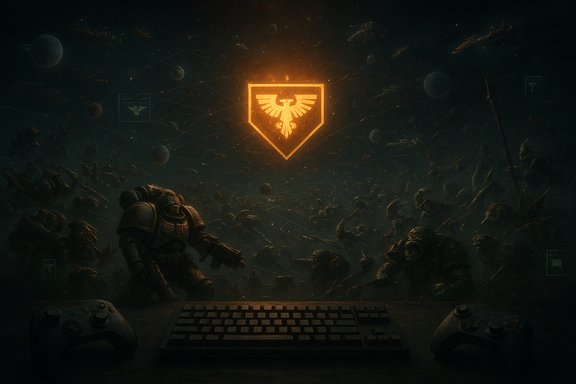
The announcement trailer is short but revealing: cinematic blitzes of infantry and vehicles, Ork hordes charging under a Waaagh!, and Space Marines unloading devastating firepower. Crucially, the trailer and accompanying press materials mention four playable factions at reveal: Space Marines, Astra Militarum, Orks, and Aeldari, and they highlight the ability to customize armies, heraldry, and wargear in a way Creative Assembly describes as “forge an army that’s truly your own.” David Harbour’s on‑stage reveal reinforced the mainstream profile of the showpiece: the actor — known for film and television roles and a vocal tabletop fan — both narrated part of the unveiling and confirmed he will be a voice and character presence in the game. That kind of celebrity tie‑in is increasingly common in AAA publishing as a marketing accelerant.Platforms and firsts for the series
For decades Total War’s primary home has been Windows PC. This announcement marks the first time the franchise is publicly confirmed to launch on PlayStation 5 and Xbox Series X|S alongside PC — a strategic pivot with wide technological and commercial consequences. Multiple outlets and the publisher’s release notes corroborated console availability at reveal. No release date was announced.Engine evolution: Warcore
Creative Assembly described engine upgrades under the Warcore banner, a next‑generation effort the studio says improves physics, pathfinding, and vehicle functionality — the very systems that will be stressed by vehicular combat, planetary traversal, and the large unit counts implied by the trailer. Warcore is positioned as a foundation for both the 40K project and future titles across the Total War portfolio.Scale: multi‑planet campaigns and mechanics
The promotional materials repeatedly emphasize a multi‑planet campaign structure rather than the single contiguous campaign maps Total War players expect. That implies changes across many design layers: movement and logistics between systems, new faction economy models tied to planetary resources, and likely fleet/transport mechanics to ferry forces between worlds. The developer’s framing suggests both a grander strategic map and technical challenges in streaming and AI decision‑making.Creative Assembly’s broader slate: Medieval 3 and Warhammer 3 expansion
Total War: Medieval III (early pre‑production)
Creative Assembly used its 25th anniversary showcase to confirm Total War: Medieval III is in early pre‑production, describing it as a return to historical roots and a long‑term multi‑year project built with community feedback in mind. The studio framed Medieval III as a major priority, but explicitly noted it is at an early stage and will undergo extensive public involvement and iteration. This positions Medieval 3 as a slow‑burn development that won’t compete for immediate resources at the same level as 40K.Total War: Warhammer III — Lords of the End Times (Summer 2026)
Creative Assembly also confirmed a large DLC for Total War: Warhammer III titled Lords of the End Times, with Nagash leading the charge and a Summer 2026 release window. The expansion promises apocalyptic mechanics that can scar or reshape the campaign map, new Legendary Lords, and high‑impact endgame threats. This shows the studio is balancing investment in its ongoing fantasy trilogy with the new 40K project.Why this matters: strategic and technical implications
A console Total War is a platform shift
Shipping a traditionally PC‑anchored franchise on PS5 and Xbox Series X|S at launch is not merely a distribution decision; it’s a core design constraint. Consoles impose stricter memory budgets, different storage architectures, and distinct controller interfaces. Creative Assembly’s statements about Warcore specifically referencing pathfinding and vehicle handling strongly suggest the studio is deliberately engineering solutions for console limitations and real‑time performance needs across large battlefields.- Strength: console presence expands audience reach and revenue potential, giving Total War a chance to become a broader cross‑platform brand.
- Risk: porting a strategic RTS with huge unit counts and complex UIs risks compromises in fidelity, framerate, or interface usability if not given adequate optimization time.
Warcore’s promises vs practical challenges
The three technical pillars Creative Assembly cited — improved physics, better pathfinding, and enhanced vehicle functionality — map directly onto the pain points that historically plague large‑scale RTS and simulation titles.- Pathfinding at planetary and battle scale is computationally expensive. Total War battles often stress pathfinding with thousands of units; adding vehicles, multi‑terrain traversal, and more complex cover/line‑of‑sight rules will amplify CPU load.
- Physics and vehicle systems introduce non‑deterministic elements and collision loads that can cascade into AI miscalculations and frame drops if not carefully bounded.
- Memory and streaming become critical when moving between planetary surfaces and displaying larger arrays of assets and destructible environments.
UI and control design for controllers
Total War’s complex menus, army management, and fine‑grained tactical control maps poorly to simple gamepads without careful redesign. Expect Creative Assembly to:- Rework selection and camera controls for thumbsticks and triggers.
- Implement context‑sensitive radial menus and smart selection to replace mouse precision.
- Offer tailored HUD scaling and navigational shortcuts for console screens.
Creative and narrative choices: celebrity casting and IP stewardship
David Harbour’s involvement is both symbolic and practical. As a known tabletop Warhammer enthusiast who’s publicly discussed painting miniatures, Harbour provides a recognizable face and a trustworthy fan voice for mainstream promotion. His casting may increase cross‑media visibility and attract new players, but casting alone doesn’t change core gameplay fundamentals.From an IP perspective, migrating from Warhammer Fantasy to Warhammer 40,000 opens darker, gun‑heavy mechanical design spaces: ranged combat, armored vehicles, orbital assets, and faction asymmetries that lean into apocalypse and attrition mechanics. Creative Assembly will need to balance tabletop authenticity with accessible Total War gameplay systems. Early press materials emphasize fidelity to the milieu alongside customization features for army creation.
- Strength: high recognition and faithfulness to the 40K brand will win core tabletop fans and collectors.
- Risk: heavy IP expectations can balloon scope (the tabletop universe is vast) and raise community scrutiny over canonical accuracy and faction balance.
Practical expectations for players and platforms
Release timing and platforms
At reveal, no ship date was announced. The game is confirmed for Windows PC (Steam/other PC stores) and both current‑gen console families, but launch timing, edition structure, and store‑specific entitlements (like cross‑buy, cross‑save, or Game Pass) remain unknown. Treat platform availability as confirmed but timing and entitlements as pending. Multiple outlets corroborate console plans and emphasize lack of release date.Hardware and system demands — what players should plan for now
No official system requirements or frame targets have been published. That said, given Warcore’s stated focus and the franchise’s historical appetite for CPU and memory, plan conservatively:- Ensure a fast NVMe SSD for campaign streaming and asset streaming.
- Aim for a multi‑core modern CPU — Total War benefits from higher core counts for AI and pathing threads.
- Prioritize a GPU with ample VRAM if you plan high resolution/high fidelity battles.
- Console players should expect multiple graphics/performance modes and potential optional features toggled for framerate stability.
Design trade‑offs and likely systems
Multi‑planet campaigns imply new gameplay layers
Moving from a single map to a system of planets implies mechanics for:- Inter‑planet logistics (transport fleets and movement windows).
- Planetary governance (planet‑level economies and infrastructure).
- Strategic fleets or orbital assets that may act as chokepoints.
Custom army creation
Press materials emphasize a deep army creator — title claims include shaping “title, heraldry, iconography and arcane wargear” and a detailed trait/tactic system for player‑forged forces. This could introduce persistent metagame choices and a richer cosmetic economy, but it also raises balance challenges and moderation of player‑created content. Creative Assembly will need robust UI tools to make customization approachable on console controllers as well as PC.Community reaction and marketplace context
The announcement landed as a huge headline for strategy fans. That enthusiasm is tempered by legitimate skepticism built on three historical patterns:- Large announcements sometimes translate into long development cycles and feature creep.
- Cross‑platform ambitions can force compromises for parity and performance.
- Warhammer fans are notoriously particular about lore fidelity and faction balance.
Risks, unknowns, and cautionary notes
- Unannounced release window: until a date is set, everything about launch parity, pre‑order editions, and cross‑buy remains tentative. Treat any leaked dates or storefront backends seen in the wild as unconfirmed until publisher announcements.
- Performance parity across platforms: delivering identical experience on high‑end PC and consoles is difficult. Expect platform‑specific feature sets or visual targets at launch. Creative Assembly’s Warcore work points at deliberate engineering, but the proof will be in third‑party testing and early reviews.
- Design scope creep: Warhammer 40K’s universe is vast. Creating dozens of faction mechanics, vehicles, and narrative beats could extend development timelines and increase post‑launch DLC reliance. That’s manageable if communicated clearly, but it can erode trust if the baseline experience feels incomplete at release.
- Controller UX: translating Total War’s micro‑heavy interface to gamepads is an inherently risky UX problem. Expect iterative patches and potential concessions to simplify or automate micromanagement for console users.
What to watch next (step‑by‑step)
- Official publisher roadmap: look for Sega/Creative Assembly release windows, edition breakdowns, and platform entitlements.
- Developer deep dives on Warcore: technical blogs or GDC‑style postmortems will reveal how pathfinding, physics, and vehicles are being engineered.
- Early gameplay demos or closed tests: these will surface performance and UI patterns, especially on consoles.
- Community Q&A sessions: Creative Assembly has signaled community involvement on other titles; watch for developer surveys, concept polls, and systems FAQs.
- System requirements: once published, cross‑check official numbers and reserve SSD and RAM headroom as advised.
Conclusion
Total War: Warhammer 40,000 is an ambitious pivot for Creative Assembly — a blending of the studio’s grand strategy DNA with the grim, mechanized warfare of the 41st Millennium and, for the first time, a clear commitment to console platforms at launch. The reveal at The Game Awards 2025 brought spectacle and credibility (with David Harbour’s high‑profile presence) and sketched an outline of technical ambition via the Warcore engine. That ambition carries upside — a potentially broader audience, new creative directions, and mechanics that could meaningfully evolve what a Total War game can be. It also carries clear engineering and design risks: pathfinding and physics at scale, controller UX, and the perpetual danger of scope expansion. Fans and platform holders alike should watch for the next developer diaries and early technical previews; those will determine whether Warcore’s promises translate into battlefield polish and whether the franchise’s console debut can capture the depth and scale PC players expect while remaining accessible to couch strategists. Creative Assembly has set a high bar in both expectation and technical ambition — the next year will be the clearest sign of whether the studio can deliver a truly galactic Total War.Source: Windows Central https://www.windowscentral.com/gaming/pc-gaming/total-war-warhammer-40k-game-awards-2025/
