

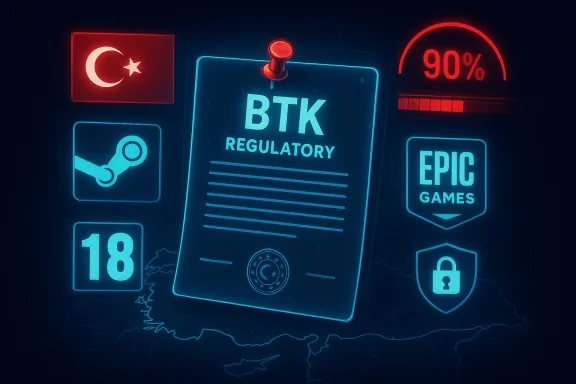
Turkey’s draft legislation to regulate digital game storefronts threatens to reshape how PC and console platforms operate inside the country — and it could become a dangerous template for other governments seeking more control over digital content and services. Major elements of the proposal would require foreign storefronts to set up a local legal presence, appoint Turkish representatives, adopt mandatory age‑rating rules for every title offered to Turkish IP addresses, respond rapidly to regulator information requests, and face escalating penalties — including fines and bandwidth throttling of up to 90% — if they do not comply. The measures are currently a draft from the Ministry of Family and Social Services and remain under review, but multiple independent news outlets and industry commentators say the effects, if enacted, would be immediate and severe for players, small developers, and global platform operators alike.
Turkey’s draft stems from a broader legislative package that aims to improve online child safety and tighten control over social networks and digital services. The measure extends existing liability and access rules to “game providers” and “game distributors,” creating a specific legal framework for online games and digital storefronts — not just social media. Under the draft, companies that exceed a stipulated daily access threshold in Turkey would be required to have a legal entity or official representative in the country and to publicly register that information with the telecoms regulator, the Information and Communication Technologies Authority (BTK).
Officials say the draft’s objectives are child protection and consumer safety: mandatory age ratings for games, parental control features, and the power for regulators to remove or order changes to “risky” content. But the enforcement architecture — short compliance deadlines, aggressive data and algorithm access demands, steep administrative fines in Turkish lira, and staged network throttling — makes this one of the strictest digital platform oversight schemes proposed anywhere in 2026. Independent reporting shows fines could range into the millions of Turkish lira and that BTK would have the power to demand corporate and algorithmic information with narrow timeframes for responses.
From a business perspective, Microsoft’s gaming revenue is a small but strategically important slice of a much larger enterprise. Recent financial reporting shows that Xbox content and services sit inside Microsoft’s “More Personal Computing” segment and represent a single‑digit percentage of the company’s overall revenue, meaning that Microsoft could weigh the cost of a localized compliance program against the relative revenue exposure in Turkey. That balance will shape Microsoft’s likely response strategy: compliance for continuity of Game Pass and Xbox storefront services, or a narrower approach limited to major market‑level investments if the commercial returns aren’t justified.
For platform operators and industry groups the choice is stark: negotiate carve‑outs and workable compliance mechanisms now; litigate later at great cost; or limit services in Turkey and accept the reputational and market consequences. For players and developers in Turkey, the sensible immediate steps are practical: catalogue rating status, prepare contingency support plans, and watch the parliamentary process closely. Finally, the global industry should take this bill as a clear signal: regulators increasingly expect local accountability for digital platforms, but they must be met with frameworks that protect children and consumers without destroying the commercial and cultural ecosystem that makes digital games a global industry.
Source: Windows Central Steam and Epic may face restrictions as Turkey targets digital platforms
 Background / Overview
Turkey’s draft stems from a broader legislative package that aims to improve online child safety and tighten control over social networks and digital services. The measure extends existing liability and access rules to “game providers” and “game distributors,” creating a specific legal framework for online games and digital storefronts — not just social media. Under the draft, companies that exceed a stipulated daily access threshold in Turkey would be required to have a legal entity or official representative in the country and to publicly register that information with the telecoms regulator, the Information and Communication Technologies Authority (BTK). Officials say the draft’s objectives are child protection and consumer safety: mandatory age ratings for games, parental control features, and the power for regulators to remove or order changes to “risky” content. But the enforcement architecture — short compliance deadlines, aggressive data and algorithm access demands, steep administrative fines in Turkish lira, and staged network throttling — makes this one of the strictest digital platform oversight schemes proposed anywhere in 2026. Independent reporting shows fines could range into the millions of Turkish lira and that BTK would have the power to demand corporate and algorithmic information with narrow timeframes for responses.
What the draft actually requires
Core operational obligations
- Platforms with high daily Turkish access must establish a legal presence or appoint a local representative and publish that representative’s contact details with BTK. This mirrors steps regulators have pursued elsewhere when they want an accountable point of contact inside their jurisdiction.
- Platforms must enable parental controls and age‑verification systems, treat children under a certain age differently (the broader bill contemplates restrictions for users under 15 on social networks), and classify or refuse to sell games that do not carry recognised age ratings. Recognised ratings cited repeatedly in reporting include PEGI and ESRB-style systems or their local equivalents.
- The BTK would gain expanded investigatory powers: the ability to request corporate structure details, algorithmic descriptions, and data processing information — typically with a very short turnaround (reporting indicates companies would have only five days to respond).
Escalating enforcement model
- Noncompliance triggers administrative fines (reporting cites ranges like 1 million to 30 million Turkish lira in some draft summaries) and technical penalties. The draft proposes stepwise bandwidth throttling — first 50%, escalating to as much as 90% — for persistent noncompliance. At 90% throttling, modern triple‑digit‑gigabyte downloads would be effectively impossible, turning an otherwise available storefront into a de facto ban. Multiple outlets confirm that bandwidth restrictions are central to the enforcement ladder.
- Under emergency criteria in the draft, content takedown or blocking decisions could be required within as little as one hour, leaving platform operators a very narrow window for appeals or technical mitigation.
Immediate practical impact for players and platforms
What 90% bandwidth throttling means in practice
A headline figure like “90% throttling” is easy to read but important to unpack. Cuts of that magnitude don’t just slow a download — they make many contemporary games unusable.- Modern AAA titles commonly exceed 50–100 GB (and some are much larger). A typical broadband connection that downloads at 100 Mbps would take about 2–3 hours to pull down 100 GB under normal conditions. Reduce effective throughput by 90% and that same download takes roughly 20–30 hours or more; on congested last‑mile networks the reality would be far worse. For multiplayer‑dependent titles that require frequent updates, throttled bandwidth would break the normal update cadence and player experience, amounting to a functional ban. Multiple news reports highlight this precise operational outcome to explain why throttling is effectively a platform‑level shutdown.
- Throttling also complicates background services (authentication, matchmaking, anti‑cheat updates). Even if a small portion of traffic remains to permit logins, the essential content delivery and patching flows would be crippled — something that would disproportionately harm live services and MMO titles where continuous content delivery is essential.
Catalog pruning and the risk to indies
The draft’s age‑rating requirement — that only rated titles may be sold — threatens to remove large swathes of small and indie content that are unreleased or unrated for cost or scope reasons.- Multiple outlets and industry observers estimate that a significant portion of Steam’s catalog has no formal, platform‑agnostic age rating and could therefore be blocked from Turkish IP addresses if the rule is enforced exactly as written. Some reports cite the figure “up to 60%” as an industry estimate; this is a headline‑grabbing number but should be treated cautiously because Steam’s library is large, heterogeneous, and continuously changing. The estimate appears in reporting because many indie and small‑team releases either rely on platform‑integrated IARC tools, lack any formal rating, or were released before modern classification workflows existed. Those titles would face new compliance friction or forced delisting.
- Age ratings are not uniformly free. The ESRB and IARC have pathways for digital products that can be low‑cost or free for certain channels, but other regional systems (and some platform/physical certification workflows) historically have imposed non‑trivial fees and per‑platform costs. Trade groups and developers have long argued that rating fees disproportionately burden smaller studios and that applying a blanket rule without subsidies or a low‑cost mechanism would create a barrier to market access. Independent reporting and trade‑group commentary corroborate those concerns and describe how PEGI’s historical fee structure has been criticized for being punitive to indies.
Data and censorship concerns
- The BTK’s proposed power to request algorithmic descriptions, corporate structural information, and data processing details within very short deadlines raises civil‑liberties and business confidentiality questions. Platforms routinely resist broad, overly rapid demands that could reveal trade secrets or user data, and disclosure under such pressure invites both legal conflicts and reputational backlash. Independent reporting highlights how the data‑access angle is central to the draft and increases friction for global platforms considering compliance.
Who stands to gain, who loses
Winners (the law’s intended beneficiaries)
- The government presents the draft as a child‑safety and consumer‑protection measure: parents gain clearer age signalling, regulators obtain faster removal powers over harmful content, and the public receives a formalised mechanism for holding platforms accountable for how they operate domestically. In principle, greater transparency and local accountability are beneficial if implemented proportionately and with procedural protections.
Losers (realities on the ground)
- Independent developers and small publishers: Compliance costs (classification, legal, administrative) and the time required for formal rating processes can be large relative to indie budgets, risking market exclusion or the decision to withdraw titles from Turkey rather than shoulder recurring compliance overhead. oper testimonials have documented these costs historically in Europe.
- Platforms with minimal local operations (Valve/Steam, Epic Games Store, smaller stores): They face an operational decision tree — appoint a representative and accept local enforcement, contest the law diplomatically or legally, or selectively restrict content and services in Turkey. Each path carries either compliance costs, litigation risk, or user‑experience degradation.
- Players in Turkey: Potentially blocked access to many titles, slower download and update performance, and fractured availability across storefronts. The net effect is reduced consumer choice and possible forced migration to VPNs or grey‑market purchases to access content — an outcome regulators typically seek to avoid but which often follows strict content and access controls.
Legal and commercial consequences for big platform operators
The calculus for Valve, Epic, Microsoft and others
Major storefront companies face three basic options if this draft advances from proposal to law:- Comply and establish a Turkish presence: This is costly in terms of legal setup, compliance staffing, and the work required to rate or remove unrated content. Compliance reduces litigation risk but creates a new regulatory overhead center and precedent for other markets. Windows Central and other outlets note that Valve is already under heavy legal scrutiny in the UK (a separate antitrust case that has produced large claimed damages figures), so the company is facing converging regulatory headwinds on multiple fronts.
- Resist and litigate: Platforms could challenge the law in Turkish courts or in international fora, but litigation is expensive and slow. Meanwhile, BTK’s staged throttling could be used to force behavior before legal remedies take effect, producing a whipsaw where platform services are degraded during prolonged legal processes.
- Partial retreat or content throttling: Some companies may choose a triage approach: keep essential services running while geo‑blocking certain unrated or risky content. That preserves a base product for users but raises questions of fairness and fragmentation and harms discoverability for affected developers. Case studies from other regulatory disputes show that geo‑withdrawal is often politically and commercially risky but sometimes chosen when compliance costs outweigh local revenue. (gameworldobserver.com)
Microsoft and Xbox: where do they fall?
Whether the legislation applies to Microsoft’s Xbox ecosystem is ambiguous in the draft text as reported. The law targets digital storefronts and distributors, not specific corporate brands, so whether the Xbox ecosystem triggers the same obligations depends on classification under Turkish administrative rules.From a business perspective, Microsoft’s gaming revenue is a small but strategically important slice of a much larger enterprise. Recent financial reporting shows that Xbox content and services sit inside Microsoft’s “More Personal Computing” segment and represent a single‑digit percentage of the company’s overall revenue, meaning that Microsoft could weigh the cost of a localized compliance program against the relative revenue exposure in Turkey. That balance will shape Microsoft’s likely response strategy: compliance for continuity of Game Pass and Xbox storefront services, or a narrower approach limited to major market‑level investments if the commercial returns aren’t justified.
Broader regulatory context and precedent
- Turkey’s approach echoes a broader global trend where national regulators demand local presence, faster takedown timelines, and more transparency from large tech platforms. The EU’s Digital Services Act (DSA) and the UK’s Digital Markets Competition Act (and other national laws) have moved the needle on duties for platforms and remedies for harmful or illegal content. But Turkey’s draft differs in the severity of the technical penalty — massive bandwidth throttling — and the inclusion of digital games explicitly as a regulated category rather than leaving games primarily to general content regulation. Hurriyet Daily News and other outlets frame the bill as part of a suite of ambitious measures to hold digital platforms accountable for child safety and misinformation.
- There’s also a comparative legal backdrop to consider: Steam (Valve) is already under intense legal pressure elsewhere, with high‑value claims pending in the UK over alleged marketplace harms; that context reduces the company’s margin for lengthy jurisdictional fights and makes regulatory compliance decisions more consequential.
Operational realities: how platforms could implement the draft (and how realistic that is)
Age-rating workflows
- The IARC (International Age Rating Coalition) provides automated age‑rating questionnaires integrated into many digital storefronts, producing PEGI/ESRB and other regional labels at low or no direct cost for certain digital channels. Platforms may accelerate integration of IARC‑style processes to comply quickly, but IARC coverage is not universal and may not satisfy the draft if regulators demand local certification or specific descriptors. Moreover, per‑platform certification costs historically imposed by some rating boards (e.g., pre‑IARC PEGI pricing tiers) and complaints by trade bodies suggest simply declaring “we’ll rate everything” is not a low‑cost solution.
Local representatives and compliance teams
- Companies that opt for a Turkish legal entity must build local compliance infrastructure: registered office, staff to handle BTK information requests, legal counsel, and possibly a localized content moderation and appeals mechanism. For a single country this is manageable, but for global players it is more and more the norm — and that norm carries both an administrative cost and the risk of regulatory capture or coercive data access demands.
Technical mitigation against throttling
- Platforms can explore technical workarounds: decentralized CDNs, multi‑region delivery, edge caching, or partnerships with local ISPs to insulate essential services from throttling. But these solutions are expensive and may only partially mitigate BTK’s targeted action if the regulator is willing to treat CDN endpoints as in‑scope for bandwidth penalties. In short, technical defenses exist but are neither cheap nor guaranteed against a regulator that can target multiple network points.
Risks beyond Turkey: regulatory contagion and market fragmentation
The draft’s most consequential external effect could be normative: it sets a precedent for other states that want both content oversight and direct enforcement tools. If other countries adopt similar technical penalties (throttling) or require mandatory local representation for platforms, we could see:- Rapid fragmentation of global storefronts and entitlements by region.
- A compliance overhead that raises the cost of shipping and supporting global digital games, most heavily burdening smaller teams that lack in‑country legal or regulatory budgets.
- Greater incentive for developers and players to use VPNs, parallel markets, or platform workarounds — outcomes that undermine regulators’ stated goals of protecting minors and ensuring safe consumption.
What developers and players in Turkey should plan for now
- Developers: inventory your catalogue and determine which titles have recognised age ratings (ESRB, PEGI, or IARC outputs). If your games are unrated, begin evaluating the cost and time needed to secure ratings or prepare a plan to restrict availability in Turkey. Consider building a regulatory budget line item into future releases.
- Players: expect short‑term disruption as platforms and publishers assess compliance costs. If you rely on frequent downloads or automatic updates, be cautious about time‑sensitive play (e.g., launches of major patches) while the law is debated. Document purchases and entitlements in case platform availability changes and support claims become necessary.
- Platforms and publishers: prepare contingency plans now. That includes legal analysis of the draft’s text, technical scenarios for throttling, and outreach to Turkish authorities to clarify thresholds, timelines, and carve‑outs for indie developers or low‑revenue publishers. Proactive dialogue may reduce the risk of blunt enforcement and enable implementation that achieves child‑safety goals without wholesale market exclusion.
Strengths and weaknesses of the proposal — a critical appraisal
Notable strengths
- The draft addresses a real problem: online content can and does expose minors to harmful interactions and material. Formal rules requiring age classification and parental controls are defensible public policy goals when carefully designed.
- Local representation requirements make it easier for regulators and consumers to hold platform operators accountable and speed communication during urgent incidents. That can help with enforcement of child‑protection measures if those powers are used proportionately.
Serious weaknesses and risks
- Disproportionate enforcement tools: Bandwidth throttling is a blunt instrument that conflates the platforms’ commercial delivery with illicit content. Throttling 90% effectively removes lawful, diverse content and harms lawful users as collateral damage. It’s an enforcement measure better suited to criminal network abuse or court orders than to content classification disputes. Multiple outlets highlight how throttling is tantamount to a ban.
- Cost‑asymmetric impact: Smaller studios and indie developers will bear a larger relative burden than global publishers. Even if some rating pathways are low‑cost, the combination of legal, administrative, and platform‑integration work magnifies the burden on those least able to pay. Trade groups have repeatedly raised concerns when rating fees or per‑platform charges become a regulatory barrier.
- Transparency and due process: The compressed timelines for takedown and the sweeping investigatory powers for algorithms and corporate structure risk undermining trade secrets, user privacy, and procedural fairness. Without tailored safeguards, companies could be required to disclose sensitive data on an impractical schedule.
- Precedent risk: If enacted, the draft could become a model for other states seeking strong technical levers to enforce content decisions — a regulatory contagion with broad consequences for internet openness and platform design.
Options and likely outcomes
- Softening during committee review — The draft is reportedly under review by ministry officials and parliamentary committees; that creates a realistic window for amendments. Industry lobbying, trade‑group intervention, or public consultation could narrow enforcement powers, add carve‑outs for indies, or create a low‑cost fast‑track rating mechanism. Reports indicate the bill is not yet scheduled for an immediate vote, leaving room for negotiation.
- Adoption with compromise — The law may pass with moderated technical penalties and clearer exemptions (e.g., reliance on IARC outputs, longer response windows). This is the politically probable middle path in many jurisdictions where ambitious bills are reined in by practical realities.
- Full enactment and platform retreat — If enacted with the present severity, some platforms might choose to withdraw certain services from Turkey, litigate, or attempt content triage. All options would produce disruption and threaten long‑term relationships between Turkish players/developers and global storefronts.
What to watch next (how this story will evolve)
- Parliamentary committee amendments and the bill’s text as published: the devil is in the definitions (who counts as a “game distributor,” what threshold triggers local‑presence obligations, and what constitutes “risky” content).
- Responses from major platforms: public policy statements, legal challenges, or announced compliance plans will signal which path operators choose.
- Trade‑group pushback: industry groups representing indies and publishers may push for exemptions, fee relief, or technical clarifications for rating regimes; that lobbying could materially change outcomes.
Conclusion: measured child‑safety goals, heavy‑handed enforcement
Turkey’s draft law attempts to square a genuine public concern — protecting minors and improving online safety — with the realities of a global digital games market. Those goals are laudable, but the enforcement architecture proposed is heavy‑handed: quick takedown windows, broad investigatory demands, steep fines, and technical penalties that functionally amount to bans. The most likely outcome, absent careful amendments, is a net loss of consumer choice in Turkey, economic harm to small developers, and a precedent that other states might emulate.For platform operators and industry groups the choice is stark: negotiate carve‑outs and workable compliance mechanisms now; litigate later at great cost; or limit services in Turkey and accept the reputational and market consequences. For players and developers in Turkey, the sensible immediate steps are practical: catalogue rating status, prepare contingency support plans, and watch the parliamentary process closely. Finally, the global industry should take this bill as a clear signal: regulators increasingly expect local accountability for digital platforms, but they must be met with frameworks that protect children and consumers without destroying the commercial and cultural ecosystem that makes digital games a global industry.
Source: Windows Central Steam and Epic may face restrictions as Turkey targets digital platforms
