

TourRadar’s latest platform release is a clear bet on rawthentic travel discovery: the Vienna-based marketplace has rolled out AI-powered discovery tools, expanded its TourRadar Moments user-generated content (UGC) experience across the platform, and kicked off a US$1 million partner fund to reward creators, agents and travellers — a package of changes designed to shorten the path from inspiration to booking and to turn social proof into a measurable growth engine.
TourRadar began as a specialist marketplace for multi‑day, organized tours and over the years has positioned itself between traditional OTAs and niche operators. The company’s Fall 2025 Release formalizes a strategy many travel platforms are already exploring: fuse authentic, first‑person content with AI-driven personalization and commercial incentives so that discovery, social proof and conversion happen inside the same product funnel. This release bundles four core moves:
The company’s move is well‑timed: consumer behavior has shifted toward short video and creator recommendations, and the travel market is actively experimenting with social commerce models. Independent industry reporting confirms TourRadar’s RISE fund and the expansion of Moments; multiple outlets have picked up the announcement and detailed the partner program’s mechanics. However, two serious caveats remain. First, travel is an operationally exact business: hallucinations and mismatched product descriptions are not only commercial problems but can create safety and reputational risks. TourRadar must show clear evidence of grounding, human oversight, and real‑time data connectors to make AI discovery reliable. Second, scaling rewarded UGC requires mature content moderation and robust labels for sponsored vs organic content to preserve the trust UGC delivers today. If those elements are not rigorously enforced, the strategy could accelerate content production — and at the same time accelerate the erosion of credibility.
In sum: TourRadar’s release is ambitious and product‑consistent with current discovery trends; it has the potential to reshape how multi‑day tours are discovered and sold, but its success will hinge on operational excellence in AI grounding, moderation and attribution.
Source: Short Term Rentals - News TourRadar adds AI discovery tools and expands UGC features
 Background
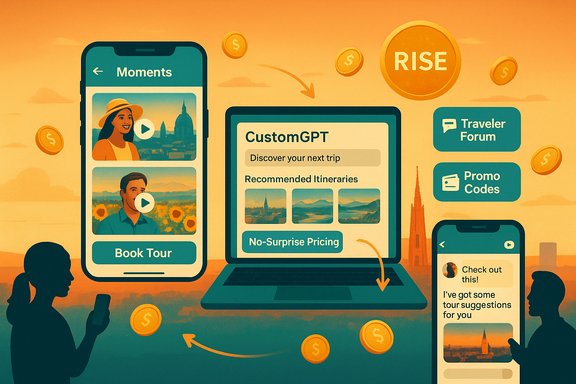
TourRadar began as a specialist marketplace for multi‑day, organized tours and over the years has positioned itself between traditional OTAs and niche operators. The company’s Fall 2025 Release formalizes a strategy many travel platforms are already exploring: fuse authentic, first‑person content with AI-driven personalization and commercial incentives so that discovery, social proof and conversion happen inside the same product funnel. This release bundles four core moves:- A UGC push through TourRadar Moments, surfacing unedited photos and short-form videos and linking them directly to bookable tours.
- A new US$1,000,000 partner fund called RISE that pays Ambassadors, Agents and Advisors for content and bookings.
- AI discovery features including a branded CustomGPT and an Instagram Trip Recommender that can generate tour suggestions from a user’s reels via direct message.
- Community and commerce features (a traveller forum, “No‑Surprise Pricing” transparency and social commerce tools) that tighten the connection between inspiration and purchase.
What’s new in detail
TourRadar Moments: raw, linked UGC across mobile and web
TourRadar Moments is a mobile‑first feature that lets travellers upload short videos and photos — “rawthentic” content, in the company’s phrasing — and attach those Moments to the exact itinerary or tour they experienced. Moments are surfaced across the app and website and, crucially, are linked with a direct booking path so users can move from watching a clip to purchasing the underlying tour. Why it matters:- First‑person video and short reels have become the primary discovery format for travel inspiration. Platforms that can surface timely, user‑captured footage reduce the gap between aspiration and action. Industry research shows UGC strongly impacts purchase intent across categories, and travel is no exception.
- For operators and agents, Moments become a new marketing channel provided by real travellers rather than polished campaigns — content that users report trusting more than brand content.
- TourRadar has linked Moments to existing inventory across thousands of multi‑day trips, and the company says Moments are now rolling out across the full platform rather than remaining mobile‑only.
- The platform includes a content review workflow for Moments and incorporates travel credits as rewards for approved uploads under the RISE program.
RISE: a US$1 million partner fund for creators, agents and travellers
RISE is a named, long‑term partner program that sets aside US$1,000,000 to incentivize creators, travel agents, guides and everyday travellers to create and share content, recommend tours and help other users book. The fund’s mechanics are deliberately broad: participants (Ambassadors, Advisors, Agents) can earn cash commissions, travel credits and opportunities for paid collaborations or free trips. Key points:- Ambassadors can earn travel credits (e.g., US$25 in credits per approved Moment upload up to a cap), affiliate commissions (TourRadar cites average commissions in the hundreds of dollars) and occasional paid collaborations or free trips.
- Travel agents and advisors can earn average commissions (TourRadar cites ~US$315 per booking in promotional materials) for bookings they facilitate.
- The partner program creates a formal conduit for creator monetization inside the TourRadar ecosystem, reducing friction between discovery content and commercial outcomes.
AI discovery: CustomGPT and the Instagram Trip Recommender
The Fall Release introduces TourRadar’s branded AI surfaces:- CustomGPT — a personalized recommendation assistant that plugs into ChatGPT‑style interactions to provide tailored tour suggestions.
- Instagram Trip Recommender — a social‑to‑commerce tool that accepts an Instagram reel via DM and returns tour suggestions inspired by that reel.
- Integrations that translate social media cues (a reel, a saved post) into a bookable product shortcut the user’s path from inspiration to conversion; this is the core product thesis behind “social commerce.”
- The business impact depends on the accuracy of the AI recommender and the quality of its grounding: systems that hallucinate or mis‑map content to trips will hurt more than help. Independent industry analysis warns that travel AI must be carefully grounded to avoid operational hazards.
No‑Surprise Pricing, forum and commerce hooks
TourRadar also rolled out:- No‑Surprise Pricing — a transparency initiative to align search results and checkout pricing, reducing hidden fees and friction.
- A community forum for creators, travellers and advisors to exchange tips and build reputation.
- Social commerce features (shareable promo codes, affiliate links and partner dashboards) that turn social posts into measurable revenue channels for creators.
Strengths: Why this release could move the needle
1. Addresses where modern travel discovery happens
Discovery increasingly starts on social platforms, not search engines. TourRadar’s model — capture UGC, link it directly to inventory, and reward creators — mirrors successful social commerce patterns in other verticals. That alignment with user behavior is a practical advantage.2. Converts trust into measurable revenue
By paying creators for approved Moments and baking commissions into affiliate links, TourRadar makes user contributions economically meaningful. This lowers the incentive gap that often pushes creators to post on third‑party platforms rather than in merchant apps. The RISE fund both compensates contributors and provides TourRadar with a predictable supply of authentic content.3. Reduces funnel friction
Linking UGC to specific tours and adding AI to parse social media inspirations shortens the path from see to book. If the AI is accurate and pricing is transparent, conversion rates could improve materially.4. Creates a defensible creator ecosystem
Many travel platforms rely on external creators. TourRadar’s approach builds a first‑party creator economy with wallets, credits and fast payouts — structural features that can make the platform stickier for creators and advisors.Risks and unanswered questions
1. Grounding and hallucination risk in travel AI
AI tools like CustomGPT and the Instagram Trip Recommender are powerful for ideation, but travel use‑cases are operationally sensitive: incorrect transport times, mis‑matched itineraries or misplaced attractions can create serious issues. Recent industry analyses show travel AIs can hallucinate plausible-sounding but false suggestions; the safe path requires retrieval‑augmented grounding and human review workflows. Those safeguards are not fully visible in promotional copy. Readers should treat AI outputs as inspiration unless TourRadar explicitly documents real‑time grounding and verification layers.2. Content moderation and authenticity
Scaling Moments globally raises moderation and authenticity challenges. UGC fuels trust — until it becomes gamed. Platforms must invest heavily in moderation, provenance signals and fraud detection to prevent fake or incentivized content from eroding the value of Moments. TourRadar’s RISE program gives clear incentives — good — but also creates potential pressure for gaming. The company will need robust review systems and transparent moderation rules.3. Attribution complexity
Attributing a booking to a Moment, a promo code or a DM‑based recommender can be messy. TourRadar’s partner dashboard and wallet features try to solve this, but affiliate attribution in multi‑touch, cross‑platform flows is notoriously brittle. Clear cookie windows, first‑click vs last‑click logic, and dispute resolution mechanics will be operationally important. Public materials note a 90‑day cookie for some affiliate links, but the details of multi‑channel attribution remain an implementation risk.4. Regulatory and consumer‑protection concerns
As travel sales shift to social and AI surfaces, consumer‑protection issues — refunds, mis‑advertising, cancellation policies — become harder to manage across creator posts and automated recommendations. No‑Surprise Pricing is a welcome move, but its effectiveness will depend on whether platform listings, operator pages and checkout always match — an engineering and contractual task.5. The “pay to play” perception
Monetizing creator activity is positive for content supply, but it can also alter perception: content might be seen as promotional rather than organic if not labeled clearly. Platforms that fail to signal sponsorship or reward status risk diluting trust rather than building it. Clear disclosure rules and UI signals are essential.How TourRadar’s claims stand up to independent verification
- TourRadar’s own Fall 2025 press materials describe the feature set — Moments expansion, RISE fund and the AI tools — and are dated October 30, 2025. Those materials are the authoritative product announcement.
- The RISE partner fund and its basic mechanics (payments per upload, affiliate earnings, travel credits and the US$1M fund size) are detailed on TourRadar’s partner pages and corroborated by multiple travel industry outlets. That confirms the program is live and substantive.
- TourRadar’s statement that “UGC and first‑person video drive higher trust” is consistent with broad industry research showing that user‑generated visuals and peer reviews significantly influence travel and purchase decisions. Reports from marketing research firms and aggregated statistics find that a large majority of consumers place more trust in peer content than brand ads, and UGC substantially impacts conversion. However, the specific Expedia Group insight TourRadar cites in its brief — while plausible and consistent with industry direction — was not independently located as a single named Expedia Group study in searchable press materials during the verification process; TourRadar attributes the insight to Expedia Group in its release. Independent industry data from research firms such as Stackla and aggregated marketing analyses provide corroborating evidence that UGC moves buyers more effectively than branded content. Where TourRadar references Expedia Group, readers should treat that as a company‑cited insight and rely on broader industry research for additional confirmation.
What this means for operators, agents and creators
For tour operators and product teams
- Expect content‑led discovery to become an important distribution channel: operators should optimize images and short‑form video assets, ensure their itineraries are accurately described and expose clear, machine‑readable pricing and inventory to avoid mismatches. Being callable by social‑to‑commerce pathways matters.
For travel agents and advisors
- TourRadar’s RISE gives agents a direct, fast‑paying route to earn commissions if they book via the platform. The portal’s promise of quick payouts (TourRadar references one business day after trip completion for commission disbursal) is attractive — but agents should carefully read attribution rules and commission dispute policies.
For creators and Ambassadors
- There is a genuine monetization path inside the platform: creators can earn travel credits, affiliate income and occasional paid collaborations. Smaller creators and everyday travellers who produce authentic Moments may benefit disproportionately compared with platforms that favor large influencers. That inclusivity is a strategic plus.
For consumers
- The most immediate benefit is discovery: if the recommender works as advertised and Moments are reliable, travellers will see more authentic footage and clearer pricing. Consumers should still verify details (schedules, inclusions, cancellation policies) directly with operators for critical logistics.
Implementation and verification checklist for product teams
- Verify provenance and moderation workflows for UGC submissions; require explicit consent and rights transfers for reuse.
- Implement retrieval‑augmented grounding for AI recommenders: connect to operator APIs, timetables and structured product data to reduce hallucination risk.
- Define clear affiliate attribution rules (cookie windows, first vs last click, UTM parameters) and publish them to partners.
- Design transparency labels for paid or incentivized content so consumers can differentiate organic Moments from sponsored posts.
- Build dispute and appeals workflows for creators and agents around attribution and payout timing.
Final analysis — does it add up?
TourRadar’s Fall 2025 Release is a coherent, product‑level execution of a broader industry thesis: social proof and UGC are central to modern discovery, and AI can accelerate personalization — but only if it’s grounded and transparently integrated. The combination of Moments + RISE + AI discovery creates a virtuous loop: creators supply authentic content, AI surfaces personalized matches, and a partner fund rewards the contributors who drive bookings. This is a defensible growth play if TourRadar can maintain moderation quality, truthful pricing, and reliable attribution.The company’s move is well‑timed: consumer behavior has shifted toward short video and creator recommendations, and the travel market is actively experimenting with social commerce models. Independent industry reporting confirms TourRadar’s RISE fund and the expansion of Moments; multiple outlets have picked up the announcement and detailed the partner program’s mechanics. However, two serious caveats remain. First, travel is an operationally exact business: hallucinations and mismatched product descriptions are not only commercial problems but can create safety and reputational risks. TourRadar must show clear evidence of grounding, human oversight, and real‑time data connectors to make AI discovery reliable. Second, scaling rewarded UGC requires mature content moderation and robust labels for sponsored vs organic content to preserve the trust UGC delivers today. If those elements are not rigorously enforced, the strategy could accelerate content production — and at the same time accelerate the erosion of credibility.
In sum: TourRadar’s release is ambitious and product‑consistent with current discovery trends; it has the potential to reshape how multi‑day tours are discovered and sold, but its success will hinge on operational excellence in AI grounding, moderation and attribution.
Conclusion
TourRadar’s Fall 2025 Release crystallizes a strategic pivot that many travel platforms are pursuing: make UGC the core discovery layer, reward the creators who supply it, and let AI translate social inspiration into personalized, bookable itineraries. The RISE fund gives the company a tangible mechanism to seed creator activity, while Moments and the new AI tools stitch inspiration to commerce. The plan is sensible and aligned with user behavior — but the payoff depends on execution. Grounding AI recommenders, policing content quality, and ensuring transparent pricing and attribution are the real engineering and governance challenges that will determine whether TourRadar’s experiment becomes a durable advantage or an unwieldy short‑term growth lever.Source: Short Term Rentals - News TourRadar adds AI discovery tools and expands UGC features
