

Transmission’s third 4.1.0 beta lands with a tight, pragmatic changelog that focuses on real‑world reliability improvements — particularly for sequential downloads, web access via proxies, and the daemon/service plumbing — while also polishing client UIs and developer tooling; the release is explicitly still in feature-not-final status, so cautious testing is the order of the day.
Transmission is a long‑running, open‑source BitTorrent client prized for a small memory footprint, a simple, no‑nonsense UI, and suitability for headless home NAS and media servers. It’s been bundled in embedded and NAS products in the past and is widely used on Linux, macOS and Windows. The 4.x series modernized a lot of the project — migrating core code to modern C/C++ toolchains, improving resource usage, and adding protocol updates such as BitTorrent v2 and hybrid torrents. After two public 4.1.0 betas, the project has published 4.1.0‑beta.3 as another incremental development snapshot. The release notes describe bugfixes, small new features, and developer‑centric build and systemd adjustments rather than headline user features; maintainers emphasize that the project remains “not in feature freeze,” so more changes are still possible before a final 4.1.0.
Why this matters:
For most home users and enthusiasts:
Conclusion
Transmission 4.1.0‑beta.3 is a focused maintenance and polish release: not revolutionary, but meaningful. It smooths rough edges in sequential downloads, web connectivity, and system integration, and it brings practical fixes for earlier beta regressions. The project’s choice to tighten build requirements and service behavior signals a push toward a cleaner, more predictable 4.1.0 release — but the beta tag matters: handle with care, verify builds and package dependencies (notably CMake 3.16.3+), and don’t deploy blindly on private tracker environments until the final release or tracker policy allows it.
Source: Neowin Transmission 4.1.0 Beta 3
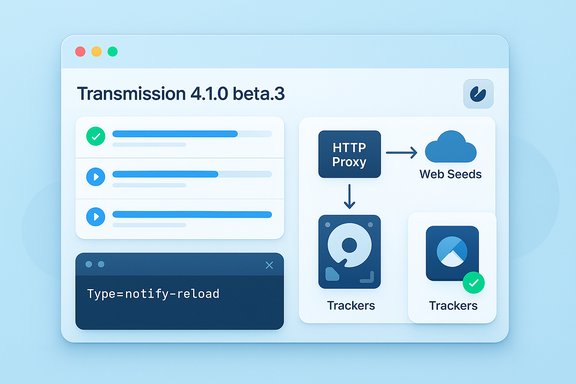 Background
Transmission is a long‑running, open‑source BitTorrent client prized for a small memory footprint, a simple, no‑nonsense UI, and suitability for headless home NAS and media servers. It’s been bundled in embedded and NAS products in the past and is widely used on Linux, macOS and Windows. The 4.x series modernized a lot of the project — migrating core code to modern C/C++ toolchains, improving resource usage, and adding protocol updates such as BitTorrent v2 and hybrid torrents. After two public 4.1.0 betas, the project has published 4.1.0‑beta.3 as another incremental development snapshot. The release notes describe bugfixes, small new features, and developer‑centric build and systemd adjustments rather than headline user features; maintainers emphasize that the project remains “not in feature freeze,” so more changes are still possible before a final 4.1.0. What’s new in 4.1.0‑beta.3 — quick summary
- Proxy support for web connections — web seeding and tracker web requests can now be routed through an HTTP (or configured) proxy.
- Sequential download improvement — when running in sequential mode, Transmission now flushes fully downloaded pieces to disk immediately after checksum verification, enabling downstream applications to access verified data with reduced latency (useful for streaming from a partially downloaded file).
- Tracker interval handling — the client will respect
min intervalandintervalkeys supplied by trackers, reducing aggressive announce behavior. - DHT announce port correctness — announce the port that was forwarded (not the local port) on DHT, which helps accurate peer connectivity when NAT or port‑forwarding is involved.
- Bug fixes from earlier betas — fixes include correcting delayed UDP tracker announces and UI hangs on certain operations.
- macOS, Qt, Web UI and daemon tweaks — Quick Look rework for newer macOS, Low Power Mode prevention hooks, colored Qt progress bars, web UI filtering and UX tweaks, and systemd service file changes for daemon users.
- Build/packaging changes — require CMake 3.16.3+ and avoid polluting CMake’s user package registry with third‑party submodules; also the systemd service now uses
Type=notify-reloadand respects the CMake install prefix.
Deep dive — user‑facing improvements and why they matter
Proxy support for web connections
Adding proxy support for web connections addresses two scenarios:- Users behind corporate or privacy‑focused exit points who must route web requests (for webseeds, tracker HTTP requests, or magnet resolution) through a proxy.
- Administrators who route traffic and want a consistent proxy policy across services on the same host.
Improved sequential download behavior — streaming use‑case
Sequential downloading has been a requested capability for years. The earlier 4.1.0 betas introduced optional sequential downloading as a capability; beta.3 specifically adds an important operational tweak: fully downloaded pieces are now flushed to disk immediately after they pass their checksum test.Why this matters:
- Many streaming or media‑indexing workflows expect that a completed piece sitting on disk can be safely read and relied upon. Prior behavior sometimes delayed flushing or wrote data in a way that other processes didn’t see immediately.
- The change reduces the window where an application (for example, a media player reading from a Transmission download folder on the same machine) would encounter incomplete or transient data.
- This is not a cure‑all for streaming from torrents (seek behavior, file prioritization, and piece layout still matter), but it removes a major bottleneck for real‑time reads of completed pieces.
Tracker interval respect
Transmission will now honor themin interval and interval values sent by trackers. This reduces excessive announces and aligns client behavior with tracker guidance, which can improve tracker load and reduce the chance of being flagged for abuse by strict private trackers. For users on private or rate‑limited trackers, this change can reduce accidental policy violations. DHT port announcement correctness
When a peer’s port has been forwarded by a router, announcing the forwarded port (instead of the local bound port) on DHT ensures that remote peers will attempt connections to the correct external port. This is an important fix for users who rely on NAT traversal and portable routers — a small change with measurable connectivity benefits for some topologies.Client, UI and platform changes
macOS client: Quick Look and power management
Beta.3 reimplemented Quick Look previews for torrent files using the modern Quick Look preview extension API for macOS 12+, and added modern APIs to prevent idle system sleep, plus support for Low Power Mode. These are platform‑level usability touches that make Transmission behave better on modern Macs while respecting user power‑saving preferences. Expect fewer surprises when leaving large downloads running overnight on a laptop.Qt client: clearer status with colored progress bars
The Qt front end will use custom colored progress bars to differentiate torrent states. This is a UI‑polish improvement that helps power users scan active lists faster — small but useful.Web client: better filtering and UX niceties
The web UI gains improved filtering (by privacy/error state), accepts torrent files directly, fixes tracker‑filtering bugs after editing announce lists, and adds a brief typing delay in the search bar to reduce jitter from rapid key events. These are quality‑of‑life improvements that stabilize the web UI for both mobile and embedded dashboards.Daemon and packaging: what admins should know
- The systemd service file now uses Type=notify-reload, and the daemon service takes the CMake install prefix into account in the installed unit file. This modernizes the service behavior and makes packages more predictable across distributions. System integrators should check their service overrides if they maintain custom units.
- Build systems: the project now requires CMake 3.16.3 or higher to build. Packagers and source builders on older distributions must either install newer CMake from backports or vendor a compatible CMake — otherwise the build will fail. The project also stopped injecting third‑party submodules into CMake’s user package registry during configuration. These changes are oriented at making the build more reproducible and less intrusive.
- Verify your distro ships CMake >= 3.16.3 or enable backports / a local CMake build.
- Check systemd unit overrides if you previously patched the service file;
Type=notify-reloadexpects services to support the notify protocol. - If you run the Transmission daemon under constrained containers, confirm that any proxy or network routing policy is updated to cover the new proxy settings used by the daemon.
Stability, regressions and known risks
1) Beta status and tracker policy implications
This is a beta release. Private trackers sometimes ban beta clients or flag them for incorrect announces. Historically, distributions that shipped Transmission beta packages into stable repositories (for example, Debian’s past experiences with beta packages) created friction for users on private trackers; administrators should weigh the risk of client version bans before deploying widely. If you rely on private trackers, prefer a stable release or verify tracker policy before upgrading.2) Sequential downloads: swarm health considerations
Sequential downloading — even when made technically better by immediate piece flushes — remains contentious. It biases piece distribution and can harm overall swarm availability on scarce swarms. Use it mainly for media playback on well‑seeded torrents or in isolated/private scenarios where the community impact is acceptable.3) Build dependency pressure and packaging lag
Requiring CMake 3.16.3 raises the bar for older distributions and embedded appliances. Expect packaging delays or the need for backports, and plan for those when deploying Transmission in production or embedded environments. Several maintainers (and Debian packagers in the past) have had to recompile or backport Transmission to avoid beta tags showing to trackers.4) Beta regressions and crash fixes still needed
The changelog shows a stream of fixes for earlier beta regressions: delayed UDP announces, Qt UI hangs when opening properties during downloads, and crashes from invalid UTF‑8 in peer client names. These fixes are promising, but they highlight that running a beta can expose rough edges. Users who value rock‑solid stability should continue to prefer the latest tagged stable release until 4.1.0 is finalized.Developer and advanced user notes
- The RPC field
torrent-get.manualAnnounceTimehas been deprecated in this cycle, so scripts that depended on it should be updated. transmission-remotenow exposestorrent-get.percentDonedirectly — a helpful convenience for scripting and remote status polling.- The project explicitly reduced CPU usage in libtransmission and adjusted the project to avoid writing third‑party package entries into CMake’s user package registry when configuring. These are quality and developer workflow improvements that reduce noise and improve build repeatability.
How to evaluate and test 4.1.0‑beta.3 safely
Follow these pragmatic steps before rolling the beta into production:- Create a disposable VM or container for testing. Do not install a beta on a critical NAS without a fallback.
- If you build from source, confirm CMake version:
- Command: cmake --version
- Ensure the reported version is >= 3.16.3; otherwise install a newer CMake from your distro’s backports or build CMake locally.
- Test tracker announces and DHT behavior on representative torrents (public and private), especially if you have port forwarding/NAT setups.
- Validate the sequential download path if you plan to stream while downloading: test media playback tools reading from the download path and confirm pieces are readable right after they appear complete.
- If you run the daemon as a service, check
systemctl status transmission-daemon.serviceand note theType=notify-reloadbehavior; ensure your init/systemd overrides are updated appropriately. - Confirm web UI layout and functionality across browsers if you rely on the web interface for remote control and embedded dashboards. The release contains viewport‑sensitive layout tweaks and search debounce behavior that should improve mobile access.
Strengths in this release
- Practical, user‑centric fixes. The sequential flush tweak and tracker interval respecting are the kinds of small changes that make a real difference in daily use.
- Daemon/service modernization. Using
Type=notify-reloadand honoring install prefixes helps downstream packagers and sysadmins deploy the daemon consistently. - Build hygiene. The CMake requirement and reduced registry pollution improve reproducibility and reduce scary surprises for packagers.
- Cross‑platform polish. macOS modern API usage (sleep prevention and Low Power Mode) and web UI refinements make the client more reliable across device types.
Where this release may fall short
- Beta vs. tracker policies. Many private trackers prohibit beta clients or have strict client whitelists. The presence of a beta tag in distro packages has already created community friction in the past — a nontrivial operational risk for some users.
- Sequential download trade‑offs. The streaming improvements are useful, but sequential downloading still compromises swarm health on poorly seeded torrents; the onus remains on the user to choose when it’s appropriate.
- Packaging friction from CMake bump. Small projects and embedded environments may find the CMake minimum a blocker; expect a short period where distributions and downstream vendors reconcile packaging with new build requirements.
- Beta churn and regressions. The changelog shows active fixes for earlier beta regressions, which is a sign of responsiveness — but may also indicate more latent issues remain. Beta adopters should be prepared to file bug reports and test edge cases.
Final assessment and recommendations
Transmission 4.1.0‑beta.3 is a technically conservative, high‑utility update that addresses practical, real‑world problems: proxying, timely piece flushes for sequential downloads, correct DHT port announcements, and several UI/daemon refinements. These changes will be especially welcome to users running Transmission as a media server or on a laptop that must respect system‑level power policies.For most home users and enthusiasts:
- Try the beta in a controlled test environment first.
- If you rely on private trackers, skip the beta until 4.1.0 final is released or verify tracker policy.
- Plan to install or backport CMake 3.16.3+ before building from source.
- Review systemd overrides and packaging workflows to accommodate
Type=notify-reloadand the CMake install prefix changes.
- Update any RPC‑dependent scripts that reference deprecated fields.
- Use the new
transmission-remotepercentDone exposure for remote monitoring tools and dashboards.
Conclusion
Transmission 4.1.0‑beta.3 is a focused maintenance and polish release: not revolutionary, but meaningful. It smooths rough edges in sequential downloads, web connectivity, and system integration, and it brings practical fixes for earlier beta regressions. The project’s choice to tighten build requirements and service behavior signals a push toward a cleaner, more predictable 4.1.0 release — but the beta tag matters: handle with care, verify builds and package dependencies (notably CMake 3.16.3+), and don’t deploy blindly on private tracker environments until the final release or tracker policy allows it.
Source: Neowin Transmission 4.1.0 Beta 3
