

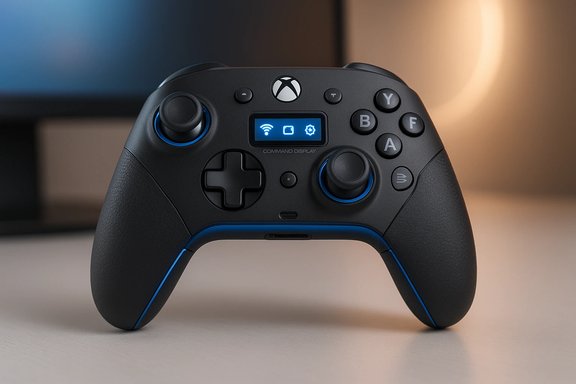
Turtle Beach’s Stealth Pivot attempts something audacious: a single Xbox‑licensed controller that physically transforms between a traditional pad and a compact 2D/fighting layout, and in doing so it forces a serious rethink about what a premium Xbox controller can — and should — offer to modern players.
Background / Overview
The Stealth Pivot launched as a direct heir to the modular ambitions we saw from Victrix and later PDP, but with Turtle Beach’s own spin: rotating “pivot” modules on both the left and right sides allow the controller to switch between a standard 3D thumbstick + face‑button layout and a dedicated 2D/fighting format on the fly. Turtle Beach ships the controller as a multi‑platform device — wired for Xbox consoles, and wireless to Windows PCs (via a 2.4 GHz USB dongle) and mobile devices (Bluetooth) — and it bundles a small LCD Command Display for quick customization and social notifications. The company advertises contactless Hall‑Effect “AntiDrift™” thumbsticks, trigger stops, adjustable audio tuning, and up to 20 hours of battery life. On price, Turtle Beach lists a full MSRP at the high‑end of mass‑market third‑party controllers but substantially below Microsoft’s Elite Series 2: the Stealth Pivot’s street price tends to sit around $129–$139 MSRP, with frequent discounts to roughly $109, while the Xbox Elite Series 2 is commonly cited at $199.99 MSRP. This feature article evaluates the Stealth Pivot’s engineering, day‑to‑day performance, and market position — and it cross‑checks vendor claims against independent measurements and community reports so WindowsForum readers can make a confident buying decision.What makes the Stealth Pivot novel
A literal two‑in‑one controller
The headline feature is the rotating module system. Each side of the pad has a release and rotation mechanism:- Default mode: standard Hall‑Effect thumbstick + four face buttons (traditional Xbox layout).
- Revolved mode: a fight‑game style six‑button cluster on the right and a D‑pad + two extra buttons on the left.
Pro features that matter
Beyond the rotating modules, the Stealth Pivot brings a set of pro‑grade hardware traits to a mid‑price tier:- Hall‑Effect (contactless) thumbsticks marketed as “AntiDrift™” for improved longevity and lower drift risk.
- Adjustable trigger stops and tactile shoulder buttons.
- Two remappable back buttons and on‑board profile storage for multiple mappings.
- Connected Command Display — a small onboard screen that lets you remap buttons, tune audio, and receive social notifications without opening a smartphone.
- Lag‑free 2.4 GHz wireless to PC, and Bluetooth for mobile devices; wired USB‑C for Xbox consoles.
- Up to 20‑hour battery life and play‑and‑charge support.
Performance: what tests and reviewers show
Controller feel and ergonomics
Multiple reviewers praised the Stealth Pivot’s ergonomics: the shell is comfortable for extended play and the textured grip helps during long sessions. The rotating modules do not make the controller feel fragile in normal use; build quality is broadly described as hefty and durable when handled normally. That tactile impression is consistent across hands‑on writeups. The Hall‑Effect sticks were reported as precise for aiming and movement in action titles by reviewers who tested them with PC and console shooters and action games. In practical play, testers found no discernible stick drift during normal review periods, which aligns with the expected advantage of contactless sensing.Measured latency and polling behaviour (PC)
Here is where the picture gets nuanced and — for some competitive PC players — important.- Turtle Beach’s official materials do not publish a raw polling‑rate figure for PC wired or wireless operation. The company emphasizes a lag‑free 2.4 GHz connection for PC play and notes wired support for Xbox consoles.
- Independent lab testing (Gamepadla) measured the Stealth Pivot’s polling and latency with concrete numbers: in their Prometheus 82 measurements a recent unit showed approximately ~245 Hz polling when wired and ~228 Hz when using the 2.4 GHz dongle, with average button latency in the single‑ to low‑millisecond range and stick latency notably higher than some competition. Those results put the Stealth Pivot squarely below controllers that advertise 500–1000 Hz polling for PC tournament modes.
- A parallel independent test and Polish review (EnvyTech) reported similar findings: measured latency in the low‑to‑mid tens of milliseconds on analogs and a polling figure they summarize as about 250 Hz rather than 500–1000 Hz, and they flagged analog linearity and large outer dead zones as a potential issue for some players.
Wireless behaviour and platform notes
A crucial practical fact: the Stealth Pivot does not use Xbox Wireless for PC wireless play; it uses a 2.4 GHz proprietary dongle (lag‑free mode) and Bluetooth as a secondary option. For Xbox consoles the controller is wired (USB‑C). That means:- You will not be leveraging the Xbox Wireless stack on PC (unless you use Microsoft’s Xbox Wireless Adapter with a controller that supports it), and
- The performance characteristics on PC are primarily determined by the dongle’s radio implementation and firmware.
Strengths — where the Stealth Pivot shines
- Genuine multi‑genre versatility. The rotating modules are more than a gimmick; they let the controller be tuned physically for both 3D AAA and 2D/fighting inputs without carrying spare hardware. That delivers real convenience for players who split time between genres.
- Pro‑grade sensors (Hall‑Effect). Contactless sticks are a notable durability and precision win and reduce the long‑term drift risk commonly cited for potentiometer sticks. Independent hands‑on reviews found the sticks precise in many real‑world tests.
- On‑board Command Display and audio tuning. The little LCD is genuinely useful for remapping and quick audio adjustments without alt‑tabbing or taking out a phone — a convenience that reviewers called out as unique in this price band.
- Value vs. Elite Series 2. At its MSRP the Pivot sits comfortably below the Elite Series 2’s typical retail price yet delivers several premium touches (advanced sticks, remappable buttons, and a novel modular system). For console players who don’t need Elite’s interchangeable massing and magnetic tension tools, the Pivot can feel like a better‑sized bargain.
- Battery life. Turtle Beach’s 20‑hour claim is supported by multiple real‑world reports that place battery life in the teens to 20‑hour range depending on features used. That’s competitive for a wireless controller with an LCD and active features.
Risks, weaknesses and real‑world caveats
- PC polling and measured latency fall short of esports hardware. Independent lab measurements show the Stealth Pivot polling and analog latency are below the 500–1000 Hz marks that many fast‑response PC controllers advertise; measured polling sits near ~225–250 Hz in third‑party tests. For players chasing every millisecond on PC, higher‑polling controllers (Razer’s V3 Pro variants, some 8BitDo tournament modes) offer measurably lower latency. This is confirmed by the hardware testers cited earlier.
- Reported unit‑to‑unit quality inconsistencies. Community threads reveal recurring reports of button or D‑pad failures and sensitivity issues in some units. While Turtle Beach support has replaced some units successfully, several threads document users seeing unresponsive inputs on the alternate module or irregular stick behaviour that required RMA. These are signals possible QC issues to be aware of when buying early in a product’s lifecycle. Consider extended‑return windows and purchasing from retailers with good return policies.
- Not a one‑to‑one Elite replacement for every user. Microsoft’s Elite Series 2 focuses on micro‑adjustability (tension tools, magnetic paddles, deep Xbox Accessories app integration) and a long track record for competitive ergonomic design. The Stealth Pivot’s strengths are different: modularity and unique controls. If your workflow depends on the Elite’s precise mechanical adjusters and Xbox Wireless parity on PC, the Pivot is a different compromise.
- Potential button mapping / software wrinkles. Some community reports and reviews note that certain titles or setups may require calibration and firmware updates to behave perfectly. Turtle Beach provides a Control Center app, but real‑world compatibility with all titles — particularly older or niche PC titles — may need extra troubleshooting.
How it stacks up against the competition
Versus Xbox Elite Series 2
- Price: the Stealth Pivot is typically $60–$90 less than the Elite Series 2 at retail, depending on sales and SKUs.
- Feature contrast: the Elite centers on mechanical adjustability (magnetic tension, adjustable triggers, and a dock/case in some SKUs) and deep Xbox Accessories support; the Pivot centers on genre modularity and anti‑drift sticks. Both are “premium” but for different buyer profiles. The Elite remains the benchmark for players who need near‑desktop mechanical adjustments and official Xbox Wireless parity with every Xbox‑centric feature turned on; the Pivot is a better pick for multi‑genre players who value the fighting‑game layout and Hall‑Effect sticks at a lower price point.
Versus Razer Wolverine V3 Pro and other performance pads
- The Razer Wolverine family (and especially recent PC‑oriented V3 Pro variants) targets tournament players with 1000 Hz wired modes and even higher HyperPolling options in newer Razer models, plus higher measured responsiveness and additional esports‑grade tuning. Razer’s recent PC‑exclusive Wolverine models and the 8K variants show what a max‑latency, PC‑first controller looks like: TMR sensors, extreme polling, and a tight focus on wired PC performance. If your priority is absolute PC latency, these controllers outperform the Pivot on raw numbers.
Buying guidance — who should buy, who should pause
Buy the Stealth Pivot if:
- You play across genres and want a single controller that can legitimately function for both 3D shooters/action and 2D/fighting titles.
- You prioritize contactless Hall‑Effect sticks to reduce the long‑term risk of stick drift.
- You mainly play on Xbox consoles and want premium features without paying Elite Series 2 prices.
- You value a long battery life and on‑board customization via a small display.
Consider something else if:
- You are a PC esports competitor or someone who needs the absolute lowest possible input latency and the highest polling rates (1,000 Hz+); tournament‑focused pads will be faster.
- You are very sensitive to early‑production QC variability; community reports suggest some units have had button or D‑pad issues, so consider buying from a retailer with an easy return window.
- You prefer the Elite Series 2’s specific adjustment toolset and full Xbox Wireless ecosystem parity on PC.
Hands‑on notes and real‑world tips
- Firmware first: update the controller firmware and the Control Center app before deep configuration — many odd behaviours reported by users were resolved with firmware updates or exchanges.
- Use the dongle for PC: for lowest wireless latency on Windows, use the included 2.4 GHz dongle rather than Bluetooth; but be aware measured polling is still below 1,000 Hz in third‑party tests.
- Keep box and receipt for 30 days: given some isolated QC reports, buying from a retailer with a liberal return policy reduces risk if you get a defective plug.
- Calibrate dead zones: testers observed asymmetry in dead zones on some units; use the Control Center and in‑game dead‑zone adjustments to tune stick behavior for precision play.
Final analysis — does the Stealth Pivot “stomp” the Elite Series 2?
Not in every metric. The phrase “stomps” is too absolute. What Turtle Beach accomplished with the Stealth Pivot is a rare blend of genuine hardware innovation and pragmatic value: you get a multi‑genre mechanical transformation, contactless sticks, robust audio features, and on‑pad customization at a price that undercuts the Elite Series 2. For many Xbox players — especially those who split time between platformers, 2D action, and fighting games — the Stealth Pivot represents a more compelling set of tradeoffs than the Elite does. That’s the domain where the Pivot effectively “stomps” because it simply gives more of what those players actually need. However, for PC players who demand the fastest polling and the tightest wired latencies available — and for users who want the full Xbox Wireless/Elite adjustment ecosystem — the Elite Series 2 and Razer’s high‑end PC models remain technically superior in the narrow area of raw competitive input performance. Independent testing shows the Pivot’s polling and analog latency are solid for most players but measurably behind tournament‑grade alternatives. That trade‑off is the Stealth Pivot’s single largest limitation.Conclusion
The Turtle Beach Stealth Pivot is an ambitious product that changes the conversation about what a premium Xbox controller can be. It blends a practical mechanical innovation (rotating modules) with modern sensor tech (Hall‑Effect sticks), an intuitive on‑board display, and broad platform compatibility — all at a price point that undercuts the traditional “pro” controller tier. For Xbox console owners and genre‑hoppers who want one controller to do more, it’s an outstanding recommendation.For PC competitive players and those who prioritize absolute lowest‑possible latency, the Stealth Pivot is a strong mid‑tier option but not the ultimate choice; tournament‑oriented controllers still hold the performance crown. And shoppers should be mindful of community reports about intermittent QC problems — buying from a retailer with a reliable return policy or an extended warranty is sensible.
In short: the Stealth Pivot is one of the most interesting and practically useful controller experiments in recent years. It doesn’t uniformly “stomp” every rival, but it redefines value in the premium pad space and gives Xbox‑centric players a genuinely new way to play.
Source: Windows Central This 2-in-1 Xbox controller stomps the Xbox Elite Series 2 Controller
