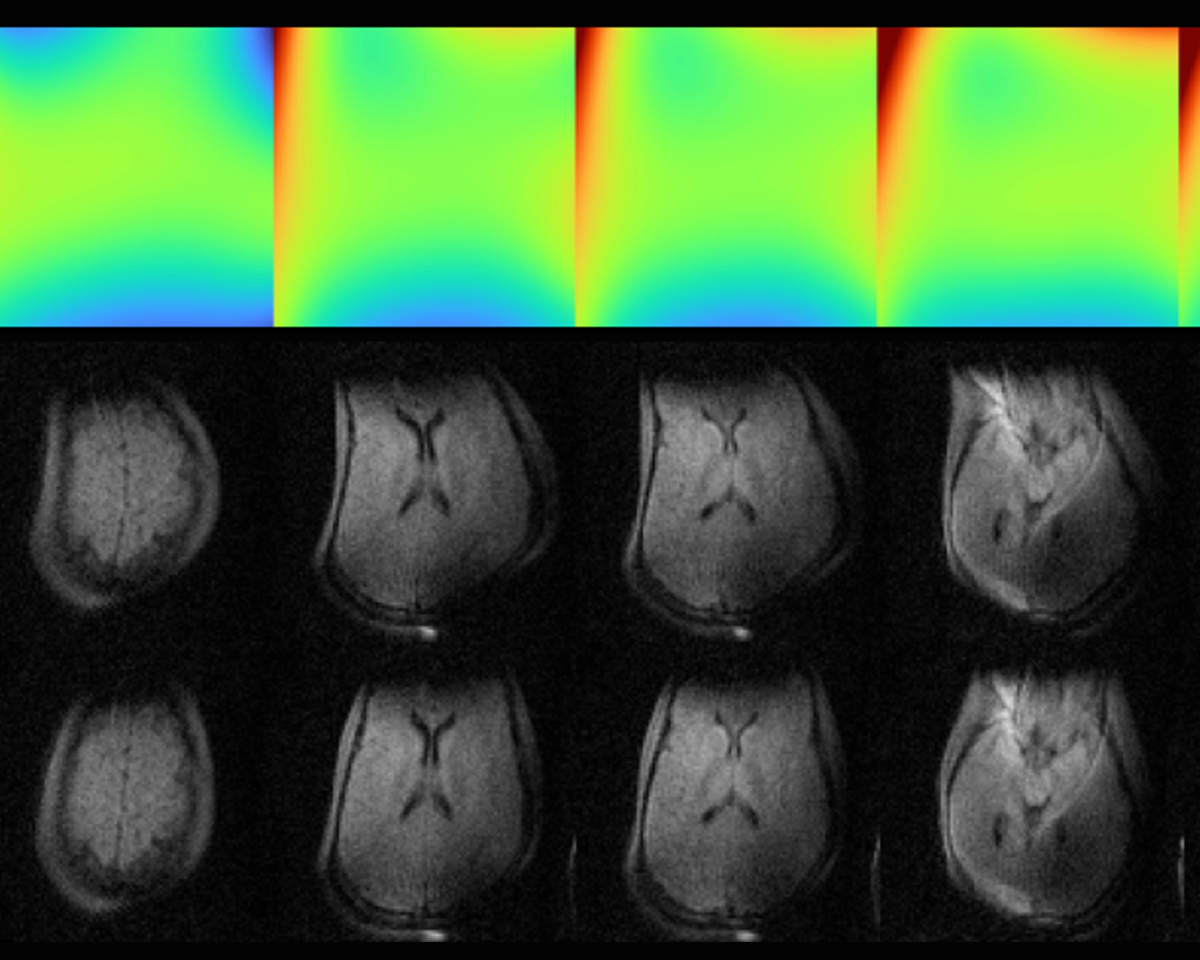
Microsoft Research’s Tyger cloud reconstruction work, highlighted in May 2026 through a collaboration with Mbarara University of Science and Technology in Uganda and Spain’s i3M, uses Azure-based processing to improve images from a 46-millitesla low-field MRI scanner built for resource-limited settings. The important story is not that Microsoft has magically made a cheap scanner equivalent to a million-dollar hospital machine. It is that the center of gravity in medical imaging is shifting from the magnet to the compute stack. For WindowsForum readers, that makes Tyger less a feel-good cloud demo than a preview of how edge devices, open research software, and hyperscale infrastructure may redraw the boundary between local hardware and remote intelligence.
MRI has always been a hardware flex. The canonical hospital machine is a cathedral of magnetic field strength: superconducting magnets, cryogenics, power conditioning, shielding, service contracts, and technicians trained to operate equipment that can cost more than the building around it. In that world, image quality is bought with mass, infrastructure, and capital.
Tyger argues for a different bargain. If the scanner can capture usable raw signal, the cloud can do more of the interpretive work that once had to be solved locally by expensive hardware and specialized reconstruction systems. That does not repeal physics, but it changes the accounting.
The Uganda project is built around an ultra-low-field scanner at Mbarara University of Science and Technology, not a gleaming clinical installation in Boston or London. The machine uses a 46 mT Halbach-style magnet system, many times weaker than standard clinical MRI systems. Weak fields produce weaker signals, and weaker signals produce noisier images.
The old answer to that problem was better hardware. Tyger’s answer is better reconstruction, more compute, and a workflow that lets raw or lightly processed MRI data move into Azure for denoising and reconstruction before returning readable images to researchers and clinicians. In Microsoft’s framing, the scanner becomes less like a self-contained appliance and more like an edge sensor connected to a cloud brain.
That framing will sound familiar to anyone who has watched the last decade of enterprise IT. Security cameras became computer vision endpoints. Industrial sensors became digital-twin feeds. Thin clients and local workloads gave way to cloud-backed services. Tyger brings that same architecture to a domain where the stakes are human diagnosis and the constraints are not office bandwidth but fragile health systems.
That is why low-field MRI has attracted so much attention. Permanent magnets can reduce power demands and eliminate some of the most exotic infrastructure requirements. Smaller systems can be assembled, maintained, and studied in places where a conventional scanner is unrealistic.
But low-field MRI is not a fairy tale. Lower field strength usually means lower signal-to-noise ratio, longer acquisition compromises, and images that may not be clinically useful without serious correction. The problem is not just building a cheap scanner; it is building a cheap scanner whose images someone can trust.
That is where the Microsoft story becomes interesting. The Mbarara project reportedly had early scans that could capture only part of a head or required long processing times to become interpretable. The Tyger workflow, paired with hardware and software improvements from the research partners, helped move the system toward full-head imaging and faster reconstruction.
The distinction matters. Tyger is not the sole invention here. The published research points to grounding and shielding work, new control electronics, open-source interface software, improved coils, calibration, and reconstruction changes. The cloud is a major character, but this is an ensemble cast.
Mbarara University’s role is not ornamental. The project is happening in a local research and training environment where engineers, students, and medical workers can understand the scanner rather than merely operate a sealed box. That is a crucial difference in global health technology, where too many imported systems become expensive monuments once the first part breaks or the first vendor contract expires.
Tyger’s open-source positioning also matters here. In a low-resource setting, black-box dependency can be fatal to sustainability. If the reconstruction pipeline, scanner interface, and operating knowledge are inspectable and teachable, the project has a better chance of becoming a platform rather than a demo.
There is still tension in the model. A cloud-dependent medical workflow raises questions about bandwidth, latency, privacy, availability, cost, and sovereignty. If reconstruction requires Azure, then the scanner’s usefulness depends on connectivity and on the continued availability of a commercial cloud service. That is not disqualifying, but it is not trivial.
The more balanced view is that Tyger shifts the bottleneck. Instead of demanding a million-dollar machine and a hospital-grade room, the system demands reliable enough data capture, reliable enough networking, and reliable enough cloud operations. In many places, that is a better trade. It is not a trade without risk.
This is cloud computing at its most defensible. The workload is bursty, computationally demanding, and easier to update centrally than to deploy repeatedly across underpowered local machines. If a better reconstruction model arrives, the pipeline can improve without shipping a new magnet to Uganda.
For Windows and Azure watchers, this is the pattern Microsoft has been trying to sell across industries: let the endpoint be specialized and inexpensive, then let the cloud provide scale, orchestration, machine learning, and manageability. Tyger’s use of Azure Kubernetes infrastructure fits neatly into that broader enterprise playbook.
But healthcare adds a harder burden than typical enterprise analytics. Medical images are not ad impressions or telemetry logs. They are sensitive, regulated, and clinically consequential. Even in research settings, the path from experimental reconstruction to routine diagnosis requires validation, governance, and careful boundaries around what a system can and cannot claim.
That is why the word “diagnostic” should be used carefully. The project shows that low-field scanners can produce more useful in vivo images in a resource-limited setting when paired with better hardware, software, and cloud reconstruction. It does not mean every rural clinic can now replace radiology infrastructure with a cheap magnet and a broadband connection.
That is what makes the research credible. Low-resource engineering is not just rich-world engineering with a smaller budget. It is a different discipline, where a part that costs pennies elsewhere can become a delay, a weak power amplifier can define the entire experiment, and local fabrication limits can force design compromises.
The project’s progress appears to come from many incremental fixes rather than one miracle algorithm. Better grounding reduces noise. Better shielding improves capture. Better electronics stabilize the system. Better software makes scanning and reconstruction more usable. Tyger then amplifies those gains by providing a reconstruction environment that local hardware could not easily match.
This should temper both hype and cynicism. The hype says Microsoft solved African MRI with the cloud. The cynicism says this is just a research demo dressed up as humanitarian PR. The evidence points somewhere in between: a real technical advance in a real setting, still surrounded by all the practical problems that make medical technology hard to deploy.
That middle ground is where most consequential technology lives. It is neither revolution nor vaporware. It is infrastructure getting just good enough, in just the right place, to make a previously unrealistic workflow worth testing.
Hydrocephalus is especially relevant in East Africa, where timely brain imaging can shape surgical decisions for infants and children. A low-cost MRI system that can identify fluid accumulation or other gross brain abnormalities closer to the patient could change the first step in care, even if more complex cases still require referral.
That is the correct near-term ambition: not replacing every high-field MRI study, but expanding the diagnostic map. A low-field system that can answer certain urgent questions locally may be far more valuable than a theoretical high-end scanner hundreds of kilometers away. Medicine is full of imperfect tools that save lives because they are available when needed.
The same argument applies to rural hospitals everywhere, not only in Uganda. High-income countries also have imaging deserts, overloaded scanners, and patients who wait too long for access. If low-field systems improve enough, they could become triage devices, bedside systems, research tools, or specialized scanners for use cases where portability and cost matter more than perfect resolution.
This is where Tyger’s global significance lies. It suggests that low-field MRI’s ceiling may be higher when reconstruction is treated as a continuously improving software problem rather than a fixed limitation of the device. The scanner may remain cheap, but the intelligence behind it need not be.
None of that invalidates the work. Corporate incentives are not automatically corrupting; they are simply part of the system. Azure benefits if more scientific and medical pipelines become cloud-native. Researchers benefit if they can access reconstruction tools that would otherwise be beyond their local infrastructure. Patients benefit if the result is more accessible imaging.
The risk is dependency disguised as democratization. If the only sustainable path for low-cost MRI is continuous reliance on a hyperscale provider, then the economics must be examined over years, not press cycles. Data egress, service availability, regulatory compliance, and cloud pricing can all turn a promising pilot into a difficult operating model.
The open-source component is therefore not a footnote. It is one of the safeguards against the project becoming a beautiful lock-in story. If Tyger can be inspected, adapted, and connected to other systems, it becomes part of a broader research ecosystem rather than just another Azure showcase.
Microsoft deserves credit for making the work visible and for contributing serious engineering. But the lasting value will be judged by whether Mbarara and similar sites gain durable capability, not merely better screenshots.
That pattern is now everywhere. Windows endpoints offload identity, management, security analytics, backup, and increasingly AI workloads to Microsoft’s cloud. Industrial PCs stream telemetry into Azure. Developer tools rely on remote build systems and cloud-hosted models. Tyger applies the same logic to medical imaging: keep the endpoint simple enough to deploy, and put the expensive intelligence where it can scale.
The difference is accountability. If a cloud PC glitches, a user loses productivity. If a reconstruction pipeline fails silently, a clinician may misread a scan. That does not make cloud medical imaging impossible, but it raises the bar for observability, validation, auditing, and fallback modes.
This is where Microsoft’s enterprise DNA could matter. The company knows identity, logging, access control, compliance tooling, and distributed systems. It also knows how to build platforms that customers come to depend on. In medicine, both traits are useful and dangerous.
Tyger is therefore a case study in the next phase of cloud computing. The cloud is no longer just where business data goes. It is becoming an active participant in measurement itself, shaping what a device can see and how quickly humans can act on it.
There is also the clinical-validation hurdle. A reconstructed low-field MRI image can be visually compelling and still require careful studies to define what it can diagnose, with what sensitivity, and under what conditions. Clinicians need protocols, not just images. Regulators need evidence, not just intent.
Bandwidth is another constraint that enthusiasts should not dismiss. Microsoft’s story mentions data moving even over limited networks, but operational healthcare cannot depend on heroics. If Tyger-like systems are to become routine, they need robust queueing, compression, retry logic, encryption, offline degradation, and clear expectations for turnaround time.
Then comes the question of who pays. A scanner that costs far less than conventional MRI may still be expensive for a clinic. Cloud reconstruction has operating costs. Training takes time. Maintenance requires budgets. The success case is not “free MRI.” It is a lower total barrier to useful imaging.
That barrier can fall dramatically and still remain significant. The achievement is in making the next step plausible.
That matters because healthcare technology often fails when it treats low-resource settings as endpoints rather than sources of design knowledge. Problems encountered in Mbarara are not peripheral edge cases. They are central engineering facts for any system that claims to democratize imaging.
A scanner that works only in a pristine laboratory is not a democratizing technology. A reconstruction method that assumes unlimited local compute is not either. A workflow that survives weak infrastructure, local training realities, and constrained supply chains has a better claim to the word.
The project also gives students a ladder into advanced technical work. Electronics, signal processing, cloud workflows, medical imaging physics, and software development are not abstract coursework when they are tied to a machine in the next room. That is capacity building with teeth.
If this model spreads, the long-term impact may be less about MRI scans per se and more about the creation of local engineering communities around medical devices. The best version of Tyger is not a product dropped into Uganda. It is a shared platform that helps Ugandan researchers build the next version themselves.
The second story is about the growing dependence of physical infrastructure on remote computation. That can unlock enormous value. It can also create new single points of failure, new governance problems, and new forms of vendor leverage.
In the Tyger case, the trade appears sensible because the alternative is often no MRI at all. When the baseline is exclusion from advanced imaging, cloud dependency may be a rational price to pay. But that price should be named, measured, and negotiated.
The same will be true across healthcare, manufacturing, energy, and public infrastructure. Cheap sensors plus expensive cloud intelligence is becoming the default architecture of modern systems. The questions are who controls the intelligence, who can audit it, who can afford it, and what happens when the connection fails.
Tyger’s importance is that it forces those questions into a domain where the social value is obvious. It is much harder to dismiss cloud dependence when the result could be earlier diagnosis for a child with hydrocephalus. It is also much harder to ignore the risks when the output may guide medical care.
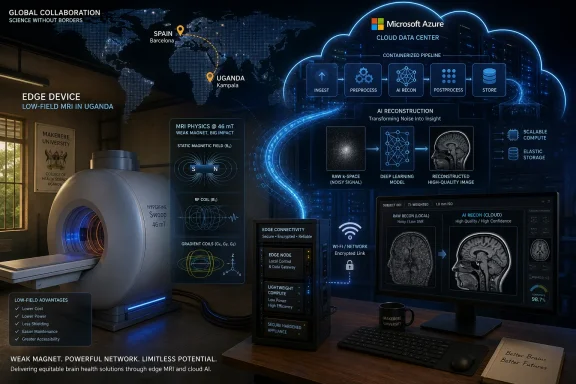 Microsoft Turns the MRI Scanner Into an Edge Device
MRI has always been a hardware flex. The canonical hospital machine is a cathedral of magnetic field strength: superconducting magnets, cryogenics, power conditioning, shielding, service contracts, and technicians trained to operate equipment that can cost more than the building around it. In that world, image quality is bought with mass, infrastructure, and capital.Tyger argues for a different bargain. If the scanner can capture usable raw signal, the cloud can do more of the interpretive work that once had to be solved locally by expensive hardware and specialized reconstruction systems. That does not repeal physics, but it changes the accounting.
The Uganda project is built around an ultra-low-field scanner at Mbarara University of Science and Technology, not a gleaming clinical installation in Boston or London. The machine uses a 46 mT Halbach-style magnet system, many times weaker than standard clinical MRI systems. Weak fields produce weaker signals, and weaker signals produce noisier images.
The old answer to that problem was better hardware. Tyger’s answer is better reconstruction, more compute, and a workflow that lets raw or lightly processed MRI data move into Azure for denoising and reconstruction before returning readable images to researchers and clinicians. In Microsoft’s framing, the scanner becomes less like a self-contained appliance and more like an edge sensor connected to a cloud brain.
That framing will sound familiar to anyone who has watched the last decade of enterprise IT. Security cameras became computer vision endpoints. Industrial sensors became digital-twin feeds. Thin clients and local workloads gave way to cloud-backed services. Tyger brings that same architecture to a domain where the stakes are human diagnosis and the constraints are not office bandwidth but fragile health systems.
The Magnet Is Still the Villain, but Not the Only One
The economic case for low-field MRI is straightforward: conventional MRI is too expensive, too fragile, and too centralized for much of the world. High-field systems can require specialized rooms, stable power, trained staff, parts supply chains, and ongoing service arrangements. For rural patients, the cost is not merely the scan. It is transport, lost work, delayed diagnosis, and sometimes the impossibility of reaching a scanner at all.That is why low-field MRI has attracted so much attention. Permanent magnets can reduce power demands and eliminate some of the most exotic infrastructure requirements. Smaller systems can be assembled, maintained, and studied in places where a conventional scanner is unrealistic.
But low-field MRI is not a fairy tale. Lower field strength usually means lower signal-to-noise ratio, longer acquisition compromises, and images that may not be clinically useful without serious correction. The problem is not just building a cheap scanner; it is building a cheap scanner whose images someone can trust.
That is where the Microsoft story becomes interesting. The Mbarara project reportedly had early scans that could capture only part of a head or required long processing times to become interpretable. The Tyger workflow, paired with hardware and software improvements from the research partners, helped move the system toward full-head imaging and faster reconstruction.
The distinction matters. Tyger is not the sole invention here. The published research points to grounding and shielding work, new control electronics, open-source interface software, improved coils, calibration, and reconstruction changes. The cloud is a major character, but this is an ensemble cast.
The Cloud Does Not Abolish Local Expertise
The most tempting version of this story is also the laziest: Microsoft beams African healthcare into the future from Azure. That is the wrong lesson. The better lesson is that cloud infrastructure becomes useful only when paired with local capacity.Mbarara University’s role is not ornamental. The project is happening in a local research and training environment where engineers, students, and medical workers can understand the scanner rather than merely operate a sealed box. That is a crucial difference in global health technology, where too many imported systems become expensive monuments once the first part breaks or the first vendor contract expires.
Tyger’s open-source positioning also matters here. In a low-resource setting, black-box dependency can be fatal to sustainability. If the reconstruction pipeline, scanner interface, and operating knowledge are inspectable and teachable, the project has a better chance of becoming a platform rather than a demo.
There is still tension in the model. A cloud-dependent medical workflow raises questions about bandwidth, latency, privacy, availability, cost, and sovereignty. If reconstruction requires Azure, then the scanner’s usefulness depends on connectivity and on the continued availability of a commercial cloud service. That is not disqualifying, but it is not trivial.
The more balanced view is that Tyger shifts the bottleneck. Instead of demanding a million-dollar machine and a hospital-grade room, the system demands reliable enough data capture, reliable enough networking, and reliable enough cloud operations. In many places, that is a better trade. It is not a trade without risk.
Azure Becomes the New Reconstruction Room
The technical architecture is elegant because it is unsurprising. A low-field scanner captures noisy magnetic resonance data. That data is sent to the cloud. Reconstruction algorithms, including denoising approaches designed for low signal-to-noise data, process the scan using compute resources that would be unrealistic to place beside every experimental scanner. The reconstructed images are then returned to the site.This is cloud computing at its most defensible. The workload is bursty, computationally demanding, and easier to update centrally than to deploy repeatedly across underpowered local machines. If a better reconstruction model arrives, the pipeline can improve without shipping a new magnet to Uganda.
For Windows and Azure watchers, this is the pattern Microsoft has been trying to sell across industries: let the endpoint be specialized and inexpensive, then let the cloud provide scale, orchestration, machine learning, and manageability. Tyger’s use of Azure Kubernetes infrastructure fits neatly into that broader enterprise playbook.
But healthcare adds a harder burden than typical enterprise analytics. Medical images are not ad impressions or telemetry logs. They are sensitive, regulated, and clinically consequential. Even in research settings, the path from experimental reconstruction to routine diagnosis requires validation, governance, and careful boundaries around what a system can and cannot claim.
That is why the word “diagnostic” should be used carefully. The project shows that low-field scanners can produce more useful in vivo images in a resource-limited setting when paired with better hardware, software, and cloud reconstruction. It does not mean every rural clinic can now replace radiology infrastructure with a cheap magnet and a broadband connection.
The Breakthrough Is Real Because It Is Uneven
The most convincing details in the project are not the glossy ones. They are the mundane constraints: limited local suppliers, diode replacements that are harder to obtain than they should be, challenges with precision mechanical work, lower-power components, and the practical difficulty of improving magnetic field homogeneity in Mbarara.That is what makes the research credible. Low-resource engineering is not just rich-world engineering with a smaller budget. It is a different discipline, where a part that costs pennies elsewhere can become a delay, a weak power amplifier can define the entire experiment, and local fabrication limits can force design compromises.
The project’s progress appears to come from many incremental fixes rather than one miracle algorithm. Better grounding reduces noise. Better shielding improves capture. Better electronics stabilize the system. Better software makes scanning and reconstruction more usable. Tyger then amplifies those gains by providing a reconstruction environment that local hardware could not easily match.
This should temper both hype and cynicism. The hype says Microsoft solved African MRI with the cloud. The cynicism says this is just a research demo dressed up as humanitarian PR. The evidence points somewhere in between: a real technical advance in a real setting, still surrounded by all the practical problems that make medical technology hard to deploy.
That middle ground is where most consequential technology lives. It is neither revolution nor vaporware. It is infrastructure getting just good enough, in just the right place, to make a previously unrealistic workflow worth testing.
The Stakes Are Highest Where Imaging Is Scarce
The clinical motivation is painfully concrete. In parts of Uganda and the wider region, access to advanced imaging is limited, and patients with neurological emergencies may face long travel times or no practical imaging option at all. For stroke, trauma, tumors, infection, and hydrocephalus, delayed imaging can mean delayed treatment.Hydrocephalus is especially relevant in East Africa, where timely brain imaging can shape surgical decisions for infants and children. A low-cost MRI system that can identify fluid accumulation or other gross brain abnormalities closer to the patient could change the first step in care, even if more complex cases still require referral.
That is the correct near-term ambition: not replacing every high-field MRI study, but expanding the diagnostic map. A low-field system that can answer certain urgent questions locally may be far more valuable than a theoretical high-end scanner hundreds of kilometers away. Medicine is full of imperfect tools that save lives because they are available when needed.
The same argument applies to rural hospitals everywhere, not only in Uganda. High-income countries also have imaging deserts, overloaded scanners, and patients who wait too long for access. If low-field systems improve enough, they could become triage devices, bedside systems, research tools, or specialized scanners for use cases where portability and cost matter more than perfect resolution.
This is where Tyger’s global significance lies. It suggests that low-field MRI’s ceiling may be higher when reconstruction is treated as a continuously improving software problem rather than a fixed limitation of the device. The scanner may remain cheap, but the intelligence behind it need not be.
Microsoft’s Incentive Is Not Charity, and That Is Fine
Microsoft Research has a long history of projects that live somewhere between pure science, platform strategy, and reputation building. Tyger fits that pattern. It advances medical imaging research, demonstrates Azure’s relevance in a demanding workload, and gives Microsoft a powerful story about cloud infrastructure serving public health.None of that invalidates the work. Corporate incentives are not automatically corrupting; they are simply part of the system. Azure benefits if more scientific and medical pipelines become cloud-native. Researchers benefit if they can access reconstruction tools that would otherwise be beyond their local infrastructure. Patients benefit if the result is more accessible imaging.
The risk is dependency disguised as democratization. If the only sustainable path for low-cost MRI is continuous reliance on a hyperscale provider, then the economics must be examined over years, not press cycles. Data egress, service availability, regulatory compliance, and cloud pricing can all turn a promising pilot into a difficult operating model.
The open-source component is therefore not a footnote. It is one of the safeguards against the project becoming a beautiful lock-in story. If Tyger can be inspected, adapted, and connected to other systems, it becomes part of a broader research ecosystem rather than just another Azure showcase.
Microsoft deserves credit for making the work visible and for contributing serious engineering. But the lasting value will be judged by whether Mbarara and similar sites gain durable capability, not merely better screenshots.
WindowsForum Readers Should See the Familiar Architecture Under the White Coat
At first glance, a Ugandan low-field MRI project may seem far from the daily concerns of Windows administrators and PC enthusiasts. Look closer and the architecture is instantly recognizable. It is edge capture, cloud orchestration, containerized compute, AI-assisted processing, and local delivery wrapped around a specialized device.That pattern is now everywhere. Windows endpoints offload identity, management, security analytics, backup, and increasingly AI workloads to Microsoft’s cloud. Industrial PCs stream telemetry into Azure. Developer tools rely on remote build systems and cloud-hosted models. Tyger applies the same logic to medical imaging: keep the endpoint simple enough to deploy, and put the expensive intelligence where it can scale.
The difference is accountability. If a cloud PC glitches, a user loses productivity. If a reconstruction pipeline fails silently, a clinician may misread a scan. That does not make cloud medical imaging impossible, but it raises the bar for observability, validation, auditing, and fallback modes.
This is where Microsoft’s enterprise DNA could matter. The company knows identity, logging, access control, compliance tooling, and distributed systems. It also knows how to build platforms that customers come to depend on. In medicine, both traits are useful and dangerous.
Tyger is therefore a case study in the next phase of cloud computing. The cloud is no longer just where business data goes. It is becoming an active participant in measurement itself, shaping what a device can see and how quickly humans can act on it.
The Limits Will Decide Whether This Becomes Healthcare Infrastructure
The practical deployment questions are unglamorous, and they will decide the outcome. Can a rural or regional site maintain the scanner mechanically and electronically? Can it keep a reliable enough internet connection? Can image reconstruction continue during outages? Can local staff validate the quality of each scan? Can the system be serviced without waiting weeks for parts?There is also the clinical-validation hurdle. A reconstructed low-field MRI image can be visually compelling and still require careful studies to define what it can diagnose, with what sensitivity, and under what conditions. Clinicians need protocols, not just images. Regulators need evidence, not just intent.
Bandwidth is another constraint that enthusiasts should not dismiss. Microsoft’s story mentions data moving even over limited networks, but operational healthcare cannot depend on heroics. If Tyger-like systems are to become routine, they need robust queueing, compression, retry logic, encryption, offline degradation, and clear expectations for turnaround time.
Then comes the question of who pays. A scanner that costs far less than conventional MRI may still be expensive for a clinic. Cloud reconstruction has operating costs. Training takes time. Maintenance requires budgets. The success case is not “free MRI.” It is a lower total barrier to useful imaging.
That barrier can fall dramatically and still remain significant. The achievement is in making the next step plausible.
The Real Revolution Is a Redistribution of Technical Power
The strongest argument for Tyger is not that Microsoft has invented a better medical imaging algorithm. It is that the project helps redistribute where expertise can live. A university lab in Uganda can participate in MRI research and system development rather than wait for imported technology to trickle down.That matters because healthcare technology often fails when it treats low-resource settings as endpoints rather than sources of design knowledge. Problems encountered in Mbarara are not peripheral edge cases. They are central engineering facts for any system that claims to democratize imaging.
A scanner that works only in a pristine laboratory is not a democratizing technology. A reconstruction method that assumes unlimited local compute is not either. A workflow that survives weak infrastructure, local training realities, and constrained supply chains has a better claim to the word.
The project also gives students a ladder into advanced technical work. Electronics, signal processing, cloud workflows, medical imaging physics, and software development are not abstract coursework when they are tied to a machine in the next room. That is capacity building with teeth.
If this model spreads, the long-term impact may be less about MRI scans per se and more about the creation of local engineering communities around medical devices. The best version of Tyger is not a product dropped into Uganda. It is a shared platform that helps Ugandan researchers build the next version themselves.
The MRI Story Microsoft Wants to Tell, and the One IT Pros Should Hear
Microsoft’s preferred narrative is easy to understand: cloud intelligence makes advanced healthcare more accessible. It is a good story, and in this case it has substance behind it. But IT professionals should hear a second story running underneath it.The second story is about the growing dependence of physical infrastructure on remote computation. That can unlock enormous value. It can also create new single points of failure, new governance problems, and new forms of vendor leverage.
In the Tyger case, the trade appears sensible because the alternative is often no MRI at all. When the baseline is exclusion from advanced imaging, cloud dependency may be a rational price to pay. But that price should be named, measured, and negotiated.
The same will be true across healthcare, manufacturing, energy, and public infrastructure. Cheap sensors plus expensive cloud intelligence is becoming the default architecture of modern systems. The questions are who controls the intelligence, who can audit it, who can afford it, and what happens when the connection fails.
Tyger’s importance is that it forces those questions into a domain where the social value is obvious. It is much harder to dismiss cloud dependence when the result could be earlier diagnosis for a child with hydrocephalus. It is also much harder to ignore the risks when the output may guide medical care.
A Cheap Magnet, a Cloud Pipeline, and the Hard Parts Still Ahead
The practical lesson from Tyger is not that low-field MRI has suddenly become easy. It is that the path to useful low-cost imaging now looks more credible because the burden can be divided differently among hardware, software, cloud systems, and local expertise.- The Mbarara system is based on a 46 mT low-field scanner, not a conventional high-field clinical MRI machine.
- Tyger’s central contribution is cloud-based reconstruction that can process noisy low-field data using compute resources unavailable on modest local hardware.
- The project’s progress depends on physical improvements to the scanner as well as cloud software, so it should not be reduced to an AI-only breakthrough.
- The most promising near-term use is expanding access to specific kinds of brain imaging where no practical MRI option exists today.
- The hardest remaining issues are validation, maintenance, connectivity, cost, governance, and avoiding long-term dependency on a single cloud provider.
- The project is most meaningful if it strengthens local technical capacity rather than turning local institutions into passive consumers of remote infrastructure.
References
- Primary source: streamlinefeed.co.ke
Published: 2026-06-10T11:30:12.153390
Loading…
streamlinefeed.co.ke - Official source: microsoft.com

When MRI images come into focus: How Tyger scales image reconstruction - Microsoft Research
Tyger moves the most demanding MRI processing to the cloud, helping researchers turn raw signals into readable images – meaning results in hours rather than days or weeks.www.microsoft.com - Related coverage: researchgate.net
Loading…
www.researchgate.net - Official source: news.microsoft.com
- Related coverage: lifescience.net
Loading…
www.lifescience.net