

Researchers in Spain and Uganda are using Microsoft Research’s Tyger cloud imaging platform in 2026 to reconstruct and clean up MRI scans from an ultra-low-field scanner at Mbarara University of Science and Technology, sending raw signals to Azure and returning clearer images for interpretation. The technical trick is easy to describe and hard to overstate: the scanner becomes less of a self-contained medical appliance and more of a sensor at the edge of a cloud system. That shift could matter enormously in places where the limiting factor is not medical need, but the cost, fragility, and scarcity of conventional imaging infrastructure. It also raises the uncomfortable but necessary question of whether the next leap in diagnostic access will come from better machines, better networks, or a more honest division of labor between the two.
For decades, MRI has been a monument to local capability. The magnet, the shielded room, the cooling systems, the trained operators, the reconstruction hardware, and the clinical workflow have all been bundled into a single expensive site. If a patient could not reach that site, the theoretical availability of advanced imaging did not matter much.
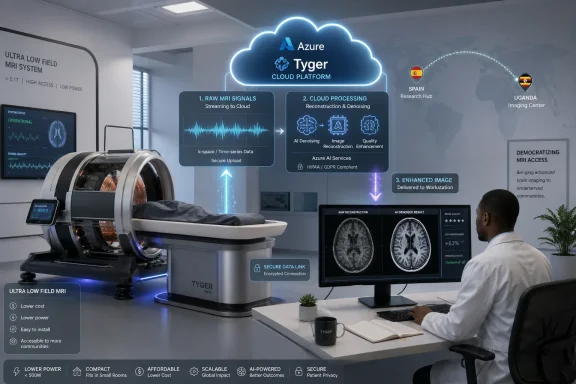
Tyger attacks that bundle at one of its most consequential points: image reconstruction. In the Uganda project, the scanner captures weak raw signals, but the heavy mathematical work of turning those signals into usable images is shifted to Microsoft Azure. Denoising and correction models, including Microsoft Research’s SNRAware, then refine the output before images are returned to researchers.
That is not the same as dropping a full hospital MRI suite into every district clinic. It is more modest, and potentially more disruptive. It suggests that low-cost and ultra-low-field MRI systems can improve not only through better magnets and electronics, but through cloud-side computation that would be unaffordable or impractical to place beside every scanner.
The distinction matters because global health technology is littered with promising devices that failed at the operational layer. A machine that works in a lab but demands expensive support, stable power, specialist maintenance, and high-end local compute is not really accessible. Tyger’s wager is that compute can be centralized while acquisition moves closer to patients.
For many patients, the problem is not that MRI does not exist anywhere in the country. The problem is that it may exist too far away, at too high a cost, and too late in the disease process. In conditions such as stroke, traumatic injury, hydrocephalus, tumors, and neurological infection, a delayed scan can turn a treatable problem into a disability or death sentence.
Ultra-low-field MRI has always promised a more portable and affordable path. Lower magnetic fields can mean lower cost, fewer infrastructure requirements, and potentially wider deployment. The tradeoff is image quality: weaker signals, more noise, more distortion, and less margin for clinical confidence.
That is where the cloud pipeline becomes more than a convenience. If a scanner in Mbarara can capture signals but cannot locally reconstruct them well enough, the barrier is no longer only hardware. It becomes a systems problem: data transfer, reconstruction algorithms, denoising, validation, training, and trust.
This sounds familiar to anyone who has watched enterprise computing migrate from local servers to cloud services. The difference is that medical imaging is not email or document storage. Latency, reliability, patient privacy, and clinical accountability all have sharper edges when the output may influence diagnosis.
Still, the architectural move is compelling. A remote signal-processing platform can run containerized workloads, scale compute resources, and allow researchers to test reconstruction methods without repeatedly redeploying code onto a physical scanner. Microsoft Research has described Tyger as an open-source framework for remote signal processing rather than a single-purpose MRI product, and that framing is important.
In the Mbarara setup, raw signals are transmitted to Azure, processed, corrected, and returned as clearer images. In principle, this lets a modest scanner benefit from computational resources far beyond what sits in the room. In practice, it means the scanner’s usefulness depends on the weakest parts of the whole chain: connectivity, workflow design, data governance, and whether the improved images can be clinically validated in the settings where they will be used.
MRI does not produce photographs. It collects measurements that must be mathematically reconstructed into images. When the magnetic field is low, the signal-to-noise ratio becomes a central challenge. Denoising models can help, but they must be handled with care because a medical image is not merely judged by whether it looks cleaner.
A sharper image that hallucinates structure or suppresses subtle pathology would be dangerous. That is why the phrase “suitable for interpretation” carries weight but should not be mistaken for full clinical deployment at national scale. Research success is a step toward clinical usefulness, not a substitute for validation, regulation, training, and ongoing quality assurance.
The most interesting part of Tyger is not that it makes images prettier. It is that it creates a repeatable environment where reconstruction methods can be developed, deployed, compared, and improved without requiring every scanner site to become a high-performance computing lab. For research teams in low-resource settings, that could shorten the cycle from experiment to usable workflow.
That said, “open source” does not automatically mean “locally sovereign” or “free to operate.” The platform may be open, but cloud compute, storage, bandwidth, compliance work, and engineering support still cost money. Azure is part of the architecture here, and that means Microsoft is both a research collaborator and a platform provider.
There is nothing inherently wrong with that. Cloud platforms have the scale and tooling needed for this kind of experiment. But the public-interest promise depends on avoiding a new form of lock-in where low-resource health systems swap scarce MRI hardware for dependence on proprietary cloud economics.
The healthiest version of this model would preserve portability. Researchers should be able to understand the pipeline, run parts of it locally when possible, move workloads when necessary, and train local engineers to maintain the system. A cloud-enabled MRI future should not require every hospital to become a Microsoft customer before it can diagnose a child with hydrocephalus.
Medical imaging capacity is not created by a scanner alone. It requires operators who can acquire useful data, engineers who can maintain and adapt the system, clinicians who can interpret the output, and administrators who can integrate scans into care pathways. In low-resource settings, those roles often overlap in ways that would make a rich-country hospital uncomfortable but are operationally necessary.
The reported progress at Mbarara is concrete: early scans captured only part of the head, while later work produced full-head images from volunteers. That kind of incremental improvement is less glamorous than a product launch, but it is how durable medical technology usually arrives. Teams learn the machine, improve coils and electronics, revise workflows, and discover which failures are technical and which are institutional.
This is also where cloud technology can be a teaching tool. If students can see how raw signals become reconstructed images, adjust parameters, and compare outputs, they are not just consuming a black-box service. They are learning the physics, software, and signal processing that could eventually support local innovation.
We have seen that pattern in productivity software, identity, endpoint management, developer tooling, gaming, and security. Now the same logic is appearing in medical instruments. The scanner is the endpoint; Azure is the backend; Tyger is the abstraction layer; the reconstruction algorithm is the workload.
That analogy should make us both optimistic and wary. Cloud abstraction can democratize access by removing local barriers. It can also move control upward into platforms whose pricing, availability, and policy choices are made far from the communities that depend on them.
The question for healthcare is sharper than it is for office software. If a cloud service is slow, unavailable, or unaffordable, a spreadsheet can wait. A patient with a neurological emergency may not. Any serious deployment of cloud-reconstructed imaging must have a plan for outages, degraded connectivity, local fallback, and clinical triage.
The project reportedly works even with limited network conditions, but “works” is a spectrum. Research scans can tolerate delays that emergency care cannot. A platform that performs well during planned volunteer imaging may face different pressures in a crowded hospital where patients, clinicians, and referral decisions are waiting.
That does not undermine the concept. It clarifies the deployment problem. If low-cost MRI becomes cloud-dependent, then broadband and mobile backhaul become part of the diagnostic imaging supply chain. Health ministries and donors would need to think about connectivity not as an administrative utility, but as clinical infrastructure.
There is also a data protection question. Raw MRI signals and reconstructed images may be medically sensitive, and cross-border cloud processing can trigger legal, ethical, and governance concerns. The right answer is not to reject cloud processing outright, but to demand transparent policies for encryption, retention, access, auditability, and local regulatory compliance.
A denoised image can look better while still being clinically uncertain. Radiologists and clinicians need to know how reconstruction affects lesions, edema, bleeding, anatomy boundaries, and artifacts. They need performance data across patient populations, body regions, scanner configurations, and disease states.
The challenge is particularly acute in global health settings because models trained or tuned on one type of scanner or population may not generalize cleanly elsewhere. Ultra-low-field images are already different from conventional high-field hospital MRI. Adding AI enhancement makes the validation chain even more important.
The right standard is not perfection. Conventional MRI also has artifacts, failures, and interpretation variability. The realistic question is whether cloud-enhanced low-field MRI is good enough for specific clinical decisions, in specific settings, compared with the alternative of no MRI at all or a delayed scan hundreds of kilometers away.
The company’s interest is obvious. If medical instruments become cloud-connected endpoints, Azure becomes part of the clinical equipment stack. That is a large strategic prize, especially as AI workloads increase demand for scalable compute.
But this project also gives Microsoft a more defensible story than generic “AI for health” marketing. It is not simply putting a chatbot in front of patients or summarizing clinical notes. It is using cloud compute to address a known technical limitation in low-cost imaging.
The risk is overclaiming. Tyger does not solve the global MRI shortage by itself. It does not train radiologists, build referral systems, pay for treatment, guarantee connectivity, or settle regulatory questions. Its contribution is narrower and more credible: it can make reconstruction and enhancement more accessible to teams working with constrained scanner hardware.
MUST is not merely a recipient. Its researchers and students are part of the experimentation, training, and operational learning. The collaboration with I3M reflects a research network, not a one-way donation pipeline. The scanner’s evolution from partial-head images to full-head acquisition reflects local technical work as much as cloud-side processing.
That distinction matters because sustainable access is built through local ownership. If the expertise remains abroad, the system will stall when funding, staff, or vendor attention shifts. If expertise grows in Uganda, the project can seed a broader ecosystem of biomedical engineering, imaging research, and maintenance capacity.
The most encouraging part of this story is not that Microsoft has a clever platform. It is that the platform is being tested in a setting where the users have every incentive to adapt it to reality. Real constraints are a better product manager than a conference demo.
That hybrid model would fit the diversity of medical imaging environments. A teaching hospital in Kampala, a rural clinic, a mobile imaging van, and a research lab in Spain do not need identical architectures. They need interoperable tools that can place computation where it makes operational sense.
Tyger’s value may therefore be less about Azure specifically and more about decoupling the scanner from the reconstruction pipeline. Once that separation exists, researchers can experiment with where compute should live. The cloud is the most visible answer today because it offers immediate scale, but the deeper innovation is modularity.
For Microsoft, that should be a lesson too. The more Tyger looks like a flexible research framework, the stronger its public-interest case. The more it looks like a funnel into one cloud, the more skepticism it will attract from health systems already wary of foreign dependence.
 Microsoft Moves the MRI Bottleneck Out of the Scanner Room
For decades, MRI has been a monument to local capability. The magnet, the shielded room, the cooling systems, the trained operators, the reconstruction hardware, and the clinical workflow have all been bundled into a single expensive site. If a patient could not reach that site, the theoretical availability of advanced imaging did not matter much.Tyger attacks that bundle at one of its most consequential points: image reconstruction. In the Uganda project, the scanner captures weak raw signals, but the heavy mathematical work of turning those signals into usable images is shifted to Microsoft Azure. Denoising and correction models, including Microsoft Research’s SNRAware, then refine the output before images are returned to researchers.
That is not the same as dropping a full hospital MRI suite into every district clinic. It is more modest, and potentially more disruptive. It suggests that low-cost and ultra-low-field MRI systems can improve not only through better magnets and electronics, but through cloud-side computation that would be unaffordable or impractical to place beside every scanner.
The distinction matters because global health technology is littered with promising devices that failed at the operational layer. A machine that works in a lab but demands expensive support, stable power, specialist maintenance, and high-end local compute is not really accessible. Tyger’s wager is that compute can be centralized while acquisition moves closer to patients.
Uganda Is Not a Demo Stage; It Is the Point
The collaboration links Spain’s Institute of Instrumentation for Molecular Imaging with Mbarara University of Science and Technology in western Uganda. That geography is not incidental. Uganda’s imaging gap is exactly the kind of environment where a conventional MRI deployment model runs into economic and logistical limits.For many patients, the problem is not that MRI does not exist anywhere in the country. The problem is that it may exist too far away, at too high a cost, and too late in the disease process. In conditions such as stroke, traumatic injury, hydrocephalus, tumors, and neurological infection, a delayed scan can turn a treatable problem into a disability or death sentence.
Ultra-low-field MRI has always promised a more portable and affordable path. Lower magnetic fields can mean lower cost, fewer infrastructure requirements, and potentially wider deployment. The tradeoff is image quality: weaker signals, more noise, more distortion, and less margin for clinical confidence.
That is where the cloud pipeline becomes more than a convenience. If a scanner in Mbarara can capture signals but cannot locally reconstruct them well enough, the barrier is no longer only hardware. It becomes a systems problem: data transfer, reconstruction algorithms, denoising, validation, training, and trust.
The Scanner Becomes a Sensor, and That Changes the Economics
Traditional MRI systems are built around an assumption that the scanner site must do nearly everything. Tyger relaxes that assumption. It treats the MRI system primarily as a signal-capture instrument, with reconstruction and enhancement handled remotely.This sounds familiar to anyone who has watched enterprise computing migrate from local servers to cloud services. The difference is that medical imaging is not email or document storage. Latency, reliability, patient privacy, and clinical accountability all have sharper edges when the output may influence diagnosis.
Still, the architectural move is compelling. A remote signal-processing platform can run containerized workloads, scale compute resources, and allow researchers to test reconstruction methods without repeatedly redeploying code onto a physical scanner. Microsoft Research has described Tyger as an open-source framework for remote signal processing rather than a single-purpose MRI product, and that framing is important.
In the Mbarara setup, raw signals are transmitted to Azure, processed, corrected, and returned as clearer images. In principle, this lets a modest scanner benefit from computational resources far beyond what sits in the room. In practice, it means the scanner’s usefulness depends on the weakest parts of the whole chain: connectivity, workflow design, data governance, and whether the improved images can be clinically validated in the settings where they will be used.
The Cloud Is Doing Math, Not Magic
It is tempting to describe this as AI making bad scans good. That is too glib. The work here is a combination of reconstruction, denoising, distortion correction, and engineering discipline, all applied to difficult low-field data.MRI does not produce photographs. It collects measurements that must be mathematically reconstructed into images. When the magnetic field is low, the signal-to-noise ratio becomes a central challenge. Denoising models can help, but they must be handled with care because a medical image is not merely judged by whether it looks cleaner.
A sharper image that hallucinates structure or suppresses subtle pathology would be dangerous. That is why the phrase “suitable for interpretation” carries weight but should not be mistaken for full clinical deployment at national scale. Research success is a step toward clinical usefulness, not a substitute for validation, regulation, training, and ongoing quality assurance.
The most interesting part of Tyger is not that it makes images prettier. It is that it creates a repeatable environment where reconstruction methods can be developed, deployed, compared, and improved without requiring every scanner site to become a high-performance computing lab. For research teams in low-resource settings, that could shorten the cycle from experiment to usable workflow.
Open Source Gives the Project Its Political Edge
Tyger’s open-source status is not a decorative detail. In global health technology, openness can be the difference between local capacity and permanent dependency. If the reconstruction framework is inspectable, adaptable, and usable by researchers outside Microsoft, the project has a better chance of becoming infrastructure rather than a showcase.That said, “open source” does not automatically mean “locally sovereign” or “free to operate.” The platform may be open, but cloud compute, storage, bandwidth, compliance work, and engineering support still cost money. Azure is part of the architecture here, and that means Microsoft is both a research collaborator and a platform provider.
There is nothing inherently wrong with that. Cloud platforms have the scale and tooling needed for this kind of experiment. But the public-interest promise depends on avoiding a new form of lock-in where low-resource health systems swap scarce MRI hardware for dependence on proprietary cloud economics.
The healthiest version of this model would preserve portability. Researchers should be able to understand the pipeline, run parts of it locally when possible, move workloads when necessary, and train local engineers to maintain the system. A cloud-enabled MRI future should not require every hospital to become a Microsoft customer before it can diagnose a child with hydrocephalus.
Mbarara’s Students May Matter as Much as the Scanner
One of the strongest signals from the Uganda collaboration is that it is also a training program. MUST researchers are reportedly involving engineering and medical students, as well as community healthcare workers, in MRI technology and image reconstruction. That matters because infrastructure without people is just equipment waiting to fail.Medical imaging capacity is not created by a scanner alone. It requires operators who can acquire useful data, engineers who can maintain and adapt the system, clinicians who can interpret the output, and administrators who can integrate scans into care pathways. In low-resource settings, those roles often overlap in ways that would make a rich-country hospital uncomfortable but are operationally necessary.
The reported progress at Mbarara is concrete: early scans captured only part of the head, while later work produced full-head images from volunteers. That kind of incremental improvement is less glamorous than a product launch, but it is how durable medical technology usually arrives. Teams learn the machine, improve coils and electronics, revise workflows, and discover which failures are technical and which are institutional.
This is also where cloud technology can be a teaching tool. If students can see how raw signals become reconstructed images, adjust parameters, and compare outputs, they are not just consuming a black-box service. They are learning the physics, software, and signal processing that could eventually support local innovation.
The Windows World Should Recognize the Pattern
For WindowsForum readers, this story sits slightly outside the usual orbit of desktop updates, Azure licensing, Copilot features, and enterprise patch cycles. But the underlying pattern is deeply familiar. Microsoft is pushing computation away from the endpoint and toward managed, scalable infrastructure, then arguing that this makes formerly specialized capability more broadly available.We have seen that pattern in productivity software, identity, endpoint management, developer tooling, gaming, and security. Now the same logic is appearing in medical instruments. The scanner is the endpoint; Azure is the backend; Tyger is the abstraction layer; the reconstruction algorithm is the workload.
That analogy should make us both optimistic and wary. Cloud abstraction can democratize access by removing local barriers. It can also move control upward into platforms whose pricing, availability, and policy choices are made far from the communities that depend on them.
The question for healthcare is sharper than it is for office software. If a cloud service is slow, unavailable, or unaffordable, a spreadsheet can wait. A patient with a neurological emergency may not. Any serious deployment of cloud-reconstructed imaging must have a plan for outages, degraded connectivity, local fallback, and clinical triage.
The Network Is the New Imaging Access Problem
Tyger’s success depends on moving data between scanner and cloud. In some places, that may be straightforward. In rural or under-resourced regions, connectivity can be inconsistent, expensive, or fragile.The project reportedly works even with limited network conditions, but “works” is a spectrum. Research scans can tolerate delays that emergency care cannot. A platform that performs well during planned volunteer imaging may face different pressures in a crowded hospital where patients, clinicians, and referral decisions are waiting.
That does not undermine the concept. It clarifies the deployment problem. If low-cost MRI becomes cloud-dependent, then broadband and mobile backhaul become part of the diagnostic imaging supply chain. Health ministries and donors would need to think about connectivity not as an administrative utility, but as clinical infrastructure.
There is also a data protection question. Raw MRI signals and reconstructed images may be medically sensitive, and cross-border cloud processing can trigger legal, ethical, and governance concerns. The right answer is not to reject cloud processing outright, but to demand transparent policies for encryption, retention, access, auditability, and local regulatory compliance.
AI Denoising Must Earn Clinical Trust the Hard Way
SNRAware and similar denoising tools point toward a future in which software compensates for weaker acquisition hardware. That could be transformative for ultra-low-field MRI. But medical AI earns trust through validation, not visual persuasion.A denoised image can look better while still being clinically uncertain. Radiologists and clinicians need to know how reconstruction affects lesions, edema, bleeding, anatomy boundaries, and artifacts. They need performance data across patient populations, body regions, scanner configurations, and disease states.
The challenge is particularly acute in global health settings because models trained or tuned on one type of scanner or population may not generalize cleanly elsewhere. Ultra-low-field images are already different from conventional high-field hospital MRI. Adding AI enhancement makes the validation chain even more important.
The right standard is not perfection. Conventional MRI also has artifacts, failures, and interpretation variability. The realistic question is whether cloud-enhanced low-field MRI is good enough for specific clinical decisions, in specific settings, compared with the alternative of no MRI at all or a delayed scan hundreds of kilometers away.
Microsoft’s Health Futures Strategy Gets a Tangible Test Case
Microsoft has spent years positioning itself as an infrastructure company for healthcare data, AI, and research. Much of that pitch can feel abstract: clouds, models, compliance frameworks, and partnerships. Tyger is more tangible because it touches a physical bottleneck in care delivery.The company’s interest is obvious. If medical instruments become cloud-connected endpoints, Azure becomes part of the clinical equipment stack. That is a large strategic prize, especially as AI workloads increase demand for scalable compute.
But this project also gives Microsoft a more defensible story than generic “AI for health” marketing. It is not simply putting a chatbot in front of patients or summarizing clinical notes. It is using cloud compute to address a known technical limitation in low-cost imaging.
The risk is overclaiming. Tyger does not solve the global MRI shortage by itself. It does not train radiologists, build referral systems, pay for treatment, guarantee connectivity, or settle regulatory questions. Its contribution is narrower and more credible: it can make reconstruction and enhancement more accessible to teams working with constrained scanner hardware.
The Africa Angle Should Not Be Flattened Into Charity Tech
Stories about African healthcare technology often fall into a familiar trap: a Western company arrives with a tool, local scarcity becomes a backdrop, and the narrative becomes one of rescue. The Mbarara project deserves better than that.MUST is not merely a recipient. Its researchers and students are part of the experimentation, training, and operational learning. The collaboration with I3M reflects a research network, not a one-way donation pipeline. The scanner’s evolution from partial-head images to full-head acquisition reflects local technical work as much as cloud-side processing.
That distinction matters because sustainable access is built through local ownership. If the expertise remains abroad, the system will stall when funding, staff, or vendor attention shifts. If expertise grows in Uganda, the project can seed a broader ecosystem of biomedical engineering, imaging research, and maintenance capacity.
The most encouraging part of this story is not that Microsoft has a clever platform. It is that the platform is being tested in a setting where the users have every incentive to adapt it to reality. Real constraints are a better product manager than a conference demo.
A Better MRI Future Will Be Hybrid, Not Pure Cloud
The long-term endpoint is unlikely to be a world where every scanner streams everything to a hyperscale cloud all the time. More likely, the future is hybrid. Some processing will happen locally, some at regional hubs, and some in global clouds depending on urgency, bandwidth, cost, and regulatory rules.That hybrid model would fit the diversity of medical imaging environments. A teaching hospital in Kampala, a rural clinic, a mobile imaging van, and a research lab in Spain do not need identical architectures. They need interoperable tools that can place computation where it makes operational sense.
Tyger’s value may therefore be less about Azure specifically and more about decoupling the scanner from the reconstruction pipeline. Once that separation exists, researchers can experiment with where compute should live. The cloud is the most visible answer today because it offers immediate scale, but the deeper innovation is modularity.
For Microsoft, that should be a lesson too. The more Tyger looks like a flexible research framework, the stronger its public-interest case. The more it looks like a funnel into one cloud, the more skepticism it will attract from health systems already wary of foreign dependence.
The Scanner-in-the-Cloud Era Comes With Fine Print
The concrete lesson from the Uganda project is not that cloud computing magically fixes healthcare infrastructure. It is that some barriers once treated as hardware problems may be solvable, or at least reduced, through software architecture and remote compute.- Researchers from I3M and Mbarara University are using Microsoft Research’s Tyger to process raw MRI signals from an ultra-low-field scanner through a cloud reconstruction pipeline.
- The platform shifts computationally intensive reconstruction, denoising, and correction work away from local scanner hardware and into Azure-based resources.
- Microsoft Research’s SNRAware denoising work is part of the image-quality story, but clinical trust will depend on validation rather than cleaner-looking scans alone.
- The project’s capacity-building component at Mbarara University may be as important as the technical platform because local expertise determines whether systems survive beyond pilots.
- Cloud-based imaging could reduce infrastructure barriers, but it also makes connectivity, data governance, cost, and fallback planning part of the clinical imaging stack.
- The most durable future for low-cost MRI is likely hybrid, with compute distributed across local devices, regional systems, and cloud platforms depending on clinical need.
References
- Primary source: standardmedia.co.ke
Published: 2026-06-15T03:30:12.009482
Loading…
www.standardmedia.co.ke - Related coverage: tech-ish.com

How Microsoft Research's Tyger is Bringing Clearer MRI Scans to Uganda Through the Cloud - • 𝐭𝐞𝐜𝐡-𝑖𝑠ℎ
Microsoft Research's Tyger platform helps Ugandan and Spanish researchers turn noisy low-field MRI signals into clear, usable medical images. tech-ish.com
- Related coverage: researchgate.net
Loading…
www.researchgate.net - Related coverage: windowsforum.com
Loading…
windowsforum.com