

On May 13, 2026, Gallup reported that 71 percent of U.S. adults oppose construction of AI data centers in their local area, a finding that turns the physical infrastructure of artificial intelligence into a national backyard fight. The result is not a small reputational problem for the AI industry; it is a warning that compute has become land use politics. The same public that has rapidly adopted AI tools is increasingly unwilling to host the power-hungry, water-sensitive, noise-producing campuses that make those tools possible. Silicon Valley’s next bottleneck may not be GPUs, transformers, or talent, but county boards, utility dockets, and neighbors who have learned how to say no.
For years, the technology industry sold the cloud as a metaphor of weightlessness. Data floated somewhere else, software scaled invisibly, and users experienced infrastructure as a monthly bill, a latency number, or an icon in the corner of a browser tab. Artificial intelligence has broken that illusion because its appetite is too large to hide.
The new generation of AI data centers is not merely an incremental upgrade to the web hosting facilities of the 2000s. These are industrial installations: vast buildings, high-voltage substations, backup generation, cooling systems, fiber corridors, security perimeters, and construction traffic. Their arrival looks less like a software deployment than a manufacturing boom.
That distinction matters because communities understand factories differently from apps. A chatbot can be adopted individually; a data center is imposed geographically. The benefits are dispersed through products, stock prices, and national competitiveness narratives, while the burdens are concentrated in a town, a watershed, a utility territory, or a road network.
Gallup’s finding crystallizes that imbalance. Americans are not simply worried about AI in the abstract. They are making a much more concrete judgment: whatever AI may do for the national economy, they do not necessarily want its machinery down the road.
The details are especially uncomfortable for developers. Among those opposed, natural resources were the dominant concern, while smaller but meaningful shares cited quality of life, rising costs, and pollution. That mix shows that the public is not reacting to one single scare story. It is reacting to the entire footprint of the model: land, power, water, noise, rates, and trust.
Supporters, by contrast, lean heavily on economics. Gallup found that people in favor most often pointed to job growth, tax revenue, and community development. That is the standard language of local development politics, and it can still work. But data centers have a structural weakness in this argument: after construction, they often employ far fewer people than their square footage suggests.
That does not mean the economic case is fake. Tax revenue can be real, and large projects can reshape a county budget. But voters increasingly understand that “investment” is not the same thing as broad local prosperity. A billion-dollar server farm can look impressive on a press release while still feeling like a poor trade if residents expect higher utility costs, stressed water systems, and a transformed landscape.
The political cross-tabs also matter. Opposition is bipartisan, even if Democrats register stronger opposition than Republicans and independents are heavily skeptical. That makes the issue harder to manage through the usual partisan channels. A data center can be attacked from the environmental left, the property-rights right, the ratepayer center, and the preservationist localist all at once.
The county board approved rezoning in December 2023 by a narrow 4-3 vote, but approval did not settle the matter. Residents and preservation groups kept fighting, and courts later sided with opponents who argued that the process had moved too quickly and deprived the public of a fair chance to participate. Compass Datacenters and the county declined to continue the appeal, while QTS pushed for review by Virginia’s highest court.
That sequence is the new playbook for data center opposition. The fight does not end when a board votes. It moves to procedure, environmental review, historic preservation, state law, and litigation. Developers may still win, but the timeline gets longer, financing assumptions get riskier, and the public learns that resistance can produce tangible delay.
Virginia is a particularly revealing battleground because it is already the gravitational center of the data center industry. Northern Virginia’s “Data Center Alley” became dominant because of fiber connectivity, power access, business-friendly local governments, and proximity to major internet exchange infrastructure. If even Virginia can become contested terrain, less experienced jurisdictions should assume the politics will be rougher, not smoother.
The Prince William fight also shows why the industry’s “this is just infrastructure” defense can backfire. Infrastructure has history, neighbors, and consequences. Placing the world’s largest data center campus near a Civil War battlefield is not merely a siting decision; it is a statement about what a community is willing to trade for the AI economy.
Data Center Watch has estimated that local activism blocked or delayed tens of billions of dollars in U.S. data center projects between May 2024 and March 2025, with later reporting suggesting the total continued to rise sharply in 2025. Even if one treats those figures cautiously, the direction is unmistakable. Local opposition has become a material development risk.
The key shift is that communities are sharing tactics. Once one county learns how to challenge a rezoning schedule, scrutinize a water rights application, question a utility upgrade, or demand a fuller noise study, those methods travel. The internet that AI companies depend on also helps opponents compare notes.
This is why the industry’s preferred narrative of isolated misunderstanding is increasingly unconvincing. Residents may not know every technical detail of training clusters or inference workloads, but they often understand the local trade-offs clearly enough. They know when a project’s electricity demand is enormous, when water use is ambiguous, when tax incentives are generous, or when approvals appear to be moving faster than public scrutiny.
The opposition is also strengthened by an uncomfortable asymmetry. A hyperscaler or developer may need hundreds of approvals across many jurisdictions to meet its capacity targets. Opponents need only slow down enough of them to alter the economics. In infrastructure, delay is not a neutral event; it is a cost center.
Power is the central issue. AI facilities can demand electricity at a scale that forces utilities to accelerate transmission upgrades, renegotiate generation plans, or keep fossil fuel assets online longer than expected. Even where developers promise on-site generation or renewable procurement, residents often ask a simpler question: who pays for the grid changes?
That question is especially sharp in regions already facing rising utility bills. If a data center increases demand, and the utility builds new infrastructure, the allocation of costs becomes politically explosive. A community may welcome tax revenue in theory while rejecting the possibility that households subsidize industrial-scale compute through rates.
Water is the second flashpoint, though the details vary by cooling design and climate. Some facilities use evaporative cooling heavily; others rely more on closed-loop or air-based systems. But in drought-prone or agricultural regions, even the perception of large water demand can be enough to trigger opposition.
Noise is the underestimated third rail. Backup generators, cooling equipment, transformers, construction activity, and truck traffic can turn a quiet rural or suburban area into something that feels industrial. Unlike abstract debates over AI safety, noise politics are immediate. Residents can imagine hearing the project before they understand its architecture.
Supporters frame such projects as strategic infrastructure. In that telling, the United States needs domestic compute capacity to compete with China, support AI innovation, and avoid surrendering technological leadership. The pitch is deliberately national, even geopolitical.
Opponents experience it locally. They see land conversion, possible water stress, gas infrastructure, tax arrangements, and a decision-making process that can feel remote from ordinary voters. When state authorities and special development entities become central to approval, residents may suspect that the governance model has been designed to route around them.
Utah also points to a broader industry response: if the grid is a bottleneck and local utilities are politically exposed, developers will try to bring more of the energy stack with them. On-site generation, pipeline access, behind-the-meter power, and dedicated substations are becoming part of the AI infrastructure story. That may solve one problem while creating another, because a self-contained energy campus can look to neighbors less like clean digital infrastructure and more like a private industrial zone.
The larger the project, the more fragile the consent. A small data center can be explained as local economic development. A multi-gigawatt AI campus asks a community to host a piece of national industrial policy. That is a much harder sell when the community did not ask to become a battlefield in the AI race.
But inevitability is a dangerous argument in democratic land use. People may accept that AI will grow and still reject a specific project. They may use AI tools and still oppose the data center next door. There is no contradiction there; modern life is full of systems people use but do not want to host.
The industry’s deeper problem is that it has not convincingly distributed the benefits. Consumers get convenience, companies get valuations, developers get contracts, utilities get load growth, and local governments may get tax revenue. Residents near a site are asked to accept the most visible costs in exchange for benefits that often feel indirect or speculative.
This is why the “you use the cloud too” rebuttal rarely works. People use electricity, but that does not mean they forfeit a voice over a power plant. They use highways, but they still debate routes. Infrastructure is not absolved from politics because it is useful.
AI companies also face a trust deficit of their own making. The sector has spent years moving fast, scraping data, shifting product terms, promising transformation, and minimizing externalities. When the same industry arrives at a county meeting promising responsible development, many residents hear a familiar pitch from institutions they do not fully trust.
Residents understand who ultimately needs the compute. Whether the sign on the permit says QTS, Compass, O’Leary Digital, or another developer, the public increasingly connects the buildout to Microsoft, Google, Amazon, Meta, OpenAI, xAI, and the rest of the AI economy. The industry may be fragmented on paper, but the backlash sees a single machine.
For Microsoft in particular, the issue cuts across its entire AI strategy. Copilot is being pushed through Windows, Microsoft 365, GitHub, Azure, and security products. Every promise of ubiquitous AI assistance implies a backend that must exist somewhere. Windows users may experience Copilot as a sidebar or a shortcut key, but the infrastructure behind it is anything but light.
That does not make Microsoft uniquely culpable. Every hyperscaler is chasing the same curve. But Microsoft’s position inside the daily workflow of businesses and consumers makes it a useful emblem of the broader bargain: AI is being normalized at the interface layer while its physical costs are becoming more visible at the county line.
The companies cannot fully outsource public legitimacy to data center developers. If AI infrastructure becomes politically toxic, the brands that profit from AI will be pulled into the debate whether they want to be or not. The next phase of corporate AI responsibility will not be only about model safety, copyright, or hallucinations. It will be about power procurement, water stewardship, local taxation, and whether communities believe the deal is fair.
Space-based data centers face obvious engineering, cost, maintenance, latency, launch, and heat-rejection challenges. They are not a near-term substitute for the terrestrial buildout now colliding with local opposition. But as a metaphor, they are perfect. When the neighborhood says no, the industry looks up.
That instinct should worry policymakers. If essential infrastructure becomes so difficult to site that companies seek increasingly exotic workarounds, the underlying governance model is failing. The answer cannot be to pretend communities have no legitimate concerns, nor can it be to block every project and hope AI demand evaporates.
A better model would force earlier disclosure, clearer resource accounting, and more honest benefit-sharing. Residents should know projected power demand, water use, backup generation plans, noise profiles, tax incentives, grid upgrade costs, and decommissioning obligations before decisions are effectively locked in. If a project is good for a community, it should survive that transparency.
The harder truth is that some projects may not deserve approval. Not every rural parcel should become a compute campus. Not every tax incentive is justified by a promise of future relevance. Not every national competitiveness argument should override local consent.
The most concrete lesson from the current backlash is that data centers are no longer invisible civic infrastructure. They are politically salient, and they will be judged project by project by residents who have learned the vocabulary of megawatts, aquifers, substations, and rezoning calendars.
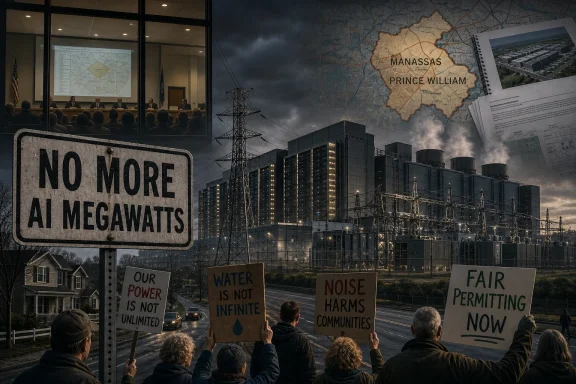 The Cloud Has Finally Touched the Ground
For years, the technology industry sold the cloud as a metaphor of weightlessness. Data floated somewhere else, software scaled invisibly, and users experienced infrastructure as a monthly bill, a latency number, or an icon in the corner of a browser tab. Artificial intelligence has broken that illusion because its appetite is too large to hide.The new generation of AI data centers is not merely an incremental upgrade to the web hosting facilities of the 2000s. These are industrial installations: vast buildings, high-voltage substations, backup generation, cooling systems, fiber corridors, security perimeters, and construction traffic. Their arrival looks less like a software deployment than a manufacturing boom.
That distinction matters because communities understand factories differently from apps. A chatbot can be adopted individually; a data center is imposed geographically. The benefits are dispersed through products, stock prices, and national competitiveness narratives, while the burdens are concentrated in a town, a watershed, a utility territory, or a road network.
Gallup’s finding crystallizes that imbalance. Americans are not simply worried about AI in the abstract. They are making a much more concrete judgment: whatever AI may do for the national economy, they do not necessarily want its machinery down the road.
The Poll Turns NIMBY Into a Market Signal
The temptation is to dismiss the Gallup result as classic NIMBYism, and Gallup itself used that frame. But treating local opposition as a mood rather than a constraint is how industries get blindsided. Seven in ten Americans opposing nearby AI data centers is not a messaging problem that can be solved with a better ribbon-cutting ceremony.The details are especially uncomfortable for developers. Among those opposed, natural resources were the dominant concern, while smaller but meaningful shares cited quality of life, rising costs, and pollution. That mix shows that the public is not reacting to one single scare story. It is reacting to the entire footprint of the model: land, power, water, noise, rates, and trust.
Supporters, by contrast, lean heavily on economics. Gallup found that people in favor most often pointed to job growth, tax revenue, and community development. That is the standard language of local development politics, and it can still work. But data centers have a structural weakness in this argument: after construction, they often employ far fewer people than their square footage suggests.
That does not mean the economic case is fake. Tax revenue can be real, and large projects can reshape a county budget. But voters increasingly understand that “investment” is not the same thing as broad local prosperity. A billion-dollar server farm can look impressive on a press release while still feeling like a poor trade if residents expect higher utility costs, stressed water systems, and a transformed landscape.
The political cross-tabs also matter. Opposition is bipartisan, even if Democrats register stronger opposition than Republicans and independents are heavily skeptical. That makes the issue harder to manage through the usual partisan channels. A data center can be attacked from the environmental left, the property-rights right, the ratepayer center, and the preservationist localist all at once.
Prince William County Became the Warning Shot
No place better illustrates the new politics than Prince William County, Virginia. The proposed Prince William Digital Gateway was not a marginal facility tucked behind an office park. It was a proposed 23-million-square-foot data center complex across roughly 2,100 acres near Manassas National Battlefield Park, a scale that transformed a zoning dispute into a national symbol.The county board approved rezoning in December 2023 by a narrow 4-3 vote, but approval did not settle the matter. Residents and preservation groups kept fighting, and courts later sided with opponents who argued that the process had moved too quickly and deprived the public of a fair chance to participate. Compass Datacenters and the county declined to continue the appeal, while QTS pushed for review by Virginia’s highest court.
That sequence is the new playbook for data center opposition. The fight does not end when a board votes. It moves to procedure, environmental review, historic preservation, state law, and litigation. Developers may still win, but the timeline gets longer, financing assumptions get riskier, and the public learns that resistance can produce tangible delay.
Virginia is a particularly revealing battleground because it is already the gravitational center of the data center industry. Northern Virginia’s “Data Center Alley” became dominant because of fiber connectivity, power access, business-friendly local governments, and proximity to major internet exchange infrastructure. If even Virginia can become contested terrain, less experienced jurisdictions should assume the politics will be rougher, not smoother.
The Prince William fight also shows why the industry’s “this is just infrastructure” defense can backfire. Infrastructure has history, neighbors, and consequences. Placing the world’s largest data center campus near a Civil War battlefield is not merely a siting decision; it is a statement about what a community is willing to trade for the AI economy.
The New Opposition Is Local, Networked, and Surprisingly Effective
The data center resistance is not a single national movement with one ideology. It is a patchwork of residents, conservationists, preservationists, ratepayer advocates, farmers, local officials, and sometimes rival landowners. That makes it messy, but it also makes it resilient.Data Center Watch has estimated that local activism blocked or delayed tens of billions of dollars in U.S. data center projects between May 2024 and March 2025, with later reporting suggesting the total continued to rise sharply in 2025. Even if one treats those figures cautiously, the direction is unmistakable. Local opposition has become a material development risk.
The key shift is that communities are sharing tactics. Once one county learns how to challenge a rezoning schedule, scrutinize a water rights application, question a utility upgrade, or demand a fuller noise study, those methods travel. The internet that AI companies depend on also helps opponents compare notes.
This is why the industry’s preferred narrative of isolated misunderstanding is increasingly unconvincing. Residents may not know every technical detail of training clusters or inference workloads, but they often understand the local trade-offs clearly enough. They know when a project’s electricity demand is enormous, when water use is ambiguous, when tax incentives are generous, or when approvals appear to be moving faster than public scrutiny.
The opposition is also strengthened by an uncomfortable asymmetry. A hyperscaler or developer may need hundreds of approvals across many jurisdictions to meet its capacity targets. Opponents need only slow down enough of them to alter the economics. In infrastructure, delay is not a neutral event; it is a cost center.
The Industry Keeps Selling Jobs While Residents Count Megawatts
The standard development pitch still sounds familiar: jobs, tax base, modernization, national competitiveness. Those arguments are not frivolous, but they are increasingly incomplete. Communities are no longer evaluating data centers only as commercial real estate; they are evaluating them as energy and environmental actors.Power is the central issue. AI facilities can demand electricity at a scale that forces utilities to accelerate transmission upgrades, renegotiate generation plans, or keep fossil fuel assets online longer than expected. Even where developers promise on-site generation or renewable procurement, residents often ask a simpler question: who pays for the grid changes?
That question is especially sharp in regions already facing rising utility bills. If a data center increases demand, and the utility builds new infrastructure, the allocation of costs becomes politically explosive. A community may welcome tax revenue in theory while rejecting the possibility that households subsidize industrial-scale compute through rates.
Water is the second flashpoint, though the details vary by cooling design and climate. Some facilities use evaporative cooling heavily; others rely more on closed-loop or air-based systems. But in drought-prone or agricultural regions, even the perception of large water demand can be enough to trigger opposition.
Noise is the underestimated third rail. Backup generators, cooling equipment, transformers, construction activity, and truck traffic can turn a quiet rural or suburban area into something that feels industrial. Unlike abstract debates over AI safety, noise politics are immediate. Residents can imagine hearing the project before they understand its architecture.
Utah Shows the Scale of the Next Fight
The proposed Stratos project in Box Elder County, Utah, backed by Kevin O’Leary’s O’Leary Digital, shows how quickly the debate is escalating. Reports describe a massive campus planned across tens of thousands of acres, with a potential full-build power profile measured in gigawatts. The numbers are so large that they invite comparison not with other office parks, but with state-level electricity consumption.Supporters frame such projects as strategic infrastructure. In that telling, the United States needs domestic compute capacity to compete with China, support AI innovation, and avoid surrendering technological leadership. The pitch is deliberately national, even geopolitical.
Opponents experience it locally. They see land conversion, possible water stress, gas infrastructure, tax arrangements, and a decision-making process that can feel remote from ordinary voters. When state authorities and special development entities become central to approval, residents may suspect that the governance model has been designed to route around them.
Utah also points to a broader industry response: if the grid is a bottleneck and local utilities are politically exposed, developers will try to bring more of the energy stack with them. On-site generation, pipeline access, behind-the-meter power, and dedicated substations are becoming part of the AI infrastructure story. That may solve one problem while creating another, because a self-contained energy campus can look to neighbors less like clean digital infrastructure and more like a private industrial zone.
The larger the project, the more fragile the consent. A small data center can be explained as local economic development. A multi-gigawatt AI campus asks a community to host a piece of national industrial policy. That is a much harder sell when the community did not ask to become a battlefield in the AI race.
The AI Boom Has a Legitimacy Problem, Not Just a Capacity Problem
Big Tech’s public argument for AI infrastructure rests on inevitability. Demand is rising, models are improving, businesses are integrating AI, and compute must expand. The implied message is that resistance is temporary friction against the future.But inevitability is a dangerous argument in democratic land use. People may accept that AI will grow and still reject a specific project. They may use AI tools and still oppose the data center next door. There is no contradiction there; modern life is full of systems people use but do not want to host.
The industry’s deeper problem is that it has not convincingly distributed the benefits. Consumers get convenience, companies get valuations, developers get contracts, utilities get load growth, and local governments may get tax revenue. Residents near a site are asked to accept the most visible costs in exchange for benefits that often feel indirect or speculative.
This is why the “you use the cloud too” rebuttal rarely works. People use electricity, but that does not mean they forfeit a voice over a power plant. They use highways, but they still debate routes. Infrastructure is not absolved from politics because it is useful.
AI companies also face a trust deficit of their own making. The sector has spent years moving fast, scraping data, shifting product terms, promising transformation, and minimizing externalities. When the same industry arrives at a county meeting promising responsible development, many residents hear a familiar pitch from institutions they do not fully trust.
Microsoft, Google, Amazon, and Meta Cannot Outsource the Backlash Forever
The largest technology companies often do not appear in these fights exactly as consumers know them. Projects may be advanced by developers, subsidiaries, utilities, landowners, or regional authorities. That distance can be useful legally and operationally, but it is less useful politically.Residents understand who ultimately needs the compute. Whether the sign on the permit says QTS, Compass, O’Leary Digital, or another developer, the public increasingly connects the buildout to Microsoft, Google, Amazon, Meta, OpenAI, xAI, and the rest of the AI economy. The industry may be fragmented on paper, but the backlash sees a single machine.
For Microsoft in particular, the issue cuts across its entire AI strategy. Copilot is being pushed through Windows, Microsoft 365, GitHub, Azure, and security products. Every promise of ubiquitous AI assistance implies a backend that must exist somewhere. Windows users may experience Copilot as a sidebar or a shortcut key, but the infrastructure behind it is anything but light.
That does not make Microsoft uniquely culpable. Every hyperscaler is chasing the same curve. But Microsoft’s position inside the daily workflow of businesses and consumers makes it a useful emblem of the broader bargain: AI is being normalized at the interface layer while its physical costs are becoming more visible at the county line.
The companies cannot fully outsource public legitimacy to data center developers. If AI infrastructure becomes politically toxic, the brands that profit from AI will be pulled into the debate whether they want to be or not. The next phase of corporate AI responsibility will not be only about model safety, copyright, or hallucinations. It will be about power procurement, water stewardship, local taxation, and whether communities believe the deal is fair.
The Orbit Fantasy Reveals the Earthbound Problem
Reports that Google and SpaceX have discussed orbital data centers sound like science fiction, but the mere plausibility of the conversation says something important. The industry is already imagining ways to move compute away from neighbors, regulators, and terrestrial constraints. The fantasy is not just technical; it is political.Space-based data centers face obvious engineering, cost, maintenance, latency, launch, and heat-rejection challenges. They are not a near-term substitute for the terrestrial buildout now colliding with local opposition. But as a metaphor, they are perfect. When the neighborhood says no, the industry looks up.
That instinct should worry policymakers. If essential infrastructure becomes so difficult to site that companies seek increasingly exotic workarounds, the underlying governance model is failing. The answer cannot be to pretend communities have no legitimate concerns, nor can it be to block every project and hope AI demand evaporates.
A better model would force earlier disclosure, clearer resource accounting, and more honest benefit-sharing. Residents should know projected power demand, water use, backup generation plans, noise profiles, tax incentives, grid upgrade costs, and decommissioning obligations before decisions are effectively locked in. If a project is good for a community, it should survive that transparency.
The harder truth is that some projects may not deserve approval. Not every rural parcel should become a compute campus. Not every tax incentive is justified by a promise of future relevance. Not every national competitiveness argument should override local consent.
The Real Constraint Is Consent
The AI industry likes to measure limits in chips, watts, dollars, and tokens. Gallup has added another metric: consent. A technology can be technically impressive and economically valuable while still losing the permission structure it needs to expand.The most concrete lesson from the current backlash is that data centers are no longer invisible civic infrastructure. They are politically salient, and they will be judged project by project by residents who have learned the vocabulary of megawatts, aquifers, substations, and rezoning calendars.
- Americans are broadly opposed to nearby AI data centers, and the intensity of that opposition makes permitting risk a central business issue rather than a public relations inconvenience.
- Environmental and resource concerns are leading the backlash, but quality of life, utility costs, pollution, noise, and distrust of approval processes are reinforcing one another.
- Prince William County showed that a narrow rezoning victory can still collapse into litigation, delay, and reputational damage when residents believe the process was rushed.
- The largest proposed campuses are turning local land use disputes into debates over national industrial strategy, which raises the stakes for both developers and opponents.
- Big Tech cannot assume that developers, utilities, or local officials will absorb the backlash while AI brands keep selling frictionless intelligence to consumers and enterprises.
- The next durable data center strategy will need to make communities genuine counterparties, not obstacles to be managed after the site has already been chosen.
References
- Primary source: The AI Economy | Ken Yeung
Published: 2026-05-18T03:41:08.099857
Nobody Wants a Data Center Next Door
A new Gallup survey puts hard numbers behind the growing backlash against AI infrastructure theaieconomy.substack.com
- Related coverage: techradar.com
'Not in my backyard': New Gallup data shows most Americans would rather have a nuclear power plant in their neighborhood than a data center | TechRadar
Opposition to data centers is rising across the USwww.techradar.com - Related coverage: axios.com
Utah law limits opposition to massive Box Elder data center proposal - Axios Salt Lake City
State officials are no longer allowed to deny water rights based on certain public welfare arguments.www.axios.com
- Related coverage: news.gallup.com
Americans Oppose AI Data Centers in Their Area
Seven in 10 Americans oppose the construction of an AI data center in their local area, including 48% strongly opposed. news.gallup.com
- Related coverage: techspot.com
70% of Americans don't want AI data centers near their home, that's more opposition than nuclear plants get | TechSpot
Given the huge number of negative stories about AI data centers, it's little wonder that people are against any being built near them.www.techspot.com - Related coverage: tomshardware.com
70% of Americans oppose data centers near their homes, now less popular than nuclear power plants — opposition towards nearby AI infrastructure heating up as tech companies ramp up projects to acquire more compute | Tom's Hardware
People don't want data centers in their backyard.www.tomshardware.com
- Related coverage: gallup.com
Gallup-SCSP American Perspectives on AI
Gallup and the Special Competitive Studies Project survey Americans on AI trust, adoption, regulation, and attitudes toward AI and the economy.
www.gallup.com
- Related coverage: redfin.com
Nearly Half of Americans Oppose AI Data Centers in Their Neighborhoods, While 38% Support Them
AI data centers face more pushback than other building types, including apartments and multi-use complexes.www.redfin.com - Related coverage: avantgardenews.com
Gallup Poll: 70% of Americans Oppose Local AI Data Centers
A Gallup poll shows 70% of Americans oppose local AI data center construction due to energy and water use concerns, creating challenges for tech growth.www.avantgardenews.com - Related coverage: wired.com
The Data Center Resistance Has Arrived | WIRED
A new report finds that local opposition to data centers skyrocketed in the second quarter of this year.www.wired.com - Related coverage: mediajustice.org
