The UAE’s Ministry of Higher Education and Scientific Research (MoHESR) has launched a formal R&D collaboration with Microsoft to design and prototype agentic AI systems for higher education — a coordinated effort to build four specialized AI agents that target career navigation, faculty course design, personalised student learning, and research alignment with national missions.
The announcement, made on the sidelines of the World Governments Summit on February 6, 2026, positions the programme as more than a one-off procurement: it is a staged research and prototyping initiative that will leverage Microsoft Azure and Microsoft cloud AI capabilities to develop four prototype agents and explore deeper technical collaborat, machine learning, and AI applications across the UAE higher-education ecosystem.
MoHESR framed the effort as aligned with national strategies to accelerate workforce readiness and research translation — explicitly tying the work to the UAE’s long-term ambitions to be a global hub for AI-driven innovation. Officials stressedgn* approach involving faculty, students, and industry representatives, and Microsoft’s UAE leadership described agentic AI as a transformative opportunity for the public sector and education.
-y chose agents, not just chatbots
The term agentic AI describes systems that go beyond single-turn chat or static content generation: agents can reason, plan, act, and coordinate across multi-step workflows, tie into institutional systems, and execute actions via APIs under human oversight. This makes them a natural fit for complex, multi-party educational tasks — mapping skills to curricula, orchestrating course co-creation with industry, or aligning research proposals where outcomes are the product of several interlocking steps.
Microsoft’s platform capabilities — notably Azure-hosted model endpoints, Azure OpenAI integrations, and Microsoft 365 Copilot tooling — form the expected technical backbone for the prototypes, enabling retrieval-augmented generation (RAG), persistent memory layers, and tool integrations with LMS/SIS environments. The ministry and Microsoft have signalled an intent to explore in-country processing and data residency guarantees to address rce requirements.
Generative systems can assist with assignment creation and grading suggestions, but offloading evaluative judgement to opaque models risks undermining academic standards. Universities must redesign assessment frameworks to be AI-aware — for example, emphasising authentic, portfolio-based assessmfor high-stakes decisions.
ts make strong outcome claims (for example, precise percentages of faculty time saved or learning gains), those figures are verifiable only through independent evaluation; early pilot claims should be treated as provisional until robust experimental evidence is published.
Microsoft’s regional posture — including investments in local cloud regions, in‑country Copilot processing options, and a portfolio of educator tools — makes it a pragmatic partner for large-scale governmental pilots, but it also accentuates the need for strict governance and contractual clarity.
For MoHESR
If MoHESR and its university partners insist on rigorous pilot charters, independent evaluation, strict data governance, and contractual portability, the programme could produce genuine improvements in curriculum agility, personalised learning, and research impact. Without those guardrails, the prototypes risk delivering attractive demos but limited long‑term public value. The difference will be transparency and evidence versus marketing metrics.
The coming months — design workshops, pilot selections, and the first controlled trials — are the critical proving ground. Success will not be measured by the speed of deployment, but by the quality of evaluation, the durability of governance commitments, and the degree to which students and faculty retain agency over educational decisions shaped by AI.
Conclusion
The UAE’sucation and Scientific Research has taken a consequential step by commissioning prototype agentic AI systems with Microsoft. The project has genuine potential to modernise higher education services — if it is pursued with a discipline that matches the scale of the ambition: independent evaluation, clear data contracts, academic oversight, and sustained transparency. Done well, this can produce a replicable model for responsible agentic AI in public education; done poorly, it will be a cautionary lesson about automation without accountability. The path forward is promising, but narrow — and it demands that policy, pedagogy, and engineering move in lockstep.
Source: Technobezz UAE Ministry Partners with Microsoft to Develop AI Agents for Higher Education
 Background / Overview
The announcement, made on the sidelines of the World Governments Summit on February 6, 2026, positions the programme as more than a one-off procurement: it is a staged research and prototyping initiative that will leverage Microsoft Azure and Microsoft cloud AI capabilities to develop four prototype agents and explore deeper technical collaborat, machine learning, and AI applications across the UAE higher-education ecosystem. MoHESR framed the effort as aligned with national strategies to accelerate workforce readiness and research translation — explicitly tying the work to the UAE’s long-term ambitions to be a global hub for AI-driven innovation. Officials stressedgn* approach involving faculty, students, and industry representatives, and Microsoft’s UAE leadership described agentic AI as a transformative opportunity for the public sector and education.
What exactly was announced?
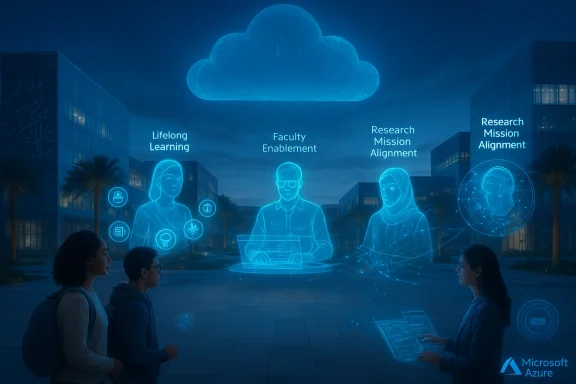
The public statements and briefing materials identify four discrete prototype agents. Each is scoped to a specific, high-valuucation:- Lifelong Learning and Skills Progression agent — Help learners (students, alumni, working professionals) map labour-market signals to competency taxonomies and recommend micro-credentials, short courses, and degree electives tailored to in-demand skills.
- Faculty Enablement and Course Co‑Creation agent — Assist faculty in updating curricula, draftinents, and co-designing industry-aligned credentials more quickly, while producing accreditation-ready artefacts for regulator review.
- Sturning agent — Deliver adaptive, diagnostic-driven learning pathways, scaffolded feedback, and just-in-time supports so students can progress at their own pace with persistent learner memory.
- Research Mission Alignment agent — Map institutional research portfolios to national mission priorities, suggest cross-disciplinary partnerships, match proposals to funding calls, and surface translational pathways to industry and policy impact.
-y chose agents, not just chatbots
The term agentic AI describes systems that go beyond single-turn chat or static content generation: agents can reason, plan, act, and coordinate across multi-step workflows, tie into institutional systems, and execute actions via APIs under human oversight. This makes them a natural fit for complex, multi-party educational tasks — mapping skills to curricula, orchestrating course co-creation with industry, or aligning research proposals where outcomes are the product of several interlocking steps.
Microsoft’s platform capabilities — notably Azure-hosted model endpoints, Azure OpenAI integrations, and Microsoft 365 Copilot tooling — form the expected technical backbone for the prototypes, enabling retrieval-augmented generation (RAG), persistent memory layers, and tool integrations with LMS/SIS environments. The ministry and Microsoft have signalled an intent to explore in-country processing and data residency guarantees to address rce requirements.
Technical contours: architecture, integra realities
Building agentic AI that can safely and reliably operate inside universities is an engineering tane‑learning problem. The likely technical architecture and operational patterns drawn from the ministry’s briefings and regional precedents include:- Azure-hosted inference endpoints and model (Azure OpenAI Service or equivalent) for reasoning and generation.
- RAG pipelines that anchor agent outputs to authoritative institutioncatalogues, accreditation rules, regulator guidance — rather than relying on unconstrained model hallucinations.
- Stateful memory layers to persist learner progress and allow agents to maintain context across sessions.
- Connectors to Learning Management Systems Student Information Systems, credential registries, and national labour-market APIs, along with identity and SSO integrations.
- MLOps and governance tooling: model versioning, audit logs, human‑in‑the‑loop checkpoints, monitoring dashboards, and red-team testing.
Immeogramme aims to deliver
If implemented sensibly, the prototypes could deliver measurable improvements across the higher‑education lifecycle:- Faster, industryrenewal** through automated gap analyses and draft artefacts, reducing friction in updating syllabi and accreditation packages.
- Scaled personalised learning, enablingdiagnostic remediation, and adaptive learning paths that free faculty time for mentoring and research supervision.
- Improved employability alignment, by matchiofiles to labour-market signals and guiding learners toward verified micro‑credentials.
- Accelerated research translation, by surfacing mission-relevant projects, identifying partners, and reducing search friction for funding and industry collaborations.
Material risks and governance challenges (what could go wrong)
Agentic AI changes the risk profile compared with simple chatbots. The MoHESR–Microsoft programme raises several urgent governance and operational questions:1. Data pritudent protection
Agents need access to sensitive student records, grades, and institutional data to personalise effectively. That access creates risks around consent, retention, cross‑border data flows, and secondary use of data. In-country processing commitments help but do not remove the need for clear contractual guarantees, telemetry transparency, and independent attestation of residencyemic integrity and assessment designGenerative systems can assist with assignment creation and grading suggestions, but offloading evaluative judgement to opaque models risks undermining academic standards. Universities must redesign assessment frameworks to be AI-aware — for example, emphasising authentic, portfolio-based assessmfor high-stakes decisions.
3. Bias, fairness, and explainability
Agents that recommend career pathways or identify "high‑impact" research can embed skewed assumptions or unrepresentative training signals, disadvantaging particular student groups. Systematic fairness testing, model cards, and explainability mechanisms requirements.4. Vendor lock‑in and market concentration
Relying heavily on a single cloud provider for national education infrastructure increases bargaining‑power asymmetries and long-term switching costs. Contracts must specify data portability, exportable fine-tuned models, and exit paths to preserve institutional sovereignty.5. Operainability
Cloud-hosted agents at scale carry continued operational costs (inference, storage, network). Without a sustainable funding model, pilot success can become an ongoing fiscal burden. Shared national infrastructure or centralised procurement models may mitigate this, but require transparent cost allocations.6. Geopolitical a
The UAE’s rapid cloud and AI investments create geopolitical dependencies — procurement and export controls around advanced AI hardware and models matter. Public institutions should account for geopolitically driven shifts in permissible model imports, data treaties, and compliance obligations.ts make strong outcome claims (for example, precise percentages of faculty time saved or learning gains), those figures are verifiable only through independent evaluation; early pilot claims should be treated as provisional until robust experimental evidence is published.
Precedents and contextual evidence
The UAE already has local precedents for faculty-facing AI agents. Hamdan Bin Mohammed Smart University (HBMSU) and other regional institutions have piloted agentic systems for faculty enablement and personalised learning, reporting notable productivity and learning improvements in internal announcements — results that are indicative but require independent replication and published methodologies for verification.Microsoft’s regional posture — including investments in local cloud regions, in‑country Copilot processing options, and a portfolio of educator tools — makes it a pragmatic partner for large-scale governmental pilots, but it also accentuates the need for strict governance and contractual clarity.
Measuring success: proposed KPIs and evidence standards
To mov to trusted, scalable services, the programme should adopt a small, robust set of KPIs and a clear evaluation protcomes: changes in mastery and retention measured via randomized controlled trials (RCTs) or matched quasi‑experimental desialignment: percentage of graduates employed in a field related to study within six months; employer validation oentials.- Equity metrics: differential outcomes by gender, nationality, socio‑economic status, and institution type.
- Faculty impact: independently audited time savings broken down by task (course design, grading, adminiSafety incidents: count and severity of agent misrecommendations, data incidents, or governance failures.
A practical, phased implementatthe ministry’s stated approach and realistic engineering timelines, a staged roadmap reduces risk and produces actionable evidence:
- Short term (0–6 months): Participatory design work legal frameworks, and data‑sharing agreements; select small, representative pilot courses or departments.
- Medium term (6–18 months): Build prototypes, run controlled pilots with pre-registered evaluation plans, iterate on technical , RAG sources, memory controls).
- Longer term (18–36 months): Scale successful prototypes into multi‑institution services with audited SLAs, federatiod centralised governance boards; publish longitudinal employment and learning outcome studies.
Practical recommendations for MoHESRcrosoft
Below are targeted, implementable actions to convert ambition into accountable impact:For MoHESR
- Mandate transparent asurement plans and data‑governance requirements before any pilot starts.
- Require model documentation (modeults, and independent algorithmic audits as contractual deliverables.
- Insist on data portability, exportable model artifacts, and defined exit pathwaysin.
- Co‑design pilots with students and faculty, run small staged trials, and redesign assessmegenerative assistance.
- Establish campus AI‑ethics boards that include student representation and rapid incident-response capability.
- Offer regional processing guant attestation and transparent telemetry so institutions can verify residency and data flows.
- Ps testing and accessible monitoring dashboards for real‑time oversight.
Why transparency and independent evaluation matter
The gulf between pilot claims and demonstrable institutional impact is non-trivial. Many earlier educational AI initiatives promised dramatic faculty time savings and learning gains; robust independent replication is what separates optimistic promises from durable policy decisions. The MoHESR–Microsoft programme can set an important global precedent if it embeds transparency, independent auditing, and publicly accessible evaluation into the programme design from day one.Final assessment: pragmatic optimism with disciplined guardrails
The MoHESR–Microsoft collaboration is strategically significant: it pairs ministerial authority and national priorities with a major cloud provider’s platform capabilities and skilling commitments. This asymmetry is a source of power — it can accelerate adoption and provide the scale needed to test agentic approaches meaningfully. It is also a source of risk, because large-scale dependence on a single vendor, combined with insufficient governance, can create systemic fragility in education infrastructure.If MoHESR and its university partners insist on rigorous pilot charters, independent evaluation, strict data governance, and contractual portability, the programme could produce genuine improvements in curriculum agility, personalised learning, and research impact. Without those guardrails, the prototypes risk delivering attractive demos but limited long‑term public value. The difference will be transparency and evidence versus marketing metrics.
The coming months — design workshops, pilot selections, and the first controlled trials — are the critical proving ground. Success will not be measured by the speed of deployment, but by the quality of evaluation, the durability of governance commitments, and the degree to which students and faculty retain agency over educational decisions shaped by AI.
Conclusion
The UAE’sucation and Scientific Research has taken a consequential step by commissioning prototype agentic AI systems with Microsoft. The project has genuine potential to modernise higher education services — if it is pursued with a discipline that matches the scale of the ambition: independent evaluation, clear data contracts, academic oversight, and sustained transparency. Done well, this can produce a replicable model for responsible agentic AI in public education; done poorly, it will be a cautionary lesson about automation without accountability. The path forward is promising, but narrow — and it demands that policy, pedagogy, and engineering move in lockstep.
Source: Technobezz UAE Ministry Partners with Microsoft to Develop AI Agents for Higher Education