

The University of Chicago’s new partnership with AI Research Commons and Microsoft is more than another university startup announcement; it is a deliberate attempt to change where AI ventures get financed, mentored, and scaled. By tying Midwest research institutions to Bay Area investor networks and Microsoft’s technical stack, the initiative tries to close a funding gap that has long slowed university spinouts in the region. The timing is significant: the program arrives just weeks after UChicago and seven other Midwestern universities launched Third Coast Foundry in San Francisco, a shared hub meant to strengthen the Midwest’s presence in one of the world’s most concentrated venture markets
For years, the debate around Midwest innovation has centered on a simple but stubborn problem: the region produces serious research and strong founders, but the capital and attention needed to scale them often sit elsewhere. UChicago’s own announcement frames the new partnership as an effort to lower the friction between early-stage AI research and commercial execution, especially for startups emerging from Third Coast Foundry universities
That framing matters because the startup challenge is no longer just technical. In the AI era, the first company a founder joins, the cloud credits they get, the investor introductions they can access, and the mentors they can call may influence whether an idea survives long enough to become a business. The University of Chicago is clearly betting that infrastructure, not lack of invention, is the bottleneck
This is also part of a broader institutional pattern at UChicago. The Polsky Center and the Data Science Institute have already built startup support programs such as Transform, an accelerator for data science and AI companies, and the university has repeatedly signaled that it wants to commercialize frontier research more aggressively
The new partnership with Microsoft and ARC extends that logic. Instead of merely helping founders with a campus-based accelerator, UChicago is linking them to a much larger ecosystem that includes cloud infrastructure, technical guidance, and investor access. In practical terms, that means the university is not just producing AI talent; it is trying to route that talent into a repeatable commercialization pipeline
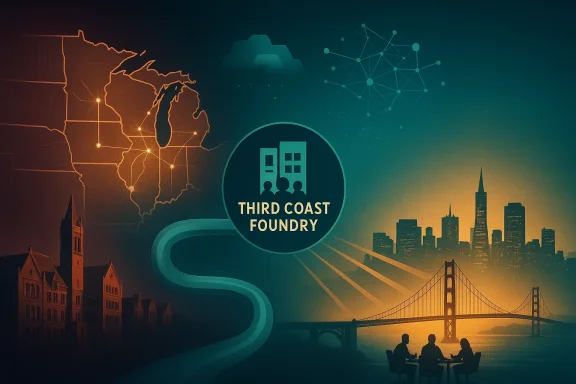
The move also reflects a changing map of the U.S. startup economy. Midwest institutions collectively bring enormous research scale and student populations, but they often lack the venture density of coastal hubs. Third Coast Foundry is an attempt to correct that imbalance by creating a shared West Coast presence rather than asking each university to compete alone for attention
The significance is broader than convenience. A consortium model can increase credibility because it suggests pipeline depth rather than isolated success. When multiple leading universities coordinate, the market is more likely to treat the region as a category, not an anomaly
That choice may frustrate purists who want innovation to stay fully local, but it reflects a hard truth: early-stage AI companies often need both home-field support and access to the largest pools of specialized money. The best version of the model is not either/or; it is Midwest invention with Bay Area reach
That makes the project as much a governance experiment as a startup initiative. If it succeeds, it will show that research universities can collaborate commercially without erasing their individual brands. If it fails, it may simply become another well-intentioned networking platform
That is especially important for AI companies, where inference, model experimentation, and data-heavy workflows can become expensive quickly. When Microsoft couples compute access with guidance, it is not just selling cloud usage; it is embedding itself in the startup’s technical decision-making process
For a university founder, that can compress months of experimentation into weeks. It also creates a subtle but real platform effect: the startup becomes more likely to build its product architecture around Microsoft services because those are the services being introduced at the point of need
It is also consistent with Microsoft’s broader startup posture, which is to present itself not simply as a cloud vendor but as an ecosystem partner. That means education, technical support, and go-to-market help are part of the product story, not side benefits
The implication is that geography still shapes startup destiny. Silicon Valley may no longer monopolize innovation, but it still dominates the networks where decisions are made, especially at seed and pre-seed stages. Third Coast Foundry is an attempt to shorten that distance without forcing founders to relocate immediately
In that sense, the partnership is a reminder that academic excellence and startup success are related but not identical. Research produces ideas; commercialization produces companies. The missing piece is often not intelligence but translation
That matters because cities compete on perceived momentum. If founders, investors, and faculty believe Chicago can support AI companies all the way from concept to capital, the city becomes more attractive as a launch point. The partnership is therefore an economic development story as much as a university story
The new UChicago partnership makes that transition visible. It combines selection, technical support, cloud resources, and investor access in a single program, which is closer to an operating system for startup formation than a simple accelerator
That infrastructure also matters to the universities themselves. If faculty and students can see a clearer path from research to company formation, they are more likely to pursue commercialization rather than leave for existing startups or large tech employers. That can strengthen the local innovation flywheel over time
The program’s design suggests a preference for founders who need help turning credible technology into investable companies. In other words, this is not just a broad incubator; it is a selective pipeline for ventures that can plausibly move into venture-scale growth
That is important for university founders, who often have technical strength but weaker commercial networks than their coastal counterparts. A curated pipeline can help correct that asymmetry by translating academic pedigree into investor confidence
That does not mean the Midwest loses by participating. On the contrary, it may be the smartest way to compete. Instead of waiting for venture attention to come east, the consortium is building a bridge on its own terms
That could create a reinforcing effect: more investor attention encourages more founders to stay in the region longer, which in turn improves the quality of the startup pipeline. The key question is whether the pilot can generate enough visible wins to sustain that loop
That is particularly valuable in the pre-seed phase, where small advantages compound quickly. A better experiment cycle, faster access to models, or a helpful intro can change a company’s trajectory before the outside world even notices it exists
That matters because the next generation of AI builders will not learn only in classrooms. They will learn in hybrid environments where research, product, and market strategy overlap, and programs like this can make that overlap more intentional
That said, faculty involvement will need careful balancing. Universities must preserve academic integrity and avoid giving the impression that all research should be optimized for startup formation. The best outcome is a healthy pipeline, not a monoculture
That is powerful because it aligns short-term founder needs with long-term platform adoption. The startup gets help now; Microsoft gets a potential customer later. This is a classic ecosystem play, but AI makes it even more durable because the technical dependency can become deeper than in ordinary software categories
To win, rivals would need either a superior technical offering, a stronger commercial incentive, or a more compelling regional partnership model. Otherwise, Microsoft’s combination of cloud, software, and startup enablement may be difficult to unbundle
That makes the partnership strategically asymmetric in Microsoft’s favor, even if the immediate public narrative focuses on university support. The company is effectively buying early influence in a high-value startup pipeline
The second thing to watch is whether founders actually use the Microsoft support in a way that changes outcomes. Cloud credits are useful, but the real test is whether they help teams shorten development cycles, improve product quality, and reach investors faster. That will determine whether the partnership creates a measurable advantage or just a temporary boost
The third is whether other universities or regional coalitions copy the model. If Third Coast Foundry works, it could become a template for how research institutions in other parts of the country organize around startup commercialization without giving up their local identities
Source: Chicago Morning Star UChicago partners with Microsoft on AI startups
 Background
For years, the debate around Midwest innovation has centered on a simple but stubborn problem: the region produces serious research and strong founders, but the capital and attention needed to scale them often sit elsewhere. UChicago’s own announcement frames the new partnership as an effort to lower the friction between early-stage AI research and commercial execution, especially for startups emerging from Third Coast Foundry universitiesThat framing matters because the startup challenge is no longer just technical. In the AI era, the first company a founder joins, the cloud credits they get, the investor introductions they can access, and the mentors they can call may influence whether an idea survives long enough to become a business. The University of Chicago is clearly betting that infrastructure, not lack of invention, is the bottleneck
This is also part of a broader institutional pattern at UChicago. The Polsky Center and the Data Science Institute have already built startup support programs such as Transform, an accelerator for data science and AI companies, and the university has repeatedly signaled that it wants to commercialize frontier research more aggressively
The new partnership with Microsoft and ARC extends that logic. Instead of merely helping founders with a campus-based accelerator, UChicago is linking them to a much larger ecosystem that includes cloud infrastructure, technical guidance, and investor access. In practical terms, that means the university is not just producing AI talent; it is trying to route that talent into a repeatable commercialization pipeline
The move also reflects a changing map of the U.S. startup economy. Midwest institutions collectively bring enormous research scale and student populations, but they often lack the venture density of coastal hubs. Third Coast Foundry is an attempt to correct that imbalance by creating a shared West Coast presence rather than asking each university to compete alone for attention
What Third Coast Foundry Actually Changes
Third Coast Foundry is not just a co-working address in San Francisco. It is a strategic signal that Midwest universities are willing to meet investors where they are, while still trying to preserve the region’s own innovation identity. The University of Chicago described the hub as a way to strengthen the collective presence of Midwest research institutions in a venture ecosystem that is still heavily concentrated on the West CoastA shared front door for founders
For founders, the biggest practical shift is access. Rather than each university separately building a fragile bridge to investors, the consortium creates a common front door to capital, mentorship, and commercial support. That can reduce duplication and make it easier for investors to see a stream of vetted teams rather than one-off pitchesThe significance is broader than convenience. A consortium model can increase credibility because it suggests pipeline depth rather than isolated success. When multiple leading universities coordinate, the market is more likely to treat the region as a category, not an anomaly
Why San Francisco still matters
The location is not accidental. The hub sits in South Park, close to a dense concentration of venture capital and the city’s AI corridor, which means founders can gain exposure to capital flows that are still hard to replicate in the MidwestThat choice may frustrate purists who want innovation to stay fully local, but it reflects a hard truth: early-stage AI companies often need both home-field support and access to the largest pools of specialized money. The best version of the model is not either/or; it is Midwest invention with Bay Area reach
A test of institutional coordination
The real challenge is coordination. Universities move at different speeds, have different incentive structures, and often compete for prestige, grants, and startup outcomes. Third Coast Foundry only works if partners can maintain a shared standard for selecting companies and supporting them after selectionThat makes the project as much a governance experiment as a startup initiative. If it succeeds, it will show that research universities can collaborate commercially without erasing their individual brands. If it fails, it may simply become another well-intentioned networking platform
- Shared venture access is the immediate benefit.
- Collective branding may matter as much as the office space.
- West Coast proximity remains strategically important.
- Coordination will determine whether the model scales.
- The consortium approach could become a template for other regions.
Microsoft’s Role in the Commercial Stack
Microsoft is the most consequential external partner in the new arrangement because it brings the infrastructure layer that many university startups cannot afford on their own. UChicago’s announcement says selected companies can receive up to $350,000 in Microsoft for Startups credits, access to AI models through Azure, technical guidance from Microsoft experts, and discounts on tools such as GitHub, Microsoft 365, and LinkedIn PremiumInfrastructure as an accelerator
Those credits are not merely accounting relief. At the earliest stages, cloud costs and engineering bottlenecks can determine whether a startup reaches product-market fit before runway expires. Microsoft’s startup programs are explicitly designed to lower those barriers by offering technical benefits, higher quota access, and startup-friendly support pathwaysThat is especially important for AI companies, where inference, model experimentation, and data-heavy workflows can become expensive quickly. When Microsoft couples compute access with guidance, it is not just selling cloud usage; it is embedding itself in the startup’s technical decision-making process
Why the AI model access matters
The addition of model access is just as important as the credits. Microsoft’s startup materials emphasize access to the latest generative AI models, enterprise-tier quota, and support for building with Azure AI and Azure OpenAI servicesFor a university founder, that can compress months of experimentation into weeks. It also creates a subtle but real platform effect: the startup becomes more likely to build its product architecture around Microsoft services because those are the services being introduced at the point of need
The ecosystem logic behind the partnership
Microsoft’s participation is also a signal to investors. If the company is willing to back a university-linked AI pipeline with credits and expertise, it implies a belief that the region can produce commercially serious startups, not just interesting research projects. That sort of validation can matter when founders are trying to cross the gap from academic credibility to venture credibilityIt is also consistent with Microsoft’s broader startup posture, which is to present itself not simply as a cloud vendor but as an ecosystem partner. That means education, technical support, and go-to-market help are part of the product story, not side benefits
Why This Matters for Midwest Universities
The partnership is as much about geography as it is about AI. UChicago’s announcement cites PitchBook data showing that Midwest startups can take roughly 18 months longer than coastal peers to raise their first $500,000, which points to a structural funding disadvantage rather than a quality problemThe Midwest funding gap is real
That lag can be devastating for early-stage AI founders. A company may have strong research roots, but if it cannot reach its first meaningful round quickly, technical momentum fades, hiring becomes harder, and competitors move in. The result is not just slower growth; it is lost optionalityThe implication is that geography still shapes startup destiny. Silicon Valley may no longer monopolize innovation, but it still dominates the networks where decisions are made, especially at seed and pre-seed stages. Third Coast Foundry is an attempt to shorten that distance without forcing founders to relocate immediately
Research scale alone is not enough
The universities behind the effort collectively represent enormous research investment and a large student population. That gives the consortium depth, but depth does not automatically become company formation unless there is a conversion mechanism between lab work and market launchIn that sense, the partnership is a reminder that academic excellence and startup success are related but not identical. Research produces ideas; commercialization produces companies. The missing piece is often not intelligence but translation
Chicago’s role is becoming more central
For Chicago specifically, the move reinforces the city’s position as a serious commercialization hub rather than just an academic center. The Polsky Center already serves as UChicago’s technology transfer office and entrepreneurship engine, so the Microsoft-ARC partnership adds external legitimacy to work that has been building for yearsThat matters because cities compete on perceived momentum. If founders, investors, and faculty believe Chicago can support AI companies all the way from concept to capital, the city becomes more attractive as a launch point. The partnership is therefore an economic development story as much as a university story
- The Midwest’s issue is access, not talent.
- Research output is abundant, but capital pathways are uneven.
- Faster first funding can change startup survival odds.
- Chicago gains credibility as a commercialization hub.
- The model could help keep more founders in-region longer.
AI Commercialization and the New University Model
This partnership is part of a broader shift in how universities think about entrepreneurship. Not long ago, many research institutions treated startup creation as a useful byproduct of campus innovation. Now they increasingly treat commercialization as a core mission, especially in AI, where breakthroughs can move from publication to product with unusual speedFrom lab to launch
University startup programs used to focus on education, mentoring, and occasional introductions. Today they must also address compute access, AI model experimentation, deployment advice, and investor readiness. That is a much more integrated value proposition, and it reflects the reality of modern AI developmentThe new UChicago partnership makes that transition visible. It combines selection, technical support, cloud resources, and investor access in a single program, which is closer to an operating system for startup formation than a simple accelerator
The role of applied AI infrastructure
AI startups are unusually infrastructure-intensive. Unlike many older software businesses, they often need fast iteration on model behavior, workflow integration, evaluation, and governance. Microsoft’s offer of credits and technical help directly addresses those pain points, which is why the partnership has real operational value and not just symbolic appealThat infrastructure also matters to the universities themselves. If faculty and students can see a clearer path from research to company formation, they are more likely to pursue commercialization rather than leave for existing startups or large tech employers. That can strengthen the local innovation flywheel over time
What kind of companies are likely to emerge
The likely beneficiaries are early-stage companies with serious technical depth but limited commercial reach. That may include new foundation-model applications, vertical AI tools, scientific software, or research-adjacent platforms built by teams with strong university tiesThe program’s design suggests a preference for founders who need help turning credible technology into investable companies. In other words, this is not just a broad incubator; it is a selective pipeline for ventures that can plausibly move into venture-scale growth
- University commercialization is becoming more strategic.
- AI startups need compute, not just mentoring.
- The best founders need both lab credibility and market access.
- Selectivity will be key to protecting quality.
- Research universities now compete on startup conversion rates.
The Investor Angle
One of the most important features of the announcement is that it addresses the network problem head-on. ARC’s role is to help connect selected founders with Bay Area investors, which is crucial because early-stage funding still depends heavily on who sees you and how quickly you can build trustWhy curated access matters
Warm introductions outperform cold outreach, especially in a market crowded with AI pitches. By curating startup selection and then offering direct investor pathways, the program increases the likelihood that serious teams get serious attention rather than getting lost in the noiseThat is important for university founders, who often have technical strength but weaker commercial networks than their coastal counterparts. A curated pipeline can help correct that asymmetry by translating academic pedigree into investor confidence
Bay Area capital is still the benchmark
Even in a more distributed startup economy, Bay Area capital remains a reference point for AI credibility. The fact that Third Coast Foundry is built around San Francisco rather than trying to avoid it says a lot about how power is still structured in the venture marketThat does not mean the Midwest loses by participating. On the contrary, it may be the smartest way to compete. Instead of waiting for venture attention to come east, the consortium is building a bridge on its own terms
Potential downstream effects
If the program works, it could influence how investors source deals from university ecosystems more generally. A consistent stream of well-supported startups would make it easier for venture firms to allocate time and diligence resources to the Midwest pipelineThat could create a reinforcing effect: more investor attention encourages more founders to stay in the region longer, which in turn improves the quality of the startup pipeline. The key question is whether the pilot can generate enough visible wins to sustain that loop
Who Benefits Most: Founders, Students, and Faculty
This partnership is likely to have different effects across the university ecosystem. Founders get the most obvious support, but students and faculty stand to gain as well, especially if the program deepens the commercialization pipeline around AI researchFounders
For startup teams, the biggest upside is reduced friction. Cloud credits, expert guidance, and investor introductions can help founders focus on product and customers instead of basic survival logisticsThat is particularly valuable in the pre-seed phase, where small advantages compound quickly. A better experiment cycle, faster access to models, or a helpful intro can change a company’s trajectory before the outside world even notices it exists
Students
Student interns are part of the package, which means the program also serves as a training ground. Students gain exposure to live startup problems, founder decision-making, and the realities of AI commercialization, all of which are hard to replicate in coursework aloneThat matters because the next generation of AI builders will not learn only in classrooms. They will learn in hybrid environments where research, product, and market strategy overlap, and programs like this can make that overlap more intentional
Faculty
For faculty, the partnership could make industry translation more attractive. Researchers who want their work to matter outside academia often need a straightforward path to startup creation, licensing, or partnership support. The more credible that path becomes, the more likely it is that commercializable ideas stay connected to the universityThat said, faculty involvement will need careful balancing. Universities must preserve academic integrity and avoid giving the impression that all research should be optimized for startup formation. The best outcome is a healthy pipeline, not a monoculture
- Founders get infrastructure and investor access.
- Students gain real startup exposure.
- Faculty gain clearer commercialization pathways.
- The university strengthens its innovation brand.
- The ecosystem becomes more interconnected.
Competitive Implications for Microsoft and Rivals
Microsoft benefits from this partnership in ways that go beyond startup goodwill. It places Azure and Microsoft’s AI tools at the center of early-stage company formation, which can create long-term platform loyalty if those startups grow on the stack they first received for freeMicrosoft’s ecosystem advantage
Microsoft’s startup strategy is built around a familiar logic: reduce the cost of entry, win the workflow, and make the platform sticky before competitors can displace it. Official Microsoft materials emphasize free access to generative AI models, technical guidance, and startup benefits that can expand as a company growsThat is powerful because it aligns short-term founder needs with long-term platform adoption. The startup gets help now; Microsoft gets a potential customer later. This is a classic ecosystem play, but AI makes it even more durable because the technical dependency can become deeper than in ordinary software categories
What rivals have to overcome
Competitors will not just be competing on model quality or cloud pricing. They will be competing against a distribution strategy that starts at the university level and extends through startup support, student talent, and venture access. That is a much harder moat to attack than a single product featureTo win, rivals would need either a superior technical offering, a stronger commercial incentive, or a more compelling regional partnership model. Otherwise, Microsoft’s combination of cloud, software, and startup enablement may be difficult to unbundle
Why the timing is smart
The timing also helps Microsoft. AI startups are still deciding which platforms to trust for infrastructure and launch support, so the companies that shape those early choices can influence the market for years. By plugging into university commercialization now, Microsoft is investing in the next wave of builders before they have set their long-term loyaltiesThat makes the partnership strategically asymmetric in Microsoft’s favor, even if the immediate public narrative focuses on university support. The company is effectively buying early influence in a high-value startup pipeline
Strengths and Opportunities
The partnership’s strongest quality is that it is concrete. It offers credits, models, technical support, and investor access rather than broad rhetoric about innovation, and that gives the program a real chance to move founders faster than traditional university support alone. It also aligns incentives across universities, Microsoft, and ARC in a way that could make the model repeatable if the pilot produces visible startup wins- It gives startups real infrastructure, not just advice.
- It strengthens the Midwest’s venture visibility.
- It could improve time-to-first-funding for founders.
- It creates a more credible commercialization pipeline.
- It may retain more talent in the Midwest longer.
- It adds student and faculty opportunities beyond venture access.
- It gives Microsoft a stronger ecosystem foothold in university AI.
Risks and Concerns
The biggest risk is that the program becomes more symbolic than transformative. If selection is too narrow, follow-through too weak, or investor access too shallow, the partnership could produce headlines without materially changing the Midwest funding gap. There is also a broader concern that university commercialization efforts can drift toward hype if they are measured more by announcements than by durable company formation- The pilot may overpromise and underdeliver.
- Startup selection could become too elite or subjective.
- Heavy dependence on Microsoft could create platform lock-in.
- Investor access may not convert into actual checks.
- Universities may struggle to maintain coordination over time.
- The model could favor companies already close to venture readiness.
- Geographic imbalance may persist if coastal capital remains dominant.
What to Watch Next
The next few months will reveal whether this is a meaningful commercialization bridge or simply a well-packaged initiative. The most important milestone is the first cohort announcement, because the quality and diversity of those startups will tell us a lot about the program’s ambition and whether the consortium can attract technically serious teams with credible market potentialThe second thing to watch is whether founders actually use the Microsoft support in a way that changes outcomes. Cloud credits are useful, but the real test is whether they help teams shorten development cycles, improve product quality, and reach investors faster. That will determine whether the partnership creates a measurable advantage or just a temporary boost
The third is whether other universities or regional coalitions copy the model. If Third Coast Foundry works, it could become a template for how research institutions in other parts of the country organize around startup commercialization without giving up their local identities
- Watch for the first startup cohort and its technical quality.
- Watch whether founders convert credits into faster milestones.
- Watch for follow-on investor participation after the pilot starts.
- Watch whether the model expands beyond AI into other deep-tech sectors.
- Watch for signs that other regions try to build similar consortia.
Source: Chicago Morning Star UChicago partners with Microsoft on AI startups
