

The University of Georgia has quietly entered the national conversation about generative AI on campus by launching a student-facing AI pilot program, a move that signals a shift from prohibition toward guided integration — but one that also raises immediate questions about privacy, pedagogy, governance and vendor risk. verview
Colleges and universities across the United States are no longer asking whether AI will arrive on campus; they are asking how best to shape it. Administrators today face three broad strategic choices: ban, restrict, or integrate. Bans are attractive because they are simple to announce, but experience shows they are brittle in the face of ubiquitous personal devices and free public models. Guided, institution-level pilots — like the one UGA has begun — represent a different tack: controlled access plus training and governance. That is precisely the framing that student journalism and campus communications have emphasized in describing UGA’s newly announced pilot.
This shift mirrors Some universities have pursued broad vendor partnerships to provide access at scale; a high-profile recent example is the University of Manchester’s announcement that all students and staff would receive Microsoft 365 Copilot access and training — a roll‑out framed explicitly as an equity measure alongside a major governance exercise. The Manchester case offers both a model and a cautionary tale: it shows how quickly access can scale and how quickly governance and operational complexity must follow.
At UGA, the pilot is presented as a bounded experiment intended to test how students actually use generative systems and what protections are necessary before any larger decision is made. The original student newsroom excerpt provided to this piece situates the program within campus life — referencing student communication tools and the realities of anonymous, peer-driven platforms — and frames the pilot as a pragmatic alternative to outright bans. Where the supplied excerpt is silg those gaps below and recommend areas where UGA should publish clarity.
Many faculty and administrators still worry that AI will produce instant essay mills and reduce deep learning to an invisible act of outsourcing. Those concerns are valid, but a growing body of experience suggests that well-designed pilots outperform bans in practical outcomes:
Practical steps every campus pilot should require before expansion:
Two specific implications:
Other institutions are moving more cautiously with bounded, assessment‑focused pilots that insist on DLP and human review before expansion. The emerging consensus across these varied approaches is clear: governance beats speed when it comes to durable educational benefits and minimized harms.
The stakes are both practical and ethical. Done well, a campus AI pilot can teach students not just how to use a tool but how to interrogate its outputs, contest its claims, and accept responsibility for human judgment. Done badly, the same technology can entrench inequities, leak sensitive records, and hollow out learning outcomes.
UGA has taken an essential first step; the quality of what follows will be determined by transparency, measurable governance, and an institutional willingness to publish both successes and failures so other campuses can learn. The rest of higher education is watching — and the lessons UGA shares will matter beyond Athens.
Source: The Red & Black UGA launches AI pilot program for students
Colleges and universities across the United States are no longer asking whether AI will arrive on campus; they are asking how best to shape it. Administrators today face three broad strategic choices: ban, restrict, or integrate. Bans are attractive because they are simple to announce, but experience shows they are brittle in the face of ubiquitous personal devices and free public models. Guided, institution-level pilots — like the one UGA has begun — represent a different tack: controlled access plus training and governance. That is precisely the framing that student journalism and campus communications have emphasized in describing UGA’s newly announced pilot.
This shift mirrors Some universities have pursued broad vendor partnerships to provide access at scale; a high-profile recent example is the University of Manchester’s announcement that all students and staff would receive Microsoft 365 Copilot access and training — a roll‑out framed explicitly as an equity measure alongside a major governance exercise. The Manchester case offers both a model and a cautionary tale: it shows how quickly access can scale and how quickly governance and operational complexity must follow.
At UGA, the pilot is presented as a bounded experiment intended to test how students actually use generative systems and what protections are necessary before any larger decision is made. The original student newsroom excerpt provided to this piece situates the program within campus life — referencing student communication tools and the realities of anonymous, peer-driven platforms — and frames the pilot as a pragmatic alternative to outright bans. Where the supplied excerpt is silg those gaps below and recommend areas where UGA should publish clarity.
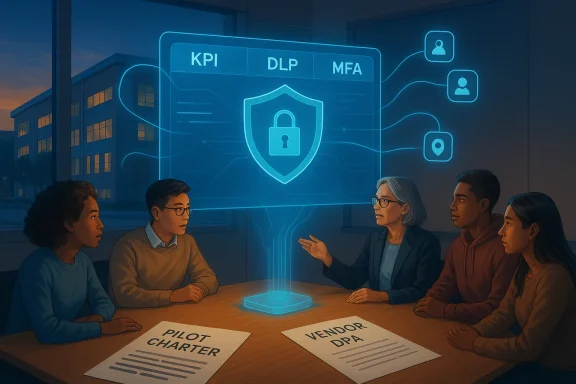 Why pilots — not bans — are winning on campus
Many faculty and administrators still worry that AI will produce instant essay mills and reduce deep learning to an invisible act of outsourcing. Those concerns are valid, but a growing body of experience suggests that well-designed pilots outperform bans in practical outcomes:- Bans are easy to evade and hard to enforce at scale; students will use tools on phones and laptops whether or not instructors allow them.
- Access paired with literacy training turns AI from a cheating risk into a teaching opportunity. Students learn to evaluate outputs, verify sources, and annotate AI assistance.
- Pilots allow campuses to measure both benefits (time saved, improved drafts, productivity lifts) and harms (accuracy problems, data leakage, academic‑integrity events) before committing to full deployment.
What the UGA pilot appears to include — and what is not yet public
Frpt and local reporting, these elements are central to UGA’s stated approach:- The pilot is explicitly bounded to a subset of students and/or courses rather ths‑wide deployment.
- The university frames the effort as education-focused: teaching responsible use, integrating AI literacy into coursework, and monitoring effects on learning.
- The announcement situates the pilot within broader campus social dynamics — noting that students already form communities and circulate information through apps (the excerpt mentions Yik Yak as an example of an anonymous, campus‑centered platform). This social context matters because it shapes how students will share prompts, outputs, and work.
- Which vendor or model(s) are being used, and under what contractual terms?
- Are student inputs to the model retained, used to train third‑party models, or otherwise logged beyond audit needs?
- What technical controls (DLP, conditional access, logging, encryption) are already in place, and what will be required before expansion?
- What are the pilot’s precise success metrics and timeline for public reporting?
Data protection and FERPA: the legal frame every campus must respect
Any university handling student educational records must reckon with FERPA (the Family Educational Rights and Privacy Act), which governs disclosure and use of education records. FERPA does not prohibit sharing some data with third‑party vendors, but it does require institutions to act as the controller and limit vendor use to documented, educationally legitimate purposes under contract. The devil is in the contract: provisions about data retention, deletion, training use, breach notification timelines and audit rights are essential. University registrars and privacy offices have already issued guidance warning about unvetted generative tools because models might persist or repurpose student data unless contracts explicitly forbid training or secondary use.Practical steps every campus pilot should require before expansion:
- Require an explicit vendor data processing addendum (DPA) that prohibits use of student inputs for model training unless the university has opt‑in consent and clear technical assurances.
- Specify retention windows, deletion procedures, and auditable logs of requests and responses.
- Insist on encryption in transit and at rest, MFA for administrative access, and role‑based access controls.
- Implement Data Loss Prevention (DLP) rules and conditional access so that sensitive education record fields (student IDs, grades, health or counseling notes) cannot be inadvertently submitted to an external LLM.
- Maintain an incident response playbook that coordinates IT, legal, student conduct, and counseling resources.
Technical controls: harden first, expand later
The technical checklist for a responsible campus pilot is deceptively short and operationally demanding:- Audit trails: log user interactions and keep tamper‑resistant records that can be reviewed in academic‑integrity investigations.
- DLP and redaction: detect and block PII and education record patterns before they leave campus identity domains.
- Conditional access: limit model access by network, device posture, and user role.
- Human‑in‑the‑loop (HITL): any system that produces feedback used in grading, advising, or counseling should include mandatory human review and flags for low‑confidence outputs.
- Model cards and transparency: demand that vendors publish model cards describing capabilities, limitations, known biases, and training datasets where feasible.
Academic integrity and pedagogy: redesign, don’t scapegoat
Generative AI changes what assessments reliably measure. The most effective pedagogical responses are not punitive—they are design‑oriented:- Redesign assignments so process matters: require drafts, revisions, annotated sources, and in‑class defenses that expose the student’s reasoning.
- Require disclosure of AI assistance: students should submit a short prompt log or reflective note documenting how AI helped, what edits they made, and why.
- Use hybrid assessment modes: oral exams, timed in‑class problem solving, and project portfolios are less amenable to simple AI reproduction.
- Train faculty: scenario‑based workshops on prompt design, hallucination detection, citation, and how to grade AI‑informed work fairly.
Student experience, campus apps, and the problem of anonymity
The newsroom excerpt that accompanied UGA’s pilot links the rollout to campus social dynamics and community apps — naming Yik Yak as a representative example of anonymous, proximity‑based platforms that shape campus conversation. That linkage is instructive: students do not inhabit discrete silos of “learning tools” and “social apps”; they move across platforms, copy prompts, and share outputs. An AI pilot that does not account for information flow across campus social systems risks leakage of prompts, model outputs, and assessment artifacts into public or semi‑public spaces.Two specific implications:
- Moderation and safety: AI can help moderate harassment on anonymous forums, but moderation models must be audited for fairness and appeal. Poorly tuned moderation can silence legitimate speech or misclassify context.
- Signal amplification: A single student’s copied prompt or model output can quickly amplify across hundreds of peers on campus apps, normalizing particular prompt patterns or outsourcing practices.
Vendor risk, lock‑in, and exit planning
Institutional agreements with big cloud AI vendors can be tempting: they scale quickly, come with training packages, and offer polished interfaces. But they also carry long‑term risks:- Vendor lock‑in: deeply embedding a single vendor’s assistant in learning platforms and administrative workflows can make migration costly and disruptive.
- Contract opacity: licensing agreements may retain rights over derivative uses or impose unforeseen restrictions on data exports.
- Hidden costs: integration, monitoring, training, and incident response often cost more than license fees.
KPIs and measurement: what success looks like
If UGA intends to move from pilot to program, it must define success in measurable terms. Useful KPIs include:- Adoption metrics: percent of pilot cohort using the tool, frequency of use, and distribution across demographics.
- Accuracy / correction rate: how often students or staff must correct or reject model outputs.
- Academic integrity incidents: counts and types of integrity violations tied to AI usage, normalized per 10,000 interactions.
- Learning impact: comparison of performance on redesigned assessments elines.
- Security events: number and severity of DLP alerts, breaches, or unauthorized disclosures.
- Accessibility metrics: measures of whether the pilot reduced or increased barriers for students with disabilities, low bandwidth, or limited device access.
- Environmental footprint: energy consumption per 1,000 interactions, where measurable.
Practical, prioritized checklist for UGA’s next 90 days
To move from announcement to accountable practice, UGA should complete the following before broadening the pilot:- Publicly publish the pilot charter, including scope, timelines, courses or cohorts involved, and the success metrics above.
- Release a summary of vendor contractual terms relevant to student data (DPA highlights, training‑use clauses, retention windows) or publish a redacted summary if confidentiality prevents full disclosure.
- Harden technical controls: DLP, conditional access, audit logging, and MFA for administrative roles.
- Launch mandatory short training modules for pilot participants (students t design, hallucination detection, documentation and citation practices.
- Form an AI steering committee including students, faculty, IT, legal, privacy, and disability services to co‑design policy and handle incident triage.
- Prepare an accessible appeal and incident reporting process for students who feel harmed by AI outputs or moderation decisions.
Risks the university must not downplay
No pilot is risk‑free. UGA’s leadership must treat the following as real possibilities and monitor them aggressively:- Data leakage that triggers FERPA complaints or regulatory scrutiny.
- Rapid normalization of outsourcing behaviors among students if assignments are not redesigned.
- Accessibility or equity gaps if certain students cannot access the tools or the support needed to use them effectively.
- Reputational fallout from biased or harmful model outputs that receive public attention.
- Vendor disputes over data or slow response to incident remediation.
Lessons from peer institutions
The University of Manchester’s campus‑wide Copilot deal shows both what is possible and what governance must accompany it: universal access, training programs, and an emphasis on digital equity. Manchester paired rollout with student and staff engagement and committed to reporting and environmental transparency — an example worth studying carefully.Other institutions are moving more cautiously with bounded, assessment‑focused pilots that insist on DLP and human review before expansion. The emerging consensus across these varied approaches is clear: governance beats speed when it comes to durable educational benefits and minimized harms.
Final assessment: strengths, gaps, and the path forward
Strengths of UGA’s announced approach- The pilot framing shows institutional humility: UGA is choosing to test rather than leap.
- The emphasis on student experience and literacy recognizes that AI is a learnable skill that belongs in the curriculum.
- Positioning the pilot within campus social realities (peer apps, anonymous platforms) is pragmatically honest and helps prepare for real‑world behavior patterns.
- Public transparency is insufficient: UGA should publish the pilot charter, vendor DPA highlights, and clear KPIs now.
- Technical and legal safeguards must be demonstrably in place before any expansion; vague promises are not enough.
- Faculty support for assessment redesign must be resourced; otherwise, the pilot risks normalizing shortcuts rather than cultivating literacy.
- Publish the pilot charter and KPIs within 30 days.
- Harden the technical stack and publish a plain‑language summary of data handling within 45 days.
- Launch student and faculty training and make participation a condition for continued access in the pilot cohort.
- Report a first public metrics dashboard at the end of the pilot term so the campus — and peers — can learn from UGA’s real outcomes.
Conclusion
UGA’s AI pilot program is an important and responsible pivot away from the false security of blanket bans toward a mode of guided integration that centers learning, measurement and governance. That approach is aligned with how leading institutions are choosing to respond to the generativeromise of campus AI — improved accessibility, better feedback loops, and new pedagogical tools — will only be realized if the university treats privacy, technical controls, vendor terms, and assessment redesign as non‑negotiable prerequisites rather than afterthoughts.The stakes are both practical and ethical. Done well, a campus AI pilot can teach students not just how to use a tool but how to interrogate its outputs, contest its claims, and accept responsibility for human judgment. Done badly, the same technology can entrench inequities, leak sensitive records, and hollow out learning outcomes.
UGA has taken an essential first step; the quality of what follows will be determined by transparency, measurable governance, and an institutional willingness to publish both successes and failures so other campuses can learn. The rest of higher education is watching — and the lessons UGA shares will matter beyond Athens.
Source: The Red & Black UGA launches AI pilot program for students
