

UiPath’s share price has sunk to roughly a quarter of its IPO level even as the company still claims a dominant grip on the niche that invented the term “robotic process automation,” leaving investors and enterprises to ask a blunt question: is this a quietly mispriced gateway into enterprise AI, or a mature niche being overrun by broader generative-AI incumbents?
UiPath began life as a small automation shop and became the poster child for RPA — software “robots” that mimic repetitive human interactions with enterprise systems to automate tasks such as invoice processing, employee onboarding, and mass communications. The company rode an early wave of corporate enthusiasm for process automation, scaled quickly through a developer- and partner-heavy go-to-market approach, and listed publicly with investor expectations that it would be a long, high-growth runway into enterprise automation.
Over the past few years, that upbeat narrative has encountered several headwinds. Revenue growth has slowed from the hyper-growth phase many expected; the company has cycled through leadership changes; competition is intensifying from both specialized RPA rivals and from large cloud and AI vendors that can bundle automation into broader productivity stacks; and capital-market dynamics have compressed valuations for unprofitable cloud and software names. UiPath today occupies a curious middle ground: a profitable-feeling operational profile in terms of gross margins and platform depth, but a market-cap and price action that reflect skepticism about its growth trajectory and strategic relevance in an AI-first world.
Yet market definitions matter. The biggest existential risk to a dedicated RPA vendor is not that automation disappears, but that the definition of “automation” broadens and incumbents with larger ecosystems bundle equivalent or superior capabilities into productivity or cloud platforms. When generative AI and large-language-model (LLM) driven assistants begin to automate conversational and knowledge-worker tasks that previously required integrating multiple point tools, the RPA category could be reframed as one component in a much larger “intelligent automation” stack rather than the driver of transformation.
Key financial traits to note:
Strategically, UiPath faces a policy decision: accelerate investment to broaden the platform into more horizontal AI-infused capabilities and integrations, or double down on profitability and protect cash flow while trying to out-execute on the core RPA play. So far, the company has pursued the latter, prioritizing cost control and path-to-profit rather than an expansionary M&A spree. That posture is rational when capital is expensive and investor patience is short — but it can cede ground to fast-moving competitors that are embedding automation inside broader suites.
At the same time, the threats from generative AI and large-platform bundlers are not abstract; they are active forces that can reshape how enterprises buy automation. UiPath’s strategic decision to pivot toward profitability rather than aggressive expansion is a defensible short-term choice, but it does not remove the long-term imperative to evolve into an “intelligent automation” platform that meaningfully leverages LLMs, domain-specific AI, and seamless cloud integrations.
For investors, the position is not a simple “buy” or “sell.” It is a risk-managed opportunity: if management can demonstrate consistent growth stabilization, profitable execution, and clear product differentiation from embedded alternatives, UiPath could be an asymmetrically attractive investment or acquisition candidate. If those proof points do not appear and competitive bundling accelerates, the company may see further multiple contraction or strategic irrelevance.
UiPath occupies an intriguing strategic crossroads: it is not dead on arrival, nor is it the obvious next-generation AI winner. The company’s fate will be decided by execution — the speed at which it can turn platform depth into AI-native differentiation and the degree to which it can defend distribution against much larger vendors. For enterprises and investors seeking exposure to the automation-to-AI transition, UiPath is a worthwhile candidate to watch closely; whether it becomes the next big winner depends on choices that are still being made.
Source: The Motley Fool Could This Quiet AI Company Become the Next Big Winner? | The Motley Fool
 Background
UiPath began life as a small automation shop and became the poster child for RPA — software “robots” that mimic repetitive human interactions with enterprise systems to automate tasks such as invoice processing, employee onboarding, and mass communications. The company rode an early wave of corporate enthusiasm for process automation, scaled quickly through a developer- and partner-heavy go-to-market approach, and listed publicly with investor expectations that it would be a long, high-growth runway into enterprise automation.Over the past few years, that upbeat narrative has encountered several headwinds. Revenue growth has slowed from the hyper-growth phase many expected; the company has cycled through leadership changes; competition is intensifying from both specialized RPA rivals and from large cloud and AI vendors that can bundle automation into broader productivity stacks; and capital-market dynamics have compressed valuations for unprofitable cloud and software names. UiPath today occupies a curious middle ground: a profitable-feeling operational profile in terms of gross margins and platform depth, but a market-cap and price action that reflect skepticism about its growth trajectory and strategic relevance in an AI-first world.
What UiPath actually does: product and platform
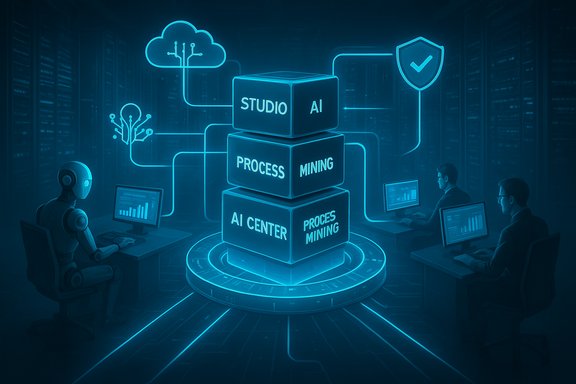
UiPath’s offering is a layered enterprise automation platform engineered to remove repetitive, rules-based human labor from digital workflows. Its product portfolio includes:- Orchestrator and robot runtime for scheduling and managing unattended automations.
- Designer/Studio tools for building automation workflows (low-code/no-code and developer tools).
- Attended automation for desktop assistants that augment human workers.
- Process and task mining to discover and prioritize automation candidates.
- Document understanding and intelligent OCR to extract structured data from semi-structured documents.
- AI/ML integrations and an “AI Center” to operationalize models that enhance decision steps inside automations.
- Governance, security, and analytics for enterprise-scale deployment and compliance.
Market size and positioning
UiPath still claims meaningful share in RPA — historically estimated at roughly a third of the RPA market — and the industry’s long-term narrative remains compelling. Many analysts project sizable growth in automation adoption as companies look to increase operational efficiency and reduce manual costs. Forecasts that anticipate a multi-year compound annual growth rate in the high tens of percent for the RPA market underpin the optimistic case that the niche will expand far beyond today’s adoption levels.Yet market definitions matter. The biggest existential risk to a dedicated RPA vendor is not that automation disappears, but that the definition of “automation” broadens and incumbents with larger ecosystems bundle equivalent or superior capabilities into productivity or cloud platforms. When generative AI and large-language-model (LLM) driven assistants begin to automate conversational and knowledge-worker tasks that previously required integrating multiple point tools, the RPA category could be reframed as one component in a much larger “intelligent automation” stack rather than the driver of transformation.
Financial snapshot and valuation considerations
UiPath’s recent financial journey is characterized by a transition from growth-at-all-costs to profit prioritization. Revenue grew substantially earlier in its public life, but growth decelerated in the latest reported periods. At the same time, the company has shifted its internal priorities toward margin improvement and GAAP profitability, signaling a more conservative capital allocation posture.Key financial traits to note:
- Revenue growth slowed materially in the most recent fiscal periods compared with earlier years of high expansion.
- Gross margins for the platform remain strong relative to software peers, reflecting SaaS-like economics and scalable delivery.
- Management’s emphasis on profitability produced sharp cost reductions and headcount pruning rather than aggressive acquisition or go-to-market expansion.
- The company’s valuation metrics today look modest relative to high-flying AI software names: a market-value-to-earnings (or EV/EBITDA) multiple that would come across as “cheap” if the company actually hits near-term profit targets and stabilizes growth.
Leadership and strategy: stability vs. signals of trouble
The company’s board and executive dynamics deserve attention. Leadership changes at software companies often accompany strategic redirection; the optics of frequent CEO transitions can also erode investor trust and slow execution. UiPath’s leadership shuffle — a founder stepping aside, a co-CEO experiment, and then a return to founder leadership — flags both the difficulty of the strategic pivot and management’s view that the original vision still matters.Strategically, UiPath faces a policy decision: accelerate investment to broaden the platform into more horizontal AI-infused capabilities and integrations, or double down on profitability and protect cash flow while trying to out-execute on the core RPA play. So far, the company has pursued the latter, prioritizing cost control and path-to-profit rather than an expansionary M&A spree. That posture is rational when capital is expensive and investor patience is short — but it can cede ground to fast-moving competitors that are embedding automation inside broader suites.
Biggest competitive threats
The competitive landscape has shifted from a small group of RPA-focused rivals to a broader field where cloud and AI giants bring familiar risks:- Platform bundlers: Large cloud and productivity vendors can embed automation into widely adopted tools, lowering switching frictions and making dedicated RPA less compelling.
- Generative AI agents: LLM-driven assistants can automate or augment tasks previously solved by deterministic RPA flows, especially in knowledge work or any process requiring natural language understanding and synthesis.
- Specialist challengers: Focused automation vendors continue to innovate in vertical use cases, potentially out-executing a horizontal vendor on domain-specific workflows.
- Price compression and commoditization: As more automation capabilities are commoditized, long-term pricing power may erode.
Product differentiation and technical strengths
Despite the competitive pressures, UiPath retains several technical and go-to-market strengths that are non-trivial:- Platform breadth: The end-to-end capability from process discovery to robot orchestration is harder to replicate than a single point-solution.
- Developer and partner ecosystem: A large base of trained automation developers, consultancies, and marketplace components accelerate deployment and reduce time-to-value.
- Enterprise-grade governance: Large organizations prize control, auditability, and security — areas where UiPath has explicit functionality designed for compliance-sensitive use cases.
- Focus on “solutions” not just software: By positioning automation as a business-transformation play and investing in process mining, UiPath increases the odds of capturing a larger part of the customer wallet beyond simple bot licensing.
Where UiPath could go right: upside scenarios
- Successful transition to “intelligent automation” platform: If UiPath can integrate LLMs, domain models, and process intelligence to offer AI-native automation that’s demonstrably better than point solutions, it becomes a clear enterprise AI play.
- Renewed acceleration through partnerships: Strategic alliances with cloud or productivity vendors could provide distribution lift and embed UiPath deeper into enterprise stacks.
- Margin expansion and cash-flow improvement: Executing on profitability while keeping a steady revenue base could make UiPath an attractive takeover target for a larger cloud vendor wanting automation capabilities.
- Execution on verticalization: Building or acquiring vertical-specific workflows (healthcare, banking, insurance) can create defensible revenue streams with higher switching costs.
Where UiPath could go wrong: downside scenarios and risks
- Integration and bundling by larger vendors: If cloud or productivity companies successfully deliver “good enough” automation embedded in their suites, many mid-market customers may never re-buy a separate RPA platform.
- Rapid commoditization: Basic task automation can become a utility, depressing license pricing and contracting growth.
- Loss of developer mindshare: If the company fails to keep the developer and partner ecosystem engaged, velocity of innovation and deployment could decline.
- Execution missteps: Leadership churn, weak go-to-market strategy, or underinvestment in AI capabilities could accelerate revenue decline.
- Customer concentration and churn: If churn increases or large customers move to alternative platforms, top-line durability will be tested.
Investment framework: how to think about UiPath as an investment
UiPath’s current profile makes it a classic binary bet that fits into one of three investor archetypes:- The speculative turnaround buyer: Aims to buy at depressed multiples and bet on execution, product differentiation, or a strategic acquisition. Time horizon: multi-year. Risk: high, reward: high if successful.
- The value-oriented acquirer: Sees steady cash generation, margin expansion, and potential for private-market takeout. Time horizon: medium-term. Risk: moderate; payoff depends on buyer appetite.
- The strategic user/customer: An enterprise that leverages UiPath strategically to accelerate digital transformation and can tolerate vendor-specific tail risks.
- Growth stabilizes or re-accelerates: Look for sequential improvement in ARR growth and net new logo momentum.
- Profitability path: Verify that GAAP profitability targets are met and that margin expansion is sustainable.
- Product differentiation: Confirm meaningful advances in AI-driven capabilities that are not easily replicated.
- Customer health: Monitor churn, upsell rates, and the share of enterprise wallet captured.
- Leadership stability: Long-term CEO and C-suite consistency reduces execution risk.
- Partner traction: Strategic distribution deals that materially increase total addressable market access.
- M&A discipline: Any acquisitions should be clearly accretive to product breadth or market expansion.
Tactical opportunities and defensive hedges
Active investors who believe in UiPath’s upside and want to manage downside should consider:- Staggered exposure: Phased buying to mitigate timing risk as execution updates arrive (quarterly pacing tied to KPIs).
- Pair trades or hedges: Balance exposure to UiPath with long positions in more diversified cloud or AI winners to protect against category compression.
- Options strategies: Use protective puts or collars to limit downside while keeping upside optionality.
- Watch product milestones: Event-driven trading around earnings that disclose ARR, churn, and AI product adoption metrics.
The strategic acquirer thesis
One of the most interesting non-organic outcomes is acquisition. UiPath’s combination of customers, IP, and ecosystem is attractive to larger vendors that need automation capabilities. A strategic buyer could:- Instantly embed automation into a broader productivity or cloud portfolio.
- Use UiPath’s platform to add a governance layer for multi-vendor automation.
- Cross-sell existing cloud and AI services into UiPath’s enterprise installed base.
Verdict: a practical, nuanced view
UiPath today is best described as a market-leading automation platform wrestling with a market that is changing faster than many expected. The company’s core strengths — platform breadth, developer ecosystem, and enterprise governance — are real and enduring. Those traits prevent an immediate obsolescence scenario.At the same time, the threats from generative AI and large-platform bundlers are not abstract; they are active forces that can reshape how enterprises buy automation. UiPath’s strategic decision to pivot toward profitability rather than aggressive expansion is a defensible short-term choice, but it does not remove the long-term imperative to evolve into an “intelligent automation” platform that meaningfully leverages LLMs, domain-specific AI, and seamless cloud integrations.
For investors, the position is not a simple “buy” or “sell.” It is a risk-managed opportunity: if management can demonstrate consistent growth stabilization, profitable execution, and clear product differentiation from embedded alternatives, UiPath could be an asymmetrically attractive investment or acquisition candidate. If those proof points do not appear and competitive bundling accelerates, the company may see further multiple contraction or strategic irrelevance.
Key takeaways for readers
- UiPath remains a category leader in RPA with a comprehensive automation platform and strong gross margins.
- The company’s recent financial stance favors profitability and cost control over aggressive market-share expansion.
- Generative AI and large platform bundlers represent an existential competitive pressure that could redefine the market boundaries for automation.
- Upside scenarios include platform evolution into “intelligent automation,” strategic partnerships, or acquisition; downside scenarios include commoditization and share loss to bundled alternatives.
- A disciplined investor should track growth stabilization, margin execution, product differentiation, customer metrics, and leadership stability before increasing exposure.
UiPath occupies an intriguing strategic crossroads: it is not dead on arrival, nor is it the obvious next-generation AI winner. The company’s fate will be decided by execution — the speed at which it can turn platform depth into AI-native differentiation and the degree to which it can defend distribution against much larger vendors. For enterprises and investors seeking exposure to the automation-to-AI transition, UiPath is a worthwhile candidate to watch closely; whether it becomes the next big winner depends on choices that are still being made.
Source: The Motley Fool Could This Quiet AI Company Become the Next Big Winner? | The Motley Fool
