

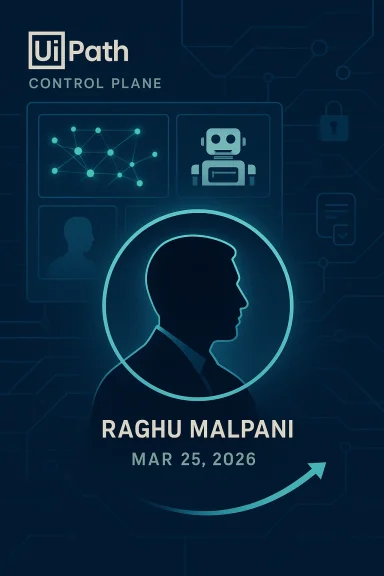
UiPath’s decision to elevate Raghu Malpani into the newly expanded role of Chief Product and Technology Officer signals more than a routine management reshuffle. It is a clear indicator that the company wants product strategy, engineering execution, and AI-era orchestration to move in tighter lockstep as the market for enterprise automation shifts from RPA into agentic automation. The appointment is effective March 25, 2026, and Malpani will continue reporting to CEO and Executive Chairman Daniel Dines, underscoring that UiPath is centralizing product-technology leadership around one executive at a pivotal moment. UiPath’s own recent platform messaging has emphasized the convergence of AI agents, robots, and people, and this move looks designed to speed that transition.
UiPath has spent the last several years repositioning itself from a pure-play robotic process automation vendor into a broader automation platform company. That evolution has accelerated sharply since 2024, when the company began publicly framing its strategy around agentic automation rather than traditional task automation alone. The language matters because the market is no longer just about scripting repetitive work; it is about orchestrating semi-autonomous systems across business processes, governance layers, and human oversight.
The company’s platform launch in April 2025 formalized that shift. UiPath said its next-generation platform was designed to unify AI agents, robots, and people on a single intelligent system, while emphasizing security, compliance, reliability, and orchestration. In other words, the company is trying to become the control plane for enterprise automation in the AI era, not just a vendor of bots. That positioning also reflects a broader industry reality: enterprises want AI capabilities, but they want them wrapped in controls that reduce risk and make outcomes predictable.
Malpani’s promotion builds on a role he has held since May 2024, when UiPath brought him in as CTO after long stints at Microsoft and Meta. His background spans Microsoft 365 Application and Data Platform, Microsoft Exchange Core, the Copilot semantic index platform, Microsoft Graph, several Azure offerings, and Meta’s global Decisions Platform team. That résumé is particularly relevant at UiPath because the company’s current challenge is not merely building features; it is integrating data, intelligence, orchestration, and execution into a coherent product architecture.
The new title also suggests organizational consolidation. UiPath already had a Chief Product Officer, Graham Sheldon, on its leadership page, so the expanded role likely reflects a decision to bring product and engineering under a single accountable leader at the top of the stack. That can be a powerful move when a company is trying to ship platform-wide changes quickly, but it also raises the bar for coordination. In a category as crowded as enterprise automation, speed without clarity can become expensive drift.
Another reason this matters is that UiPath is operating in a fiercely competitive environment. Microsoft, ServiceNow, Salesforce, Google, and a long list of specialist automation vendors are all pushing some version of AI-enabled workflow orchestration. UiPath’s advantage has always been depth in automation; its current challenge is to preserve that depth while proving that its platform can remain the trusted layer for increasingly autonomous work. This leadership change reads as a bet that the fastest route there is tighter integration between product vision and engineering delivery.
Malpani’s remit is likely to influence not just release cadence but the company’s entire definition of value. The platform has to do more than automate a task; it has to support end-to-end processes that involve bots, agents, and people making decisions in sequence. That requires product and engineering teams to be aligned on data models, workflow semantics, reliability standards, and governance assumptions from the start, not after the fact.
UiPath is not simply asking him to build features faster. It is asking him to help turn a broad technology stack into a platform with clear operational boundaries. That means prioritizing reliability, policy enforcement, observability, and interoperability alongside the flashy parts of AI. Those are not the easiest problems to sell, but they are the ones enterprises pay for.
The other advantage is language fluency across large organizations. Leaders from Microsoft and Meta tend to be comfortable with global scale, internal platform dependencies, and the compromises that come with serving many product lines at once. UiPath, which is positioning itself as a control layer for enterprise transformation, needs exactly that kind of systems-level discipline.
The technical challenge is that agentic systems are inherently messier than classic RPA. Traditional automation works best when inputs and outputs are predictable. Agentic workflows, by contrast, involve probabilistic models, policy constraints, exception handling, and human supervision. UiPath’s platform language around controlled agency and governance is a recognition that enterprise buyers want the benefits of autonomy without surrendering control.
That is also why the phrase “agents, robots, and people work seamlessly together” matters so much. It points to a hybrid operating model in which the software stack has to coordinate deterministic and non-deterministic systems without breaking business continuity. In practical terms, that is a product architecture problem, an engineering problem, and a go-to-market problem all at once.
The leadership change may help UiPath sharpen that message. If Malpani can unify product and engineering around faster platform delivery, the company may be able to respond more quickly to competitive feature launches and customer demands. In a market where category boundaries are blurring, speed of integration is becoming almost as important as feature innovation.
The competitive danger, of course, is that larger platform vendors can bundle automation features into broader suites and undercut standalone tools on procurement convenience. UiPath’s answer appears to be depth, governance, and cross-system orchestration. If Malpani can translate those themes into a tighter product story, the company may preserve differentiation even as the market gets noisier.
For enterprises, the impact is direct and material. Customers want a platform that can reduce manual work, orchestrate complex processes, and keep AI behavior within guardrails. Malpani’s expanded role suggests UiPath intends to accelerate that platform vision while reducing organizational friction between what customers ask for and what the product team can deliver.
The leadership structure also suggests that UiPath is trying to reduce ambiguity in its operating model. If product and engineering are more tightly fused, then Dines can spend more time on company direction, market positioning, and customer narrative while Malpani handles the execution engine. That division of labor is common in high-growth software firms, but it is especially useful when the business is navigating a platform transition.
Still, the success of this arrangement will depend on how well UiPath scales decision-making. Expanding one executive’s remit is useful only if it results in fewer bottlenecks and better tradeoffs. If it merely adds another layer of centralization, the company could slow itself down at the very moment it needs to move faster.
The company’s latest filings and releases have continued to describe the platform as the foundation for future transformation, which means product leadership is now inseparable from corporate identity. In a market that is still sorting out the difference between AI experimentation and AI deployment, UiPath is trying to occupy the more mature side of that divide. Malpani’s expanded role reinforces that ambition.
That is why the expanded title matters so much. It suggests that UiPath no longer sees product and engineering as separable disciplines with occasional overlap. Instead, they are being treated as one combined system whose success will define whether the company can capitalize on the agentic automation opportunity.
The most important thing to watch is not the title itself, but the outputs it enables. Investors and customers will care about product velocity, reliability, and adoption signals more than org-chart nuance. Still, when a software company makes this kind of leadership change during a platform transition, it usually means the internal stakes are high and the next phase is supposed to be more disciplined, not less.
Source: citybiz UiPath Names Raghu Malpani Chief Product and Technology Officer
 Background
UiPath has spent the last several years repositioning itself from a pure-play robotic process automation vendor into a broader automation platform company. That evolution has accelerated sharply since 2024, when the company began publicly framing its strategy around agentic automation rather than traditional task automation alone. The language matters because the market is no longer just about scripting repetitive work; it is about orchestrating semi-autonomous systems across business processes, governance layers, and human oversight.The company’s platform launch in April 2025 formalized that shift. UiPath said its next-generation platform was designed to unify AI agents, robots, and people on a single intelligent system, while emphasizing security, compliance, reliability, and orchestration. In other words, the company is trying to become the control plane for enterprise automation in the AI era, not just a vendor of bots. That positioning also reflects a broader industry reality: enterprises want AI capabilities, but they want them wrapped in controls that reduce risk and make outcomes predictable.
Malpani’s promotion builds on a role he has held since May 2024, when UiPath brought him in as CTO after long stints at Microsoft and Meta. His background spans Microsoft 365 Application and Data Platform, Microsoft Exchange Core, the Copilot semantic index platform, Microsoft Graph, several Azure offerings, and Meta’s global Decisions Platform team. That résumé is particularly relevant at UiPath because the company’s current challenge is not merely building features; it is integrating data, intelligence, orchestration, and execution into a coherent product architecture.
The new title also suggests organizational consolidation. UiPath already had a Chief Product Officer, Graham Sheldon, on its leadership page, so the expanded role likely reflects a decision to bring product and engineering under a single accountable leader at the top of the stack. That can be a powerful move when a company is trying to ship platform-wide changes quickly, but it also raises the bar for coordination. In a category as crowded as enterprise automation, speed without clarity can become expensive drift.
Another reason this matters is that UiPath is operating in a fiercely competitive environment. Microsoft, ServiceNow, Salesforce, Google, and a long list of specialist automation vendors are all pushing some version of AI-enabled workflow orchestration. UiPath’s advantage has always been depth in automation; its current challenge is to preserve that depth while proving that its platform can remain the trusted layer for increasingly autonomous work. This leadership change reads as a bet that the fastest route there is tighter integration between product vision and engineering delivery.
Why This Promotion Matters
At first glance, this looks like a classic internal promotion: a strong technical executive gets broader responsibility after proving himself in the CTO seat. But the strategic subtext is more interesting. UiPath is effectively saying that architecture is now strategy. In a world where AI features can be copied quickly, the company’s differentiation depends on how well it knits together orchestration, policy, observability, and human-in-the-loop control.Malpani’s remit is likely to influence not just release cadence but the company’s entire definition of value. The platform has to do more than automate a task; it has to support end-to-end processes that involve bots, agents, and people making decisions in sequence. That requires product and engineering teams to be aligned on data models, workflow semantics, reliability standards, and governance assumptions from the start, not after the fact.
A signal to customers
For enterprise buyers, this appointment is a promise of continuity and execution. UiPath is telling customers that the same executive who has been overseeing the technical foundation will now also help shape the roadmap, reducing the chance of a gap between what the market wants and what the engineering organization can realistically ship. That is especially important in enterprise software, where roadmaps can fail not because the ideas are bad, but because the integration burden is underestimated.A signal to investors
For investors, the move suggests discipline. UiPath is trying to show that its product transformation is not an abstract AI narrative but a managed execution program led by someone with deep cloud and platform experience. In a market that has become skeptical of vague “AI strategy” claims, that sort of role consolidation can be read as operational seriousness rather than corporate theater.- It aligns product and engineering under one leader.
- It reinforces UiPath’s agentic automation narrative.
- It reduces the chance of roadmap fragmentation.
- It suggests a stronger focus on execution speed.
- It may help the company respond faster to customer feedback.
- It gives Daniel Dines a clearer single-threaded partner on platform direction.
Malpani’s Background and Why It Fits UiPath
Malpani’s previous roles are unusually well matched to UiPath’s current needs. Microsoft experience across productivity, data, identity-adjacent platforms, and cloud services is valuable because enterprise automation increasingly depends on deeply integrated systems rather than standalone workflow tools. His time at Meta adds another dimension: large-scale decisioning systems, experimentation frameworks, and platform thinking. That combination is highly relevant to a company trying to orchestrate workflows that blend deterministic automation with AI behavior.UiPath is not simply asking him to build features faster. It is asking him to help turn a broad technology stack into a platform with clear operational boundaries. That means prioritizing reliability, policy enforcement, observability, and interoperability alongside the flashy parts of AI. Those are not the easiest problems to sell, but they are the ones enterprises pay for.
From infrastructure to product leadership
One of the most consequential shifts in this appointment is the move from a primarily technical remit to a broader product-and-technology portfolio. That matters because enterprise AI adoption rarely fails at the demo stage; it fails in the transition from prototype to governed deployment. A leader who understands both platform infrastructure and product packaging is often better positioned to close that gap.The other advantage is language fluency across large organizations. Leaders from Microsoft and Meta tend to be comfortable with global scale, internal platform dependencies, and the compromises that come with serving many product lines at once. UiPath, which is positioning itself as a control layer for enterprise transformation, needs exactly that kind of systems-level discipline.
- Microsoft background supports enterprise integration.
- Meta background supports experimentation at scale.
- Platform experience matters in orchestration-heavy markets.
- His profile suggests comfort with complex internal dependencies.
- The role likely needs both technical and product judgment.
- UiPath appears to value execution over symbolism.
The Broader Shift From RPA to Agentic Automation
UiPath’s own messaging tells you how much the market has changed. The company increasingly describes itself as a leader in agentic automation, not just automation software. That evolution reflects a wider industry belief that the next phase of enterprise software will involve AI agents that can plan, coordinate, and execute within guardrails, rather than merely assist users at the point of action.The technical challenge is that agentic systems are inherently messier than classic RPA. Traditional automation works best when inputs and outputs are predictable. Agentic workflows, by contrast, involve probabilistic models, policy constraints, exception handling, and human supervision. UiPath’s platform language around controlled agency and governance is a recognition that enterprise buyers want the benefits of autonomy without surrendering control.
Why governance is now a product feature
In 2026, governance is no longer a back-office compliance concern; it is a product differentiator. If an AI agent can make decisions or trigger actions, then auditability, permissions, lineage, and rollback become fundamental capabilities. UiPath has repeatedly emphasized these themes, which suggests it understands that trust is the real bottleneck in enterprise AI adoption.That is also why the phrase “agents, robots, and people work seamlessly together” matters so much. It points to a hybrid operating model in which the software stack has to coordinate deterministic and non-deterministic systems without breaking business continuity. In practical terms, that is a product architecture problem, an engineering problem, and a go-to-market problem all at once.
- AI agents introduce probabilistic behavior.
- Automation platforms must add stronger controls.
- Governance becomes a feature, not an afterthought.
- End-to-end orchestration is the real prize.
- Human oversight remains essential in regulated workflows.
- Reliability will matter as much as model quality.
Competitive Implications
This move should be read against a crowded competitive field. Microsoft is pushing Copilot-based automation through its own ecosystem, ServiceNow is extending workflow and AI orchestration, and Salesforce continues to build AI-infused business process tooling. UiPath’s counterargument is that it already has deep enterprise automation credibility and can add agentic capabilities without forcing customers to rip out existing workflow investments.The leadership change may help UiPath sharpen that message. If Malpani can unify product and engineering around faster platform delivery, the company may be able to respond more quickly to competitive feature launches and customer demands. In a market where category boundaries are blurring, speed of integration is becoming almost as important as feature innovation.
The moat question
UiPath’s moat is not just its installed base. It is the accumulated trust that comes from being used in serious enterprise environments where automation failures have real business consequences. The company’s challenge is to keep that trust intact while expanding into AI-native use cases that may attract customers from adjacent platforms. That is a delicate balancing act, and it helps explain why leadership continuity is so valuable right now.The competitive danger, of course, is that larger platform vendors can bundle automation features into broader suites and undercut standalone tools on procurement convenience. UiPath’s answer appears to be depth, governance, and cross-system orchestration. If Malpani can translate those themes into a tighter product story, the company may preserve differentiation even as the market gets noisier.
- Microsoft has distribution advantages.
- ServiceNow has workflow adjacency.
- Salesforce has CRM gravity.
- UiPath still has automation depth.
- The platform story must stay enterprise-first.
- Differentiation will depend on trust and control.
Enterprise Versus Consumer Impact
For consumers, this announcement is mostly indirect. UiPath is not a consumer app company, and the average individual user will not notice a leadership change in its executive ranks. But the ripple effects can still reach consumer experiences through back-office automation, faster service operations, and better data handling in businesses that deploy UiPath successfully. In that sense, enterprise automation often becomes invisible consumer convenience.For enterprises, the impact is direct and material. Customers want a platform that can reduce manual work, orchestrate complex processes, and keep AI behavior within guardrails. Malpani’s expanded role suggests UiPath intends to accelerate that platform vision while reducing organizational friction between what customers ask for and what the product team can deliver.
What enterprises will care about most
Buyers will likely focus on three things: faster product delivery, more coherent roadmap execution, and stronger integration across automation and AI features. They will also want proof that UiPath can support large-scale deployments without creating governance headaches. In enterprise software, trust is a feature and sometimes the most important one.- Faster release cadence
- Better roadmap cohesion
- Stronger auditability
- More reliable orchestration
- Easier agent deployment
- Lower implementation risk
The Role of Daniel Dines and UiPath’s Leadership Structure
Daniel Dines remains central to the story. By keeping Malpani reporting directly to him, UiPath is signaling that product strategy remains tightly connected to the founder’s broader vision for the company. That can be a strength because founders often preserve clarity of purpose during periods of strategic transition. It can also be a challenge if too much depends on a small number of executives making the right calls quickly.The leadership structure also suggests that UiPath is trying to reduce ambiguity in its operating model. If product and engineering are more tightly fused, then Dines can spend more time on company direction, market positioning, and customer narrative while Malpani handles the execution engine. That division of labor is common in high-growth software firms, but it is especially useful when the business is navigating a platform transition.
Founder-led strategy, operator-led execution
This is one of those moments when a founder-led company can gain an advantage. Dines has been associated with UiPath’s long arc from automation pioneer to AI-era platform vendor, while Malpani brings the operational and technical discipline needed to turn that vision into shippable systems. The combination can work well if the lines are clear and the product organization stays focused.Still, the success of this arrangement will depend on how well UiPath scales decision-making. Expanding one executive’s remit is useful only if it results in fewer bottlenecks and better tradeoffs. If it merely adds another layer of centralization, the company could slow itself down at the very moment it needs to move faster.
- Dines retains strategic control.
- Malpani becomes executionally central.
- The structure reduces roadmap ambiguity.
- Coordination should improve if roles stay clear.
- Centralization can also create bottlenecks.
- Execution will determine whether the model works.
Why This Fits UiPath’s 2026 Narrative
The timing is important. UiPath has been publicly reinforcing its agentic automation platform throughout 2025, including launches and expansions tied to orchestration, developer flexibility, and enterprise-grade controls. A leadership upgrade in early 2026 suggests the company wants 2026 to be a year of operational proof rather than just product messaging. That is often the point where strategy either earns credibility or begins to look overhyped.The company’s latest filings and releases have continued to describe the platform as the foundation for future transformation, which means product leadership is now inseparable from corporate identity. In a market that is still sorting out the difference between AI experimentation and AI deployment, UiPath is trying to occupy the more mature side of that divide. Malpani’s expanded role reinforces that ambition.
From product launch to product proof
A lot of AI companies can launch a compelling demo. Far fewer can prove that the software holds up inside real enterprises with real governance requirements. UiPath’s challenge in 2026 is to show that its platform story is not just visionary, but repeatable and measurable. A strong product-technology chief can help turn promises into operating metrics.That is why the expanded title matters so much. It suggests that UiPath no longer sees product and engineering as separable disciplines with occasional overlap. Instead, they are being treated as one combined system whose success will define whether the company can capitalize on the agentic automation opportunity.
- 2025 established the agentic automation thesis.
- 2026 is about proving the thesis in production.
- Product and engineering alignment is central.
- Execution quality will influence market perception.
- Enterprise customers will judge outcomes, not slogans.
Strengths and Opportunities
UiPath has a few clear advantages here. It already has a recognized enterprise automation brand, a deep installed base, and a platform narrative that maps well to the current AI cycle. The promotion also gives the company a leader with experience in large-scale cloud and productivity ecosystems, which could strengthen execution as UiPath expands its platform ambitions.- Brand credibility in enterprise automation
- Platform momentum around agentic automation
- Leadership continuity under Daniel Dines
- Technical depth from Microsoft and Meta experience
- Better product-engineering alignment
- Opportunity to accelerate roadmap delivery
- Potential to deepen governance-led differentiation
Risks and Concerns
The biggest risk is execution complexity. Expanding the scope of a CTO into product leadership can work well, but it also increases the consequences of any misalignment between roadmap priorities, engineering capacity, and customer expectations. In a fast-moving market, even a technically strong organization can stumble if the cadence of delivery lags behind its promises.- Organizational bottlenecks if decision-making centralizes too much
- Execution risk if roadmap promises outrun delivery
- Competitive pressure from larger platform vendors
- Messaging risk if agentic automation sounds better than it performs
- Enterprise trust risk if governance features lag
- Integration complexity across agents, robots, and people
- Market skepticism toward AI narratives without measurable ROI
Looking Ahead
The next several quarters should reveal whether UiPath’s leadership change is primarily symbolic or genuinely operational. If Malpani’s expanded role leads to faster delivery of integrated agentic automation features, stronger customer adoption, and clearer platform coherence, this will look like a smart preemptive move. If not, it will be remembered as another attempt to streamline a complex product story without fully simplifying the execution challenge.The most important thing to watch is not the title itself, but the outputs it enables. Investors and customers will care about product velocity, reliability, and adoption signals more than org-chart nuance. Still, when a software company makes this kind of leadership change during a platform transition, it usually means the internal stakes are high and the next phase is supposed to be more disciplined, not less.
- New product releases under the combined role
- Evidence of tighter orchestration across the platform
- Customer response to agentic automation features
- Signals on execution speed and roadmap coherence
- Competitive positioning versus Microsoft and ServiceNow
- Any further leadership or organizational changes
Source: citybiz UiPath Names Raghu Malpani Chief Product and Technology Officer
