

UiPath’s latest quarter marked a clear inflection: stronger-than-expected revenue, healthier recurring revenue, a first GAAP operating profit in recent history, and a bullish revenue guide for the coming quarter — all delivered alongside an aggressive set of hyperscaler and AI model partnerships that position the company at the intersection of robotic process automation (RPA) and agentic AI. The market reacted decisively, with PATH stock jumping sharply on the news as traders priced in a renewed growth/profitability narrative.
UiPath (NYSE: PATH) reported third-quarter fiscal 2026 results that beat consensus across several key metrics, underpinning management’s argument that enterprise customers are accelerating automation programs that combine deterministic RPA with emergent agentic AI capabilities. The quarter’s headline numbers included roughly $411 million in revenue, annual recurring revenue (ARR) of $1.782 billion, a net-new ARR contribution of $59 million, and — importantly for sentiment — GAAP operating income that turned positive to $13 million. GAAP net income for the period also swung materially positive, reported at roughly $198.8 million. Management then issued guidance for the fourth quarter that set revenue expectations between $462 million and $467 million, comfortably ahead of the Street’s midpoint. Those results did more than beat estimates; they validated several strategic shifts UiPath has made over the past 18 months. The company is pivoting from growth-at-all-costs toward a hybrid strategy: retain product breadth and go-to-market reach while prioritizing profitability, balance-sheet strength, and selective partnerships with hyperscalers and model providers. This repositioning turns UiPath into a different kind of vendor in the automation value chain — less a standalone RPA purveyor and more a platform orchestrator that expects to coexist (and interoperate) with large cloud and model ecosystems.
The quarter’s positives are real: improving unit economics, a large cash cushion, incremental ARR, and partnerships that materially broaden deployment choices. However, the strategic environment is unforgiving. Hyperscaler bundling, the operational complexity of agentic deployments, and the pressure to convert pilot enthusiasm into production dollar flow remain active threats.
For enterprises, UiPath remains a leading choice when governance, legacy-system automation, and observability are priorities. For investors, the company is no longer a pure turnaround story — it’s now a conditional growth opportunity that must prove durable execution over the next several quarters. If UiPath can sustain ARR growth, convert partnerships into large, recurring deployments, and make GAAP profitability repeatable, the current re-rating will be validated. If not, the market’s optimism may prove short-lived.
Either way, this quarter marked a meaningful strategic pivot: UiPath is staking its future on being the enterprise-grade orchestration and governance layer for agentic automation. The next challenge is turning orchestrated promises into durable cash flows at scale.
Conclusion: UiPath’s recent results and guidance shifted the narrative from “surviving in the AI era” to “competing as an orchestration platform in the AI era.” That is a defensible and pragmatic position — but it’s also a race. The company must demonstrate that agentic automation is additive to customer spend, not merely a repackaging of legacy RPA dollars, and that its partner-first approach produces real, repeatable ARR and margin expansion. Execution, not announcements, will decide whether this quarter becomes the start of a sustained comeback or a temporary reprieve.
Source: FXDailyReport.Com UiPath Inc (NYSE:PATH) Gave Strong Q4 Guidance
 Background / Overview
UiPath (NYSE: PATH) reported third-quarter fiscal 2026 results that beat consensus across several key metrics, underpinning management’s argument that enterprise customers are accelerating automation programs that combine deterministic RPA with emergent agentic AI capabilities. The quarter’s headline numbers included roughly $411 million in revenue, annual recurring revenue (ARR) of $1.782 billion, a net-new ARR contribution of $59 million, and — importantly for sentiment — GAAP operating income that turned positive to $13 million. GAAP net income for the period also swung materially positive, reported at roughly $198.8 million. Management then issued guidance for the fourth quarter that set revenue expectations between $462 million and $467 million, comfortably ahead of the Street’s midpoint. Those results did more than beat estimates; they validated several strategic shifts UiPath has made over the past 18 months. The company is pivoting from growth-at-all-costs toward a hybrid strategy: retain product breadth and go-to-market reach while prioritizing profitability, balance-sheet strength, and selective partnerships with hyperscalers and model providers. This repositioning turns UiPath into a different kind of vendor in the automation value chain — less a standalone RPA purveyor and more a platform orchestrator that expects to coexist (and interoperate) with large cloud and model ecosystems.Why this quarter matters
The numbers — profitable growth, at last
The raw financials are the clearest reason markets reacted. Revenue grew ~16% year-over-year to about $411 million and ARR rose ~11% to $1.782 billion, indicating expansion within the installed base plus steady new-business traction. Net-new ARR of $59 million is modest but meaningful in context: it signals that the base is still expanding even as the company tightens its go-to-market discipline. Crucially, UiPath reported positive GAAP operating income ($13 million) and generated positive operating cash flow. Non-GAAP adjusted free cash flow was reported at $28 million. These metrics together move UiPath from a narrative of “growth with heavy losses” to one of “growth at improving margins,” which reorients investor expectations and valuation multiples.Guidance that matters
Management set Q4 revenue guidance of $462–$467 million, which sits ahead of the Street’s consensus and implies sequential momentum into the year‑end quarter. Given the market’s sensitivity to guidance, this forward-looking beat was as important as the quarter’s realized results: it suggests management is seeing durable pipeline strength — particularly around agentic automation use cases — and feels comfortable locking in a higher revenue target while continuing to invest in product and partnerships. That guidance is the proximate cause of the stock’s sharp intraday move, as traders re-priced both near-term growth and the durability of the company’s margin expansion playbook.Partnerships and product signal new TAM
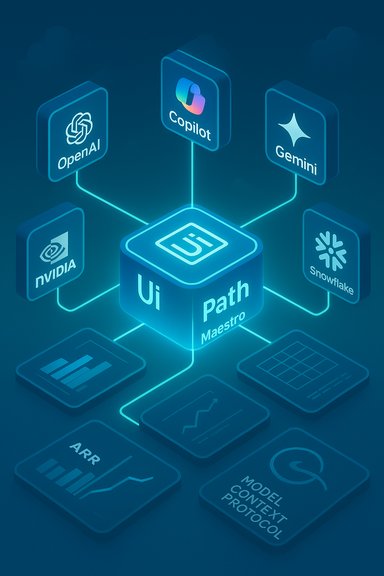
UiPath used the quarter’s cadence — and its annual FUSION event earlier in the year — to highlight a web of integrations that materially expand its addressable market and defensibility:- Deep integrations with Microsoft Azure AI Foundry — enabling UiPath agents to interoperate with Azure-hosted agents and models via a Model Context Protocol, and tighter links to Microsoft Copilot experiences.
- A formal collaboration with OpenAI to build a ChatGPT connector that embeds OpenAI frontier models into UiPath workflows, effectively lowering the development bar for enterprise-grade agents.
- Conversational and voice-enabled agents powered by Google’s Gemini models, reducing friction for natural language–driven automation scenarios.
- New integrations with NVIDIA and a joint proposition with Snowflake to combine UiPath’s agent orchestration with Snowflake Cortex AI — positioning UiPath to turn data signals into autonomous actions. These partnerships indicate a two-fold strategy: broaden model and compute choices for customers, and embed UiPath as an orchestration and governance layer on top of hyperscaler model stacks.
What the market reaction signalled
On the day following UiPath’s announcement, PATH stock rallied strongly — mid-day moves in the low double-digits were reported by market trackers. That reaction reflects a classic re-rating event: investors are willing to pay more for a secular software asset when the company demonstrates that it can expand ARR while moving to sustainable profitability and securing hyperscaler distribution pathways. The rally was paired with a spike in options activity and a reappraisal from some research desks that had previously discounted UiPath’s outlook. But price moves alone don’t change the strategic calculus: they reduce the downside of execution missteps by creating market optionality, and they create pressure for the company to deliver on the improved guidance and translate partnerships into measurable customer outcomes.Deep dive: product, partnerships, and technical posture
Platform breadth remains the core asset
UiPath’s enduring advantage is breadth: process discovery, low-code/no-code authoring (Studio), robot runtimes (attended and unattended), orchestration (Maestro/Orchestrator), document understanding, and governance/observability. That end-to-end stack is still hard to replicate for regulated or legacy-heavy enterprise processes — especially where UI-bound interactions with on-prem ERPs or legacy portals are required. This makes UiPath more than a simple macro recorder; it’s a platform that enterprises rely on for auditability and control.Orchestration is the strategic pivot
UiPath is positioning Maestro as the “single pane” for orchestrating a heterogeneous set of agents and models. The architecture-centric move is pragmatic: as generative AI and model providers proliferate, enterprises will demand a governance layer that can route tasks to the right agent, measure outcomes, and provide human-in-the-loop checkpoints. The new Model Context Protocol (MCP) integrations with Azure AI Foundry and Copilot highlight this choreography strategy: UiPath can sit above cloud model endpoints and still preserve enterprise governance. This is a sensible answer to the hyperscaler bundling threat — partner where distribution matters, but preserve the unique governance and audit features enterprises pay for.Partnerships are both opportunity and dependency
The collaborations with OpenAI, Google, Microsoft, NVIDIA, and Snowflake materially accelerate time-to-value for agentic automation by offering customers model choice and GPU/compute scale. However, these partnerships also create dependency vectors: if a hyperscaler decides to deeply embed comparable orchestration or governance directly in productivity suites, that could compress UiPath’s pricing power over time. The company’s defense is twofold: (1) keep building platform-level features — observability, security, enterprise integrations — that hyperscalers cannot easily match without heavy engineering; and (2) make integration so seamless that hyperscalers find it more attractive to partner than to replace. Early signs — like bi-directional integration with Copilot Studio and a ChatGPT connector with OpenAI — show UiPath pursuing the partner-first approach.Strengths: what investors and IT buyers should appreciate
- Platform depth and governance: UiPath’s audit, compliance, and orchestration features are valuable for regulated industries where “explainability” and traceability are mandatory.
- Improving unit economics: Positive GAAP operating income and improved free cash flow signal that previous cost-structure resets are taking hold. That reduces financing and execution risk.
- Hyperscaler distribution and model choices: Integrations give customers the ability to pick models and clouds while maintaining a consistent orchestration and governance layer. This widens the TAM for enterprise-grade agentic automation.
- Healthy balance sheet: Over $1.5 billion of cash, equivalents, and marketable securities provides optionality for continued R&D, M&A, or buffer against macro shocks.
Risks and failure modes — what can still go wrong
- Hyperscaler bundling: Microsoft, Google, or other cloud vendors can embed “good enough” automation directly into productivity suites. This reduces the need for a separate RPA license in many mid‑market scenarios. If that accelerates, UiPath’s growth could be structurally constrained. Independent analysis in the market reflects this persistent threat.
- Execution on agentic economics: Partnerships drive distribution, but UiPath must prove agentic automation increases deal sizes and retention (higher ARR per customer), not merely replace existing license dollars with lower-margin integrations. The key metrics to watch in coming quarters are net-new ARR, dollar-based net retention, and product gross margin trends.
- Model risk and operational safety: Agentic systems powered by LLMs require rigorous validation. Hallucinations, erroneous actions, or compliance breaches in production could cause customer churn and regulatory scrutiny. Enterprises demanding strong SLAs and auditability may raise the bar for production adoption.
- Leadership and sales execution: Past leadership churn created investor skepticism. Rebuilding predictable sales motions and sustaining enterprise conversions from pilot-to-production will be essential to maintain the re-rating. The market will watch sequential quarters for consistency.
What to watch next — a practical KPI dashboard
Investors and IT buyers should monitor the following metrics over the next 3–6 quarters to judge whether this quarter is an inflection or a one-off:- ARR growth and net-new ARR (quarterly cadence).
- Dollar‑based net retention and cohort expansion within larger accounts.
- Gross margin trends and cloud delivery costs per customer.
- Conversion rates from pilot to production for agentic projects, and any evidence that agentic features increase average selling prices (ASPs).
- Partner-led revenue and co-sell pipeline outcomes with Microsoft, Google, OpenAI, NVIDIA, and Snowflake.
- Evidence of sustained GAAP profitability beyond one quarter (is operating income repeatable?.
For enterprise buyers: practical guidance
- Treat UiPath as a strong candidate for complex, cross‑system processes where governance and legibility are essential. Its orchestration and observability matter for regulated industries.
- For agentic use cases, require measurable production metrics: error rates, mean time to value (MTTV), cost per agent run, and clear rollback procedures. Demos are insufficient; insist on pilot-to-production metrics.
- Avoid vendor lock‑in by defining model and orchestration portability upfront. If your automation strategy depends on a single hyperscaler’s integrated agent, quantify the switching cost and data residency implications. UiPath’s model-agnostic approach can be helpful here.
Investment implications — a pragmatic view
UiPath today is a classic “binary” investment: execution and product-led differentiation can unlock substantial multiple expansion (if agentic automation leads to sustained ARR acceleration and margin leverage); failure to fend off bundling or to convert pilots into durable customer spend would justify continued multiple compression. Key considerations:- The company is now generating cash and positive GAAP operating profit; that alone reduces a major tail risk present in earlier years.
- Upside requires evidence that agentic automation meaningfully increases ASPs and retention (i.e., customers open new budgets for agentic capabilities rather than cannibalizing existing spend).
- Strategic acquirers might value UiPath’s platform, partner relationships, and installed base — making M&A a plausible upside scenario if the company remains differentiated and profitable.
Cross‑checks and cautionary notes
- The quarter’s GAAP net income included certain accounting items and comparisons to the prior year’s loss; readers should consult the company’s reconciliations for a full understanding of what drove the swing. The public filings and press release include detailed reconciliations.
- Partnership announcements (OpenAI, Microsoft, Google, NVIDIA, Snowflake) are real and materially change product integration pathways, but the pace at which these integrations produce large-scale revenue can be uneven. Press releases and product demos do not equal broad customer adoption overnight; treat those claims as forward-looking until validated through recurring revenue recognition.
- Market reactions (stock rallies) reflect both fundamentals and sentiment; rapid price appreciation raises expectations and therefore execution risk. Subsequent quarters will be judged more harshly when expectations are elevated.
Final assessment — where UiPath stands today
UiPath’s Q3 showed the company can simultaneously expand ARR and move toward sustainable profitability while forging integrations with the biggest model and cloud providers in the market. That combination is valuable: it answers the two existential questions for a pure‑play automation vendor in 2025 — can you remain relevant as the world adopts LLMs, and can you do so profitably?The quarter’s positives are real: improving unit economics, a large cash cushion, incremental ARR, and partnerships that materially broaden deployment choices. However, the strategic environment is unforgiving. Hyperscaler bundling, the operational complexity of agentic deployments, and the pressure to convert pilot enthusiasm into production dollar flow remain active threats.
For enterprises, UiPath remains a leading choice when governance, legacy-system automation, and observability are priorities. For investors, the company is no longer a pure turnaround story — it’s now a conditional growth opportunity that must prove durable execution over the next several quarters. If UiPath can sustain ARR growth, convert partnerships into large, recurring deployments, and make GAAP profitability repeatable, the current re-rating will be validated. If not, the market’s optimism may prove short-lived.
Either way, this quarter marked a meaningful strategic pivot: UiPath is staking its future on being the enterprise-grade orchestration and governance layer for agentic automation. The next challenge is turning orchestrated promises into durable cash flows at scale.
Conclusion: UiPath’s recent results and guidance shifted the narrative from “surviving in the AI era” to “competing as an orchestration platform in the AI era.” That is a defensible and pragmatic position — but it’s also a race. The company must demonstrate that agentic automation is additive to customer spend, not merely a repackaging of legacy RPA dollars, and that its partner-first approach produces real, repeatable ARR and margin expansion. Execution, not announcements, will decide whether this quarter becomes the start of a sustained comeback or a temporary reprieve.
Source: FXDailyReport.Com UiPath Inc (NYSE:PATH) Gave Strong Q4 Guidance
