

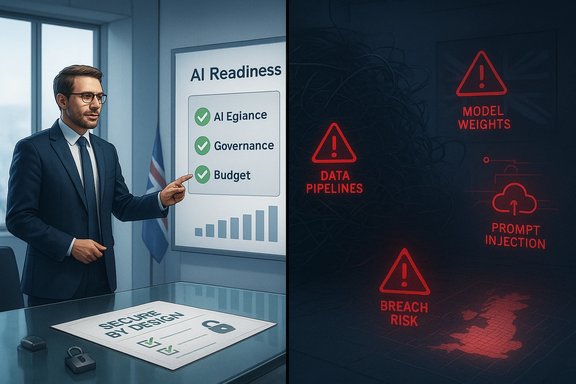
UK organisations are telling themselves a story of AI readiness that the data now shows is more optimism than operational reality.
ANS, a UK-based cloud and digital services provider that was recently named Microsoft UK Partner of the Year 2025, has published a new industry study — AI Readiness Secured — that quantifies a growing disconnect between executive confidence and technical preparedness for AI security across British organisations. The survey, conducted in partnership with market research firm Censuswide and sampling more than 2,000 UK IT decision-makers, finds that while the vast majority of firms believe they have invested enough to adopt AI safely, substantially fewer have embedded security-by-design into AI projects or plan the forward-looking investments needed to defend models, training pipelines and staff against AI-specific threats. This is not just a vendor memo. ANS’s report and subsequent media coverage highlight specific numbers that should concern boards and CISOs: 85% of organisations say they’ve invested enough to support safe AI adoption, yet only 42% report security is embedded into their AI projects and just 37% treat security as a priority during implementation. Longer-term commitment to model security and workforce training is even thinner: 39% plan to invest in securing AI models and algorithm training in the next three years, and only 34% intend to upskill employees on the secure and responsible use of AI.
The next practical step for UK IT leaders is straightforward: commission a short, independent readiness assessment focused on model security, data provenance, and user behaviour, and use the findings to create a 12‑month AI security roadmap with measurable milestones. This converts the current optimism — which the data shows is mixed with complacency — into a defensible, auditable capability that unlocks AI’s value without leaving organisations exposed.
(Report references and industry indexes used for verification: ANS AI Readiness Secured report and briefings; media coverage summarising the report; Cisco’s Cybersecurity Readiness Index and related industry reporting on organisational overconfidence in resilience.
Source: Technology Record UK organisations overestimate AI security readiness, finds ANS
 Background
ANS, a UK-based cloud and digital services provider that was recently named Microsoft UK Partner of the Year 2025, has published a new industry study — AI Readiness Secured — that quantifies a growing disconnect between executive confidence and technical preparedness for AI security across British organisations. The survey, conducted in partnership with market research firm Censuswide and sampling more than 2,000 UK IT decision-makers, finds that while the vast majority of firms believe they have invested enough to adopt AI safely, substantially fewer have embedded security-by-design into AI projects or plan the forward-looking investments needed to defend models, training pipelines and staff against AI-specific threats. This is not just a vendor memo. ANS’s report and subsequent media coverage highlight specific numbers that should concern boards and CISOs: 85% of organisations say they’ve invested enough to support safe AI adoption, yet only 42% report security is embedded into their AI projects and just 37% treat security as a priority during implementation. Longer-term commitment to model security and workforce training is even thinner: 39% plan to invest in securing AI models and algorithm training in the next three years, and only 34% intend to upskill employees on the secure and responsible use of AI. Why the findings matter: context and immediate implications
AI changes the attack surface. Traditional security controls — network firewalls, endpoint protection, standard IAM and perimeter DLP — were not designed to defend model weights, prompt injection, retrieval-augmented generation (RAG) pipelines, or agentic workflows that can act across systems. The effective risk picture now includes:- Sensitive-data leakage via prompts or retrieval layers.
- Model-manipulation and poisoning during training or fine-tuning.
- Prompt injection and multi-turn jailbreaks that can exfiltrate secrets or cause unsafe actions.
- Agentic automation mis-execution that escalates privileges or triggers costly operational steps.
What ANS’s survey actually found
Headline figures
- 85% of organisations believe they have invested enough to support safe AI adoption.
- 42% report that security is embedded into their AI projects.
- 37% treat security as a priority during implementation.
- 39% plan to invest in securing AI models and algorithm training over the next three years.
- 34% intend to upskill employees on secure and responsible AI use within the same timeframe.
Sectoral and behavioural notes
ANS’s materials point to a number of behavioural patterns that underpin the headline numbers: many organisations equate spend with security (mistaking budgets for capability), employees are a common entry point for risk due to shadow AI usage, and boards may acknowledge AI risks in principle but fail to fund or prioritise the technical and operational work needed to make AI safe and auditable. ANS frames security as a strategic enabler rather than a compliance checkbox — a framing echoed in their event commentary and thought leadership.Critical analysis: what the numbers reveal — and where they fall short
Strengths of the ANS report
- Large, targeted sample. A survey of over 2,000 IT decision-makers gives reasonable statistical power for UK-focused inference and allows segmentation by sector and role. ANS’s use of an established survey partner (Censuswide) strengthens methodological credibility.
- Action-focused framing. The report moves beyond alarm to offer practical recommendations (governance, model protection, training), aligning with what security practitioners and regulators are now urging.
- Vendor credibility. ANS’s strong position in the Microsoft partner ecosystem (including recognition as Microsoft UK Partner of the Year 2025) gives them operational visibility into enterprise Copilot and Azure AI deployments — useful context for the report’s claims about enterprise behaviour.
Important caveats and potential limitations
- Self-reported perception vs measured capability. The survey measures attitudes and declared intentions. Confidence (85% say they’ve invested enough) does not equal capability (the technical controls, SLAs, verification and testing needed to stop a motivated adversary). Self-reported readiness commonly overstates actual resilience; independent readiness indices repeatedly show this gap. Treat the “85%” figure as a perception metric, not a validated assurance.
- Survey methodology transparency. Public summaries do not publish the full questionnaire, weighting methodology or exact sector breakdowns in every circulation — standard for vendor reports, but a gap if you need to benchmark a regulated procurement decision. Request the full methodology before using the report as procurement evidence.
- Potential sample bias. The population sampled — IT decision-makers — may lean towards optimism about investments because they influence or report on budgets. Cross-checking with vendor telemetry, red-team results, and SOC metrics gives a more objective picture. Independent indexes (Cisco, Tenable) cite objective incident rates and capability measures that complicate optimistic self-assessments.
Why organisations overestimate AI security readiness
- Conflating vendor features with operational security. Platforms now ship with AI-focused controls (audit logs, tenant isolation, DLP for Copilot, model fine-tuning controls), but these features are only effective when configured, monitored and operated correctly. Many organisations adopt features without the human and process work needed to enforce them.
- Underinvestment in model-level controls. Model security (provenance, signing, tamper detection, integrity checks on training data) is a distinct discipline from traditional application security. ANS’s survey shows only 39% plan to invest in securing model training/algorithms in the next three years — too slow given the threat velocity.
- Shadow AI and human behaviour. Employees will paste confidential prompts into public tools unless provided enterprise alternatives and trained on what constitutes sensitive data — a recurring theme in the ANS findings and corroborated in multiple industry studies. Without role-based training, the human vector remains the weakest link.
- Leadership trade-offs and board prioritisation. Boards recognise AI’s strategic value but often treat security as a cost-centre. That mismatch undermines funding and the appointment of accountable owners for AI security. ANS recommends reframing security as a growth enabler to secure board-level investment.
Cross-checking the picture: independent corroboration
- Cisco’s Cybersecurity Readiness Index and related industry reporting show only a small fraction of organisations at a “mature” readiness level, while many respondents report confidence in their defences — a pattern identical to ANS’s perception-versus-practice gap. Cisco also reports high incidence rates for AI-related incidents and widespread uncertainty about shadow AI. This independent assessment supports ANS’s central thesis: confidence is high, operational maturity low.
- Broader industry reporting (Tenable, Datacom and other regional readiness studies) documents similar leadership blind spots: reactive KPIs, underfunded risk-reduction programs, and a tendency to prioritise experimentation speed over governance. These sources reinforce the policy implication that the ANS survey flags — that organisations must pivot from feature adoption to controlled, auditable, and testable operation.
Practical roadmap: 10 focused steps to close the gap now
- Create an AI accountability board (CISO, CTO, legal, compliance, business owners) with clear KPIs and budget authority.
- Inventory AI endpoints and data flows (model endpoints, RAG connectors, vendor SaaS agents). Treat this inventory as your attack surface map.
- Classify data that may be used in inference or training; apply sensitivity labels and enforce no-train or tenant/region-only clauses where necessary.
- Implement model security controls: signed model artifacts, training data provenance, versioning and drift detection.
- Add adversarial testing and red-team exercises focused on multi-turn prompt injection, RAG manipulation and agent abuse. Make these tests part of CI/CD gates.
- Deploy runtime monitoring and anomaly detection for AI interactions (prompt telemetry, abnormal retrieval patterns, spike detection). Integrate these alerts with SOC workflows.
- Harden identity and access: least privilege for model endpoints, PIM for automation accounts, Conditional Access and device posture checks for AI tooling.
- Operationalise DLP for AI: apply DSPM, block high-risk documents from being sent to third-party LLMs, and implement prompt sanitisation on sanctioned interfaces.
- Run role-based training and a “Copilot hero” pilot program: mandatory basic training for all users and technical upskilling for model owners and SOC analysts.
- Measure outcome metrics not vanity metrics: MTTR for AI incidents, number of blocked exfiltration attempts, percent of models under automated drift monitoring, and time-to-remediate model vulnerabilities.
Implementation checklist for the next 90 days (prioritised)
- Run a 4‑week AI asset discovery sprint: identify all AI endpoints, RAG sources, and users with model access.
- Enable tenant-level audit logging and central telemetry ingestion for AI interactions. Feed telemetry into SIEM/SOAR playbooks immediately.
- Lock down high-risk data paths: apply no-train or tenant-only routing for finance, HR and IP repositories.
- Launch mandatory user training (30-minute course) for everyone and advanced training for model stewards.
- Commission an adversarial prompt test from an external specialist; remediate highest priority vulnerabilities within 30 days.
The vendor and partner angle: why ANS’s positioning matters — and what to watch for
ANS positions itself as a practical delivery partner for Microsoft Azure, Copilot and security stacks, and its award as Microsoft UK Partner of the Year 2025 underscores that ecosystem role. That gives ANS visibility into how enterprises are deploying Copilot and Azure AI features — and therefore reasonable grounds to survey market sentiment and recommend integration patterns. However, vendor-backed studies can tilt toward emphasising the value of partner services and managed offerings; readers should interpret recommendations through a risk-and-value lens and ask for independent verification where procurement or regulation demands it.Risks if the gap persists
- Operational compromise of models: Poisoned training data or unsecured model endpoints can produce incorrect outputs with business consequences or leak IP and PII.
- Escalating regulatory exposure: As the EU AI Act and other jurisdictions squeeze liability and audit obligations, organisations without model-level accountability will face fines and contract friction.
- Supply-chain contagion: Smaller suppliers that fail to secure AI-related integrations can become the weak link that brings down larger customers.
- Reputational damage: A single high-profile AI misuse or leak can erode trust in automated services, killing adoption momentum and causing lost revenue.
Final assessment and editorial call to action
The ANS AI Readiness Secured survey offers a clear, actionable warning: UK organisations are disproportionately confident about their AI security posture while doing too little to secure the new, model-oriented attack surfaces that AI introduces. The findings are consistent with independent industry indexes that show a small fraction of organisations at a truly mature security posture and substantial overconfidence among leadership. That gap is solvable — but it requires a shift from reactive, checkbox security to a programmatic, productised approach that treats AI systems as enduring business capabilities. Investment should prioritise model integrity, adversarial testing, telemetry and workforce training, not merely additional spend on more point products. Boards must treat AI security as strategic infrastructure: fund it, measure it, and hold accountable the owners who operate it.The next practical step for UK IT leaders is straightforward: commission a short, independent readiness assessment focused on model security, data provenance, and user behaviour, and use the findings to create a 12‑month AI security roadmap with measurable milestones. This converts the current optimism — which the data shows is mixed with complacency — into a defensible, auditable capability that unlocks AI’s value without leaving organisations exposed.
(Report references and industry indexes used for verification: ANS AI Readiness Secured report and briefings; media coverage summarising the report; Cisco’s Cybersecurity Readiness Index and related industry reporting on organisational overconfidence in resilience.
Source: Technology Record UK organisations overestimate AI security readiness, finds ANS
