

Microsoft told a UK judge that a planned mass lawsuit over its cloud licensing is defective because the claim’s methodology cannot reliably identify who suffered loss or by how much, a procedural attack that — if successful — would block a high‑stakes Collective Proceedings Order and leave thousands of UK businesses without the collective route to damages.
The proposed collective action, brought by competition lawyer Dr Maria Luisa Stasi, alleges Microsoft structured its Windows Server licensing and commercial offerings so that running Windows Server on rival clouds such as Amazon Web Services (AWS), Google Cloud Platform (GCP) and Alibaba Cloud was materially more expensive or operationally awkward than running the same workloads on Microsoft Azure. The claim seeks aggregate damages in the region of £1.7–£2.1 billion and would include tens of thousands of UK organisations if the Competition Appeal Tribunal (CAT) grants a Collective Proceedings Order (CPO). The CPO hearing — a procedural gatekeeping stage that determines whether the claim can proceed as an opt‑out collective action — was listed for 11 December 2025 before the CAT. The tribunal’s role at that hearing is not to determine liability on the merits but to decide whether common questions of law and fact and a workable damages methodology exist such that a single collective trial is appropriate. The CAT case record confirms the matter and hearing date.
Economists and litigation experts will focus on three contentious technical issues at the tribunal:
Source: MLex Microsoft says UK collective claim over its cloud licensing is defective | MLex | Specialist news and analysis on legal risk and regulation
 Background
The proposed collective action, brought by competition lawyer Dr Maria Luisa Stasi, alleges Microsoft structured its Windows Server licensing and commercial offerings so that running Windows Server on rival clouds such as Amazon Web Services (AWS), Google Cloud Platform (GCP) and Alibaba Cloud was materially more expensive or operationally awkward than running the same workloads on Microsoft Azure. The claim seeks aggregate damages in the region of £1.7–£2.1 billion and would include tens of thousands of UK organisations if the Competition Appeal Tribunal (CAT) grants a Collective Proceedings Order (CPO). The CPO hearing — a procedural gatekeeping stage that determines whether the claim can proceed as an opt‑out collective action — was listed for 11 December 2025 before the CAT. The tribunal’s role at that hearing is not to determine liability on the merits but to decide whether common questions of law and fact and a workable damages methodology exist such that a single collective trial is appropriate. The CAT case record confirms the matter and hearing date. What the claim alleges
- The claim frames two core theories of abuse:
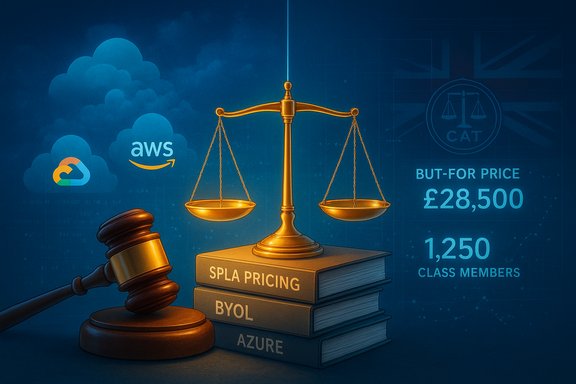
- SPLA Pricing Abuse — wholesale and listed provider licence arrangements (e.g., Service Provider License Agreements) allegedly produced higher effective licence costs for rival cloud providers versus Azure, inflating rivals’ customer prices.
- Re‑licensing / BYOL Distortion — pathways and relicensing rules allegedly allowed easier, cheaper migration to Azure (or reduced Azure’s costs) compared with listed third‑party clouds, creating a structural advantage for Microsoft’s cloud.
- The complaint also asserts operational differentiation — that Azure enjoyed integration and management advantages (patching, tooling, licence mobility mechanics) that were either unavailable or less convenient on competing platforms, further skewing customer choice. Those functional and contractual differences are central to the claimant’s “coherent abusive strategy” narrative.
- The proposed claim period begins in December 2018 and allegedly covers tens of thousands of transactions and organisations; the claimant’s public materials place potential class membership at roughly 59,000 and quantify potential aggregate damages at up to £2.1 billion. These are plaintiff‑supplied figures and remain allegations pending judicial or expert verification.
Microsoft’s procedural defence: attack the methodology
Microsoft’s argument at the certification hearing was surgical and familiar in large competition damages claims: deny that the proposed damages methodology can deliver reliable, class‑wide answers. The company told the tribunal the claimant’s model is “defective” because it cannot disentangle the many contract‑level and usage‑level differences that determine whether any particular organisation actually paid more because of Microsoft’s conduct. Key facets of Microsoft’s defence presented to the CAT:- Heterogeneity of customers and contracts — bespoke enterprise discounts, committed spend arrangements, migration incentives and service bundling make the average or extrapolated model unreliable for assessing individual loss.
- Counterfactual complexity — the damages model rests on what customers would have paid “but for” Microsoft’s licensing design; building a robust counterfactual at scale is economically and evidentially fraught.
- Data and discovery limits — much of the decisive data (detailed contract terms, cloud telemetry, bespoke discounts) is proprietary. Microsoft says the claimant’s evidence patchwork cannot support the sweeping inferences required for certification.
- Technical causation — allegations that Microsoft deliberately degraded performance on rival clouds, or engineered Azure‑only feature differentials, require intrusive technical disclosure and granular proof that the CAT should not accept as a basis for class certification without detailed discovery.
Regulatory and market context
This private litigation sits inside an active regulatory ecosystem that strengthens the factual canvas against which the CAT will view plausibility — even though regulatory findings are not determinative at a CPO hearing.- The UK Competition and Markets Authority (CMA) conducted a market investigation into public cloud infrastructure services and concluded there were real competitive concerns in the market, including that licensing and technical differences could raise switching costs and reduce choices. That public regulatory finding has been repeatedly invoked by the claimants as corroboration of systemic effects.
- Similar scrutiny has emerged in the EU and the U.S., with separate inquiries and complaints examining cloud licensing, interoperability and market power in infrastructure services — a development that increases the political and commercial pressure around the underlying facts in this case.
Why the methodology question is decisive
At the CPO stage the CAT must be satisfied that:- The proposed class raises common issues of fact and law suitable for collective resolution.
- The class is ascertainable and the proceedings are manageable.
- There is a credible methodology for estimating loss and apportioning damages fairly among class members.
Economists and litigation experts will focus on three contentious technical issues at the tribunal:
- The validity of the counterfactual model used to estimate “but‑for” prices.
- The sampling and extrapolation approach used to scale from a sample of customers to tens of thousands.
- The mitigation and pass‑through assumptions — how costs and discounts flow through market contracts to end customers — which drive aggregate damage estimates.
Independent verification of the headline facts
To ensure the most load‑bearing claims are verifiable:- The CAT case record lists Dr Maria Luisa Stasi v Microsoft as registered and confirms the CPO hearing was scheduled for 11 December 2025.
- Reuters contemporaneous coverage corroborated that Microsoft argued the claimant’s methodology is flawed and that the case seeks about £2.1 billion in aggregate damages.
- The claimant’s public materials and court filings set out the proposed class parameters, including the December 2018 start date and an estimated class size in the tens of thousands (c. 59,000), figures that are carried in the claimant’s documentation and press materials but should be treated as plaintiff‑asserted until judicially confirmed.
Legal and strategic implications
For Microsoft
- A refusal to certify the collective action would preserve a major procedural win: it avoids a single national damages trial and the attendant disclosure burden and settlement pressure.
- If the CAT certifies the claim, Microsoft faces years of disclosure, expensive expert economics, potential injunctive remedies, and meaningful financial exposure; even then, settlement remains a realistic mid‑path outcome.
For the claimants and class members
- Certification would consolidate thousands of potential suits and create a single forum to litigate systemic allegations about licensing and portability.
- A failure at the CPO stage would likely force the claimants to pursue narrower cases or individual damages suits, or to continue pressing regulatory channels like the CMA and European authorities.
For the cloud market
- A successful claim or parallel regulatory remedies could change how licence portability, re‑licensing rules and vendor bundles are priced, making multi‑cloud migration easier and reducing the cost premium for non‑Azure deployments.
- Conversely, a failure to certify will leave the existing commercial architecture largely intact but maintain regulatory pressure as the primary corrective mechanism.
Strengths of the claimant’s position
- Regulatory corroboration — the CMA’s findings about switching frictions and licensing differentials supply independent, contemporaneous facts the claimants can rely on to show systemic issues rather than isolated contract disputes.
- Economic scale — even modest per‑customer differentials aggregate to significant sums when tens of thousands of customers are involved; that economic reality makes a mass damages model commercially attractive for funders and litigators.
- Structured legal framing — the claim targets clear contractual constructs (SPLA pricing, BYOL rules, Azure Hybrid Benefit mechanics) that are amenable to legal analysis if common issues can be reliably established.
Weaknesses and risks for the claimants
- Methodological vulnerability — the CAT has historically been cautious about certifying complex damages models where individualized inquiries will predominate; Microsoft’s attack on the methodology is therefore a potent route to defeat certification.
- Data access and heterogeneity — the need for granular, contract‑level evidence across thousands of customers is a logistical and legal obstacle; discovery is costly and subject to confidentiality constraints.
- Causation and counterfactual fragility — showing that licensing differences, rather than other legitimate commercial factors (performance preferences, bundled services, negotiated discounts), caused the asserted overcharges is conceptually demanding at scale.
What is likely to happen next (practical timeline)
- The CAT will reserve or deliver its decision on certification after the December hearing; a ruling could arrive weeks or months later depending on judicial workload.
- If a CPO is granted, expect intensive disclosure, multiple rounds of expert reports (economic and technical), and protracted litigation that could take several years to reach trial — with settlement always a material possibility along the way.
- Parallel regulatory processes (CMA, European Commission inquiries) will proceed on their own timelines and may produce remedies that change the commercial landscape regardless of the CAT’s decision.
Practical guidance for enterprise IT and procurement teams
No knee‑jerk migrations or contract terminations should be made based on litigation headlines alone. Organisations should, however, take prudent steps to document and manage risk:- Review and archive licence and cloud procurement records, including invoices, SPLA or listed provider agreements, and migration correspondence.
- Identify whether your organisation falls inside the claimant’s proposed class definition and note opt‑out deadlines and notice mechanisms if a CPO is granted.
- Reassess cloud cost modelling to separate licence cost lines from compute and operational charges to better understand true TCO across providers.
- If considering migration, three‑way risk analysis should include security, compliance, contractual exit costs, and realistic migration timelines rather than litigation-driven incentives.
- Engage legal counsel early if you believe you may be covered by the claim and if you hold evidence of specific overcharges or bespoke discounts that substantively alter your position.
Broader market and policy takeaways
- This litigation is a clear demonstration of how licensing architecture has become both a commercial lever and a regulatory flashpoint in cloud markets dominated by vertically integrated incumbents.
- The outcome — whether certification, refusal, settlement or a regulatory remedy — will shape procurement practices, cloud pricing transparency, and the appetite for private enforcement in digital markets.
- Policymakers and competition authorities are increasingly receptive to private litigants using collective proceedings to challenge complex platform economics; courts will therefore play a growing gatekeeping role in whether such disputes can be tried en masse.
Conclusion
The CAT’s certification decision will be the immediate inflection point: a refusal would neutralise the plaintiff’s preferred litigation vehicle and leave regulatory enforcement as the primary route for systemic reform, while certification would open a potentially precedent‑setting collective damages trial that could force changes to how Windows Server and similar software are priced across clouds. Microsoft’s strategy — to win on methodology — is a high‑stakes, efficient defensive gambit, and the tribunal’s handling of statistical proof, counterfactuals and manageability will determine whether the case proceeds collectively or fragments into individual disputes. The matter remains fluid: facts such as class size, exact damages figures and the technical particulars of any performance or feature differences are plaintiffs’ allegations and regulatory signals rather than judicial findings at this stage. Readers and affected organisations should therefore treat the CMA’s market work, the CAT procedural timetable, and forthcoming disclosures as the most reliable trackers of where this dispute is heading.Source: MLex Microsoft says UK collective claim over its cloud licensing is defective | MLex | Specialist news and analysis on legal risk and regulation
