Microsoft’s cloud business is heading into another regulatory test in the UK, and this one is more surgical than the CMA’s broad cloud market investigation that closed in July 2025. The watchdog has now moved toward a separate strategic market status probe focused on Microsoft’s business software ecosystem, with licensing practices again at the center of the complaint. That matters because the CMA is no longer just looking at cloud infrastructure pricing and migration friction; it is asking whether Microsoft’s software stack itself helps lock customers into Azure. The result could reshape how enterprises buy, move, and mix cloud services in the UK, especially as AI becomes more deeply embedded in everyday business software. (gov.uk)
The UK cloud market has been under scrutiny for years, but the path to this latest move is important. Ofcom opened the original cloud services market study in October 2022, referred the matter to the CMA in October 2023, and the CMA’s final decision on the market investigation arrived on 31 July 2025. That final report concluded that cloud services are now a vital input to the UK economy and that competition was not working as well as it could, particularly around switching, multi-cloud usage, and licensing. (gov.uk)
The CMA’s July 2025 report did not stop at diagnosis. It concluded that technical and commercial barriers such as egress fees, combined with Microsoft’s licensing practices, could create an anti-competitive environment in which customers pay more to leave than to stay. The report explicitly devoted a chapter to Microsoft’s licensing practices and another to egress fees, showing that the regulator viewed these as structural rather than incidental issues. In plain English, the CMA was not describing a few awkward pricing quirks; it was describing the economics of lock-in. (assets.publishing.service.gov.uk)
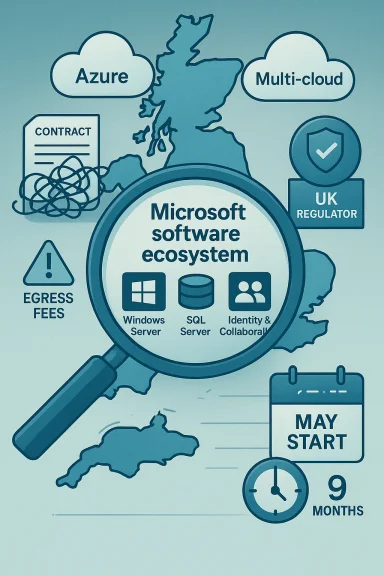
That history explains why the CMA’s latest decision is a step beyond the usual “we have concerns” language. The regulator now plans to open an SMS investigation into Microsoft’s business software ecosystem in May, with the process potentially taking up to nine months. Under the Digital Markets, Competition and Consumers Act 2024, an SMS designation would allow the CMA to impose conduct requirements intended to open up markets and reduce entrenched advantages. In practice, that could give the watchdog a far more direct lever over Microsoft than the ordinary competition tools it has relied on so far.
The timing is telling. The CMA says it is acting now because concerns about today’s cloud market could simply be replayed in the AI era if the same gatekeepers dominate the next layer of business software. That argument is not hard to follow: if core productivity, identity, data, and server software remain tightly coupled to one vendor’s cloud, then AI services built on top of that stack may inherit the same switching costs and commercial leverage. The regulator is effectively saying that the market of 2026 should not become the locked-in infrastructure of 2030.
The regulator also said that switching and multi-cloud require customers to take a series of steps and incur costs that affect their ability and incentive to move. That finding is essential because it means the CMA sees lock-in as a layered problem: transport costs, migration tools, licensing terms, and service integration all feed into the same outcome. Even if one obstacle is reduced, the broader competitive picture may remain distorted. (assets.publishing.service.gov.uk)
The immediate market response shows that the debate is already moving from theory to implementation. Microsoft and Amazon both point to new steps on egress and interoperability, while critics say those steps are too limited or too late. That tension is likely to define the next phase of the CMA process.
One important feature of the CMA’s analysis is that it separated the cloud market into multiple layers of harm. It looked at barriers to switching, barriers to multi-cloud, Microsoft’s licensing practices, and committed spend agreements. That matters because it suggests the regulator is not expecting a single silver bullet. Instead, it is building a case that competition can be impaired through several mutually reinforcing mechanisms. (assets.publishing.service.gov.uk)
That selective approach is notable. Regulators often face a choice between sweeping intervention and targeted conduct rules. The CMA appears to be testing a middle path: let the cloud firms keep making operational commitments on egress and interoperability, but open a separate line of attack where the licensing problem appears most concentrated. In policy terms, that is a more granular approach than a single all-purpose cloud designation.
The cloud case also fits a broader pattern in the UK. The CMA has increasingly used sector-specific digital powers to shape conduct instead of waiting for a traditional antitrust case to mature. That approach is faster, more behavioral, and often more prescriptive. It can also be more controversial, because firms see it as regulation by another name.
The report’s chapter structure is revealing because it mirrors the practical bottlenecks customers face. Egress fees are not just a pricing issue; they are a logistics issue. Licensing is not just a contract issue; it is a workload-placement issue. Committed spend is not just a commercial discount; it is a future switching constraint. The CMA’s framing suggests it views all three as components of the same strategic problem. (assets.publishing.service.gov.uk)
This is where software licensing turns into cloud strategy. Enterprises rarely buy infrastructure in isolation; they carry Windows, SQL Server, identity tools, collaboration software, and security controls into whatever cloud they choose. If the vendor controlling the software stack can alter the economics of deployment depending on the target cloud, then cloud competition is no longer just about compute and storage. It becomes a contest over who gets to define the baseline environment. (assets.publishing.service.gov.uk)
Microsoft has long argued that its tools help customers manage hybrid and multicloud environments. Azure Arc, for example, is marketed as a bridge that extends Azure into on-premises, edge, and multicloud environments, projecting resources into Azure Resource Manager for centralized management and governance. Microsoft’s multicloud connector for Azure Arc also says it can connect non-Azure public cloud resources to Azure and provide a centralized source for management and governance. That is a real interoperability story, but it does not automatically solve the licensing question.
The distinction matters because management visibility is not the same as commercial neutrality. A tool can make it technically easier to monitor or govern another cloud while still leaving the economics of running key workloads skewed toward Azure. That is the heart of the CMA’s concern: interoperability theater is not enough if the pricing model still nudges customers toward one destination.
Microsoft’s claim that these changes respond to CMA concerns is significant even though the source details here are company-reported. If implemented as described, the changes would reduce the penalty for partial migrations, which is often how enterprises actually move. Most large customers do not leave a cloud in one shot; they peel off workloads gradually. A policy that only rewards total exit is, by definition, less useful than one that recognizes incremental migration.
The company is also promising a dedicated interoperability request mechanism for other cloud providers within six months, modeled on the framework it implemented for Windows under the EU Digital Markets Act. That is a telling analogy. It suggests Microsoft understands that regulators now expect not just compliance, but a repeatable process for external parties to ask for interoperability on defined terms. The question is whether a request mechanism changes outcomes in practice, or simply formalizes a queue.
AWS says it has already launched AWS Interconnect multicloud in preview, with Google Cloud as the first launch partner and Microsoft Azure expected later in 2026. AWS also says the service offers private, high-speed connectivity between clouds, and that customers can avoid the traditional do-it-yourself networking complexity. Those are meaningful product developments, especially for enterprises building hybrid data and AI architectures. But the timing also looks like a regulatory hedge.
AWS’s multicloud product is best understood as a response to that regulatory and commercial pressure. It simplifies the mechanics of moving data between clouds, and it can do so over dedicated private connections rather than the public internet. That helps with latency, security, and reliability. It also helps AWS present itself as part of the solution rather than part of the lock-in problem.
Still, network products do not erase ecosystem power. If the application layer, identity layer, or licensing layer remains sticky, then cheaper data movement alone may not unlock real competition. In other words, egress reform is necessary, but it may not be sufficient. (assets.publishing.service.gov.uk)
There is also a strategic reason both firms are engaging. If the CMA concludes that the cloud market can be made more competitive through commitments, the companies avoid the heavier hand of SMS designation. That is worth a lot. An SMS designation is not merely reputational; it can lead to ongoing conduct requirements and closer ongoing supervision. A cooperative posture is therefore a rational attempt to keep the regulator in the light-touch lane.
The CMA has already shown that the regime can move quickly. Its Google mobile platform case led to designation in October 2025, and more recently the regulator secured commitments from Apple and Google to improve fairness and interoperability in app store processes. Those cases matter because they demonstrate that the CMA is willing to combine designation, commitments, and targeted rules rather than using only one instrument. Microsoft is now entering that same policy architecture.
If the CMA designates Microsoft in this space, the company could face obligations not just around pricing, but around how it structures interoperability requests, licensing portability, and customer switching paths. The practical effect could be to make Microsoft justify the default advantages of its own ecosystem. That would be a meaningful shift in how cloud-adjacent software is regulated in the UK.
This also has a competitive symbolism that extends beyond Microsoft. If the UK can treat software-layer behavior as a competition issue in the cloud era, other regulators may take the same view in adjacent markets such as identity, collaboration, AI tooling, and managed security. The boundaries between software, cloud, and AI are blurring, and regulators are following that blur.
The CMA’s report recognized that not all customers are affected equally. That is important because cloud lock-in often hides inside operational convenience. A customer may think it is choosing the most efficient platform, when in reality it has optimized itself into dependence on one vendor’s tooling, billing model, and support structure. The economic damage appears later, when a renewal cycle or regulatory requirement forces a move. (assets.publishing.service.gov.uk)
The upside for enterprises is more choice and more negotiation leverage. If regulators succeed in lowering switching barriers, procurement teams can demand better terms from incumbents without assuming that a move is economically impossible. That alone can alter buying behavior, because the credible threat of exit is often more important than actual exit. (assets.publishing.service.gov.uk)
There is also a governance angle. Many large organizations are under pressure to diversify suppliers for resilience, sovereignty, or compliance reasons. If cloud ecosystems become more portable, those governance goals become easier to implement in practice rather than only on paper. That is especially true for multinational firms juggling data residency, regional controls, and AI model deployment.
The CMA’s six-month review point on progress around egress and interoperability will also matter. If the companies deliver tangible improvements, the regulator may lean toward negotiated remedies. If progress is thin, it may become harder to resist more formal conduct requirements. In practice, this will be measured by whether customers can actually move workloads more cheaply and with less risk, not by how polished the product announcements sound.
Microsoft’s challenge is therefore larger than defending Azure. It must persuade regulators that its software ecosystem is genuinely open enough to support competition, not merely flexible enough to preserve its own advantage. If it succeeds, the company keeps the narrative of multicloud empowerment. If it fails, the UK may redraw the rules for how a dominant software vendor can behave in the cloud era, and that could echo far beyond London.
Source: theregister.com Microsoft to face CMA scrutiny over cloud software licensing
 Overview
The UK cloud market has been under scrutiny for years, but the path to this latest move is important. Ofcom opened the original cloud services market study in October 2022, referred the matter to the CMA in October 2023, and the CMA’s final decision on the market investigation arrived on 31 July 2025. That final report concluded that cloud services are now a vital input to the UK economy and that competition was not working as well as it could, particularly around switching, multi-cloud usage, and licensing. (gov.uk)The CMA’s July 2025 report did not stop at diagnosis. It concluded that technical and commercial barriers such as egress fees, combined with Microsoft’s licensing practices, could create an anti-competitive environment in which customers pay more to leave than to stay. The report explicitly devoted a chapter to Microsoft’s licensing practices and another to egress fees, showing that the regulator viewed these as structural rather than incidental issues. In plain English, the CMA was not describing a few awkward pricing quirks; it was describing the economics of lock-in. (assets.publishing.service.gov.uk)
That history explains why the CMA’s latest decision is a step beyond the usual “we have concerns” language. The regulator now plans to open an SMS investigation into Microsoft’s business software ecosystem in May, with the process potentially taking up to nine months. Under the Digital Markets, Competition and Consumers Act 2024, an SMS designation would allow the CMA to impose conduct requirements intended to open up markets and reduce entrenched advantages. In practice, that could give the watchdog a far more direct lever over Microsoft than the ordinary competition tools it has relied on so far.
The timing is telling. The CMA says it is acting now because concerns about today’s cloud market could simply be replayed in the AI era if the same gatekeepers dominate the next layer of business software. That argument is not hard to follow: if core productivity, identity, data, and server software remain tightly coupled to one vendor’s cloud, then AI services built on top of that stack may inherit the same switching costs and commercial leverage. The regulator is effectively saying that the market of 2026 should not become the locked-in infrastructure of 2030.
Why this case matters now
The cloud market is no longer a niche infrastructure story. The CMA’s final decision said UK cloud services spending reached £10.5 billion in 2024, and revenues in IaaS and PaaS grew at an annual average rate of 29% between 2020 and 2024. That is a fast-growing market with a small number of very large buyers and a small number of very large sellers, which is exactly the kind of market where subtle design choices can have outsized effects. (assets.publishing.service.gov.uk)The regulator also said that switching and multi-cloud require customers to take a series of steps and incur costs that affect their ability and incentive to move. That finding is essential because it means the CMA sees lock-in as a layered problem: transport costs, migration tools, licensing terms, and service integration all feed into the same outcome. Even if one obstacle is reduced, the broader competitive picture may remain distorted. (assets.publishing.service.gov.uk)
The immediate market response shows that the debate is already moving from theory to implementation. Microsoft and Amazon both point to new steps on egress and interoperability, while critics say those steps are too limited or too late. That tension is likely to define the next phase of the CMA process.
The CMA’s Cloud Diagnosis
The CMA’s 2025 cloud investigation did more than identify market concentration. It described a market in which a handful of hyperscalers enjoy major scale advantages, while customers face technical and commercial frictions that make real switching difficult. The regulator’s final decision framed cloud services as a core economic input, not a discretionary IT purchase, which raises the stakes for every licensing and migration rule. (assets.publishing.service.gov.uk)One important feature of the CMA’s analysis is that it separated the cloud market into multiple layers of harm. It looked at barriers to switching, barriers to multi-cloud, Microsoft’s licensing practices, and committed spend agreements. That matters because it suggests the regulator is not expecting a single silver bullet. Instead, it is building a case that competition can be impaired through several mutually reinforcing mechanisms. (assets.publishing.service.gov.uk)
From market study to market intervention
The sequence of events tells its own story. Ofcom studied cloud first, then referred the market to the CMA, and the CMA’s independent inquiry group published provisional findings in January 2025 before its final decision in July. In those provisional findings, the inquiry group recommended that the CMA use its new digital markets powers to consider SMS designations for AWS and Microsoft. The latest announcement shows that the CMA is now selectively using that power: it is pressing ahead with Microsoft software licensing scrutiny while pausing a broad cloud SMS move against both cloud giants for the moment. (gov.uk)That selective approach is notable. Regulators often face a choice between sweeping intervention and targeted conduct rules. The CMA appears to be testing a middle path: let the cloud firms keep making operational commitments on egress and interoperability, but open a separate line of attack where the licensing problem appears most concentrated. In policy terms, that is a more granular approach than a single all-purpose cloud designation.
The cloud case also fits a broader pattern in the UK. The CMA has increasingly used sector-specific digital powers to shape conduct instead of waiting for a traditional antitrust case to mature. That approach is faster, more behavioral, and often more prescriptive. It can also be more controversial, because firms see it as regulation by another name.
What the market investigation actually found
The final decision report emphasized that cloud services are now vital to UK businesses and that competition in the market is not functioning as well as it could. It also noted that customers of different sizes and use cases experience switching barriers differently, which is an important caveat: some businesses may be relatively free to move, while others are effectively trapped by their architecture, contracts, or operational complexity. That kind of uneven harm is often harder to fix with blunt remedies. (assets.publishing.service.gov.uk)The report’s chapter structure is revealing because it mirrors the practical bottlenecks customers face. Egress fees are not just a pricing issue; they are a logistics issue. Licensing is not just a contract issue; it is a workload-placement issue. Committed spend is not just a commercial discount; it is a future switching constraint. The CMA’s framing suggests it views all three as components of the same strategic problem. (assets.publishing.service.gov.uk)
- Cloud competition is shaped by more than headline instance prices.
- Switching costs can come from software rules as much as network fees.
- Multi-cloud strategies can be constrained by integration friction.
- Enterprise buyers often optimize for risk, not only cost.
- Small changes in vendor policy can have large market effects. (assets.publishing.service.gov.uk)
Microsoft Licensing Under the Microscope
Microsoft’s licensing practices are the sharpest point in the CMA’s new move. The core complaint is straightforward: products such as Windows Server and SQL Server can be more expensive to run on some rival clouds than on Azure, because Microsoft permits customers to reallocate on-premises licenses to cloud instances in a way that advantages its own platform. Google has argued that this can make migration to a non-Microsoft cloud several times more expensive, and the CMA appears willing to test whether that dynamic distorts competition.This is where software licensing turns into cloud strategy. Enterprises rarely buy infrastructure in isolation; they carry Windows, SQL Server, identity tools, collaboration software, and security controls into whatever cloud they choose. If the vendor controlling the software stack can alter the economics of deployment depending on the target cloud, then cloud competition is no longer just about compute and storage. It becomes a contest over who gets to define the baseline environment. (assets.publishing.service.gov.uk)
Why licensing can be a lock-in weapon
Licensing is powerful because it acts before a workload ever reaches a cloud. The customer may believe it is making a pure infrastructure decision, but the effective cost of the workload can change depending on which cloud is chosen and which license terms apply. That makes licensing an upstream lever, and upstream levers are often more dangerous than visible price hikes because they are harder for buyers to spot in procurement spreadsheets. (assets.publishing.service.gov.uk)Microsoft has long argued that its tools help customers manage hybrid and multicloud environments. Azure Arc, for example, is marketed as a bridge that extends Azure into on-premises, edge, and multicloud environments, projecting resources into Azure Resource Manager for centralized management and governance. Microsoft’s multicloud connector for Azure Arc also says it can connect non-Azure public cloud resources to Azure and provide a centralized source for management and governance. That is a real interoperability story, but it does not automatically solve the licensing question.
The distinction matters because management visibility is not the same as commercial neutrality. A tool can make it technically easier to monitor or govern another cloud while still leaving the economics of running key workloads skewed toward Azure. That is the heart of the CMA’s concern: interoperability theater is not enough if the pricing model still nudges customers toward one destination.
What Microsoft says it is changing
Microsoft says it has already taken global steps to remove barriers to switching cloud providers, and it is now making new changes for UK customers migrating from its UK datacenters. Free egress will apply not only to transfers using standard internet channels, but also to transfers using the Microsoft Global Network. The company also says the free switch period will be extended from 60 days to 180 days, and that the definition of a qualifying switch will expand to include moving out of an individual Azure service rather than requiring a full exit from Azure.Microsoft’s claim that these changes respond to CMA concerns is significant even though the source details here are company-reported. If implemented as described, the changes would reduce the penalty for partial migrations, which is often how enterprises actually move. Most large customers do not leave a cloud in one shot; they peel off workloads gradually. A policy that only rewards total exit is, by definition, less useful than one that recognizes incremental migration.
The company is also promising a dedicated interoperability request mechanism for other cloud providers within six months, modeled on the framework it implemented for Windows under the EU Digital Markets Act. That is a telling analogy. It suggests Microsoft understands that regulators now expect not just compliance, but a repeatable process for external parties to ask for interoperability on defined terms. The question is whether a request mechanism changes outcomes in practice, or simply formalizes a queue.
AWS, Egress Fees, and the Politics of Cooperation
AWS has an interest in this drama that is easy to overlook. The CMA’s cloud investigation did not only criticize Microsoft; it also identified Amazon as one of the two dominant providers in the UK market. Yet the latest move stops short of launching an AWS SMS probe on the cloud side, at least for now, because both companies have made commitments on egress and interoperability. That is a pragmatic regulatory choice, but it also creates a political risk: one giant can feel singled out while the other remains on the sidelines.AWS says it has already launched AWS Interconnect multicloud in preview, with Google Cloud as the first launch partner and Microsoft Azure expected later in 2026. AWS also says the service offers private, high-speed connectivity between clouds, and that customers can avoid the traditional do-it-yourself networking complexity. Those are meaningful product developments, especially for enterprises building hybrid data and AI architectures. But the timing also looks like a regulatory hedge.
Why egress fees became such a flashpoint
Egress fees are the classic cloud friction point because they affect the cost of leaving, not entering. In a healthy market, providers may charge for data transfer because bandwidth is not free. In a concentrated market, though, egress charges can become a moat, especially when combined with weak interoperability. The CMA’s final decision explicitly treated egress fees as a commercial barrier to switching and multi-cloud. (assets.publishing.service.gov.uk)AWS’s multicloud product is best understood as a response to that regulatory and commercial pressure. It simplifies the mechanics of moving data between clouds, and it can do so over dedicated private connections rather than the public internet. That helps with latency, security, and reliability. It also helps AWS present itself as part of the solution rather than part of the lock-in problem.
Still, network products do not erase ecosystem power. If the application layer, identity layer, or licensing layer remains sticky, then cheaper data movement alone may not unlock real competition. In other words, egress reform is necessary, but it may not be sufficient. (assets.publishing.service.gov.uk)
Cooperation as strategy, not surrender
The CMA has said it will continue “ongoing dialogue” on multi-cloud adoption and switching, and will review progress in six months. That gives Microsoft and AWS an opening to present themselves as cooperative actors, not obstructionists. The risk, however, is that voluntary commitments can soften scrutiny without fully changing the market structure. Regulators often accept cooperation because it delivers faster relief, but speed can come at the expense of permanence.There is also a strategic reason both firms are engaging. If the CMA concludes that the cloud market can be made more competitive through commitments, the companies avoid the heavier hand of SMS designation. That is worth a lot. An SMS designation is not merely reputational; it can lead to ongoing conduct requirements and closer ongoing supervision. A cooperative posture is therefore a rational attempt to keep the regulator in the light-touch lane.
- AWS wants to be seen as enabling multicloud, not blocking it.
- Egress reforms are easier to explain than licensing reform.
- Private interconnects appeal to large enterprises with compliance needs.
- Voluntary commitments can reduce immediate regulatory risk.
- Competition pressure may accelerate product innovation in networking.
The SMS Strategy and the Digital Markets Regime
The CMA’s use of SMS powers is the real institutional story here. The Digital Markets, Competition and Consumers Act 2024 gives the regulator a more flexible toolkit than classic antitrust enforcement, allowing it to designate firms with strategic market status and then impose conduct requirements tailored to the specific digital activity. That is a much more modern regulatory model than a traditional, one-shot competition case.The CMA has already shown that the regime can move quickly. Its Google mobile platform case led to designation in October 2025, and more recently the regulator secured commitments from Apple and Google to improve fairness and interoperability in app store processes. Those cases matter because they demonstrate that the CMA is willing to combine designation, commitments, and targeted rules rather than using only one instrument. Microsoft is now entering that same policy architecture.
Why a software ecosystem is different from a cloud platform
The phrase “business software ecosystem” is not a cosmetic wording change. It broadens the focus from cloud infrastructure to the stack of software that shapes where workloads live and how they can move. That includes server software, database software, identity systems, management tools, and the commercial rules attached to them. For Microsoft, that is a far larger surface area than Azure alone.If the CMA designates Microsoft in this space, the company could face obligations not just around pricing, but around how it structures interoperability requests, licensing portability, and customer switching paths. The practical effect could be to make Microsoft justify the default advantages of its own ecosystem. That would be a meaningful shift in how cloud-adjacent software is regulated in the UK.
This also has a competitive symbolism that extends beyond Microsoft. If the UK can treat software-layer behavior as a competition issue in the cloud era, other regulators may take the same view in adjacent markets such as identity, collaboration, AI tooling, and managed security. The boundaries between software, cloud, and AI are blurring, and regulators are following that blur.
Sequential path the CMA is likely to follow
- Launch the SMS investigation in May.
- Gather customer and competitor evidence on licensing harm.
- Test whether Microsoft’s conduct creates durable market power.
- Decide whether designation is warranted under the DMCCA.
- If designated, consult on specific conduct requirements.
Enterprise Buyers and the Real-World Cost of Lock-In
For enterprises, this is not an abstract regulatory bout. It is about whether long-lived workloads can move without punishing fees, contract traps, or re-licensing shocks. The biggest customers often have the resources to engineer around barriers, but they still face internal risk, retraining, and migration costs. Smaller organizations may be even more constrained because they lack the specialist teams to re-platform software safely. (assets.publishing.service.gov.uk)The CMA’s report recognized that not all customers are affected equally. That is important because cloud lock-in often hides inside operational convenience. A customer may think it is choosing the most efficient platform, when in reality it has optimized itself into dependence on one vendor’s tooling, billing model, and support structure. The economic damage appears later, when a renewal cycle or regulatory requirement forces a move. (assets.publishing.service.gov.uk)
Enterprise impact versus consumer impact
There is no direct consumer broadband-style harm here, but there is a broad economic effect. Cloud infrastructure underpins payroll systems, logistics, healthcare applications, retail operations, and AI services. When enterprise buyers face higher switching costs, those costs can eventually feed through to business investment, prices, and innovation rates across the economy. That is why competition authorities are willing to intervene even in markets where the end user never sees the invoice.The upside for enterprises is more choice and more negotiation leverage. If regulators succeed in lowering switching barriers, procurement teams can demand better terms from incumbents without assuming that a move is economically impossible. That alone can alter buying behavior, because the credible threat of exit is often more important than actual exit. (assets.publishing.service.gov.uk)
There is also a governance angle. Many large organizations are under pressure to diversify suppliers for resilience, sovereignty, or compliance reasons. If cloud ecosystems become more portable, those governance goals become easier to implement in practice rather than only on paper. That is especially true for multinational firms juggling data residency, regional controls, and AI model deployment.
- Easier switching improves procurement leverage.
- Partial migrations become more realistic.
- Multi-cloud strategies become less risky.
- Licensing clarity helps finance and architecture teams.
- Better portability can support resilience and compliance goals. (assets.publishing.service.gov.uk)
Strengths and Opportunities
The CMA’s approach has real strengths because it combines market diagnosis with targeted pressure on the exact behaviors customers complain about. The opportunity is not just to penalize incumbents, but to normalize portability in a market where portability should have been standard all along. If the commitments stick, UK customers could gain genuine bargaining power. (assets.publishing.service.gov.uk)- Stronger incentives for multi-cloud adoption.
- More realistic partial migration paths.
- Better transparency around software licensing.
- More competition in interconnect and data transfer services.
- Potential reduction in egress fee friction.
- Greater pressure for interoperability by design.
- A possible template for AI-era market oversight.
Risks and Concerns
The main risk is that the CMA ends up with partial progress and no structural reset. If Microsoft and AWS make enough voluntary commitments to calm the market, but not enough to change incentives, the result could be a regulatory truce rather than a competitive one. That would leave the hardest problems intact while creating a sense of closure.- Voluntary commitments may prove too narrow.
- A Microsoft-only probe may leave market symmetry concerns unresolved.
- Interoperability requests could become slow and bureaucratic.
- Licensing changes may be hard to verify in practice.
- Smaller competitors may still struggle to gain scale.
- Enterprises may see limited benefit if architectural lock-in remains.
- AI services may inherit the same concentration patterns.
Looking Ahead
The next decisive moment is the planned SMS investigation into Microsoft’s business software ecosystem, due to start in May. Once that begins, the debate will move from cloud infrastructure economics to the deeper mechanics of software leverage, and that is likely to be more contentious. Microsoft will almost certainly argue that its tools improve portability and management across clouds, while rivals will say that the licensing system still favors Azure in ways that no dashboard can fix.The CMA’s six-month review point on progress around egress and interoperability will also matter. If the companies deliver tangible improvements, the regulator may lean toward negotiated remedies. If progress is thin, it may become harder to resist more formal conduct requirements. In practice, this will be measured by whether customers can actually move workloads more cheaply and with less risk, not by how polished the product announcements sound.
Key things to watch
- The launch of the SMS investigation in May.
- The CMA’s invitation for comments from UK customers and competitors.
- Whether Microsoft’s free egress changes are fully implemented as described.
- Whether AWS and Microsoft deliver meaningful interoperability mechanisms.
- Any sign that the CMA broadens scrutiny to other parts of the cloud stack.
Microsoft’s challenge is therefore larger than defending Azure. It must persuade regulators that its software ecosystem is genuinely open enough to support competition, not merely flexible enough to preserve its own advantage. If it succeeds, the company keeps the narrative of multicloud empowerment. If it fails, the UK may redraw the rules for how a dominant software vendor can behave in the cloud era, and that could echo far beyond London.
Source: theregister.com Microsoft to face CMA scrutiny over cloud software licensing