

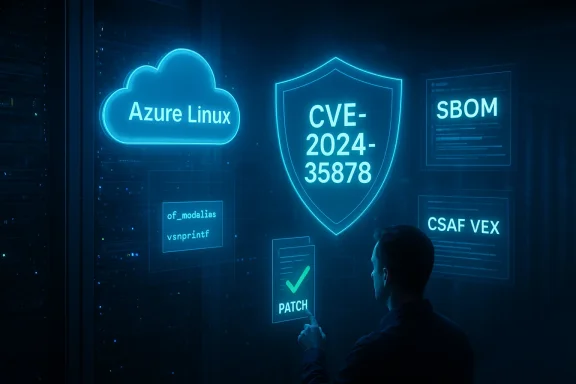
Microsoft’s short answer — no, Azure Linux is not necessarily the only Microsoft product that could include the vulnerable open‑source code — but it is the only Microsoft product Microsoft has publicly attested, at the time of its advisory, to include the specific upstream component implicated by CVE‑2024‑35878.
CVE‑2024‑35878 is a kernel‑level robustness defect discovered in the Linux kernel’s device‑tree / open firmware codepath. The upstream patch targets an unsafe call pattern in of_modalias() where the function can pass a NULL pointer (or negative length) into vsnprintf(), producing a NULL pointer dereference or unexpected buffer sizing because of type mismatches between ssize_t and size_t. The immediate impact is an availability issue — a kernel oops or panic — not a confidentiality or integrity compromise.
Microsoft’s Security Response Center (MSRC) entry for the CVE includes a short product attestation phrase that has become common in recent Microsoft advisories: “Azure Linux includes this open‑source library and is therefore potentially affected by this vulnerability.” That sentence is an explicit inventory statement: it confirms Microsoft has inspected Azure Linux artifacts and found the implicated upstream code there. Microsoft has also stated it will expand its machine‑readable CSAF/VEX attestations and update CVE mappings if other Microsoft products are identified to ship the same component.
This article explains what the MSRC wording does — and does not — mean, describes the technical root cause and scope of CVE‑2024‑35878, evaluates the practical exposure for Microsoft customers beyond Azure Linux, and gives concrete detection and remediation steps for operators who must triage and mitigate risk across heterogeneous Microsoft artifacts.
However, a phased rollout necessarily creates a verification gap: customers who run artifacts outside the initial product family cannot rely on silence. The operational responsibility shifts to customers and their asset‑inventory processes to detect which artifacts they run and whether those artifacts were included in the vendor’s VEX mapping. Several community analyses have warned practitioners about this precise verification gap and recommend aggressive SBOM and artifact inventory practices until vendor mapping is comprehensive.
For CVE‑2024‑35878 specifically, the practical risk is availability (kernel oops/crash) in kernels that include the device‑tree modalias code; the upstream fix is defensive input validation. Patch Azure Linux hosts now if you run them, inventory other Microsoft artifacts you rely on, and automate CSAF/VEX ingestion so future phased attestations produce rapid, machine‑actionable remediation in your environment.
Source: MSRC Security Update Guide - Microsoft Security Response Center
 Background / Overview
CVE‑2024‑35878 is a kernel‑level robustness defect discovered in the Linux kernel’s device‑tree / open firmware codepath. The upstream patch targets an unsafe call pattern in of_modalias() where the function can pass a NULL pointer (or negative length) into vsnprintf(), producing a NULL pointer dereference or unexpected buffer sizing because of type mismatches between ssize_t and size_t. The immediate impact is an availability issue — a kernel oops or panic — not a confidentiality or integrity compromise.Microsoft’s Security Response Center (MSRC) entry for the CVE includes a short product attestation phrase that has become common in recent Microsoft advisories: “Azure Linux includes this open‑source library and is therefore potentially affected by this vulnerability.” That sentence is an explicit inventory statement: it confirms Microsoft has inspected Azure Linux artifacts and found the implicated upstream code there. Microsoft has also stated it will expand its machine‑readable CSAF/VEX attestations and update CVE mappings if other Microsoft products are identified to ship the same component.
This article explains what the MSRC wording does — and does not — mean, describes the technical root cause and scope of CVE‑2024‑35878, evaluates the practical exposure for Microsoft customers beyond Azure Linux, and gives concrete detection and remediation steps for operators who must triage and mitigate risk across heterogeneous Microsoft artifacts.
What the MSRC phrase actually means
Product attestation versus exclusivity
When Microsoft writes “Azure Linux includes this open‑source library and is therefore potentially affected,” that is:- A confirmed, authoritative signal that Azure Linux has been inventoried and the vulnerable upstream component was found in those images.
- A machine‑readable assertion intended to power CSAF/VEX automation and rapid triage for Azure Linux customers.
- A phased transparency step: Microsoft begins with a product family (Azure Linux) where it can produce a complete inventory, then expands attestations as it completes inventory for other product families.
Why Microsoft approaches advisories this way
Large vendors ship many discrete artifacts: distribution images, cloud VM images, Marketplace appliances, kernel builds for cloud hosts, WSL kernels, container base layers, and statically linked or bundled binaries. Whether an upstream kernel function or driver appears in a given artifact depends on several build‑time factors:- Kernel version and which upstream commits or stable‑tree backports were included.
- Kernel configuration flags (CONFIG_* options) that enable or disable the subsystem or driver in question.
- Packaging choices (module vs compiled‑in, stripped builds, or trimmed kernels used for appliances).
Technical deep dive: what CVE‑2024‑35878 is and why it matters
The bug, in plain terms
CVE‑2024‑35878 arises when of_modalias() accepts parameters that allow a NULL pointer to be passed to vsnprintf() while the length parameter is non‑zero, or when a negative len value is interpreted unsafely because of signed-to-unsigned conversions (ssize_t → size_t). The result is either:- A NULL pointer dereference inside vsnprintf(), producing a kernel oops and potential host crash, or
- An unexpectedly large buffer allocation or incorrect snprintf() sizing due to the negative-to-unsigned conversion, which can produce memory corruption or further instability in some contexts.
Scope within the kernel
This particular defect is localized to the device‑tree / OF (Open Firmware) aliasing codepath — code that translates device tree aliases into module names or modalias strings. Not all kernels enable those specific OF helpers, and many trimmed or specialized kernels omit portions of device‑tree support depending on target hardware or intended deployment. Because kernel builds differ, the presence/impact of CVE‑2024‑35878 is an artifact‑level property: it only affects a kernel that includes the of_modalias() codepath in question.Is Azure Linux the only Microsoft product at risk?
Short, concrete answer
- Azure Linux is the only Microsoft product that Microsoft has publicly attested (via its MSRC update guide and CSAF/VEX mappings) to include the open‑source component implicated by CVE‑2024‑35878 at the time the advisory was published. That attestation is authoritative for Azure Linux customers and should be treated as such.
- However, that attestation is not a technical guarantee that no other Microsoft product ever included the same component. Until Microsoft publishes additional attestations or an organization inspects other Microsoft artifacts it runs, those artifacts should be treated as potentially affected.
Practical examples of potentially affected Microsoft artifacts
Other Microsoft artifacts that can plausibly include the same upstream kernel code — depending on how they were built — include:- WSL2 kernel builds shipped in Windows updates or in WSL package channels.
- linux‑azure kernel packages used in certain Azure VM images.
- Azure Marketplace VM images or vendor appliances that include snapshot kernels.
- Container base images or Marketplace containers that include a kernel userland or kernel modules (rare, but possible in certain distribution packaging).
- Custom kernel images used by specialized Microsoft-managed services or appliances.
How to determine whether your Microsoft artifacts are affected
Recommended triage checklist (quick)
- Identify all Microsoft‑supplied Linux artifacts you run: Azure Linux images, Marketplace images, WSL kernels, linux‑azure packages, and any Microsoft-provided appliance images.
- Obtain SBOMs, VEX/CSAF attestations, or package manifests for each artifact. If Microsoft has published a CSAF/VEX entry for the CVE for that product family, use it as a canonical source.
- For kernels, check the kernel version and upstream commit range against the upstream patch that fixed CVE‑2024‑35878.
- Inspect kernel config (CONFIG_OF etc.) and check whether the specific device‑tree/of codepath is present (grep for of_modalias in the kernel source tree or modules list).
- Where you cannot obtain authoritative SBOM/VEX data, run targeted scanning (binary-level or source-level) to detect the presence of the vulnerable function or module.
- If an artifact is found to be affected, follow vendor remediation guidance: apply Microsoft hotfixes, update the kernel packages, or replace the image with a patched variant.
Tools and signals to use
- Vendor‑supplied CSAF/VEX artifacts when available: the most authoritative, machine‑readable product mapping Microsoft provides.
- NVD and distribution security advisories (Debian, Red Hat, Oracle, Amazon ALAS) which list affected kernel package versions and backports. These trackers can help map upstream commits to distribution package versions.
- Binary scanning and SBOM comparison tools that look for symbols, function names, or module names (for kernels, search for of_modalias references).
- Kernel config inspection (zcat /proc/config.gz on running systems) to confirm whether relevant config options were enabled during build.
Remediation and mitigation guidance
Immediate actions for Azure Linux customers
- Prioritize patching: Azure Linux customers should apply Microsoft’s published kernel updates for affected Azure Linux images as soon as they are available. Microsoft’s attestation explicitly marks Azure Linux as in‑scope and therefore a triage priority.
- Automate VEX ingestion: If your environment consumes Microsoft CSAF/VEX feeds programmatically, ensure your automation is configured to ingest and act on the Azure Linux mapping for this CVE.
- Reboot carefully: Kernel updates require host reboots in most cases. Schedule reboots to minimize operational impact, and verify post‑patch kernel versions and config.
Actions for organizations running other Microsoft artifacts
- Don’t assume “not mentioned = safe.” Absence of a VEX mapping for a Microsoft product is not proof of absence; inventory and scan your Microsoft artifacts.
- Request SBOM or VEX attestations from Microsoft for specific artifacts if they are critical to your environment and not yet covered by public mappings.
- Where you cannot obtain an immediate vendor attestation, prioritize direct artifact inspection: check kernel versions, config, and whether the affected of_modalias codepath is present.
- For appliances or Marketplace images, reach out to the image publisher or Microsoft support and request clarification and remedial guidance.
Temporary mitigations (limited usefulness)
- System‑level hardening (seccomp, kernel lockdown) does not prevent a kernel NULL dereference in code paths already running in kernel mode; these mitigations are of limited value for this class of bug.
- Isolate or reduce attack surface: if the vulnerable codepath can only be triggered by specific inputs (for example, device-tree parsing at boot or module loading), reduce exposure to untrusted device trees or prevent loading of the implicated module until a patch is applied.
Detection — how to spot a possible exploit or crash
- Look for kernel oops messages mentioning vsnprintf, of_modalias, or the OF/device‑tree aliasing stack trace in your system logs (dmesg, journalctl). A NULL dereference typically produces a recognizable stack trace anchored on vsnprintf or the callsite.
- Monitor cloud provider telemetry: if Microsoft publishes telemetry or guidance for Azure Linux customers, ingest it and correlate with local logs.
- For fleet detection, create a SIEM rule that flags kernel oopses referencing the OF helpers or the modalias path.
Supply‑chain and programmatic lessons
Why MSRC’s product‑scoped attestations matter
Microsoft’s move to publish machine‑readable CSAF/VEX attestations (a program Microsoft began publishing as part of an October 2025 rollout) is a major step toward operational transparency. When vendors provide per‑product attestations, automation can triage thousands of assets quickly. That reduces time‑to‑remediation for the products the vendor has inventoried.However, a phased rollout necessarily creates a verification gap: customers who run artifacts outside the initial product family cannot rely on silence. The operational responsibility shifts to customers and their asset‑inventory processes to detect which artifacts they run and whether those artifacts were included in the vendor’s VEX mapping. Several community analyses have warned practitioners about this precise verification gap and recommend aggressive SBOM and artifact inventory practices until vendor mapping is comprehensive.
Organizational controls to reduce future uncertainty
- Maintain an authoritative internal SBOM and inventory of all vendor artifacts (images, kernels, appliances) you run.
- Integrate CSAF/VEX ingestion into your vulnerability management pipeline so product‑level attestations are automatically correlated with your asset inventory.
- Treat vendor attestations as high‑value signals but not as the sole source of truth for your environment: maintain artifact‑level controls and runtime detection.
Critical analysis: strengths and risks of Microsoft’s approach
Strengths
- Transparency where available: Publishing product‑scoped CSAF/VEX attestations gives Azure Linux customers a fast, automatable way to triage exposure and apply patches. That is operationally valuable and reduces manual effort for the product family covered.
- Clear remediation path for attested products: Because the attestation explicitly identifies Azure Linux as potentially affected, Microsoft’s update guidance and kernel patches for Azure Linux can be consumed and acted upon quickly by cloud operators and automation.
Risks and limitations
- Phased coverage leaves uncertainty: Until Microsoft expands VEX mappings across other product families, customers running Microsoft artifacts beyond Azure Linux must assume uncertainty and perform independent verification. This gap can produce triage delays in large, heterogeneous environments.
- Potential for misinterpretation: Non‑technical readers may misread the MSRC sentence as “only Azure Linux is affected,” which is an operationally dangerous assumption. The wording is precise by design but easily misunderstood if the differences between attestation and exclusivity aren’t explained.
- Artifact variability: Because kernel inclusion is a build‑time decision, two Microsoft artifacts with similar names can have different exposure — increasing the burden on customers to verify each artifact individually.
Practical checklist for security teams (one page, actionable)
- Ingest and parse Microsoft CSAF/VEX feeds; subscribe to Azure Linux mappings immediately for CVE‑2024‑35878.
- Inventory all Microsoft Linux artifacts you run (Azure images, WSL kernels, linux‑azure, Marketplace images). Mark each artifact as “attested safe,” “attested affected,” or “unknown.”
- For “unknown” artifacts, run artifact inspection: check kernel version, grep for of_modalias, and check kernel config for OF helpers. If detection is non‑trivial, escalate to vendor support for an SBOM/VEX attestation.
- Patch Azure Linux hosts per Microsoft guidance and schedule reboots where required.
- Create SIEM rules to detect kernel oopses referencing vsnprintf or device‑tree helpers; escalate and remediate accordingly.
Conclusion
Microsoft’s statement that “Azure Linux includes this open‑source library and is therefore potentially affected” is an authoritative, product‑level attestation and a concrete remediation signal for Azure Linux customers. It is not, however, a categorical guarantee that no other Microsoft product includes the implicated upstream kernel code. Because kernel inclusion is an artifact‑level property — driven by kernel version, configuration, and packaging — organizations must inventory and inspect any Microsoft artifacts they run that are outside the Azure Linux family. Treat Microsoft’s VEX/CSAF mapping as a high‑fidelity signal where published, but don’t let absence of an attestation substitute for artifact‑level verification.For CVE‑2024‑35878 specifically, the practical risk is availability (kernel oops/crash) in kernels that include the device‑tree modalias code; the upstream fix is defensive input validation. Patch Azure Linux hosts now if you run them, inventory other Microsoft artifacts you rely on, and automate CSAF/VEX ingestion so future phased attestations produce rapid, machine‑actionable remediation in your environment.
Source: MSRC Security Update Guide - Microsoft Security Response Center
