

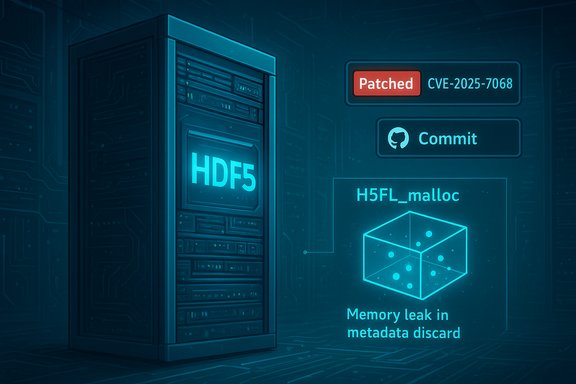
HDF5 users and maintainers should treat a newly disclosed flaw — CVE-2025-7068 — as a real but limited operational risk: a memory‑leak in the HDF5 metadata/cache code that affects HDF5 1.14.6 and can be triggered by local operations that exercise the library’s metadata discard paths.
HDF5 is a foundational C library and file format used across scientific computing, data analysis, imaging pipelines, and many vendor appliances. The library exposes a rich metadata and caching layer that manages on‑disk object headers, metadata cache entries, and memory used to hold transient state while files are read and closed. In HDF5 1.14.6 a defect in the metadata discard/cleanup logic — specifically the code path that calls H5FL__malloc and later discards metadata cache entries — can cause allocated objects not to be freed correctly, producing a memory leak under certain failure conditions. This behavior has been cataloged as CVE‑2025‑7068. Why this matters: even a small persistent leak in a long‑running service that processes untrusted files (for example, an ingestion pipeline, thumbnailing service, or a shared research cluster) can, over time or at scale, degrade performance and cause worker churn or OOM conditions. The exploit model in public advisories is local: an attacker or misbehaving workload able to trigger the discard path repeatedly or create the error condition can incrementally consume memory. Multiple vulnerability feeds and vendor trackers list the flaw and categorize the primary impact as availability/resource exhaustion rather than information disclosure or integrity compromise.
Source: MSRC Security Update Guide - Microsoft Security Response Center
 Background / Overview
HDF5 is a foundational C library and file format used across scientific computing, data analysis, imaging pipelines, and many vendor appliances. The library exposes a rich metadata and caching layer that manages on‑disk object headers, metadata cache entries, and memory used to hold transient state while files are read and closed. In HDF5 1.14.6 a defect in the metadata discard/cleanup logic — specifically the code path that calls H5FL__malloc and later discards metadata cache entries — can cause allocated objects not to be freed correctly, producing a memory leak under certain failure conditions. This behavior has been cataloged as CVE‑2025‑7068. Why this matters: even a small persistent leak in a long‑running service that processes untrusted files (for example, an ingestion pipeline, thumbnailing service, or a shared research cluster) can, over time or at scale, degrade performance and cause worker churn or OOM conditions. The exploit model in public advisories is local: an attacker or misbehaving workload able to trigger the discard path repeatedly or create the error condition can incrementally consume memory. Multiple vulnerability feeds and vendor trackers list the flaw and categorize the primary impact as availability/resource exhaustion rather than information disclosure or integrity compromise. Technical anatomy: what the bug actually is
The vulnerable component and function
- Affected library: HDF5 (HDFGroup)
- Affected release: HDF5 1.14.6 (explicitly named by trackers)
- Vulnerable code: src/H5FL.c, function H5FL__malloc and related metadata discard logic.
Trigger and attacker model
- Attack vector: Local (operations on files / local code paths that exercise metadata discard).
- Complexity: Low — the issue is a straightforward cleanup omission; where the discard path is executed repeatedly or error conditions are deliberately or accidentally triggered, the leak accumulates.
- Privileges required: Low (local process privileges sufficient to cause HDF5 to open/close or otherwise discard metadata in a user process or service).
Verification and evidence
Several independent sources corroborate the same technical facts:- The NVD entry for CVE‑2025‑7068 identifies HDF5 1.14.6 and the H5FL__malloc path as the locus of the problem. The NVD description explicitly lists a local memory‑leak scenario.
- Distribution trackers (Ubuntu, Debian, SUSE) and vulnerability aggregators (OpenCVE, cvefeed, Wiz) list the same affected version and describe the memory leak behavior; they also include vendor issue links and patch references in their records.
- The upstream HDF Group GitHub commit that addresses the problem is published and explicitly references CVE‑2025‑7068 in the changelog and PR notes; the commit implements defensive cleanup behavior during metadata cache entry discard and documents calling the free callback even on error paths. That commit is visible in the upstream repo (commit 7dd1102) and is the canonical code‑level evidence of both the problem and its mitigation.
Severity, scoring differences, and what they mean
Scoring across trackers varies:- Some sources report a CVSSv3.1 base score around 3.3 (Low), reflecting the local attack vector and limited confidentiality/integrity impact.
- Other aggregators show a 5.5 (Medium) score or a CVSSv4.0 vector at 4.8 (Medium), emphasizing availability impact (resource exhaustion) for long‑running services.
Upstream fix and package status
The HDF Group merged a targeted fix (commit 7dd1102 and associated PR #5817) that changes the metadata cache discard flow to attempt to fully free a cache entry before signalling an error, ensuring the free callback runs even when the discard sequence reports an error. The changelog entry explicitly references CVE‑2025‑7068 and the associated GitHub issue. Operators should look for the presence of this upstream commit (or equivalent backport) in their distribution packages as the canonical sign of remediation. Distribution trackers are at different stages of packaging and backporting:- Debian lists related issue/PR references and maps affected package versions; some Debian package builds remain flagged as vulnerable pending inclusion of the upstream changes.
- Ubuntu and SUSE have published CVE pages and priority notes while they evaluate or ship updates for their respective releases.
Practical remediation checklist (step‑by‑step)
- Inventory: identify every binary, container, and image that includes HDF5 1.14.6. Search for hdf5 shared libraries, conda/pip wheels that depend on HDF5, and statically‑linked executables that include the library.
- Confirm fix presence: verify installed HDF5 packages include the upstream commit (commit 7dd1102) or vendor advisory listing CVE‑2025‑7068. If the package changelog or upstream release notes mention the specific commit or PR number, treat that as proof of remediation.
- Apply vendor patches: install distribution updates (apt/yum/zypper) that include the HDF5 fixes, or rebuild HDF5 from source including the upstream commit and then rebuild any statically linked artifacts.
- Rebuild static artifacts: for any product that statically links HDF5 (embedded devices, vendor binaries), rebuild and redeploy those artifacts with the patched HDF5. Replacing only the system library is not enough.
- Short‑term mitigations if patching is delayed:
- Block or quarantine untrusted .h5 uploads to ingestion services.
- Run HDF5 processing in constrained sandboxes (containers with mem limits, seccomp/AppArmor profiles).
- Disable automated preview/thumbnailing of .h5 files where possible.
- Monitor: enable crash and OOM alerts for HDF5‑using processes, and scan logs for repeated failures or worker restarts correlated with .h5 file inputs.
Detection and incident response guidance
- Indicators to hunt for: repeated memory growth in HDF5‑using processes, worker restart churn, core dumps or SIGABRTs during file close or metadata flush operations, and suspicious batches of uploaded .h5 files arriving before crash windows.
- Forensics: if you suspect exploitation, collect process memory snapshots and coredumps, record exact file inputs processed before failure, and preserve the precise HDF5 binary used (with symbol information if available) to reproduce the discard path in a controlled environment.
- Validation: reproduce the failure in an isolated test environment by running build/test cases that exercise metadata discard and error handling; then confirm that a patched build no longer leaks under the same conditions. The upstream PR and issue discussion include test points and the logic change to validate against.
Risk analysis: who should care and why
- High priority: cloud ingestion services, public file upload endpoints, HPC file servers, containerized batch processors and any automated pipeline that opens and closes arbitrary user‑supplied .h5 files. These services frequently process untrusted input at scale; a local leak becomes a DoS risk when triggered repeatedly across many workers.
- Medium priority: research workstations and developer systems where users open third‑party .h5 files—risk is exposure to targeted, local attacks or accidental resource exhaustion.
- Lower priority: isolated single‑user desktop apps where HDF5 is used only for trusted, local files — the attacker model and exploitability are constrained in these environments. Nevertheless, statically linked appliances should be validated because they are harder to patch in the field.
Strengths and limitations of the public record
What’s strong about the public evidence:- The upstream HDF Group commit is public, explicit, and mapped to the CVE ID; that gives defenders a clear remediation target and a way to validate vendor backports.
- Multiple independent trackers (NVD, Debian, Ubuntu, SUSE, OpenCVE) converge on the same technical description (missing cleanup in metadata discard) and affected release (1.14.6), so the core facts are consistent across authoritative sources.
- Public exploit tooling: some vulnerability aggregators and feeds flag a public PoC or exploit demonstrations exist, but not all sources provide a canonical, validated exploit that produces a production‑grade weaponization. Treat PoC claims with caution and validate any PoC before assuming broad exploitability. A few feeds reference GitHub PoCs but the presence of a small reproduction test does not imply wide‑scale weaponization. Flag these claims as partially verified unless you can reproduce them in a controlled lab.
- Impact scoring variance: CVSS differences reflect different environmental assumptions. The raw technical facts point to availability as the real impact; whether that maps to low or medium severity in your org depends on how exposed your HDF5 consumers are.
Practical recommendations for teams
- Short term (0–72 hours): inventory, isolate vulnerable processing pipelines, and apply temporary upload quarantines and resource limits on HDF5 worker processes. Implement strict authentication/authorization on file uploads.
- Medium term (72 hours–2 weeks): deploy vendor or distribution patches that include the upstream commit; rebuild and redeploy statically linked artifacts. Validate the fix in staging using the same reproduction cases used to confirm the issue locally.
- Long term: add fuzz testing and CI checks that exercise metadata discard and error paths in your HDF5‑using products; monitor memory consumption over long runs; maintain an inventory of all third‑party native libraries embedded in images so traceability for future CVEs is immediate.
Final assessment and conclusion
CVE‑2025‑7068 is a verifiable, real vulnerability affecting HDF5 1.14.6 that manifests as a memory leak in metadata cache discard and H5FL__malloc-related paths. The defect is not a buffer overflow or memory corruption in the published descriptions; instead it is a resource lifecycle/cleanup omission. The HDF Group has merged a specific fix (commit 7dd1102 / PR #5817) that addresses the error‑path cleanup and explicitly references the CVE, giving operators a concrete remediation target. Operational risk depends heavily on deployment patterns. Public ingestion services and automated pipelines that accept untrusted .h5 files are the most exposed and should be prioritized for patching and sandboxing. For environments where HDF5 is statically linked into appliances, a rebuild is necessary to fully remediate the risk. While PoC claims exist in some feeds, the dominant real‑world impact is availability via incremental memory consumption; claims of easy RCE from this defect are not supported by the upstream descriptions and should be treated as unverified until independent exploit writeups demonstrate otherwise. Action checklist (one more time, distilled):- Inventory all HDF5 usages and artifacts.
- Verify packages include upstream commit 7dd1102 or vendor backports.
- Patch dynamic libraries and rebuild static binaries.
- Sandbox and limit memory for HDF5‑using worker processes while patches are deployed.
- Monitor for worker memory growth, restarts, and crash signatures tied to .h5 inputs.
Source: MSRC Security Update Guide - Microsoft Security Response Center
