

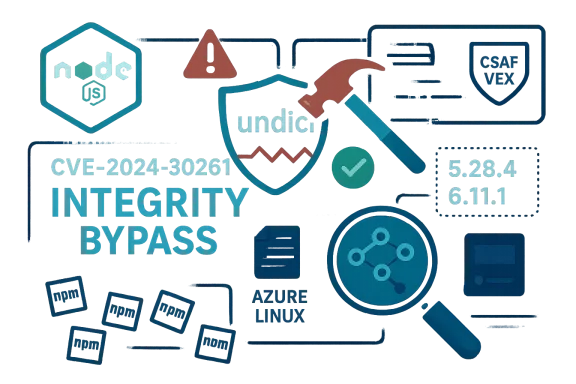
Undici’s publicly tracked integrity bypass (CVE-2024-30261) is real, it was fixed upstream, and Microsoft’s short MSRC attestation that “Azure Linux includes this open‑source library and is therefore potentially affected” is a product‑scoped inventory statement — useful for Azure Linux customers, but not proof that no other Microsoft product or image could contain the vulnerable library.
Undici is a high‑performance HTTP/1.1 client library for Node.js that exposes a fetch() API used by many server‑side JavaScript applications and by packaged Node runtimes in some Linux distributions. In April 2024 the project and public CVE trackers recorded a vulnerability — tracked as CVE‑2024‑30261 — in Undici’s handling of the integrity option passed to fetch(). The core issue: when an integrity algorithm is specified but the hash value is incorrect or manipulated, the check could be bypassed and fetch() might accept a tampered resource. The upstream maintainers released fixes; the patched releases are 5.28.4 and 6.11.1 (and any later versions).
This article explains the technical mechanics of the bug, what the public vulnerability records and Microsoft’s messaging actually mean for customers, who should be worried, and what practical steps administrators and developers should take to verify and remediate exposure across Microsoft‑supplied artifacts and images.
Why that distinction matters: a product‑scoped attestation is a slice of Microsoft’s supply‑chain inventory at the time of publication. It is authoritative for that product, but it does not prove absence of the same upstream component in other Microsoft images, containers, or services unless Microsoft publishes attestations for them as well. Treat the absence of an attestation for a Microsoft artifact as “not yet checked/published,” not as proof of immunity.
Patch promptly, enforce SBOM and SCA controls, and combine vendor attestations with your own artifact verification to close the loop on supply‑chain risk.
Source: MSRC Security Update Guide - Microsoft Security Response Center
 Background / Overview
Undici is a high‑performance HTTP/1.1 client library for Node.js that exposes a fetch() API used by many server‑side JavaScript applications and by packaged Node runtimes in some Linux distributions. In April 2024 the project and public CVE trackers recorded a vulnerability — tracked as CVE‑2024‑30261 — in Undici’s handling of the integrity option passed to fetch(). The core issue: when an integrity algorithm is specified but the hash value is incorrect or manipulated, the check could be bypassed and fetch() might accept a tampered resource. The upstream maintainers released fixes; the patched releases are 5.28.4 and 6.11.1 (and any later versions).This article explains the technical mechanics of the bug, what the public vulnerability records and Microsoft’s messaging actually mean for customers, who should be worried, and what practical steps administrators and developers should take to verify and remediate exposure across Microsoft‑supplied artifacts and images.
The bug in plain terms
What the integrity option is supposed to do
The fetch() API in modern JavaScript supports an integrity option (inspired by Subresource Integrity, or SRI) that lets the caller supply a hash of the expected payload. When functioning correctly, fetch() computes the hash of the downloaded resource and refuses the result if the computed hash does not match the supplied one. That protects callers from server‑side tampering or in‑flight modification of fetched artifacts.What went wrong in Undici
In the affected Undici versions the client’s validation logic could be tricked when the integrity algorithm was present but the corresponding hash value was malformed or otherwise incorrect. Under some malformed inputs the library’s internal checks were “too lax” — they mis‑parsed or incorrectly accepted the integrity value — effectively allowing a mismatch to pass as valid. In practice, exploiting the bug requires the attacker to control or alter the integrity option being supplied to fetch() (for example, via a vulnerable intermediate module or by manipulating a call path that forwards integrity values). The vulnerability therefore allows an attacker who can interpose on or control the integrity string to make fetch() accept a tampered response as if it matched the stated integrity.Severity and practical reach
Major vulnerability databases rate CVE‑2024‑30261 as low severity (CVSS v3.x scores reported in public trackers vary — common values are in the low 2.x–3.x range). That rating reflects two important constraints:- The attacker must be able to control the integrity option (which often requires local or supply‑chain access to code that sets or forwards that value).
- The bug affects integrity checking (integrity/confidentiality tradeoffs), not direct remote code execution or wide‑open remote compromise in most typical deployments.
Patch status and vendor coverage — what’s fixed and where
- Fixed upstream: Undici releases 5.28.4 and 6.11.1 include the security fix; upgrading to these or any later release eliminates the upstream vulnerability.
- Distribution advisories: major Linux and enterprise OS vendors and security trackers (Ubuntu, Debian, Amazon Linux, Red Hat distributions, and security vendors) published entries and packages that reflect the vulnerability and the availability of fixed packages. These sources confirm the affected version ranges and the patched versions.
- Public CVE records: NVD, OSV and multiple secondary trackers contain consolidated details and references to the upstream GitHub advisory and the fixes. Use those records to confirm version ranges and CVSS interpretations for your context.
Microsoft’s public wording: what it actually says and why that matters
Microsoft’s Security Response Center (MSRC) and the Update Guide pages commonly include a short FAQ line that reads, in effect, “Azure Linux inc library and is therefore potentially affected,” followed by a commitment to publish CSAF/VEX attestations and to update the CVE mapping if additional Microsoft products are identified as carriers. That phrasing and programmatic change is real and deliberate: Microsoft has started publishing machine‑readable VEX/CSAF attestations (the rollout began in October 2025) to give customers more deterministic artifact‑level mappings. However, the wording is an inventory attestation for Azure Linux only — it is not an exclusive assertion that Azure Linux is the only Microsoft product that could include Undici. In short: Microsoft is confirming what their inventory work has already shown (Azure Linux includes the library) and promising to expand the mapping if their internal artifact scans find the same component in other products.Why that distinction matters: a product‑scoped attestation is a slice of Microsoft’s supply‑chain inventory at the time of publication. It is authoritative for that product, but it does not prove absence of the same upstream component in other Microsoft images, containers, or services unless Microsoft publishes attestations for them as well. Treat the absence of an attestation for a Microsoft artifact as “not yet checked/published,” not as proof of immunity.
Short answer to the reader’s question
Is Azure Linux the only Microsoft product that inclurefore potentially affected?- Official MSRC wording: Azure Linux is a Microsoft product that Microsoft has inventory‑checked and publicly attested to include the implicated open‑source component (Undici) for this CVE. That attestation is accurate and useful for Azure Linux customers.
- Exclusive claim? No. Microsoft’s language does not and cannot guarantee exclft artifacts (container images, internal Node runtimes, Azure Marketplace images, custom images used by Azure services, or other Microsoft products that package Node modules) could include the same Node.js module; Microsoft has committed to update the CVE mapping if additional products are found to carry the component. Until Microsoft publishes additional VEX/CSAF attestations, administrators and security teams should assume other Microsoft‑distributed artifacts may contain the library and verify individually.
Why you should not treat an MSRC attestation as global coverage
There are three practical reasons:- Microsoft’s CVE pages are projecting a specific inventory result rather than a global scan across every Microsoft‑published artifact. The company explicitly frames the statement as the outcome of the inventory for Azure Linux and promises to expand the mapping as additional artifacts are checked. That is helpful — but it’s not the same as an automatic, product‑wide guarantee.
- The same open‑source component can appear in many shapes: prebuilt packages in a distro (Azure Linux), language package registries (npm), container image layers, function‑app runtimes, and custom images. Finding Undici in one Microsoft artifact (Azure Linux) does not prove whether or not it exists in other artifacts such as Azure Marketplace images, AKS node images, or baked‑in runtimes in cloud services. Those require separate checks.
- The Node ecosystem and container supply chain mean a vulnerability in a small, high‑level library can have disparate carriers. A library like Undici might be present in distribution packages, in rebuilt Node runtimes distributed by vendors, or in container images published by third parties and consumed in Microsoft services. Only direct artifact scanning or SBOM inspection yields certainty.
Practical detection and verification steps (for security teams)
If you manage Microsoft Azure artifacts, or you rely on Microsoft images or services that could contain node modules, use the following prioritized checks.1. Check local/host images and packages
- For Node projects and hosts: run npm/yarn/pnpm scans:
- npm ls undici --all
- yarn why undici
- pnpm why undici
- For Linux packages:
- Check distro packaging (dpkg -l | grep undici on Debian/Ubuntu family; rpm -qa | grep undici on RHEL/Fedora) and confirm the package versions against the fixed releases. Use your distro’s package manager to determine if the maintained package has been updated.
2. Scan container images and artifacts
- Use container scanners (SBOM generators, SCA tools) to enumerate npm packages in image layers.
- Inspect image SBOMs or run: docker run --rm image-name sh -c "npm ls undici --json || true" (or unpack the image and run npm utilities). Many registries now publish SBOMs — use those SBOMs to quickly locate undici. Vendor images provided by Microsoft (Azure Marketplace images, Azure Functions base images, etc.) often publish metadata or SBOMs you can request or download.
3. Query SBOMs and VEX/CSAF artifacts
- Microsoft is publishing CSAF/VEX attestations for Azure Linux and incrementally for other artifacts. If you rely on Microsoft SKUs, check the MSRC Update Guide and the product‑specific VEX files for updated mapping; but don’t stop at the attestation — run your own artifact scans if your workloads use custom images or service runtimes.
4. Package manager and build pipelines
- For CI/CD pipelines, ensure your dependency scanning rules flag undici versions <5.28.4 and 6.0.0–6.11.0. Block builds that produce images with vulnerable releases embedded.
- Rebuild and redeploy containers with rebuilt Node runtimes that include the patched undici, or bake a fixed undici into application images.
5. Use vendor advisories and official fixes
- Where possible, rely on updated vendor packages from your OS vendor (Ubuntu, Amor distribution‑level installations. Where applications manage their own node_modules, update the module directly.
Remediation checklist — prioritized actions
- Upgrade undici in project dependencies to 5.28.4 or 6.11.1 (or later). Confirm by running npm/yarn/pnpm update and re‑running dependency‑graph checks.
- Rebuild and redeploy any container images that include undici (whether in base images or application layers). Regenerate SBOMs and verify that the new images contain only fixed versions.
- For distribution packages (system package managers), apply OS vendor updates that include the fixed package (Ubuntu, Red Hat, Amazon Linux and others have advisories and packages). Validate package versions with apt/yum/dnf queries.
- Add dependency‑scanning rules to CI/CD to block builds that depend on vulnerable ranges (<=5.28.3, >=6.0.0 <6.11.1). Automate enforcement via SCA tools and SBOM checks.
- If you operate in Azure and use Microsoft images or services: consult MSRC VEX/CSAF attestations for product‑level mapping, but also run your own scans of any images or service artifacts you control or that are included in your deployment pipeline. Expect Microsoft to update CVE mappings if additional products are found to ship the component.
Who should be most concerned?
- Application owners who ship Node applications or containers that directly depend on Undici.
- DevOps teams who bake baseode runtimes or preinstalled npm packages.
- Operators of environments that consume Microsoft‑published images or runtimes (including Azure Marketplace images, some Azure Functions custom containers, or images used in AKS clusters) — because Microsoft’s current attestation confirms Azure Linux as a known carrier but does not yet verify every Microsoft artifact.
- Security teams responsible for supply‑chain assurance: this CVE underscores the need for SBOMs and artifact scanning across cloud and on‑prem pipelines.
Critical analysis: strengths, risks, and gaps
Strengths
- Upstream response and fixes: the Undici maintainers fixed the issue and released explicit patched versions; the GitHub advisory and commits are public and traceable. Multiple distribution vendors and security trackers have recorded the fix and published advisories. That short cycle from disclosure to fixes is a positive sign for the Node ecosystem’s maintainers and downstream vendors.
- Microsoft transparency improvements: Microsoft’s move to publish machine‑readable CSAF/VEX attestations (rollout beginning October 2025) improves artifact-level visibility and makes it easier for customers to determine which Microsoft SKUs are known carriers. That transparency is a meaningful operational improvement for enterprise customers that consume Microsoft images.
Riskstestation scope vs. artifact reality: Microsoft’s attestation that Azure Linux includes the library is accurate and helpful — but it is not the same as a comprehensive sweep of every Microsoft artifact. Relying solely on the presence/absence of MSRC attestations can produce a false sense of security for teams that consume other Microsoft‑published images or services. Administrators must pair vendor attestations with their own artifact scanning.
- Supply‑chain complexity: Node modules can be introduced transitively (through other npm modules) or via preinstalled runtime images. That complexity means a vulnerability in a relatively small module can be widely present in disparate artifacts; a one‑off attestation therefore cannot be the final word on exposure. Public advisories from distributions and vendors help, but active SBOM and SCA enforcement remains necessary.
- Narrow exploitability can be misread as low urgency: the vulnerability requires a vector that controls integrity strings. Some teams might deprioritize patching because the exploit path appears awkward. That would be a mistake: when the vector exists (for example, in multi‑tenant build pipelines, artifact servers that forward integrity metadata, or misconfigured application code that accepts remote integrity specifications), the risk becomes real. Treat the fix as a standard, high‑priority supply‑chain hardening step: patch, verify, and enforce.
Unverifiable or tionary notes
- It is not possible from public records alone to assert with certainty whether every Microsoft product — across hundreds of SKUs, images, and internal build artifacts — contains Undici. Microsoft’s public statement confirms only what their inventory work has shown to date. Until Microsoft publishes additional VEX attestations or until artifact scans are performed by customers on those products, any claim of “only Azure Linux” should be handled as a status update, not an exclusivity guarantee. Microsoft has explicitly promised to update the CVE mapping if impact to additional products is identified.
Recommended policy and operational changes
- Require SBOMs for all images and enforce a gating policy: images without SBOMs or with vulnerable packages should not be accepted into production registries.
- Integrate SCA into CI: fail builds when transitive or direct dependencies match known vulnerability ranges (configure rules specifically for undici <5.28.4 and 6.0.0–6.11.0).
- Automate vendor attestation checks: regularly pull MSRC VEX/CSAF mappings for relevant Microsoft SKUs and combine those attestations with your internal artifact scan reports.
- Maintain a prioritized remediation list: even “low” CVSS issues can produce high operational risk in the presence of dependent/conflicting controls; plan for scheduled patch windows that allow rapid rollout across container images and base images.
Closing assessment
CVE‑2024‑30261 is a legitimate integrity‑bypass bug in a widely used Node library. The fix is available and straightforward: upgrade to undici 5.28.4 or 6.11.1 (or later) and rebuild any artifacts that contain the vulnerable package. Microsoft’s public advisory correctly identifies Azure Linux as a product that includes the open‑source library and is therefore potentially affected; importantly, that language is a product‑scoped attestation, not a categorical claim that Azure Linux is the only Microsoft artifact that could be exposed. Customers should treat the MSRC attestation as useful evidence for Azure Linux and as an invitation to perform their own scans on other Microsoft artifacts they consume.Patch promptly, enforce SBOM and SCA controls, and combine vendor attestations with your own artifact verification to close the loop on supply‑chain risk.
Source: MSRC Security Update Guide - Microsoft Security Response Center
