UniGetUI 2026.1.0: Enterprise-Grade Update Security and Distribution

  • Thread Author
UniGetUI’s 2026.1.0 update marks a clear inflection point: the project has left its lone-developer phase and entered an organization-backed era focused on distribution hardening, release integrity, and enterprise-readiness — changes that improve security and reliability for everyday users, but also reshape trust and governance around a tool that installs software on hundreds of thousands of Windows desktops. (devolutions.net)

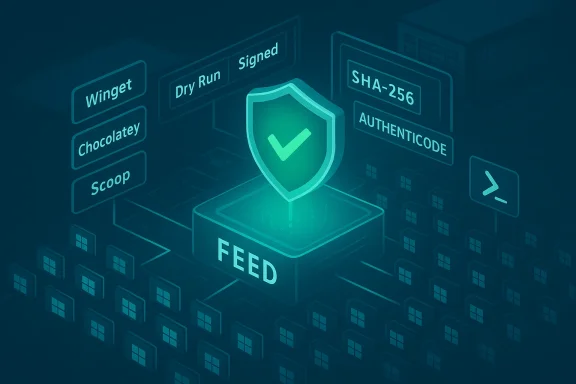
Shield with a checkmark over FEED, surrounded by package managers and verification labels.Background / Overview​

UniGetUI began life as a community-driven GUI wrapper for Windows package managers, originally born from the need to bring Winget-style package management to users who prefer graphical workflows. Over time it expanded to aggregate multiple backends — Winget, Chocolatey, Scoop, and others — and became popular for its bulk-update capabilities, cross-source discovery, and pragmatic feature set for both novices and IT pros. The project website still describes those core features: multi-manager support, bulk operations, package verification and a friendly install/update UX. (unigetui.com)
In March 2026 the most visible change arrived: Martí Climent, UniGetUI’s maintainer, announced a transition of stewardship to Devolutions — a commercial company known for remote‑desktop and privileged‑access tooling — and the first Devolutions-branded release, UniGetUI 2026.1.0, followed immediately. Devolutions frames the acquisition as a bet on sustainability: staff, security processes, and production-grade distribution infrastructure to match UniGetUI’s user scale. (devolutions.net)
This article summarizes the key technical changes in 2026.1.0, analyzes their security and operational implications, and offers practical guidance for users and administrators who want to adopt (or resist) the new model while keeping systems safe.

What changed in UniGetUI 2026.1.0​

The public changelog and reporting around the release focus on three tightly linked areas: update distribution, release integrity, and build/release automation. The high-level changes reported across community and press coverage are:
  • Transition of update checks and distribution to the Devolutions product info feed, with a fallback to the legacy GitHub updater when needed. (tweakers.net)
  • Hardened update validation: SHA‑256 integrity checks for updates and explicit installer signer validation. (tweakers.net)
  • Reworked bundling for WinGet (architecture-aware CLI selection) and cleanup of legacy packaged binaries. (tweakers.net)
  • A PowerShell-based build, signing and release pipeline, including draft releases and dry‑run signing, plus payload caching for WinGet CLI artifacts. (tweakers.net)
Those items constitute the central operational shift: the project’s update feed, signing pipeline and packaging now run through Devolutions’ systems rather than the ad hoc GitHub-backed approach used previously.
Devolutions also publicly committed to keeping UniGetUI open source under the MIT license, positioning the move as scaling responsibility rather than closing the project. At the same time, the company signaled enterprise ambitions — centrally managed deployment, policy controls, and privileged-install workflows — which shows where product evolution may head. (devolutions.net)

Why these changes matter (practical benefits)​

  • Stronger supply‑chain hygiene
  • Signing installers and validating checksums reduces the chance that corrupted or tampered payloads get installed. The 2026.1.0 release explicitly introduces SHA‑256 integrity checks and installer signer validation — the most immediate and measurable defenses against tampered binaries. (tweakers.net)
  • Fewer user‑visible failures from upstream metadata errors
  • The release pipeline now includes dry‑run signing and pre‑signing validation, which can catch manifest and publisher metadata mismatches before an update reaches end users. This addresses common user complaints (e.g., “update available” notices that point to broken packages). (warp2search.net)
  • Better operational scale and incident response
  • A corporate backing with a security team and formal SDLC (secure development lifecycle) processes promises clearer incident escalation paths, coordinated vulnerability response, and hardened CI/CD — all important when a tool is in the business of installing software. Devolutions cites dedicated security processes and release hardening as primary motivations for the acquisition. (devolutions.net)
  • More deterministic builds and repeatable packaging
  • The PowerShell‑based build and caching for WinGet payloads help create predictable artifacts, which is essential for enterprise rollouts and reproducible verification workflows. (tweakers.net)
These are real, tangible upgrades for a user-facing updater: better checksums, signing, and pipeline automation materially reduce incidents caused by corrupted releases and mismatched metadata.

The trade-offs and risks: what to watch for​

While the technical improvements raise the security bar, they also introduce new operational and governance considerations that deserve scrutiny.

Centralization of trust and supply‑chain concentration​

Shifting the update feed and distribution to Devolutions’ product info service centralizes a critical piece of the update supply chain. That reduces some risks (e.g., ad hoc GitHub release mistakes), but concentrates trust in a single vendor pipeline. If that feed is compromised, altered, or misconfigured, a broad population of UniGetUI users could be affected. The release notes explicitly mention the Devolutions feed as the primary source, with GitHub as a fallback — a design that helps, but does not remove the single-point-of-trust concern. (tweakers.net)

Community governance and project stewardship​

Even though UniGetUI remains open source, community reactions on discussion boards are mixed: some users expressed skepticism about handing control to a commercial vendor, fearing eventual feature gating or telemetry changes. Others pointed out that enterprise features were being discussed and that the tool in its current community form may not be desirable for sensitive corporate environments without additional review. Those community reactions are important because they reflect real concerns about long-term project direction and trust. (tweakers.net)

Telemetry and privacy considerations​

When a third party hosts release metadata and update feeds, there’s often implicit telemetry: which versions are served to which clients, error rates, fallback usage, etc. Devolutions has promised to keep UniGetUI free and open, but users should expect new telemetry and telemetry‑control options to appear as the project evolves under corporate ownership. The community commentary already shows a level of mistrust that privacy‑minded users will want clarified. (devolutions.net)

Enterprise feature creep and licensing divergence​

Devolutions’ roadmap signals enterprise features like centrally‑managed package whitelists, installation without local admin, and privilege management. Those are attractive for IT, but delivering them as paid or managed features could bifurcate the project into community edition vs. enterprise edition over time — a common pattern that can erode the original community experience unless carefully governed. (devolutions.net)

How to verify the new update pipeline locally (practical steps)​

If you run UniGetUI in personal or enterprise environments, you should verify what your client is installing. The 2026.1.0 release brings SHA‑256 verification and installer signer validation — but you should not rely solely on the client; you can independently validate installers you download.
Recommended checks (PowerShell examples):
  • Compute the SHA‑256 hash of a downloaded installer and compare it to the expected value:
  • Example: Get-FileHash "C:\Downloads\UniGetUI-setup.exe" -Algorithm SHA256
  • On Windows, PowerShell’s Get‑FileHash computes cryptographic hashes and is a standard tool for file verification.
  • Inspect the Authenticode signature for installer validity:
  • Example:
  • $sig = Get-AuthenticodeSignature "C:\Downloads\UniGetUI-setup.exe"
  • $sig.Status
  • $sig.SignerCertificate.Thumbprint
  • Get‑AuthenticodeSignature will report whether the file’s signature is valid and give certificate details so you can confirm the publisher and timestamp.
  • Use the Windows Explorer GUI as a quick double-check:
  • Right-click the file → Properties → Digital Signatures tab. Confirm that the signer, timestamp and certificate chain look correct.
  • Automate checks for fleets:
  • For IT admins, script the above checks into a pre‑deployment gate: validate SHA‑256 against an internal allowlist, and require an expected signer thumbprint before proceeding with an installation.
  • Trust but verify: if UniGetUI obtains updates from the Devolutions feed, consider certifying the installers in an internal repository (private feed) and letting devices update from that controlled source rather than directly from the public feed.
Those steps reduce risk by shifting verification responsibility towards the administrative domain rather than relying exclusively on the update client. Microsoft documentation and guidance explicitly recommend using file hashing and signature verification to validate downloads; these are standard defensive controls for update pipelines.

Recommendations for different stakeholders​

For everyday users (home / power users)​

  • Update cautiously: if you use UniGetUI for general bulk updates, the 2026.1.0 improvements are positive. Still, check release notes and enable any available options to see what feed and telemetry settings your client uses. (tweakers.net)
  • If privacy is a concern, look for settings that opt out of anonymous telemetry or adjust update-check frequency; if none are available, raise it in the project’s issue tracker or community forum.

For advanced users and enthusiasts​

  • Fork the repo and build your own client if you want a fully community‑controlled binary that avoids the Devolutions feed. The project remains MIT‑licensed and forkable; the community path remains available. (devolutions.net)
  • Verify any downloaded installers with SHA‑256 and Authenticode checks before running them. See the PowerShell examples above for reproducible commands.

For IT administrators and enterprises​

  • Treat the UniGetUI update feed as part of your supply chain: require verification gates and consider mirroring approved releases to an internal artifact repository or private feed. Use the new signing metadata to automate allowlisting rules based on signer thumbprints. (tweakers.net)
  • Evaluate any new enterprise features for integration risk: centralized deployment and privilege elevation must be assessed for how they interact with your current endpoint security and privilege management policies. Devolutions’ stated roadmap explicitly targets those enterprise areas. (devolutions.net)
  • Maintain a fallback plan: continue to use official package manager backends directly (Winget, Chocolatey) for critical systems where external update redirection is unacceptable.

Governance, transparency, and community oversight​

Acquisitions of popular OSS tools are not uncommon — they can bring resources, security processes, and stability. But they also change the governance model. The Devolutions blog emphasizes keeping UniGetUI open source and pledges resources for secure development and auditing. That is a constructive start, but open-source projects benefit most when third‑party oversight and transparent processes accompany corporate backing.
Key governance expectations moving forward:
  • Public changelogs and signed release artifacts for each release that are reproducible and auditable.
  • Clear telemetry policies and opt‑out controls for users who prefer privacy.
  • Community representation in the project’s roadmap (e.g., advisory board, community maintainers).
  • Independent audits or security reviews of the new pipeline — especially the signing and distribution channels — with results published for public scrutiny.
Devolutions has an opportunity to model a positive stewardship approach: enterprise-grade processes without closing community decision‑making. The pledge to remain open source is necessary but not sufficient; the community will want visible, ongoing proof of transparency and independent review. (devolutions.net)

Alternatives and complementary tooling​

If you or your organization evaluate UniGetUI’s new model and decide it doesn’t match your risk or privacy posture, there are alternatives and complementary approaches:
  • Use native command‑line backends directly (Winget, Chocolatey, Scoop) and script your own update pipelines for full control.
  • Consider managed patching solutions and enterprise update management platforms for centralized, policy-driven control.
  • Use a private artifact repository/mirror to stage and scan third‑party updates before rollout.
UniGetUI’s value proposition — a single GUI to aggregate many backends — remains attractive, but splitting the control plane (who hosts release metadata) from the client (who installs) is a legitimate strategy for risk‑averse environments.

Conclusion: a pragmatic but watchful stance​

UniGetUI 2026.1.0 is a technically sensible release: signing, SHA‑256 checks, and a formalized build and release pipeline address long‑standing reliability and security pain points for users who manage many updates. Devolutions’ acquisition gives the project resources and processes it lacked as a single‑maintainer effort, and those investments will likely reduce incidents caused by broken or unsigned releases. (tweakers.net)
At the same time, centralizing the distribution and update trust into a vendor-controlled feed requires deliberate mitigation: independent verification, mirrored internal feeds, and governance checks. Users, power users, and IT teams should take advantage of the improved integrity features while also verifying signer thumbprints and hashes, demanding transparency around telemetry, and preparing fallback plans if corporate product direction diverges from community expectations. (warp2search.net)
In short: treat UniGetUI 2026.1.0 as a net improvement in technical security, but pair that appreciation with sensible operational controls — verify installers, monitor telemetry and feed settings, and keep the option to self-host or fork the project if you need absolute sovereignty over your update pipeline. (unigetui.com)


Source: Neowin UniGetUI 2026.1.0
 

UniGetUI’s 2026.1.0 release and the simultaneous Devolutions acquisition mark a decisive turning point for one of Windows’ most popular third‑party package‑management GUIs — a shift from lone‑developer agility toward corporate-backed scale, security hardening, and enterprise integration that will improve reliability for millions while also raising new governance and trust questions for sysadmins and privacy‑conscious users.

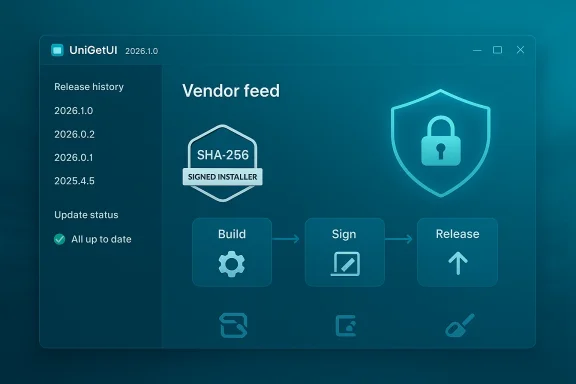
UniGetUI interface showing vendor feed and Build → Sign → Release workflow with version history.Background / Overview​

UniGetUI began as a community‑driven project that wrapped multiple Windows package managers (WinGet, Chocolatey, Scoop and others) in a single graphical interface to make software discovery, updates, and bulk maintenance accessible to less command‑line‑inclined users. Its simple value proposition — surface installed apps, make updates visible, and automate what would otherwise be a periodic CLI chore — resonated widely. Devolutions’ announcement puts the scale of that adoption into concrete terms: UniGetUI reportedly serves in excess of 300,000 monthly active users, a user‑base that has moved the project from a useful hobby to critical infrastructure for many workplaces and power users. (devolutions.net)
For years the project’s momentum came from a small team — in practice, one lead developer who shepherded builds, maintained integrations with multiple backends, and handled releases from the GitHub workflow. That model works well in early stages but is fragile when the tool begins to operate at system level trust — running installers, invoking signed binaries, and automating package changes on thousands of endpoints. Devolutions frames the acquisition as a pragmatic decision to bring operational discipline to that trust surface without removing UniGetUI’s open‑source core: the project will remain MIT‑licensed, but distribution, signing, and release processes will be folded into Devolutions’ infrastructure. (devolutions.net)

What 2026.1.0 changes — the technical picture​

Enterprise‑grade distribution and updater migration​

The headline technical change for 2026.1.0 is the migration of UniGetUI’s update checks and distribution feed from the community/GitHub‑centric updater to a Devolutions product‑info feed. The release notes reported by independent outlets describe the update mechanism now defaulting to Devolutions’ product feed while keeping GitHub as a fallback — a pragmatic staged transition that centralizes metadata and distribution control under Devolutions’ operational controls. This shift is consistent with Devolutions’ stated goal of “hardened update and release mechanisms.” (devolutions.net)
Why this matters: update infrastructure is one of the highest‑risk surfaces for supply‑chain attacks. Consolidating update metadata and binary hosting under a vendor that already operates signed distribution systems enables formal signing, reproducible release pipelines, and centralized monitoring. For organizations that require a clear chain of custody for binaries, an authoritative product feed simplifies validation and auditing.

Integrity checks and signing validation​

The changelog elements picked up by reporters indicate that 2026.1.0 introduces SHA‑256 integrity checks for updater payloads and installer signer validation — meaning UniGetUI will verify a downloaded installer’s cryptographic hash and the digital signature on the installer before proceeding. These are pragmatic mitigations against a handful of real‑world attack modes: corrupted release artifacts, tampered update manifests, and misattributed binaries. Independent summaries list SHA‑256 verification and signer validation among the first round of safety improvements.
Caveat: Devolutions’ acquisition statement committed to “hardened update and release mechanisms” and “strengthened infrastructure and signing workflows,” but it did not publish a line‑by‑line technical changelog in the blog post. The granular items (exact algorithm use, which signer certificates are considered trusted, and detailed failover behavior) are reported by third‑party outlets and on mirrored changelogs; until Devolutions publishes its canonical release notes or the repository tags reflect the Devolutions pipeline, some specifics remain corroborated but not formally central‑source verified. Treat the SHA‑256 / signer‑validation improvements as well‑supported by independent coverage and aligned with Devolutions’ promise, but subject to confirmation in Devolutions’ or UniGetUI’s official release artifacts. (devolutions.net)

Packaging and WinGet bundling improvements​

The release notes circulating publicly describe a rework of how UniGetUI bundles the WinGet CLI payload: architecture‑aware CLI selection (e.g., choosing x64 vs. arm64 artifacts appropriately), improved fallback handling, and caching of WinGet CLI payloads in the release automation. Those changes reduce update failures caused by mismatched architectures or transient CDN issues and are a natural complement to integrity checks. The release also reportedly cleaned up legacy packaged binaries and removed an in‑app announcements panel, streamlining the UI and packaging footprint.
These are usability + reliability improvements, but they also have security implications: ensuring the correct arch binary is selected reduces the risk of misinstalling the wrong binary (which could fail in ways that produce exploitable states), and caching CI artifacts reduces reliance on transient network resources during automated installations.

Build and signing pipeline automation​

Under the hood, the 2026.1.0 notes mention a new PowerShell‑based build/signing/release pipeline, release‑draft support in workflows, dry‑run signing checks, and improved compatibility for repositories with different branch names. These are textbook operational upgrades for reproducible releases: automated signing, preflight checks, and unified release drafts give maintainers the chance to validate artifacts and metadata before publication. In practice, this reduces accidental exposure of unsigned binaries.
Again: these changes align with Devolutions’ stated capability set — a dedicated security team, formal secure development lifecycle (SSDLC) practices, and experience operating trusted distribution systems — but the deeply internal details of the pipeline (who holds signing keys, HSM usage, key rotation policy, signing certificate lifecycles, private key access controls) are not published in the acquisition post. Those remain important questions for security‑conscious deployers and will require explicit documentation or an audit to fully validate. (devolutions.net)

Why Devolutions bought UniGetUI — strategic reading​

Devolutions is a longtime vendor in remote desktop, password/secret management, and privileged access — spaces that benefit from both large user bases and strong operational discipline. Acquiring UniGetUI does several things at once:
  • It integrates a popular, widely deployed client utility into Devolutions’ portfolio and distribution channels, enabling the company to offer a safe, controlled path for software updates on managed endpoints.
  • It buys Devolutions credibility among the Windows‑power user and SysAdmin communities, many of whom already use UniGetUI to keep systems patched. That’s a valuable upstream seat at the table for enterprise customers. (devolutions.net)
  • From a security posture point of view, UniGetUI’s role as a software installer/updater means that when it’s secure and auditable, it becomes a reliable extension of an organization’s update strategy rather than a supply‑chain wildcard. Devolutions explicitly framed the deal as a way to scale security and maintain the project’s open‑source nature while professionalizing governance. (devolutions.net)
The acquisition mirrors Devolutions’ prior pattern: the company has made similar investments in open tooling (PowerShell Universal, sponsorship of Avalonia) where professional stewardship promises improved stability for a broader customer base. For Devolutions, UniGetUI’s user base and role in the Windows ecosystem are naturally synergistic with its remote‑management product suite.

Benefits for users and organizations​

  • Stronger update integrity: SHA‑256 checks and installer signer verification reduce risk from corrupt or tampered installers. Independent reports show these checks are part of 2026.1.0.
  • More reliable updater: Using Devolutions’ product feed with GitHub fallback provides a centralized control plane with redundancy, which should reduce update inconsistencies and allow for coordinated patch management.
  • Enterprise management capabilities (roadmap): Devolutions is explicit about a future enterprise vision: bulk deployment, centrally defined approved package catalogs, policy‑based enforcement of updates, and ability to install/update without granting local admin rights — features that many IT organizations asked for when using community tools at scale. (devolutions.net)
  • Operational maturity: Automated signing workflows, release dry‑runs, and CI changes mean fewer accidental unsigned releases and fewer surprise regressions for administrators who automate UniGetUI in broader scripts.

Risks, tradeoffs, and open questions​

No acquisition is risk‑free. This transition, while promising improved security, raises several legitimate concerns that enterprise teams and privacy‑minded users should consider.

Centralization of update control and trust​

Moving update checks to a Devolutions feed means users now place trust in another organization’s distribution and signing practices. For organizations that value decentralized control, this is a change in the trust model: they must trust Devolutions’ security, key‑management, and operational controls. Devolutions’ public statements promise a formal secure development lifecycle and dedicated security teams, but operational trust requires transparency — published signing policies, key custody descriptions, and preferably independent audits.
  • Action for admins: request or demand an operational security whitepaper outlining key custody, HSM usage (if any), certificate validity and rotation, and incident response procedures.

Backwards compatibility and community expectations​

UniGetUI’s community has used GitHub releases and the original maintainer’s workflows for years. The change to Devolutions’ distribution model could introduce transient compatibility issues, edge cases for users who self‑host or run portable versions, and possible friction if Devolutions’ release cadence diverges from community expectations.
  • Action for users: preserve an offline copy of installers if you maintain controlled endpoints, and test the Devolutions feed in a staging environment before fleetwide rollout.

Auditability and supply‑chain transparency​

While SHA‑256 checks add integrity verification, the full supply chain security story includes reproducible builds, signing key transparency, and the ability to trace an artifact from source commit to final signed binary. The public communication so far discusses improved signing workflows and dry‑run signing, but it does not yet publish whether UniGetUI artifacts will support reproducible builds or publish signed metadata in a transparent, machine‑verifiable way.
  • Action for interested parties: request reproducible build instructions or attestations and ask for a public signing key‑trust tree. Where possible, retain fallback to GitHub-based checksums until you can validate the Devolutions feed end‑to‑end.

Privacy and telemetry​

Acquisitions often come with changes to telemetry, analytics, or usage reporting. Devolutions has stated an intent to maintain UniGetUI as a standalone and open product, but any new telemetry the company adds for operations or security telemetry must be carefully documented and opt‑in where appropriate.
  • Action for privacy‑conscious users: audit network calls made by UniGetUI in a controlled environment; confirm whether product‑feed checks or error reports send identifiable telemetry, and whether they are opt‑out. Requirebe explicit about what is collected and why.

Practical advice for users and IT teams​

If you manage endpoints, deploy software at scale, or simply rely on UniGetUI on day‑to‑day machines, here is a short, prioritized checklist to help you prepare for and evaluate this transition.
  • Test the new release in an isolated lab environment before deploying it fleetwide. Validate update scenarios, fallback to GitHub, and verify integrity checks.
  • Capture current behavior: record the exact network endpoints UniGetUI contacts (DNS names, IPs) and compare them after upgrading to 2026.1.0 to identify any new telemetry or product‑feed calls.
  • Verify signer certificates and hashes: when an update arrives, check the SHA‑256 hash and the signing certificate chain; confirm whether the signing certificate is known and whether it rotates across releases.
  • Establish a rollback plan: keep a local repository of approved installers (GitHub or local file share) so you can reimage or re‑install without depending on live feeds if an issue emerges.
  • Ask Devolutions for an operations and security FAQ: specifically request details about key management, HSM use, incident response, and telemetry policies. Devolutions’ acquisition materials outline intent but do not replace operational documentation. (devolutions.net)

How the community reacted (early signals)​

Early coverage of 2026.1.0 and the acquisition was broadly factual and focused on the security and operational implications. Aggregator outlets and Linux/Windows enthusiast communities picked up the release notes, repeating the core commit to “hardened update and release mechanisms” and mentioning SHA‑256 checks, installer signer validation, and pipeline automation. User forums show mixed reactions: relief that a larger organization will shoulder security responsibilities, but also skepticism among those who prefer decentralized, community‑only stewardship. The standard pattern with such transitions applies: short‑term churn in releases and documentation, followed by stabilization once operational controls and communications are in place.
Note: during attempts to corroborate the Neowin article at the URL provided, automated fetching returned a gate/anti‑bot or paywall response (HTTP 402 / security verification), preventing direct capture of that page’s HTML via automated tools. This transient access barrier means the Neowin page could not be fetched and parsed automatically at the time of reporting; the facts in this article lean on Devolutions’ official blog and press release plus corroborating third‑party changelog summaries. ([]())

Independent verification and transparency recommendations​

Devolutions’ public statements and the third‑party changelogs establish a coherent narrative: acquisition, commitment to open‑source continuity, and concrete steps to professionalize release processes. For customers, however, the assurance of safety and supply‑chain integrity should be accompanied by verifiable artifacts. These are sensible transparency requests to make of any vendor that acquires a tool with privileged behavior:
  • Publish a detailed release signaling document describing the product feed format, signed metadata format, and the method for publishing signed checksums; include examples and normal/rotated signing key fingerprints.
  • Provide a public, machine‑readable history of signing keys used for releases and a rotation/compromise policy.
  • Publish a concise security operations whitepaper covering CI/CD pipeline controls, dry‑run signing checks, and whether releases are signed via an HSM (recommended) or by ephemeral key pairs.
  • Offer reproducible build instructions or attestation so third parties can confirm that a given binary corresponds to a specific source commit.
  • Keep a public issue tracker or security advisory page for UniGetUI releases, and commit to timely disclosure and coordinated vulnerability response for any supply‑chain issues.
If these artifacts (or if they already exist in a Devolutions/UniGetUI repo), they materially lower the operational risk for administrators who need to trust the tool inside managed environments. (devolutions.net)

Final assessment — how to think about UniGetUI in 2026​

UniGetUI 2026.1.0 is not merely a point release; it is the technical embodiment of a governance shift. The move toward Devolutions’ distribution feed, SHA‑256 verification, and a signed, PowerShell‑driven release pipeline meaningfully improves the tool’s security posture and reliability — outcomes that benefit individuals and enterprises alike. At the same time, the centralization of trust around Devolutions means that operational transparency, key management, and auditability become first‑class concerns for administrators.
For everyday users and hobbyists who value convenience, the release should be a net positive: fewer corrupted updates, more reliable installations, and a continuing commitment to the project’s open‑source roots. For enterprise IT and security teams, the release is a welcome step toward an auditable, policy‑friendly deployment model — provided Devolutions follows through with detailed operational documentation and a clear, transparent signing and release governance model.
In short: 2026.1.0 lowers some of the most acute technical risks around using UniGetUI at scale, but it also converts a decentralized community project into a vendor‑backed product — a tradeoff that increases safety for many while shifting where trust must be placed. The rational next step for administrators is to test aggressively, ask for operational artifacts, and treat the Devolutions feed as a managed dependency that deserves the same lifecycle controls as any other enterprise software source. (devolutions.net)

Conclusion
UniGetUI’s first Devolutions‑branded release and the acquisition are an inflection point: they combine the pragmatic security upgrades many users have asked for with a new, centralized trust model. That model is acceptable and even desirable for most managed environments — provided Devolutions makes good on transparency, publishes operational details, and commits to auditable signing practices. Until those artifacts are visible in full, cautious testing and conservative rollout plans remain the responsible approach for IT teams looking to adopt UniGetUI 2026.1.0 at scale. (devolutions.net)

Source: Neowin UniGetUI 2026.1.0
 

Back
Top