

UniGetUI’s newest release and the stewardship shift announced in March 2026 mark a decisive moment for a tool millions of Windows users rely on to discover, install, and update software without touching the command line. What began as a one‑developer project has just entered an organizational phase: Devolutions announced it has acquired UniGetUI and rolled out the 2026.1.x releases that rework how updates are distributed and verified, while promising to keep the project open under the MIT license. This change brings real security and operational benefits — and new governance questions that IT teams, sysadmins, and security-minded users need to understand before they adopt the new default behaviors.
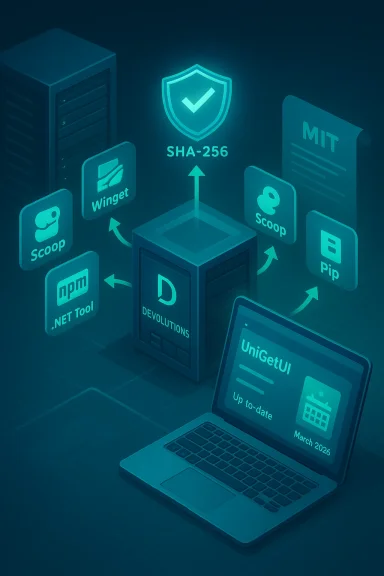
UniGetUI (formerly WingetUI) is a graphical front end that aggregates multiple Windows package managers — Winget, Chocolatey, Scoop, Pip, Npm, .NET tools, and PowerShell Gallery — into a single, searchable interface. Its core value proposition is simple: make package management accessible to users who don’t want to use the CLI, while providing power users and administrators a consolidated view of installed packages and pending updates. The project has grown rapidly and is widely used; the acquiring company frames the tool as serving hundreds of thousands of monthly users.
In March 2026 Devolutions announced the acquisition and published both a press release and a blog post that outline the immediate changes and a roadmap centered on distribution hardening, formalized secure development processes, and enterprise‑oriented features (centrally approved catalogs, policy enforcement, and deployment controls). The vendor emphasized that UniGetUI will remain open source and MIT‑licensed, but its update feed and release infrastructure will be integrated into Devolutions’ operational tooling. That combination — community codebase plus vendor‑operated distribution — is the central fact every reader should keep in mind.
Why this matters: update infrastructure is one of the highest‑risk surfaces for software supply‑chain attacks. By moving to a vendor‑managed feed, UniGetUI gains the possibility of stronger signing, reproducible release pipelines, and centralized monitoring. At the same time, centra single point of control and trust — a tradeoff IT teams must weigh. Independent reporting notes the change and highlights the mitigation goals (improved signing, tighter release controls).
For most individual users and small teams, the changes will improve reliability and reduce accidental exposure to unsigned binaries. For large enterprises and high‑assurance environments, the acquisition should be treated as an opportunity: insist on technical proofs (attestations, deterministic builds) and integrate UniGetUI into your existing software supply‑chain controls rather than treating the vendor feed as an unconditional trust anchor.
UniGetUI remains a powerful, user‑friendly tool for cross‑manager software management. The next few months will be telling: if Devolutions publishes transparent provenance, maintains open governance, and demonstrates consistent, auditable release practices, the acquisition will likely be judged a responsible way to scale security for a community tool. If those transparency artifacts lag, organizations should take a conservative posture — verify, pin, and control — until the technical assurances arrive.
Conclusion: UniGetUI 2026.1.x is the beginning of a safer, more enterprise‑aware chapter — but the full security benefits depend on the visibility and verifiability of the implementation. Adopt carefully, validate constantly, and demand auditable proofs.
Source: Neowin UniGetUI 2026.1.1
 Background / Overview
UniGetUI (formerly WingetUI) is a graphical front end that aggregates multiple Windows package managers — Winget, Chocolatey, Scoop, Pip, Npm, .NET tools, and PowerShell Gallery — into a single, searchable interface. Its core value proposition is simple: make package management accessible to users who don’t want to use the CLI, while providing power users and administrators a consolidated view of installed packages and pending updates. The project has grown rapidly and is widely used; the acquiring company frames the tool as serving hundreds of thousands of monthly users.In March 2026 Devolutions announced the acquisition and published both a press release and a blog post that outline the immediate changes and a roadmap centered on distribution hardening, formalized secure development processes, and enterprise‑oriented features (centrally approved catalogs, policy enforcement, and deployment controls). The vendor emphasized that UniGetUI will remain open source and MIT‑licensed, but its update feed and release infrastructure will be integrated into Devolutions’ operational tooling. That combination — community codebase plus vendor‑operated distribution — is the central fact every reader should keep in mind.
What changed in 2026.1.x (technical summary)
Distribution and updater migration
One of the most consequential technical changes in the 2026.1.x branch is the migration of UniGetUI’s update mechanism from a community/GitHub‑centric updater to Devolutions’ centrally managed product feed. In practical terms, UniGetUI will now consult Devolutions’ product metadata and distribution endpoints as its primary source for update information and binaries, while preserving GitHub as a fallback for users who opt out or in scenarios where the primary feed is inaccessible. This was described as part of the release and confirmed in reporting that inspected the changelog. The move centralizes release metadata and binary hosting under an organization that already runs signed distribution systems.Why this matters: update infrastructure is one of the highest‑risk surfaces for software supply‑chain attacks. By moving to a vendor‑managed feed, UniGetUI gains the possibility of stronger signing, reproducible release pipelines, and centralized monitoring. At the same time, centra single point of control and trust — a tradeoff IT teams must weigh. Independent reporting notes the change and highlights the mitigation goals (improved signing, tighter release controls).
Integrity checks: SHA‑256 and artifact verification
The 2026.1.0 release notes and subsequent coverage indicate that UniGetUI’s updater now performs stronger artifact verification, including SHA‑256 hash checks for installer artifacts and released binaries. This shifts the updater away from looser checksum approaches toward a standard modern cryptographic digest (SHA‑256). Reporters who inspected the changelog and release behavior saw SHA‑256 checks implemented as part of the hardened update pipeline. Administrators should treat this as a necessary baseline — hash verification is not a substitute for signed binaries and reproducible builds, but it significantly raises the bar for simple tampering.Signing and release provenance
Devolutions’ public statements emphasize strengthened signing workflows and moving release processes into the company’s existing infrastructure. That implies two practical security improvements when executed correctly:- Signed installer artifacts and a consistent signing identity for release binaries.
- A formal, auditable release pipeline that can be monitored for anomalies.
Why Devolutions’ involvement matters (benefits)
1) Operational discipline and security teams
Devolutions is an established vendor with experience operating software distribution for enterprise customers. That brings resources: a security team, structured code reviews, and existing signing and distribution infrastructure. For a tool that installs software system‑wide, those capabilities materially reduce operational risk if they are applied comprehensively.2) Formal updates and enterprise controls
The roadmap the company published signals enterprise‑oriented features that many IT organizations want:- Centrally defined, approved package catalogs.
- Policy‑based update enforcement and rollout controls.
- The ability to install or update software without granting local admin rights via centrally managed privileges.
3) Continuity and resources for the project
Open‑source projects maintained by individuals often struggle with continuity, funding, and long‑term maintenance. Devolutions’ acquisition promises operational continuity, infrastructure, and investment in the codebase and CI/CD tooling. That’s potentially good for users who have come to rely opart of their workflows.The risks and governance questions
While the technical improvements are real, the change in stewardship also creates new governance and trust considerations.Centralization of trust and the supply chain
By moving the update feed and signing authority under Devolutions, the project replaces a decentralized, community‑centric distribution model with a vendor‑operated model. That brings operational discipline but also concentrates control. For enterprise customers that want an authoritative vendor and audit trails, that’s desirable. For privacy‑conscious users or those who prefer completely community‑operated distribution, it raises questions about vendor lock‑in, metadata control, and policy. Assess whether your environment needs the vendor feed or would rather pin to GitHub artifacts and verify locally.Need for published provenance and reproducible builds
Hash checks are helpful, but they’re not the same as reproducible builds or a full attestable provenance chain. Admins and security teams should insist on:- Machine‑readable release attestations (SLSA attestations or similar).
- Reproducible build instructions and verified deterministic outputs.
- Public keys and signing policies published for verification.
Community oversight and open governance
The project will remain MIT‑licensed, but community trust depends on governance. Questions to monitor:- Who will control the release feed and signing keys?
- Will maintainers retain commit access and final say over changes?
- How will security issues reported by researchers be triaged and disclosed?
How UniGetUI behaves now — practical admin guidance
If you manage workstations or run UniGetUI at scale, here’s a practical checklist to adopt the new release without introducing avoidable risk.- Inventory: identify machines running UniGetUI and note the installed version and update settings.
- Policy decision: choose whether to accept Devolutions’ managed product feed as the primary update source or to pin to GitHub artifacts for the short term.
- Verify: before rolling the 2026.1.x updater widely, sample‑download the installer, verify the SHA‑256 digest that’s published, and validate the signing certificate. Ensure you have a local procedure to re‑verify periodically.
- Test in staging: deploy to a limited set of noncritical endpoints and confirm update behavior (fallback to GitHub, rollback behavior, and installer options).
- Audit logs: enable and collect UniGetUI logs and monitor for unexpected update sources or configuration changes.
- Require provenance: for production rollout, insist on reproducible build attestations and public signing keys. If those artifacts are not present, treat the vendor feed as operational convenience rather than as an auditable source of truth.
Community reaction and third‑party reporting
Community discussion has been mixed and pragmatic. Many users welcome the stability and security discipline a vendor brings to a widely used tool; others are cautious about the centralization of distribution controls. Independent reporting and community threads highlight both sides: journalists and smaller outlets have documented the switch to Devolutions’ feed and the addition of SHA‑256 checks, while forum conversations emphasize the need for transparency on signing and release provenance. That debate is normal and healthy for any widely used utility that touches the update surface.Deep dive: supply‑chain technical considerations
Below are the specific technical controls that matter most for secure adoption — and what to check for in Devolutions’ implementation.Reproducible builds and attestation
- Goal: ensure a binary correlates to a specific commit. Tools like SLSA attestations, in‑CI provenance records, or deterministic build outputs allow validation.
- Check: Does Devolutions publish build attestations or a reproducible‑build guide for UniGetUI releases? If not, request them before trusting the vendor feed exclusively.
Cryptographic signing
- Goal: provide tamper resistance via well‑managed private keys and verifiable certificates.
- Check: Verify that released installers are signed with a corporate certificate and that the certificate chain is published and verifiable. Confirm key rotation policies and where signatures are applied (installer, MSI/MSIX, and internal binaries).
Hash verification and metadata integrity
- Goal: ensure clients verify artifacts against authoritative digests and metadata.
- Check: Confirm the updater validates SHA‑256 checksums before executing installers and that digests are delivered over authenticated channels (preferably the same signed feed, not plain GitHub raw files).
Update channel governance
- Goal: clear separation of channels (stable, beta) with explicit metadata for breaking changes.
- Check: Confirm channel metadata is explicit and signed. Enrts pinning to a channel and that admins can opt out of the default feed if required.
What we verified and what remains to be confirmed
Verified from multiple independent sources:- Devolutions acquired UniGetUI in March 2026 and committed to retaining the MIT license while providing operational backing. This is published directly by Devolutions’ press release and blog.
- UniGetUI’s 2026.1.x releases migrate the updater toward Devolutions’ product feed and implement stronger hash checks (SHA‑256) as part of update verification. Multiple independent reports inspected the changelog and observed this change.
- UniGetUI continues to support multiple package managers (Winget, Chocolatey, Scoop, Pip, Npm, .NET Tool, PowerShell Gallery), per the official project pages.
- Full release provenance artifacts (SLSA attestations or equivalent reproducible‑build proofs) published for each release. Devolutions signaled strengthened signing and release controls but has not publicly published a line‑by‑line provenance ledger at the time of writing. Administrators should request these artifacts before trusting the vendor feed in high‑assurance environments. If the organization cannot provide them, consider pinning to verified GitHub artifacts and conduct independent verification.
Recommendations (for IT teams and end users)
- Individuals and power users: the release is safe to install if you verify the SHA‑256 digest and check that the binary is signed. If you prefer community distribution, UniGetUI still allows fallback to GitHub artifacts in many scenarios; verify your updater settings.
- Small IT teams: test the new updater in a staging pool. Confirm fallback behavior and rollback strategies in case a signed update causes unexpected interactions with local package managers (Winget, Chocolatey, etc.).
- Enterprises and security teams: require provenance and attestations for automated trust. Ask Devolutions for SLSA‑style attestations and a published key management policy. Only adopt the vendor feed as authoritative once you can automatically verify that releases map to a reproducible source. Consider adding UniGetUI to your endpoint hardening checklist with monitored logs and controlled rollout windows.
- OSS community and maintainers: insist on collaborative governance practices. Devolutions should publish detailed release processes, disclosure timelines for vulnerabilities, and an open roadmap with community engagement. This will preserve the open ethos while delivering enterprise reliability.
Final verdict
UniGetUI’s transition into a vendor‑backed phase — and the 2026.1.x updates that centralize distribution and tighten verification — are a pragmatic and, on balance, positive evolution for a widely used tool. Devolutions brings the operational maturity required to harden a high‑risk attack surface: signing, formal release pipelines, and centralized monitoring. At the same time, responsible adoption requires administrators and users to demand reproducible builds, publicly auditable signing policies, and published provenance artifacts before trusting the vendor feed without reservation.For most individual users and small teams, the changes will improve reliability and reduce accidental exposure to unsigned binaries. For large enterprises and high‑assurance environments, the acquisition should be treated as an opportunity: insist on technical proofs (attestations, deterministic builds) and integrate UniGetUI into your existing software supply‑chain controls rather than treating the vendor feed as an unconditional trust anchor.
UniGetUI remains a powerful, user‑friendly tool for cross‑manager software management. The next few months will be telling: if Devolutions publishes transparent provenance, maintains open governance, and demonstrates consistent, auditable release practices, the acquisition will likely be judged a responsible way to scale security for a community tool. If those transparency artifacts lag, organizations should take a conservative posture — verify, pin, and control — until the technical assurances arrive.
Conclusion: UniGetUI 2026.1.x is the beginning of a safer, more enterprise‑aware chapter — but the full security benefits depend on the visibility and verifiability of the implementation. Adopt carefully, validate constantly, and demand auditable proofs.
Source: Neowin UniGetUI 2026.1.1
