

Unilever built a small, tightly controlled AI assistant that turns a curated set of sustainability reports and internal documents into a fast, searchable answers service for colleagues and customers — a pragmatic pilot that shows both the real operational upside of retrieval‑augmented assistants and the governance traps any large company must dodge as it scales.
Unilever’s global sustainability team was drowning in repetitive data requests: single data points for procurement and marketing, routine Scope 3 emissions queries for customers, and the occasional large questionnaire with more than 100 items across multiple tabs. To reclaim time and surface consistent, documented answers, a sustainability team member, Francesca Kennedy Wallbank, led a project to create a tenant‑scoped chatbot using Microsoft Copilot Studio. She uploaded a hand‑curated “knowledge bank” — company sustainability reports and related documents — trained the agent on test questions, iteratively improved the knowledge set, and published the assistant for internal use. According to the team, the knowledge base started small (roughly 25 documents), every reply includes a source link, and the bot is intentionally not permitted to browse the public web.
This approach mirrors a common enterprise pattern in 2024–25: build a retrieval‑augmented generation (RAG) assistant grounded in corporate sources (SharePoint, OneDrive, Dataverse) so outputs can be traced back to specific files, and use low‑code platforms such as Microsoft Copilot Studio for authoring and lifecycle control. Microsoft’s documentation confirms Copilot Studio ingests files into Dataverse, vectorizes them, and uses those embeddings for retrieval at query time; an agent can include hundreds of uploaded files (the platform supports up to 500 files per agent).
But the project also underlines the deeper truth about enterprise AI today: the technology is only as useful as the content and governance around it. If Unilever (or any other company) hopes to move from internal Q&A to an industry data feed that automatically serves customers, it must invest in canonical data models, legal frameworks, third‑party assurance and rigorous audit trails. Those investments are less visible than the agent UI but far more consequential.
The short‑term win is clear: get the right documents into the right knowledge bank, test with SMEs, and publish a scoped assistant that returns answers with evidence. The long‑term challenge is organizational: scale the content pipeline, harden auditability, and embed AI outputs into formal compliance workflows — or risk turning a productivity booster into a regulatory liability.
Source: Trellis Group (formerly GreenBiz) How Unilever created an AI chatbot to mine sustainability data
 Background / Overview
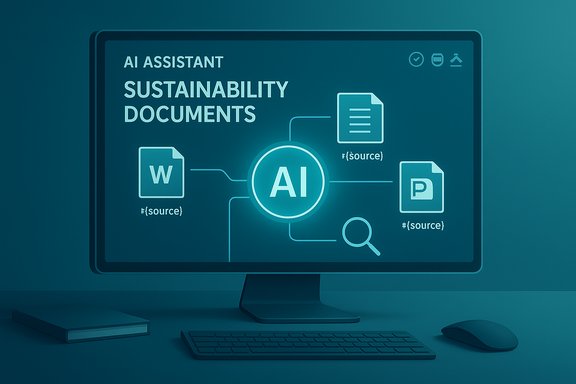
Unilever’s global sustainability team was drowning in repetitive data requests: single data points for procurement and marketing, routine Scope 3 emissions queries for customers, and the occasional large questionnaire with more than 100 items across multiple tabs. To reclaim time and surface consistent, documented answers, a sustainability team member, Francesca Kennedy Wallbank, led a project to create a tenant‑scoped chatbot using Microsoft Copilot Studio. She uploaded a hand‑curated “knowledge bank” — company sustainability reports and related documents — trained the agent on test questions, iteratively improved the knowledge set, and published the assistant for internal use. According to the team, the knowledge base started small (roughly 25 documents), every reply includes a source link, and the bot is intentionally not permitted to browse the public web.This approach mirrors a common enterprise pattern in 2024–25: build a retrieval‑augmented generation (RAG) assistant grounded in corporate sources (SharePoint, OneDrive, Dataverse) so outputs can be traced back to specific files, and use low‑code platforms such as Microsoft Copilot Studio for authoring and lifecycle control. Microsoft’s documentation confirms Copilot Studio ingests files into Dataverse, vectorizes them, and uses those embeddings for retrieval at query time; an agent can include hundreds of uploaded files (the platform supports up to 500 files per agent).
How Unilever actually built the assistant
The simple, repeatable recipe they used
Unilever’s workflow is textbook RAG for enterprise assistants:- Curate a small set of authoritative documents (company sustainability reports, regulatory notes, intranet pages).
- Upload those files as a knowledge source into Copilot Studio so Dataverse can index and create vector embeddings.
- Run iterative testing: staff ask the bot test questions, rate the responses, and route gaps back to subject‑matter teams (e.g., regulatory affairs) to expand or correct the knowledge bank.
- Publish a scoped agent for internal users and add provenance links to every answer so requesters can verify the facts in the original documents.
Platform choices and the technical plumbing
Unilever used Microsoft Copilot Studio as the authoring and runtime surface. Copilot Studio stores uploaded documents in Microsoft Dataverse, chunks and embeds them into a semantic index, and uses that index to ground model outputs whenever a user asks a question. Microsoft’s docs show that organizers can upload files directly (Word, Excel, PDF, PowerPoint and many more), group files, and guide retrieval behavior via group‑level instructions — features that speed domain curation and manage relevance. Where enterprise patterns matter is in the surrounding architecture: enterprises typically connect Copilot Studio to SharePoint, Microsoft Graph, Fabric/OneLake, or other systems to broaden the knowledge surface, while preserving tenant authorization so the assistant only returns documents a user is allowed to see. Independent enterprise case studies show this pattern repeatedly: content lives in SharePoint/OneDrive, is indexed by Azure AI Search / Dataverse, and the agent uses RAG to return snippets plus citations.What Unilever gained (and what they claim)
- Time savings on low‑value tasks. The sustainability team freed staff from hunting for spreadsheets, policy documents, and regulatory interpretations, letting them focus on analysis and engagement. The team framed the assistant as a support tool — not a replacement for employees — that allows people to spend more time on high‑value work.
- Faster, verified answers for customers. For customer requests that feed procurement, tenders, and Scope 3 reporting, the bot delivers consistent figures and links to the source documents, which helped teams strengthen bids and — by one account — win more business because they could attach more granular sustainability data.
- Controlled provenance. Every answer the assistant returns includes the source link and the team encourages users to click through and verify before sharing externally — an important step toward auditability and defensibility.
Cross‑checks and verifications (what public records confirm)
Several product facts and regulatory context that matter to this story are independently verifiable:- Microsoft Copilot Studio ingests uploaded files into Dataverse, chunking and vectorizing them for semantic retrieval, and supports up to 500 uploaded files per agent. This is documented in Microsoft Learn and the Copilot product blog.
- Enterprise patterns (Dataverse/SharePoint for knowledge, Azure AI Search/Foundry for retrieval and model orchestration, Microsoft Graph for delegated access) are widely used in production assistants and are described in multiple case studies and product guides.
- The European Union’s Regulation on Deforestation‑Free Products (EUDR) covers commodities such as palm oil, soy, cattle, coffee, cocoa, rubber and wood and requires traceability and due diligence for products in scope; guidance and implementation timelines have been published by the European Commission and major advisory firms. Those rules are exactly the sort of regulatory product coverage that prompted Unilever to ask the regulatory affairs team to clarify which products are in scope and add that to the knowledge corpus.
Critical analysis — strengths
1) Rapid, measurable operational wins
Grounded assistants are uniquely good at retrieving and summarizing facts from fixed documents. For knowledge retrieval tasks that are repetitive and well‑bounded (e.g., "Which product lines contain palm oil?" or "What is the Scope 3 figure for category X?"), the assistant can shave hours per response and make small teams much more effective. This is visible in multiple enterprise deployments and is the explicit productivity case Unilever pursued.2) Provenance reduces downstream risk
By returning the source link and encouraging verification, Unilever reduces one of the largest enterprise hazards: un‑audited claims. The presence of a clear evidence trail — filename, location, and ideally an extract snippet — moves the assistant from a black‑box summarizer into an auditable research assistant. That design is consistent with the recommended enterprise practice of preserving prompts, source snippets and decision logs for any AI outputs used externally.3) Low barrier for iterative improvement
The team’s iterative build — test questions, SME corrections, add documents — is a low‑risk, high‑signal workflow. It avoids premature large data ingestion, surfaces edge cases early (e.g., EUDR coverage questions), and improves the assistant in a prioritized way without large upfront engineering investment. This "start small, scale knowledge" playbook works in practice and is used by many other adopters.Critical analysis — risks and limits
1) Ground truth is only as good as the knowledge bank
A key, recurring risk: if the knowledge bank is incomplete, out of date, or inconsistent, the assistant will return answers that are grounded but incorrect or stale. Enterprise deployments repeatedly show that the heavy lift is not model training but content curation: finding the right document, proving it is the authorative record, and versioning updates. Unilever’s team recognized that and linked regulatory gaps back to SMEs, but scaling this governance is costly and operationally demanding.2) Hallucination vs. confident mistakes
A tenant‑scoped assistant that disallows web browsing still risks generating fluent but misleading summaries if the retrieval and ranking are imperfect. Best practice is to attach confidence indicators, source snippets, and as Unilever does, explicit prompts to verify the underlying source. Enterprise playbooks emphasize continuous monitoring of hallucination rates and red‑teaming tests before broad rollout.3) Audit trails and governance requirements escalate with use
Once a sustainability assistant feeds external stakeholders (e.g., customers, regulators), the bar rises: auditors and lawyers expect versioned data lineage, preserved prompts and outputs, and the ability to reconstruct how a figure was derived. The new regulatory landscape — for sustainability disclosures and even marketing claims — increasingly treats public sustainability statements as compliance matters, which demands robust evidence chains that go beyond a clickable link. Companies must prepare to preserve the underlying records, not just the chat transcript.4) Vendor lock‑in and platform dependency
Unilever built on Microsoft Copilot Studio and Dataverse; there are clear usability and governance benefits to that choice if your organization already runs on Microsoft 365. But there is also platform lock‑in risk: how easily can the knowledge corpus, indexing, and audit logs be ported to another vendor? Firms should negotiate contractual protections for data export, model non‑use, and audit rights as they scale agent programs. Analysts repeatedly flag missing model‑non‑use clauses and export rights as a critical negotiation item.Governance checklist for sustainability assistants (practical, prioritized)
- Inventory and classify the knowledge items that feed the assistant: who owns them, how often are they updated, and where are the canonical versions kept.
- Require legal sign‑off for any answer used externally; preserve the prompt, the returned answer, and the exact source snippet as a single audit record.
- Run red‑team tests for prompt injection, adversarial queries, and misinformation scenarios before expanding user access.
- Track metrics: hallucination rate, human override frequency, citation click-through rate, and time saved per query.
- Negotiate vendor contracts that include:
- Data export and retention guarantees
- Model non‑training clauses where required
- Audit rights and SOC/ISO attestations.
Where this stops being a productivity tool and becomes a compliance program
One important theme in Unilever’s account is aspiration beyond the internal assistant: Wallbank described a future where customers access a centralized repository directly (instead of submitting questionnaires), and she envisions an industry coalition to standardize data fields so downstream users can receive standardized data automatically. That vision is technically achievable — Microsoft and other cloud vendors offer templates and connectors to automate data publishing — but it requires a formal operating model:- Harmonized data schemas and agreed ontologies across an industry.
- Clear SLAs and legal frameworks for automated data exchange.
- Third‑party assurance and audit frameworks to support external claims.
Practical takeaways for IT and sustainability leaders
- Start small and prove value on well‑bounded tasks (e.g., regulatory Q&A, product‑level ingredient lookups). The iterative “test, feedback, expand” loop used by Unilever is an effective blueprint.
- Preserve provenance by default: require that every AI answer include the exact document and passage that supported it, and store that triplet (prompt, output, evidence) in a compliance log.
- Make content curation your priority investment: the marginal ROI from better indexing, clear canonical sources, and SME workflows usually exceeds marginal improvements from model tuning.
- Hard‑wire human review for any answer that contributes to customer contracts, external sustainability reporting, or regulatory filings. Generative AI should augment, not replace, human approval in these contexts.
- Build for portability and contractual protections: negotiate export, audit, and model‑non‑use language up front if you plan to scale beyond internal Q&A.
Final assessment
Unilever’s pilot is neither hype nor a strategic misstep — it is a textbook, risk‑aware application of retrieval‑augmented assistants to unglamorous but mission‑critical work. The value proposition is straightforward: reduce the “search tax,” accelerate responses to high‑volume requests, and surface verified evidence quickly so teams can act faster and customers can get defensible figures.But the project also underlines the deeper truth about enterprise AI today: the technology is only as useful as the content and governance around it. If Unilever (or any other company) hopes to move from internal Q&A to an industry data feed that automatically serves customers, it must invest in canonical data models, legal frameworks, third‑party assurance and rigorous audit trails. Those investments are less visible than the agent UI but far more consequential.
The short‑term win is clear: get the right documents into the right knowledge bank, test with SMEs, and publish a scoped assistant that returns answers with evidence. The long‑term challenge is organizational: scale the content pipeline, harden auditability, and embed AI outputs into formal compliance workflows — or risk turning a productivity booster into a regulatory liability.
Source: Trellis Group (formerly GreenBiz) How Unilever created an AI chatbot to mine sustainability data
