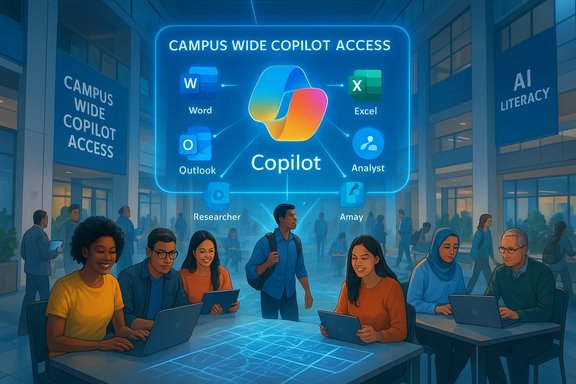
The University of Manchester has announced a strategic collaboration with Microsoft that will give every student and member of staff access to Microsoft 365 Copilot and accompanying training — a campus‑wide rollout covering some 65,000 people and scheduled for completion by summer 2026.
Background / Overview
The University of Manchester positions this agreement as a continuation of its long AI heritage — tracing a line from Alan Turing to contemporary research — and frames the move as both an educational and equity intervention designed to close an emerging digital divide. The university and Microsoft describe the arrangement as the first time a university has provided universal Microsoft 365 Copilot access and training to all students and staff. Under the announced terms, the rollout will provide the full Microsoft 365 Copilot suite — Copilot-integrated Office apps and agent features such as Researcher and Analyst — alongside a structured training programme to support effective and responsible use. The university says this will support teaching, research productivity and graduate employability while ensuring the tools are used within clearly defined policies for responsible AI. The formal launch follows earlier pilots at Manchester that Microsoft and the university have referenced as evidence of adoption readiness. The timetable set out by the university calls for rollout completion by summer 2026. The institution says the programme will be delivered in partnership with student representatives, staff networks and trade unions, and that transparency around environmental and wider impacts will be part of ongoing governance work with Microsoft.What the deal actually provides
Core elements
- Microsoft 365 Copilot licences for approximately 65,000 students, academics and colleagues, including in‑app Copilot capabilities within Word, Excel, PowerPoint, Outlook and Teams.
- Agent features such as Researcher and Analyst, which are designed to support literature synthesis, exploratory data analysis and structured research workflows.
- Training and skills development across the community — not only tool access but a stated emphasis on AI literacy and responsible use.
- Governance and partnership structures including the Students’ Union, trade unions and staff networks to co‑design policies for deployment.
Timeline and scale
The university publicly states that the rollout will be completed by summer 2026 and that pilot activity between 2024 and 2025 produced strong early adoption metrics (the university reports 90% adoption among licensed users within 30 days during its pilot). Those pilot figures come from the university’s published materials and Microsoft’s customer stories.Notable framing points
The university and Microsoft stress three strategic rationales:- Equity: universal access closes a cost‑based barrier so students can use the same advanced productivity tools regardless of personal means.
- Employability: experience with Copilot and agentic productivity tools is presented as a marketable skill for graduate employability.
- *Research acceleration: able to reduce time on routine synthesis and analysis tasks, enabling faster iteration across interdisciplinary projects.
Why Manchester — and why now
The announcement was timed as part of the university’s new strategic direction, Froorld, which highlights digital transformation and research impact as institutional priorities. The university frames this partnership as both practical and symbolic — a way to turn its AI research heritage into campus‑wide capability and to make a visible investment in students’ digital futures. From Microsoft’s perspective the move aligns with broader education and skillhe company has been promoting — including education‑facing Copilot features and programmes that bundle training and platform access. Microsoft highlights how institution‑scale deployments can help close digital divides and build a pipeline of graduates familiar with AI‑augmented productivity tools.How Microsoft 365 Copilot will be used in practice
Microsoft 365 Copilot is not a single standalone product but a set of AI features embedded across Microsoft 365 apps and surfaced through agents and assistants. The features Manchester has highlighted in public statements include:- Integrated drafting, summarisation and editing inside Word and Outlook.
- Data analysis assistants inside Excel (Analyst‑style features for summarising and visualising datasets).
- Research and synthesis helpers able to pull togethetutional documents (Researcher agents).
- Teams and meeting support for minutes, action items and agenda generation.
- Feature availability varies by region, tenant configuration and device. Microsoft’s product rollout is staged; not every capability (for example, advanced agent or multimodal Vision features) is guaranteed in every market or immediately for every user. Institutions should expect phased availability and to test specific workflows.
- Copilot’s value depends on organisational data readiness. Copilot uses the Microsoft Graph and connected content (SharePoint, OneDrive, Exchange, etc. to ground responses. If data sources are fragmented, poorly indexed or access‑restricted, the assistant’s utility drops and verification overhead rises. This dependency has been repeatedly documented in Copilot customer case studies.
Evidence from pilots and existing case studies
The University of Manchester has earlier case material and pilots that Microsoft has included in customer storytelling. Those documents show early cohorts across 2024–2025 and describe measurable productivity gains in specific administrative and teaching tasks. Manchester’s 2024‑2025 pilot cohorts reportedly saw high early engagement and productivity improvements in areas such as quiz generation, transcript analysis and meeting summarisation. Broader sector evidence about Copilot deployments shows a pattern: where governance, training and data hygiene are in place, organisations report meaningful time savings; where these are lacking, benefit is limited. Large public sector pilots and corporate rollouts that tracked outcomes documented both meaningful time savings and a strong dependence on training and tooling to get the benefits in practice.Strengths and immediate upsides
t scale. Providing Copilot licences to all students removes cost as a barrier to access and normalises responsible AI use across cohorts. That can be important for programs where industry‑standard digital skills increasingly assume AI familiarity. ([manchester.ac.uk](https://www.manchester.ac.uk/about/...ester-and-microsoft-announced/?utm_soractical productivity gains. Early internal pilots at Manchester and other organisations show reductions in routine work (drafting, summarisation, administrative processing) that free staff time for higher‑value tasks — provided users are trained and outputs verified.- Research acceleration potential. Foraerature synthesis and exploratory data analysis can shorten cycles for hypothesis generation and project scoping. Manchester emphasises these research gains in its public materials.
- A platform for AI literacy. The rollout explicitly pairs licences with training, presenting a chance to literacy and to embed critical digital skills into curricula and support services. ([ukstories.microsoft.com](https://ukstories.microsoft.com/fea...-and-training-to-all-students-and-staff/?utm_## Risks, governance gaps and practical concerns
1. Data governance and privacy
Copilot relies on organisational data surfaces to create grounded outputs. That power brings risk: **sensitive data exposure, prompt‑injection and unint real threats if connectors and entitlements are not carefully scoped. Deployments must include robust DLP, conditional access and auditing. The sector playbooks emphasise cdata sources and locking down what Copilot may access by default.2. Academic integrity and assessment design
Universities must decide how Copilot fits within teaching and assessment. Wide‑open access without assessment redesign can increase plagiarism risks and distort learning outcomes. Leading practice includes updating assessment rubrics, providing explicit guidance about acceptable AI use, and teaching students how to use Copilot critically (prompt literacy, verification, citation practices). File materials reviewing campus deployments stress the need to treat AI assistance as a new submission vector to be managed rather than ignored.3. Vendor lock‑in and platform concentration
A camdency on Microsoft for productivity tooling and for the institutional knowledge graph that powers assistants. That concentration has advantages (integrated tooling, single vendor support) and disadvantages (reduced negotiation flexibility, migration cost if the institution later wants to shift platforms). The strategic trade‑offs should be explicit in procurement and t, legal and academic governance teams.4. Feature variability and equity of experience
Not all Copilot features are uniformly available across regions, tenants or devices. Institutions must manage expectations: some agentic features and Vision/multimodal capabilities are rolled out incrementally and may be gated by device capabilities or regulatory requirements. That can create uneven student experiences if not communicated clearly.5. Security incidents and historical precedents
Generative AI tools and integrated assistants have had security incidents in the past (for example, accidental data exposures and vulnerabilities in agent frameworks). These precedents underscore the need for logging, audit trails and incident‑response plans tailored to AI‑assistants and agent behaviour. File materials recommend locking down telemetable audit trails.Practical governance and rollout checklist for universities
Drawing from Manchester’s published materials, Microsoft case studies and sector playbooks, the following practical checklist condenses what an IT leader or provost should prioritise.- Prepare (Weeks 0–4)
- Inventory high‑value data sources (finance, HR, research data, student records).
- Draft an initial acceptable‑use policy and assign an executive sponsor and data steward.
- Pilot (Month 1–3)
- Scope Copilot access to a controlled cohort (30–300 users) with targeted use cases (e.g., meeting summaries, grading assistance).
- Pair licences with short workshops and role‑specific prompt templates. Track KPIs (time saved, correction rate, DLP flags).
- Harden (Month 3–6)
- Implement DLP and conditional access for Copilot-enabled apps. Use audit logs and retention windows.
- Define data lineage and retention policies, and run tabletop exercises for prompt‑injection and exfiltration scenarios.
- Prove (Mone outcomes against baselines; share success stories and failures transparently across faculties.
- Adapt training based on real user feedback and error rates.
- Scale (Month 6–12)
- Expand licences in waves, keeping governance guardrails and investing in a Centre of Excellence for prompt design and reproducible templates.
- Continuous review
- Publish transparency reports on uptake, energy and environmental impacts, and DLP incidents; keep student and staff re.
How Manchester’s approach compares with other universities
Several universities worldwide have taken public stances on campus‑scale AI access — but approaches have differed.- Some institutions have given students access to consumer‑grade Copilot or promotional offers (Microsoft’s student promotions) or to competing platforms such as ChatGPT Edu, often driven by affordability and student familiarity. These choices reflect different trade‑offs between tenant‑managed control and consumer verification flows.
- Other universities have focused Copilot primarily on staff or research cohorts while using different products for students, seeking a dual‑tool environment to balance control with student prefector materials include institutions that rolled out Copilot to staff but adopted alternative student‑facing systems for teaching and research support.
Environmental and wider impact transparency
The University of Manchester says it will work with Microsoft to ensure transparency around environmental rosoft’s public sustainability commitments — including targets such as carbon negativity and reduced environmental footprint — are part of how the institutction, but operational carbon impacts of large AI deployments depend on workloads, model hosting and data cld be independently monitored and reported. Institutional transparency around cources and model‑training footprints will be important for genuinely assessing sustainability claims.What students and staff should expect day one
- Access routes and accounts: Students will likely be provisioned either through tenant‑managed student accounts or via verified personal accounts depending on licensing terms; the exact sign‑up and verification flow matters for data boundaries and should be clarified band support:** Manchester emphasises training; expect short hands‑on workshops, online guidance, and role‑specific templates for common tasks (assignment drafting, literature reviews, meeting notes).
- Rules of engagement: New acceptable‑use guidance will define what is allowed in coursework and when Copilot outputs must be cited or treated as drafts. Academic units will need to translate university‑wide policy into course‑level guidance.
Flags and unverifiable claims
- The phrase “world‑first” appears in the university and Microsoft announcements; it should be read as the institution’s claim about providing Microsoft 365 Copilot access and training to every student and colleague rather than a provable global legal status. Comparable large university deployments of other generative assistants have been announced elsewhere, but identifying an absolute global first requires exhaustive confirmation beyond public press releases. That nuance matters for factual accuracy.
- Some vendor‑supplied performance and time‑saved figures in customer materials are directional and context‑dependent. Independent verification through measurable KPIs (e.g., correction rate, DLP incidents, MAU) is essential before extrapolating benefits to different faculties or institutions.
Final analysis: significant opportunity — conditional on governance
The University of Manchester’s move to provide Copilot to the whole campus is a bold operationalisation of institutional AI strategy. The strength of this approach lies in combining scale with training and in elevating AI literacy across the campus population — an outcome that can materially benefit students’ employability and researchers’ productivity.However, the value is conditional. The hard work is not buying licences but implementing strong governance, data stewardship, training that fosters prompt and verification literacy, and continuous monitoring of security and academic integrity outcomes. Manchester’s public materials and Microsoft’s customer stories provide a sensible road map — pilots, governance, training and measured scale — but the real test will be whether the university can sustain rigorous controls while enabling creative, research‑focused use.
For other universities watching this rollout, the Manchester example will be instructive: it shows what a large‑scale, vendor‑backed deployment looks like in practice, and it underscores the reality that the technical benefits of Copilot are attainable but only when paired with governance, data hygiene and human oversight.
Short operational recommendations for IT leaders
- Start with a bounded pilot that measures correction rates, DLP events and user satisfaction.
- Publish transparent acceptable‑use and assessment guidance co‑authored with academic representatives.
- Harden DLP, conditional access and audit trails before broadening access.
- Invest in short, scenario‑based training that teaches prompt design, verification and citation practice.
- Report outcomes publicly: adoption, incidents, energy use, and student experience metrics.
Source: Prolific North University of Manchester launches "world-first" Microsoft Copilot partnership for all staff and students - Prolific North