

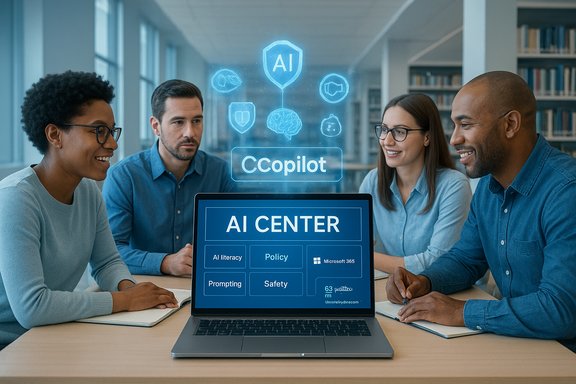
University of Phoenix’s new centralized AI Center for students represents a decisive step toward mainstreaming generative AI literacy and practices across a large, working-adult population of learners, pairing tool access with policy, ethics, and practical instruction to help students use AI responsibly and productively.
Background
The University of Phoenix has launched a Central AI Center (also described in press materials as a Center for AI Resources) designed to bring together foundational AI literacy, policy-aligned expectations for coursework, and step‑by‑step practical advice on how to use generative AI tools and prompts. The Center is reachable from the university’s virtual learning environment and is positioned as an institutional complement to the technology services already provided to students. The initiative is explicitly framed for working adult learners — a demographic with different time constraints, workplace integration needs, and risk profiles than typical undergraduate cohorts. University leadership says the Center’s content covers what generative AI is, how it works, institution‑specific policies for coursework, ethical and responsible use (including citation and academic integrity), tool guidance and prompting, and safety and privacy practices. At the same time, the University confirms that students receive Microsoft 365 accounts and access to Microsoft Copilot through the institution’s technology ecosystem, and the Center aims to provide orientation and responsible‑use scenarios for those institutional tools. The University describes the Copilot access as an institution-supported environment for research, ideation, and productivity.What the Center offers — features and structure
Core curriculum and practical modules
The Center consolidates several practical modules and guidance areas into one virtual hub:- AI literacy: plain‑English explanations of generative AI concepts and how models generate responses.
- Policy alignment: the university’s stance on acceptable uses of AI in coursework and how AI usage maps to academic integrity expectations.
- Prompting and tools: step‑by‑step orientations to institutionally available tools (like Microsoft Copilot) and basic prompting techniques to obtain useful outputs.
- Safety & privacy: explicit guidance on protecting personal and institutional data when interacting with AI tools.
- Benefits & limitations: concrete scenarios explaining when AI is helpful and when human judgment is required.
Accessibility and integration points
The Center is accessible from multiple touchpoints within the University of Phoenix virtual environment: classroom main pages, the Virtual Student Union, Student Resources pages, the Library, and the Center for Writing Excellence. It also appears as part of New Student Orientation pathways intended to standardize baseline competency. A built‑in feedback mechanism allows learners to rate content usefulness and submit suggestions for rapid updates and short explainer videos.Leadership messaging
University leadership frames the Center as empowerment rather than restriction. Doris Savron, Vice Provost of Colleges, Assessment and Curriculum, is quoted as saying the Center is designed to give students "the confidence and practical know‑how to use AI thoughtfully, cite sources, protect their data and uphold academic integrity while they learn." That language signals the institution’s effort to balance enabling tool use with maintaining evaluation standards.Context: how this fits current higher‑education AI trends
Institutional moves to combine tool access with governance
Across higher education, the response to generative AI has coalesced around three themes: tool provisioning (ensuring students and faculty can access tools), policy creation (defining acceptable uses in coursework), and literacy/skill development (teaching how to use and evaluate AI outputs). University of Phoenix’s Center bundles those three components in a single learner‑facing resource — an approach increasingly common among institutions that have both centralized IT services and high online enrollment.Workforce and adult‑learner orientation
Universities serving adult learners face pressures from employers and learners to make education immediately applicable to workplace needs. Integrating generative AI education into the student experience is thus both a learning‑support decision and a career‑readiness strategy. The Center’s emphasis on real‑world examples and workplace productivity tools mirrors demand for practical digital skills in hiring and reskilling contexts.Research and ethical oversight vectors
Separately from student support centers, some universities have created research groups and ethics centers focused on AI governance and evaluation. The University of Phoenix has related initiatives (for example, a Phoenix AI research group within the College of Doctoral Studies) that indicate the institution is building both operational support and scholarly inquiry capacity. This dual approach helps institutions test pedagogical models while updating policy in response to evidence.Critical analysis — strengths
1. Unified, learner‑focused approach
The Center’s consolidation of policy, literacy, tool guidance, and privacy advice into a single hub reduces friction for adult learners who need quick, actionable information rather than long academic treatises. Centralizing these resources within the virtual campus environment increases discoverability and the chance that orientation will be completed early in a program.2. Tool integration with institutional security
Offering Microsoft Copilot through institutional Microsoft 365 accounts — rather than asking students to use third‑party consumer accounts — is a responsible operational choice. Institution-managed accounts can be configured with data protection settings, conditional access, and compliance features that reduce exposure of sensitive academic or employer‑related data. That said, tool configuration details matter (see Risks).3. Practical emphasis and feedback loop
The Center’s stated plan to include rapid updates and short‑form explainer videos, supported by an in‑platform feedback mechanism, is a pragmatic design choice. AI tools and best practices evolve quickly, and a responsive single‑source hub helps instructors and students keep pace with changes without reengineering syllabi each term.4. Explicit treatment of academic integrity and citation
Placing citation, attribution, and academic integrity guidance alongside demonstrations of how to use tools helps normalize responsible behavior. This combats the binary framing (AI = cheating) and instead encourages documented, transparent AI‑assisted workflows.Critical analysis — risks, gaps, and implementation pitfalls
1. Overreliance on vendor ecosystems and potential vendor lock‑in
While Microsoft Copilot integration provides a secure, supported interface for students, institutions should weigh the systemic dependency on a single vendor. Relying heavily on one vendor’s APIs, prompts, and feature set can limit flexibility and complicate future migrations or multi‑tool strategies. Institutions must plan exit strategies and interoperability standards.2. Data flows and privacy nuance
Institutional access to Copilot reduces some risks, but it does not eliminate them. Key questions that are often not fully answered in high‑level announcements include: what data is logged by the AI service, how long logs are retained, whether prompts (which can contain personal or proprietary data) are stored or used to train models, and what contractual protections exist for student data. These technical specifics should be documented in accessible language for students. Where such details are not published, the claim of a “secure, institution‑supported environment” should be treated with caution until contractual and configuration details are shared.3. Hallucination, bias, and assessment validity
Generative models can produce confident‑sounding but incorrect outputs (hallucinations) and reproduce biases present in training data. Teaching students how to validate AI outputs — with source verification, cross‑checking against trusted databases, and explicit skepticism — is necessary but challenging to scale. Faculty assessment practices must adapt to measure genuine comprehension rather than tool‑enabled surface performance. The Center’s guidance on when human judgment is required is an important safeguard, but operationalizing that guidance into assessment rubrics and grading workflows presents institutional work.4. Faculty readiness and pedagogy
Faculty adoption is a known friction point. Faculty need not only policy documents but also scaffolded guidance for redesigning assignments, adjusting rubrics, and detecting misuse. The Center’s student orientation is necessary but insufficient without integrated faculty professional development and consistent enforcement mechanisms.5. Metrics and outcomes measurement
Announcements emphasize empowerment and readiness, but hard outcomes — changes in retention, learning gains, academic integrity incident rates, or employer satisfaction — must be defined and tracked. The feedback system for content usefulness is a start, but institutions should publish (internally or publicly) learning analytics and evaluation frameworks to validate the Center’s impact. Absence of these metrics makes it difficult to judge effectiveness over time.Practical guidance for institutions building similar Centers
- Define clear learning outcomes for AI literacy, tied to program competencies and assessment rubrics.
- Provide institutionally managed tool access (e.g., Microsoft 365/Copilot), and publish a plain‑language data‑handling statement explaining retention, training data usage, and redress mechanisms.
- Co‑design faculty development with pilot cohorts: provide ready‑to‑use assignment templates, rubric adjustments, and detection/verification workflows.
- Implement a feedback loop that includes qualitative user comments and quantitative usage metrics to prioritize updates and short explainer content.
- Maintain vendor‑neutral guidance that teaches generalizable skills (prompt engineering, source verification) so students remain tool‑agnostic as the ecosystem evolves.
Suggested content map for a practical AI literacy curriculum
- Week 0: Introduction to Generative AI — basic concepts, model limitations, and ethical considerations.
- Week 1: Tool access and safety — configuring institutional accounts, protecting PII, and avoiding sensitive prompts.
- Week 2: Prompting fundamentals — crafting prompts for research, data summarization, and ideation.
- Week 3: Source verification — techniques for validating outputs and citing AI‑assisted work.
- Week 4: Assessment design for AI era — redesigning assignments and demonstration tasks that require higher‑order thinking.
- Ongoing: Micro‑learning videos and scenario‑based refreshers (2–3 minute explainers on common pitfalls).
Technical considerations: what institutions must verify before rolling out Copilot‑style access
- Contractual Terms: Confirm whether vendor terms permit student data to be used for model training, and demand opt‑out clauses or contractual protections if required.
- Logging and Retention: Understand what prompt logs are retained, where they are stored, and who can access them.
- Configuration Controls: Use conditional access, DLP (Data Loss Prevention), and administrative guardrails to prevent accidental exposure of PII or proprietary materials.
- Identity and Access Management: Ensure single sign‑on is enforced and that student identity credentials are protected with multi‑factor authentication where appropriate.
- Incident Response: Build incident response playbooks for accidental data leakage or model misuse, including notification procedures for affected learners or partners.
How the University of Phoenix approach compares to peer strategies
- Centralized hub vs. fragmented resources: The Center’s one‑stop model contrasts with institutions that publish separate policy pages, library guides, and faculty memos scattered across different sites. Centralization favors discoverability for time‑pressed adults.
- Tool integration vs. bring‑your‑own model: Institutions vary. Some provide no institutional AI tools and instead ban or restrict third‑party usage; others provide managed tooling. The University of Phoenix falls in the managed‑tool camp, which can reduce immediate risk but increases vendor dependence.
- Rapid content refresh vs. static policies: The inclusion of short videos and an update feedback loop indicates an agile content approach — a best practice when dealing with fast‑moving AI capabilities.
Measuring success — recommended KPIs
- Completion rate for AI orientation modules among new students.
- Change in student confidence scores (pre/post surveys) for using AI responsibly.
- Number and type of academic integrity incidents involving AI — with qualitative categorization.
- Faculty adoption metrics: number of courses adopting AI‑aligned rubrics and the share of faculty completing professional development.
- Employer feedback on graduates’ AI‑enabled skills in internships or placements.
Warnings and unverifiable claims
- Where the university states students receive Microsoft Copilot access, public summaries confirm institutional provisioning of Microsoft 365 and access to Copilot, but precise contractual and configuration details (data retention, training usage clauses) are not published in the public announcement. These technical specifics should be requested directly from the institution or vendor contracts for full verification. Until those details are transparent, any assertion that institutional Copilot access fully protects student data or prevents model‑training use should be treated as provisional.
- The University’s messaging on "upholding academic integrity" is clear and laudable, but the effect of the Center on actual integrity incidents, learning outcomes, or employment results is not yet measurable from the public announcement. Institutions planning similar launches should set baselines and commit to publishing outcome data where possible.
Recommendations for working adults using the Center and Copilot
- Treat Copilot as an assistant, not an authority: always cross‑check factual claims, and prefer original source material for citations.
- Keep sensitive personal or employer data out of prompts unless you’ve confirmed how prompts are stored and used.
- Learn to produce reproducible prompts: document the prompt and the verifiable sources you used to validate the output.
- Cite AI assistance explicitly in coursework where allowed, including what the tool generated and how you verified or edited it.
- Use the Center’s feedback mechanism to report confusing guidance, hallucinations, or issues in tool behavior so the institution can iterate quickly.
Conclusion
The University of Phoenix’s Central AI Center represents a thoughtful, pragmatic attempt to integrate generative AI into the student experience for working adults by pairing institutional tool access with literacy, policy alignment, and practical prompting guides. The initiative reflects broader higher‑education trends toward consolidation of AI guidance, institutionally managed tool access, and agile content updates — all sensible priorities given the pace of change in AI capabilities. At the same time, meaningful risk management will require transparency around vendor contracts and data practices, robust faculty development, and clear outcome metrics to prove the Center’s educational value over time. Institutions adopting similar approaches should design for vendor neutrality, measurement, and continuous improvement so that students gain reliable skills that transfer across tools and workplaces. The launch is a positive, well‑constructed step — but its real test will be in sustained implementation, published outcomes, and the institution’s willingness to disclose the technical and contractual safeguards that determine whether the student experience is not only convenient and empowering, but also secure and academically sound.Source: EdTech Innovation Hub University of Phoenix launches central AI Center to help adult learners use generative AI effectively and responsibly — EdTech Innovation Hub
