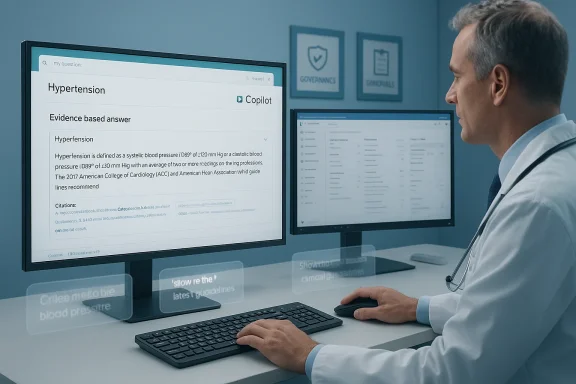
The healthcare AI landscape just picked up a heavyweight pairing: Wolters Kluwer Health is integrating its flagship clinical decision support service, UpToDate, into Microsoft’s productivity and clinical AI stack — including Dragon Copilot, Microsoft 365 Copilot, and Microsoft Teams — promising clinicians evidence‑based, fully cited answers inside the very workflows where they document, communicate, and collaborate.
Wolters Kluwer’s announcement formalizes a collaboration that had been signaled during earlier Copilot ecosystem expansions: UpToDate content will be surfaced through Microsoft’s healthcare agent service in Copilot Studio and will power in‑context clinical answers, Q&A, and ambient documentation experiences inside Dragon Copilot and other Microsoft productivity touchpoints. The companies say all outputs based on UpToDate will include source citations, and that the integration aims to place trusted clinical intelligence at the point of care.
This is a textbook example of two strategic plays colliding: Wolters Kluwer brings a curated, editorially governed evidence base; Microsoft brings scale, ambient capture, and enterprise integration across M365 and Teams. Practically, the result is intended to reduce context switching for clinicians, let AI‑driven assistants answer clinical questions with traceable citations, and fold curated clinical knowledge into documentation drafts and team communications.
Health systems should embrace the potential — but only with the controls, measurement, and clinician oversight that clinical safety demands.
Source: 01net Wolters Kluwer partners with Microsoft to bring trusted clinical intelligence to Microsoft productivity workflows
 Background / Overview
Wolters Kluwer’s announcement formalizes a collaboration that had been signaled during earlier Copilot ecosystem expansions: UpToDate content will be surfaced through Microsoft’s healthcare agent service in Copilot Studio and will power in‑context clinical answers, Q&A, and ambient documentation experiences inside Dragon Copilot and other Microsoft productivity touchpoints. The companies say all outputs based on UpToDate will include source citations, and that the integration aims to place trusted clinical intelligence at the point of care.This is a textbook example of two strategic plays colliding: Wolters Kluwer brings a curated, editorially governed evidence base; Microsoft brings scale, ambient capture, and enterprise integration across M365 and Teams. Practically, the result is intended to reduce context switching for clinicians, let AI‑driven assistants answer clinical questions with traceable citations, and fold curated clinical knowledge into documentation drafts and team communications.
What exactly is being integrated?
UpToDate: the content layer
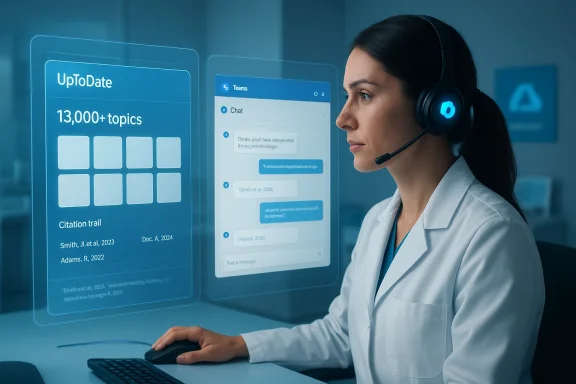
UpToDate is Wolters Kluwer’s long‑running point‑of‑care clinical reference. The company publicizes a content footprint measured in:- 13,000+ clinical topics spanning roughly two dozen specialties,
- 10,000+ graded recommendations and numerous algorithms, tables, and graphics,
- an editorial network of thousands of physician authors and editors who create and review content.
Microsoft’s integration surface
Microsoft will make UpToDate content available through the healthcare agent service in Copilot Studio, which enables third‑party knowledge sources to be connected as grounding layers for Copilot’s generative responses. Microsoft specifically lists the first delivery points as:- Dragon Copilot — Microsoft’s ambient and voice‑centric assistant for clinical documentation,
- Microsoft 365 Copilot — the enterprise productivity assistant (for tasks like drafting, summarization, and knowledge lookup inside Office apps),
- Microsoft Teams — where care teams coordinate and could invoke fast, cited clinical answers.
Why this matters: the promise for clinicians and health systems
- Speed and trust at point of care. Embedding an evidence base into the assistant reduces the friction of opening a browser, searching a separate database, and then returning the key recommendation to the chart or team conversation. For time‑pressed clinicians, fewer clicks can translate into faster decisions and less after‑hours charting.
- Traceability and governance. The commitment to include full citations means the generative output won’t be a faceless paragraph: clinicians get the rationale and a path to the source material, which is critical for clinical safety and for documenting the reasoning behind decisions.
- Enterprise scale and identity. For health systems already standardized on Azure and Microsoft 365, integrating UpToDate via Microsoft’s Copilot platform reduces the delivery and identity overhead associated with adding a separate third‑party tool. This matters operationally for deployment, access control, and audit logging.
What UpToDate brings: content, clinical voice, and constraints
Strengths of the UpToDate layer
- Editorial rigor. UpToDate topics are authored, peer‑reviewed, and continuously updated by clinicians; that editorial process is the principal reason health systems subscribe to it. Leveraging this curated corpus reduces the risk of unvetted internet content being used as the basis for clinical advice.
- Breadth and depth. The cataloged topics and graded recommendations cover diagnosis, treatment, drug monographs, and patient education — allowing the Copilot experiences to answer both clinical and patient‑facing questions.
- Patient education content. Including patient‑friendly materials means clinicians could quickly generate or share plain‑language explanations during a visit or via Teams for care coordination.
Practical constraints and caveats
- Subscriptions and entitlements matter. The integration will surface UpToDate content for organizations that use UpToDate. That means the depth of the content available to an individual health system depends on licensing and the specific UpToDate package purchased. Administrators must confirm entitlements before assuming universal access.
- Content currency and local practice variation. UpToDate updates rapidly, but clinical practice guidance can vary by region, formularies, and institutional policies. An answer grounded in UpToDate still needs local contextualization — e.g., formulary substitutions, local antibiotic stewardship protocols, or system triage pathways.
The Microsoft side: Dragon Copilot, Copilot Studio, and the agent model
Dragon Copilot and ambient capture
Dragon Copilot is Microsoft’s ambient AI tailored for clinical workflows, combining high‑accuracy speech recognition (the legacy of Dragon Medical) with generative summarization and context signals from Microsoft 365. The platform aims to:- capture multi‑party conversation (ambient capture),
- transcribe and extract clinical facts,
- draft specialty‑tuned notes, summaries, and coding suggestions.
Copilot Studio and the healthcare agent model
Copilot Studio’s healthcare agent is effectively a plumbing layer: vendors like Wolters Kluwer connect curated knowledge stores so the Copilot agent can ground generated responses in a trusted source set. This architecture has two practical benefits:- it provides a controlled grounding layer (reducing hallucinted correctly), and
- it supports enterprise deployment models where identity, logging, and governance are centrally managed through Azure and Microsoft 365 controls.
Benefits — concrete and measurable
Health systems evaluating this integration should expect these practical gains if deployment is well‑executed:- Faster documentation: ambient capture + summarization can cut documentation time per encounter, especially in high‑volume ambulatory settings.
- Quicker access to evidence: clinicians get a cited, summarized recommendation without leaving the note or chat.
- Better team coordination: situational answers in Teams mean care teams can alit steps and patient education.
- Auditability: citation metadata and centralized logging help satisfy auditors and compliance teams by providing provenance for AI‑informed decisions.
Risks, governance, and what health IT leaders must demand
No technology is risk‑free, and generative AI in clinical settings amplifies both opportunity and potential harm. The most important governance imperatives are:- Human‑in‑the‑loop controls. Generated summaries and recommendations must remain decision support — clinicians must verify and sign off on orders and documentation. Automating sign‑off or letting model outputs auto‑populate billing codes without clinician validation is legally and ethically risky.
- Auditing and monitoring. Health systems should instrument usage metrics, run periodic content audits comparing AI outputs to original UpToDate topics, and monitor for divergence or error patterns.
- Consent and ambient recording policies. Ambient capture affects patient privacy. Organizations must ensure consent workflows, recording notices, and data retention policies comply with local law and internal policy.
- Coding and billing checks. Generative suggestions for ICD‑10 or CPT codes can speed billing — but must be audited for specifavoid denials or compliance exposure.
- Data residency and vendor lock‑in. Deep embedding into Microsoft 365 ecosystem improves convenience but concentrates operational risk. Contracts should specify data portability, access to raw logs, and exit‑strategy provisions.
A pragmatic rollout playbook (recommended steps)
- Scope a narrow pilot. Choose a specialty or clinic with structured workflows (e.g., primary care, hospital medicine) to reduce variability.
- Confirm licensing and entitlements. Map which UpToDate modules the organization actually has access to, and verify which content will be surfaced inside Copilot.
- Integrate with identity and EHR. Prefer native EHR embedding where possible to reduce context switching and align authentication flows.
- Design governance and human‑in‑the‑loop rules. Explicitly document what parts of AI output require clinician review and what controls block automatic insertion of orders or codes.
- Instrument and measure. Track objective metrics (time in note, after‑hours charting, coder exceptions) and clinician‑reported outcomes.
- Iterate and scale. Use pilot data to refine prompts, templates, and specialty tuning before broader rollout.
Commercial and market implications
- For Wolters Kluwer: Integrating UpToDate into a major productivity vendor’s AI layer extends the product’s reach into how clinicians work rather than only where they search. That increases UpToDate’s strategic value and creates new pathways for subscription retention and enterprise embedding. Wolters Kluwer is a large public company, and its recent full‑year reporting confirms scale: the group reported revenues in the multi‑billion‑euro range, underscoring the strategic importance of enterprise partnerships.
- For Microsoft: The move consolidates Microsoft’s healthcare strategy: build the AI assistant (Dragon Copilot), stitch in curated content partners, and deliver an enterprise‑grade experience that hospitals can adopt at scale. Public disclosures indicate Dragon Copilot is already being used by large provider networks and that Microsoft is seeing rapid document volume growth — signals that the product is out of early experimentation and into operational use.
- For competitors and the market: This sets a higher bar for how clinical knowledge vendors engage with generative AI: firms must be able to provide auditable, citation‑capable content and offer enterprise licensing models that allow third‑party agents to surface content securely inside clinical workflows.
Technical and operational details that matter to IT teams
- Authentication and SSO. The integration will rely on existing enterprise identity controls in Microsoft 365; IT teams must ensure correct mapping of clinician identities and role‑based access to UpToDate entitlements.
- Data flows and logs. Configurations should ensure that transcripts, model inputs, and Copilot outputs are logged according to privacy and retention policies, and that the logs are accessible to authorized compliance teams.
- Latency and availability SLAs. Clinical workflows demand low latency and high availability. Procurement teams should insist on SLAs for the full integrated service (Copilot + UpToDate) and understand failure modes — e.g., what happens when UpToDate is unreachable.
- Local integration points. Confirm whether notes generated by Dragon Copilot will be pushed into the EHR or copied into a clinician clipboard for manual sign‑off; this affects both usability and audit trails.
Independent validation and the evidence gap
Vendor and customer metrics show impressive scale and promising operational outcomes, but the community still needs peer‑reviewed, specialty‑specific studies that evaluate:- diagnostic accuracy when clinicians use Copilot‑delivered guidance,
- downstream patient outcomes (e.g., readmissions, safety events),
- long‑term effects on clinician workload and burnout.
Quick reference: what to ask vendors before procurement
- Exactly which UpToDate modules will be available through Copilot for our tenancy, and how will entitlements be enforced?
- How are UpToDate citations surfaced in the Copilot UI, and can clinicians access the underlying topic quickly?
- What human‑in‑the‑loop guardrails prevent automatic placement of orders, signatures, or billing codes?
- Where are transcripts and model logs stored, how long are they retained, and who has access?
- What change management, training, and on‑site support will the vendor provide during go‑live?
Conclusion
The Wolters Kluwer–Microsoft integration is a pragmatic step in the maturation of generative AI in healthcare: it pairs a curated, clinically‑governed content layer with a scalable productivity and ambient‑AI platform. For clinicians, the promise is compelling — faster, cited, point‑of‑care answers embedded directly in documentation and team workflows. For IT and clinical leaders, the work begins now: translate that promise into safe, auditable practice through narrow pilots, robust governance, and independent evaluation. Done right, this is a concrete example of AI augmenting clinical work rather than simply adding another app to the clinician’s to‑do list. Done poorly, it risks propagating errors, increasing compliance exposure, and producing brittle operational integrations.Health systems should embrace the potential — but only with the controls, measurement, and clinician oversight that clinical safety demands.
Source: 01net Wolters Kluwer partners with Microsoft to bring trusted clinical intelligence to Microsoft productivity workflows