

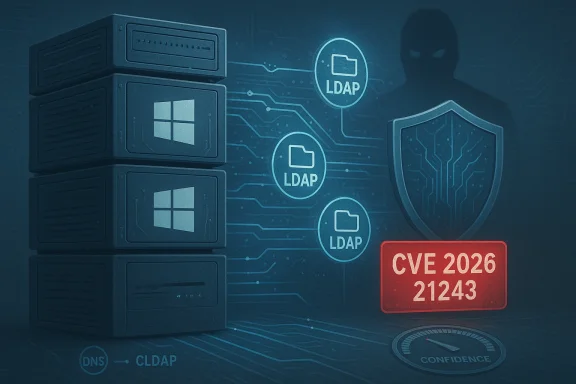
Microsoft’s security feed now lists CVE-2026-21243 as a vulnerability in the Windows Lightweight Directory Access Protocol (LDAP) that can be leveraged to cause a denial-of-service condition against Windows systems, and the advisory emphasizes uncertainty around the detailed technical root cause while flagging the confidence metric as an important indicator of how much is known — and how urgently defenders should act. The net: if your organization runs Domain Controllers, Active Directory-dependent services, or any systems that rely on Windows’ LDAP implementation, this entry should be treated as high priority even where public technical details remain sparse.
LDAP is the backbone of directory services and identity lookups in Windows environments. Domain Controllers use LDAP for authentication, group lookups, policy queries, and many parts of everyday domain operation. When LDAP is disrupted — whether by a crash, resource exhaustion, or manipulation of referrals — the impact can cascade across the enterprise: logons fail, policy application stalls, authentication-dependent services degrade or stop, and domain-wide management tasks break.
Windows has a long history of LDAP-related vulnerabilities. Over the past two decades Microsoft and independent researchers have repeatedly found flaws that range in impact from failure to gracefully handle malformed LDAP requests (leading to DoS) to buffer overflows with the potential for remote code execution. That history makes any new LDAP advisory inherently serious: these are not low-level utilities that can be easily quarantined — they sit at the heart of identity and access in enterprises.
Your immediate priorities should be to: confirm vendor guidance and patches, harden LDAP exposure and DNS referral behavior, increase monitoring for LSASS and DC anomalies, and prepare a staged patch plan with robust rollback and recovery options. Even if the public details remain intentionally sparse for now, the historical record and the advisory’s own emphasis on confidence metrics make clear that treating this as a high-priority operational security event is the prudent course.
Stay vigilant, update your plans, and treat identity infrastructure as the sensitive, high-risk asset it is.
Source: MSRC Security Update Guide - Microsoft Security Response Center
 Background: why LDAP vulnerabilities matter
LDAP is the backbone of directory services and identity lookups in Windows environments. Domain Controllers use LDAP for authentication, group lookups, policy queries, and many parts of everyday domain operation. When LDAP is disrupted — whether by a crash, resource exhaustion, or manipulation of referrals — the impact can cascade across the enterprise: logons fail, policy application stalls, authentication-dependent services degrade or stop, and domain-wide management tasks break.Windows has a long history of LDAP-related vulnerabilities. Over the past two decades Microsoft and independent researchers have repeatedly found flaws that range in impact from failure to gracefully handle malformed LDAP requests (leading to DoS) to buffer overflows with the potential for remote code execution. That history makes any new LDAP advisory inherently serious: these are not low-level utilities that can be easily quarantined — they sit at the heart of identity and access in enterprises.
What we know about CVE-2026-21243 (and what we don’t)
- The vendor listing identifies CVE-2026-21243 as a Windows LDAP Denial of Service vulnerability. The vendor advisory uses a confidence/credibility metric to indicate how certain the public technical details are.
- The advisory language supplied alongside the CVE stresses that sometimes only the existence of a vulnerability is publicized without full technical detail, and that the confidence level can change as research corroborates a cause or vendor confirmation follows.
- At the time of publication, public technical specifics (exact call chain, vulnerable component function name, or a line-level root cause) are limited or not fully disclosed in public write-ups. That incomplete disclosure is likely why the advisory emphasizes the confidence metric.
Technical context and plausible exploitation patterns
We must be careful not to assert technical details about CVE-2026-21243 that the public advisory doesn’t confirm. However, based on the common classes of LDAP bugs and prior, closely related incidents, we can outline plausible vectors and why they matter:Typical LDAP DoS mechanics in Windows environments
- Malformed LDAP requests: Historically, DoS conditions arise when LDAP parsing code receives malformed ASN.1/BER-encoded messages (search filters, attribute lists, referral data) and fails to validate length or state, producing exceptions that crash service processes.
- Referral / CLDAP manipulation: Several recent attacks exploit LDAP referral or CLDAP referral flows. A server making follow-up or referral requests (for example, after receiving a DNS SRV response) can be induced to contact a malicious endpoint that returns crafted referral data which provokes crashes inside the LDAP client or LSASS stack.
- Integer overflows and resource exhaustion: Integer overflow during size computations (leading to buffer allocation errors) or logic that allows uncontrolled resource consumption can produce crashes or persistent service unavailability.
- Intermediary dependencies: Attacks sometimes chain through DNS or RPC subsystems — for example, a crafted DCE/RPC or DNS SRV response that causes the target to attempt a CLDAP connection to an attacker-controlled host.
Why LDAP DoS can be far worse in practice
- Zero-interaction attackability: Many LDAP issues can be triggered without valid credentials if the attacker can reach the LDAP service (or can provoke it to reach out), which reduces the attacker’s burden and raises urgency.
- Domain Controller fragility: On domain controllers, LSASS crashes are particularly disruptive because they affect security tokens and authentication; LSASS or related crashes can force reboots or degrade authentication across the domain.
- Escalation risk: A DoS that provokes a memory corruption or logic flaw could, with additional exploitation steps, be transformed into Remote Code Execution in some circumstances — making DoS advisories a potential early warning of a deeper exploitation chain.
The “confidence” metric explained — and why it matters
The advisory highlights a metric that measures the degree of confidence in the vulnerability’s existence and the credibility of available technical details. This is a critical operational signal:- Low confidence: The vulnerability is reported but lacks reproducible technical proof or vendor confirmation. Treat these as investigate and monitor items; prioritize only if your exposure is high or if reconnaissance shows active exploitation attempts.
- Medium confidence: Research corroborates where the weakness may lie but lacks full reproducibility or precise exploit details. Increase urgency: patch testing and mitigations should accelerate.
- High/Confirmed confidence: Vendor acknowledgement, reproducible PoC, or multiple independent confirmations. This is the highest urgency tier — patch now and hunt for exploitation indicators.
Risk assessment: who’s in danger and what’s the likely impact
- Most at-risk systems
- Internet-exposed Domain Controllers or LDAP endpoints that accept unauthenticated traffic.
- Environments where DNS or network segmentation allows external or untrusted systems to influence DNS SRV responses or referral flows.
- Legacy or unpatched Windows Server installations that historically have contained LDAP parsing bugs.
- Likely impact
- Availability: Direct denial of service of LDAP service on affected hosts; domain-wide authentication disruption if Domain Controllers are affected.
- Operational: Forced reboots, service restarts, and administrative overhead to restore normal operations.
- Security posture: Disruption that can be used as a stepping stone or distraction by attackers performing concurrent lateral movement or other attacks.
- Exploitability
- Without published PoC or precise root-cause, exploitability is uncertain. But the combination of zero-auth attack paths seen previously for LDAP flaws and the centrality of LDAP in domain operations means defenders should assume an exploit path could exist or be developed quickly.
Immediate actions for defenders — emergency checklist
If you manage Windows servers, especially Domain Controllers, follow this prioritized checklist now:- Confirm presence of vendor guidance — Check Microsoft’s Security Update Guide entry for CVE-2026-21243 and any associated advisory text or patches. Treat vendor advisories as the single source of truth for official fixes and mitigations.
- Prioritize patching — If Microsoft has released a patch or update addressing the CVE, schedule immediate rollout to Domain Controllers and other LDAP-exposing hosts. Test in a staging environment where possible, but expedite deployment for exposed hosts.
- Isolate domain controllers from untrusted networks — Ensure DCs do not perform DNS or LDAP lookups to untrusted external resolvers and are prevented from initiating outbound connections to untrusted hosts.
- Block or heavily filter LDAP/CLDAP from the internet — Ensure firewall rules and perimeter devices block inbound LDAP (TCP/389) and CLDAP/connectionless LDAP (UDP/389) from untrusted sources. LDAP should not be internet-facing in most organizations.
- Egress filtering for DNS and LDAP referrals — Block or monitor unexpected DNS SRV responses and restrict DNS recursion for DCs; require DCs to query internal, trusted DNS resolvers only.
- Increase monitoring and hunting — Look for LSASS crashes, unexplained domain controller reboots, anomalous DNS SRV queries, and unusual CLDAP traffic. Prioritize alerts and create temporary detection rules.
- Prepare incident response — Ensure backups and recovery paths for Domain Controllers are current; rehearse procedures for failover and restore to minimize downtime.
Detection and threat-hunting playbook
Below are practical detection approaches and queries teams can implement in SIEMs and network sensors. These are heuristic and should be tuned to your environment.- Windows event logs
- Monitor for Service crashes: Event IDs referencing LSASS, services stopping unexpectedly, or Windows Error Reporting (WER) entries tied to lsass.exe.
- System reboots with no scheduled maintenance: Event ID 6008 (unexpected shutdown), and Event ID 41 (Kernel-Power) combined with application crash events.
- Service-specific logs for Active Directory, Netlogon errors, or Directory Service event IDs showing failures.
- Network indicators
- Unexpected inbound LDAP or CLDAP traffic from external IPs.
- Outbound CLDAP or LDAP queries from DCs to unusual endpoints (UDP/TCP 389).
- DNS SRV replies pointing clients to unexpected hosts or domains.
- IDS/IPS/Network rules
- Add rules to flag CLDAP on the wire, DRILL-DOWN of anomalous DNS SRV/NS record responses, and sudden bursts of NBNS/NetBIOS or unusual multicast name queries.
- Create Suricata/Zeek-style signatures to detect CLDAP referral sequences or malformed LDAP packets if you have packet-bed visibility. (Be cautious — avoid blocking legitimate traffic.)
- Host-based forensic
- Collect crash dumps from affected hosts (e.g., memory dumps after LSASS crash) for offline forensic analysis.
- Trace DNS and network flows on DCs at the timestamp of the event.
Mitigations beyond the immediate window
- Harden DNS and referral logic
- Ensure Domain Controllers use internal, locked-down DNS resolvers.
- Disable unnecessary referral behaviors where possible and block unsolicited referral responses from untrusted networks.
- Adopt principle of minimal exposure
- LDAP should rarely be accessible directly from the internet. Use secure proxying, VPN, or other controlled access methods for remote directory access.
- Consider restricting LDAP to TLS (LDAPS) with strict certificate validation when external/partner integrations require directory access.
- Robust patch management
- Maintain a prioritized patching schedule for identity-critical infrastructure separate from general endpoints.
- Practice rapid staged rollouts for domain controllers and maintain rollback plans for problematic updates.
- Layered defense and segmentation
- Place Domain Controllers in highly restricted network segments with strict access control and monitoring.
- Limit which hosts and services can query the DCs for LDAP and require authentication where possible.
Operational concerns and the cost of patching domain controllers
Patching domain controllers is operationally sensitive. DCs are critical infrastructure, and applying updates requires careful staging, backups, and rollback plans. The pressure-cooker of a highly publicized vulnerability adds complexity:- Testing vs urgency: Organizations often delay DC updates to avoid service disruption. For CVE-2026-21243, treat DCs as high-priority but still follow staged testing to avoid creating new outages.
- Compatibility worries: Some updates interact with Group Policy, replication, or third-party security agents. Validate replication health after patches.
- Fallback and recovery: Ensure system state backups, System State backups, and rapid restoration procedures are in place in case an update causes regression.
Critical analysis: strengths, gaps, and practical risk
- Microsoft’s measured disclosure is a strength — withholding low-level exploit details while confirming the vulnerability and providing a confidence metric can reduce easy weaponization. That said, many organizations interpret “limited detail” as “lower priority,” which is a risky assumption for LDAP advisories.
- Lack of deep public technical detail is a double-edged sword — it protects customers from immediate PoC proliferation but hampers defenders who rely on technical indicators to detect in-the-wild exploitation.
- Historic patterns show rapid weaponization — prior LDAP vulnerabilities have transitioned quickly from disclosure to public PoC and then to active exploitation, particularly when attackers can trigger crashes remotely without authentication.
- Operational friction is real — many organizations delay DC patching because of the disruption risk. For critical identity flaws, this delay increases attack surface and is one of the biggest practical risk multipliers.
Recommended 30/60/90-day plan for security teams
- Days 0–7
- Inventory all domain controllers and LDAP-facing hosts.
- Apply emergency firewall rules to block LDAP/CLDAP from untrusted networks.
- Patch immediately if vendor provides an update; otherwise expedite staged testing.
- Enable elevated monitoring for LSASS crashes and DNS SRV anomalies.
- Days 7–30
- Complete staged patch rollout across DCs.
- Harden DNS resolver configuration and implement egress filtering for DCs.
- Validate replication health and authentication post-patch.
- Days 30–90
- Perform a post-mortem of the incident response readiness and update playbooks.
- Incorporate LDAP-specific detection rules into threat-hunting routines.
- Review architecture for long-term minimization of internet-exposed identity services.
Final word: act now, but act carefully
CVE-2026-21243 sits squarely in an area where speed and caution must coexist. LDAP-related issues hit the foundations of identity and availability — the consequences of inaction can be severe, but so too can be the fallout from poorly planned emergency remediation on Domain Controllers.Your immediate priorities should be to: confirm vendor guidance and patches, harden LDAP exposure and DNS referral behavior, increase monitoring for LSASS and DC anomalies, and prepare a staged patch plan with robust rollback and recovery options. Even if the public details remain intentionally sparse for now, the historical record and the advisory’s own emphasis on confidence metrics make clear that treating this as a high-priority operational security event is the prudent course.
Stay vigilant, update your plans, and treat identity infrastructure as the sensitive, high-risk asset it is.
Source: MSRC Security Update Guide - Microsoft Security Response Center
