

Siemens has published an urgent security advisory for TeleControl Server Basic after ProductCERT and national tracking authorities assigned CVE‑2025‑40942 to a local privilege escalation flaw that—if an attacker gains local access—could allow execution of arbitrary code with elevated rights; operators are advised to update all affected TeleControl Server Basic installations to V3.1.2.4 or later immediately and apply network compensations until updates can be validated.
TeleControl Server Basic is a widely used component in Siemens’ remote telemetry and control stack for small‑to‑medium industrial installations. The vendor’s advisory SSA‑192617 states the issue affects “all versions < V3.1.2.4” and lists the vulnerability as a local privilege escalation (CWE‑250), with Siemens assigning a CVSS v3.1 base score of 8.8 (High) and a CVSS v4 base score of 7.3 (High). The ProductCERT page is explicit: the remediation is to “update to V3.1.2.4 or later.” Industry vulnerability trackers and national databases have mirrored that information: the NVD has an entry for CVE‑2025‑40942 describing the same affected product and version boundary, and independent CVE aggregators list matching CVSS vectors and CWE mapping. These independent records corroborate the vendor’s published severity and affected‑version boundaries.
Source: CISA Siemens TeleControl Server Basic | CISA
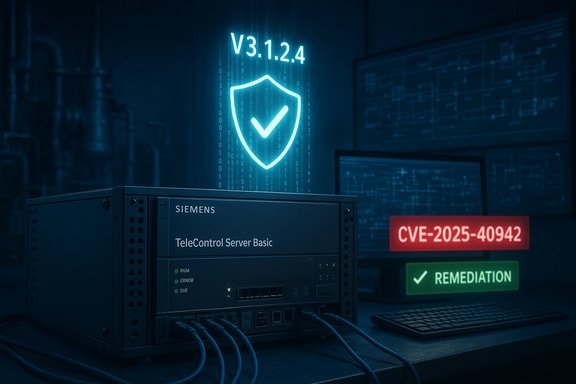 Background / Overview
TeleControl Server Basic is a widely used component in Siemens’ remote telemetry and control stack for small‑to‑medium industrial installations. The vendor’s advisory SSA‑192617 states the issue affects “all versions < V3.1.2.4” and lists the vulnerability as a local privilege escalation (CWE‑250), with Siemens assigning a CVSS v3.1 base score of 8.8 (High) and a CVSS v4 base score of 7.3 (High). The ProductCERT page is explicit: the remediation is to “update to V3.1.2.4 or later.” Industry vulnerability trackers and national databases have mirrored that information: the NVD has an entry for CVE‑2025‑40942 describing the same affected product and version boundary, and independent CVE aggregators list matching CVSS vectors and CWE mapping. These independent records corroborate the vendor’s published severity and affected‑version boundaries. What the advisory actually says
- Vulnerability: Local privilege escalation (CWE‑250) in TeleControl Server Basic prior to V3.1.2.4 that could allow an attacker with local access to execute code with elevated privileges.
- Affected versions: TeleControl Server Basic — all versions earlier than V3.1.2.4.
- Vendor remediation: Update to V3.1.2.4 or later.
- Severities published by Siemens: CVSS v3.1 = 8.8 (High); CVSS v4 = 7.3 (High). These numeric scores and vector strings were published by Siemens and are reflected in public CVE feeds.
Technical breakdown: what the vulnerability is and why it matters
Nature of the flaw
The defect is categorized as Execution with Unnecessary Privileges (CWE‑250)—meaning some part of the TeleControl Server Basic software performs an operation at a higher privilege level than strictly required. In practical terms, this can convert a low‑privilege local compromise into full system control if an attacker can cause or trigger the vulnerable privileged operation. Siemens identifies this explicitly as a local privilege escalation.Attack model and prerequisites
- Local access required: Reported vector properties indicate the exploit requires local access (attack vector: Local), not a direct unauthenticated remote connection. This places emphasis on protecting hosts from lateral movement and misuse of local accounts.
- Privileges required: The CVSS vector indicates low privileges required to exploit, which means an account with limited rights on the host could, in the worst case, be escalated to a much higher privilege.
- User interaction: Siemens’ vector strings show no user interaction required in the v3.1 calculus; under CVSS v4 Siemens models attacker techniques as possible with some privileged action needed. Regardless, practical exploitation is much simpler when an attacker already has a foothold.
Why this is significant for industrial environments and Windows‑centric operations
While this vulnerability is local rather than remote, industrial control systems (ICS) operate in environments where jump hosts, engineering workstations, and shared administrative systems are common. A single local escalation on a Windows‑based engineering server or an operator workstation can be the pivot that grants an attacker the ability to alter process logic, exfiltrate credentials, or deliver disruptive instructions to OT assets. In short, a local LPE in an ICS component carries an outsized operational risk relative to the raw CVE vector because of typical environment architectures.Affected inventory and exposure mapping
Operators must treat the advisory as prescriptive: identify every TeleControl Server Basic instance and verify the exact version string. Because Siemens publishes per‑SKU and per‑build remediation thresholds in ProductCERT, the canonical action is to map each host’s installed build to the vendor table and confirm whether it is < V3.1.2.4. Automated inventory tools, software asset management (SAM) systems, and endpoint management platforms should be used to extract version strings at scale. Key first steps:- Build an inventory of TeleControl Server Basic hosts and record exact build strings and hostnames.
- Identify which hosts are reachable from business networks, VPNs, or the Internet.
- Prioritize hosts exposed to users or management workstations for immediate mitigations.
Immediate mitigations (what to do before you can patch)
Given the local exploit requirement, the shortest path to risk reduction focuses on reducing the ability of attackers to obtain local access or to move laterally and to constraining what local accounts can do.- Patch immediately where possible: Apply V3.1.2.4 or later per Siemens’ remediation guidance. This is the definitive fix.
- Isolate affected hosts: Place TeleControl Server Basic hosts behind a management VLAN/firewall and restrict inbound management traffic to dedicated jump hosts or admin workstations with MFA. Block all non‑essential ports and deny access from business networks.
- Harden local accounts and privileges: Enforce least privilege on Windows local accounts, remove shared admin credentials, and restrict who can log on locally or via RDP. Convert any generic service accounts to narrow, audited service principals.
- Lock down engineering jump hosts: Ensure jump hosts that can reach TeleControl hosts are hardened, have EDR/antivirus active, and require MFA plus endpoint posture assessment before allowing a session.
- Elevate monitoring: Enable file integrity monitoring (FIM), audit local privilege escalation events, and forward Windows event logs for suspicious processes, service installations, or unusual scheduled tasks. Add detection rules for new or unexpected service installations or binary writes under program directories.
Patching and operational guidance
Updating complex ICS software requires coordination between OT and IT teams to avoid unintended downtime. Use the following practical sequence when planning the TeleControl Server Basic update:- Inventory and backup:
- Record current build strings and configuration exports.
- Back up configuration and databases in a verifiable, tested manner.
- Test patch in staging:
- Apply V3.1.2.4 in a staging environment that mirrors production connectivity.
- Validate service start/health checks, gateway links, and any custom integrations.
- Schedule maintenance:
- Plan a maintenance window with rollback procedures and a validated fallback image.
- Apply patch to production:
- Deploy V3.1.2.4 (or later) to production instances and verify functional behavior.
- Post‑patch hardening:
- Rotate any credentials, certificates, or service account keys that were present on patched hosts.
- Revalidate ACLs on configuration files and ensure no world‑readable secrets exist.
- Document and report:
- Keep records for audit and compliance and notify stakeholders of the patch timeline and verification steps.
Detection and incident response considerations
If an organization suspects exploitation or unusual local activity, pursue a prioritized investigative path:- Preserve evidence: snapshot the host, collect Windows event logs, AppLocker or Sysmon logs, and copies of suspicious binaries.
- Hunt for indicators: abnormal privilege escalation events, creation of scheduled tasks, service creation events, and unexpected network connections from the host to unfamiliar management systems.
- Validate integrity: check file hashes for binaries and libraries in the installation directories and compare them with known‑good versions after patching.
- Contain and remediate: isolate impacted hosts, rotate service credentials, rebuild affected servers if evidence of compromise is found, and consult Siemens ProductCERT if there is uncertainty around artifact integrity.
Vendor and industry response — strengths and caveats
Siemens’ ProductCERT published the advisory on January 13, 2026 and supplied a targeted remediation (V3.1.2.4). The vendor’s advisory includes per‑product version boundaries and an explicit remediation path, which is the correct and authoritative source for operators tracking affected TeleControl Server Basic instances. Public CVE trackers and NVD entries reflect the vendor’s published severity and version thresholds, providing independent confirmation. Strengths of the response:- Clear remedial version and update instructions.
- Published CVSS v3.1 and v4 scores, which help triage using both legacy and modern scoring frameworks.
- The flaw is local but requires careful attention to internal access controls; operators who deprioritize local issues in favor of remote flaws may be left exposed.
- Patching ICS software incurs operational risk; Siemens’ advisory does not remove the need for staged testing and controlled rollouts.
Practical recommendations for Windows admins and OT teams
- Treat all TeleControl Server Basic hosts as high‑priority assets until patched: assume compromise is plausible and prepare containment plans.
- Enforce least privilege on Windows hosts: remove local admin rights where not required, use constrained delegation for services, and avoid shared local accounts.
- Harden jump hosts: place them in a bastion environment with strong endpoint detection and network egress controls.
- Integrate ProductCERT feeds into patch‑management workflows: automating vendor advisory ingestion reduces the time between disclosure and remediation planning.
- Complement patching with monitoring: add detections for suspicious local privilege escalations, untrusted binaries placed in program directories, and rapid certificate/credential usage patterns.
Risk assessment and longer‑term lessons
- Local privilege escalations remain a core risk in ICS because engineering and operational processes often require elevated access and shared tooling. A single LPE can enable lateral movement and system‑level persistence in environments where segmentation and account hygiene are weak.
- Patch management must be reconciled with operational continuity: the correct approach is staged validation, but organizations must not allow long dwell times due to scheduling or procedural delays.
- Vendor advisories are authoritative for version mappings; however, independent registries (NVD, CVE aggregators) are useful for cross‑checking and integrating vulnerability data into SIEMs and ticketing systems. Use both but treat ProductCERT as the definitive remediation source.
What remains unverified and cautionary notes
- There are no publicly confirmed reports of active exploitation of CVE‑2025‑40942 at the time of the advisory’s publication; several trackers and writeups explicitly state no known exploitation was observed. That said, exploitation of local flaws is typically underreported, and the absence of public exploit code does not reduce operational urgency. Treat this as a warning, not a consolation.
- Any environment‑specific claims (for example, about third‑party integrations that might be impacted) should be verified against the exact TeleControl Server Basic build strings and configuration present in that environment—Siemens’ ProductCERT lists per‑product details and remains the canonical reference. If your installation includes bespoke plugins or third‑party connectors, validate them in staging prior to production patching.
Quick operational checklist (one page summary)
- Inventory: list all TeleControl Server Basic hosts and version strings.
- Isolate: place vulnerable hosts behind management VLANs and restrict access to trusted jump hosts.
- Patch: update to V3.1.2.4 or later after testing in staging.
- Harden: enforce least privilege, remove shared admin credentials, and secure local accounts.
- Monitor: enable FIM, Windows Sysmon, and SIEM rules for privilege escalation and suspicious service activity.
- Document: keep records of backups, test results, and patch rollouts for audit and incident response.
Conclusion
CVE‑2025‑40942 is a high‑impact local privilege escalation affecting Siemens TeleControl Server Basic builds prior to V3.1.2.4. Siemens’ ProductCERT has published a targeted remediation—update to V3.1.2.4 or later—and independent registries echo the vendor’s assessment. Because the bug enables elevation of privilege from low rights to potentially system‑level control, organizations that operate TeleControl Server Basic in mixed Windows/OT environments should treat the advisory as a priority: inventory, isolate, test, and patch promptly while hardening local account hygiene and monitoring for suspicious activity. The vendor patch is the definitive fix, and compensating network and host controls are essential until updates are validated and deployed.Source: CISA Siemens TeleControl Server Basic | CISA
