

Siemens has published fixes for a cluster of high‑severity vulnerabilities in Spectrum Power 4 that can lead to local and network‑accessible privilege escalation and remote command execution; operators must update to V4.70 SP12 Update 2 (or later) immediately and apply network compensations while they patch.
Spectrum Power 4 is a widely deployed energy‑sector network management and distribution management suite that operates in control centers and regional utilities worldwide. The product plays a central role in operational workflows — aggregating telemetry, managing dispatch commands and housing application accounts — which makes any privilege or command‑execution flaw an immediate operational risk.
In November 2025 Siemens ProductCERT published advisory SSA‑339694 describing five assigned CVEs affecting all Spectrum Power 4 versions prior to V4.70 SP12 Update 2. The issues were reported by Limes Security researchers Felix Eberstaller and Sixtus Leonhardsberger and were coordinated with Siemens for remediation. Siemens lists explicit defect fixes for each CVE and recommends updating to the patched release. CISA republished the advisory for visibility when it was first released, but U.S. federal practice since January 10, 2023, directs operators to consult Siemens ProductCERT for ongoing status and updates. This procedural change places the onus on asset owners to monitor vendor feeds directly for hotfixes and follow‑up clarifications.
Implement the immediate checklist, validate fixes in a controlled environment, and update incident response playbooks to address the specific indicators described above. Continuous vendor monitoring and cross‑verification with independent CVE registries should be part of standard operating procedure for every organization that relies on Siemens ProductCERT advisories for ICS security.
Source: CISA Siemens Spectrum Power 4 | CISA
 Background / Overview
Spectrum Power 4 is a widely deployed energy‑sector network management and distribution management suite that operates in control centers and regional utilities worldwide. The product plays a central role in operational workflows — aggregating telemetry, managing dispatch commands and housing application accounts — which makes any privilege or command‑execution flaw an immediate operational risk.In November 2025 Siemens ProductCERT published advisory SSA‑339694 describing five assigned CVEs affecting all Spectrum Power 4 versions prior to V4.70 SP12 Update 2. The issues were reported by Limes Security researchers Felix Eberstaller and Sixtus Leonhardsberger and were coordinated with Siemens for remediation. Siemens lists explicit defect fixes for each CVE and recommends updating to the patched release. CISA republished the advisory for visibility when it was first released, but U.S. federal practice since January 10, 2023, directs operators to consult Siemens ProductCERT for ongoing status and updates. This procedural change places the onus on asset owners to monitor vendor feeds directly for hotfixes and follow‑up clarifications.
Executive summary of the technical findings
- Affected product: Spectrum Power 4 — all versions prior to V4.70 SP12 Update 2.
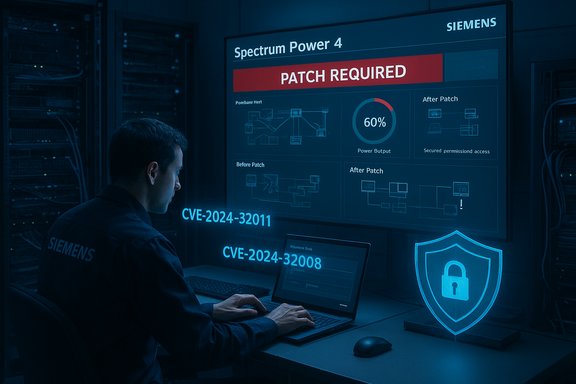
- Assigned CVEs: CVE‑2024‑32008, CVE‑2024‑32009, CVE‑2024‑32010, CVE‑2024‑32011, CVE‑2024‑32014.
- Highest network‑accessible impact: CVE‑2024‑32011 — a user‑interface command execution flaw that is reachable over the network and carries a high CVSS v3.1 (8.8) / CVSS v4 (8.7) severity.
- Other CVEs are primarily local privilege escalation vectors (exposed debug interfaces, wrong binary permissions, world‑readable credential files, and local database manipulation) but together they enable a fast escalation chain from a low‑privilege foothold to administrative control.
Detailed technical breakdown
CVE‑2024‑32011 — Network‑accessible command execution (highest immediate risk)
- What it is: A user interface that is reachable over the network allows execution of arbitrary commands as the application’s administrative user. This is an in‑product command execution issue — not merely a configuration mistake.
- Severity: CVSS v3.1 = 8.8; CVSS v4 = 8.7. These scores reflect an attacker with some privilege (PR:L) but without user interaction being required.
- Why it matters: Because the interface is networked, exploitation can be combined with remote access or a pivot from an adjacent network to achieve administrative control; in energy systems that control plane access often links directly to device orchestration, so the blast radius is significant.
CVE‑2024‑32008 — Exposed debug interface (local privilege escalation)
- What it is: A debug interface bound to localhost allows any local user to trigger code execution as the administrative application user. This is a privileged API misuse (CWE‑648).
- Severity: CVSS v3.1 = 7.8 (CVSS v4 = 8.5). Although local in vector, debug‑interface flaws are frequently exploited after gaining limited shell access or in multi‑tenant environments where low‑privilege accounts exist.
CVE‑2024‑32009 — Wrong permissions on a binary (local privilege escalation)
- What it is: A binary shipped with overly permissive filesystem permissions (or SUID misconfiguration) enables local account privilege escalation to administrative level (CWE‑266).
- Severity: CVSS v3.1 = 7.8 (CVSS v4 = 8.5). Such misconfigurations are low‑complexity to exploit when local access exists.
CVE‑2024‑32010 — World‑readable credential file (credential disclosure)
- What it is: A credential file containing database connection credentials is world‑readable, allowing local attackers to obtain privileged DB access and run system commands via database functionality (CWE‑732).
- Severity: CVSS v3.1 = 7.8 (CVSS v4 = 8.5). This is particularly dangerous because it converts a local, low‑privilege compromise into a privileged service account takeover.
CVE‑2024‑32014 — Local database alteration (moderate‑local impact)
- What it is: Insufficient protection of the local application database allows an attacker to alter application credentials, enabling administrative access to the application. CWE mapping: Incorrect Permission Assignment for Critical Resource (CWE‑732).
- Severity: CVSS v3.1 = 4.7 (CVSS v4 = 5.6). This CVE is lower in numeric score because it requires local access and higher attack complexity, but in the context of the other CVEs it completes an escalation chain.
What Siemens changed and available fixes
Siemens ProductCERT documents the fixes and the specific defect IDs mapped to each CVE. The vendor’s explicit remediation is to update Spectrum Power 4 to V4.70 SP12 Update 2 or later, and Siemens lists internal defect‑fix identifiers that map to each CVE. Operators should download and install the vendor package released for SSA‑339694 and validate installed build strings against the advisory. Independent CVE aggregators and vulnerability databases reflect Siemens’ published scoring and the same affected version boundaries; these registries confirm that the advisories were published on 11 November 2025 and that the CVEs were coordinated with Siemens as the CNA. Cross‑checking vendor and independent registries is recommended before applying production updates.Immediate mitigation and compensating controls (practical checklist)
Apply the following in order of urgency — patching first where possible, compensating controls concurrently:- Update:
- Download and apply Spectrum Power 4 V4.70 SP12 Update 2 (or later) to every managed instance; verify the update was successful using the product’s build/version commands.
- If update cannot be scheduled immediately:
- Isolate affected hosts from all untrusted networks — place them behind a management VLAN with strictly enforced ACLs.
- Block external access: Ensure Spectrum Power 4 management UIs and database ports are not internet‑reachable; deny access from general office networks.
- Firewall: Limit inbound management traffic to a short list of known IPs (engineering jump hosts) and log all access.
- Hardening steps (short term):
- Remove unnecessary local accounts and audit user privileges on the host OS.
- Harden file permissions for application directories and credential files; ensure only the service account can read DB credentials.
- Disable or restrict any debug or admin interfaces bound to localhost until the patch is applied.
- Logging & detection:
- Increase logging verbosity on Spectrum Power 4 management UI, DB connections, and host OS authentication events; forward logs to a centralized SIEM for correlation.
- Deploy IDS/IPS rules and EDR detections tuned for local privilege escalation and suspicious database shell commands.
- Access controls:
- Enforce least privilege for service and human accounts; rotate service credentials following patching.
- If the product integrates with Active Directory, temporarily restrict its AD account privileges until the system is patched and validated.
- Test & validate:
- Apply patches first in a staging/lab environment that mirrors production; run functional and failover tests, and keep rollback procedures prepared.
A Windows‑focused operational playbook (for IT teams and SOCs)
Spectrum Power components often interface with Windows servers (engineering tools, AD integration, backup and log servers). Follow these platform‑specific steps:- Inventory and map: Identify all hosts (Windows or Linux) that host Spectrum Power components, database instances, and supporting services; log software and OS build versions.
- Patch sequencing: Update Spectrum Power 4 first, then supporting agents (backup tools, database clients) to avoid incompatibilities during restart cycles. Maintain maintenance windows with OT stakeholders.
- Credential inventory: Locate all copies of application credentials on Windows file shares or backup archives; mark and protect them with ACLs immediately.
- EDR/AV hunting queries: Search for processes invoking database clients from unexpected user contexts, suspicious local file reads of credential files, and interactive shells spawned by the Spectrum Power process.
- AD posture: Revoke or isolate any domain accounts configured for automation against Spectrum Power until the system is validated; check for abnormal group membership changes or unusual Kerberos/TGT patterns that could indicate credential theft.
- Backup and rollback: Ensure backups of configuration and database snapshots exist before applying patches; test restores in a sandbox to confirm clean fallback.
Detection and incident response guidance
- Indicators of Compromise (IoCs) to track:
- Unexpected local processes or shells spawned by Spectrum Power service users.
- Elevated database connections from local accounts or unknown hosts.
- File reads of credential files by non‑service accounts.
- Unusual remote UI commands or sequences consistent with automation/scripting against management endpoints.
- Immediate IR steps on suspected exploitation:
- Isolate the host from networks but preserve volatile evidence (memory/active sessions) if possible for forensic analysis.
- Collect SIEM/EDR logs for the host and surrounding infrastructure (jump hosts, AD servers, database logs).
- Reset service and application credentials tied to the instance after containment and patching.
- Perform a full integrity check of critical binaries and configuration files; compare to known good images.
- If privileged credentials were likely exposed (world‑readable credential file), assume reuse and rotate keys and passwords across all systems that trusted those credentials.
- Post‑incident: perform a root cause analysis, assess lateral movement, and review segmentation and monitoring gaps to prevent recurrence.
Why Windows admins and IT leaders should care
Even though several CVEs are local in vector, the combined threat model directly impacts Windows environments in multiple ways:- Credential reuse and AD integration: If Spectrum Power exposes privileged database or service credentials, attackers can use those secrets to access Windows servers, automate lateral movement, or escalate within Active Directory.
- Cross‑domain pivot: Management plane compromise can produce orchestration‑level impacts — pushing malicious configuration or commands into downstream network devices that are managed by Windows‑based tooling.
- Shared infrastructure: Backup servers, logging collectors, and jump hosts often sit on Windows platforms; a compromise in Spectrum Power that exposes credentials or scripts can quickly jeopardize those Windows resources.
Critical analysis — vendor response, disclosure practice, and risk tradeoffs
- Strengths:
- Siemens ProductCERT published a consolidated advisory with mapped CVEs, defect IDs, and an explicit fixed release (V4.70 SP12 Update 2), enabling operators to remediate with vendor‑approved packages. This direct remediation path is the correct operational approach.
- The vulnerabilities were reported by an external research team and coordinated with Siemens, which aligns with responsible disclosure practices.
- Weaknesses / operational risks:
- The advisory includes a mix of local and network vectors that, when chained, produce high operational risk. Local vulnerabilities are often underestimated because they require initial access — but in OT environments, many workstations and jump hosts have weaker protections, making local exploitability practical.
- CISA’s practice of republishing vendor advisories only once (and directing operators to ProductCERT for ongoing updates) reduces the redundancy of public tracking; organizations without robust vendor‑feed monitoring may miss follow‑up corrections or product‑specific guidance.
- The presence of world‑readable credential files and exposed debug interfaces points to systemic hardening gaps in some deployments — these represent configuration hygiene issues that will persist unless addressed as part of a broader security posture program.
- Verification and corroboration:
- Siemens’ advisory is corroborated by independent CVE trackers and vulnerability databases, which confirm the CVE assignments, scoring, and affected‑version range published by Siemens; cross‑verification with at least two registries is prudent before operational action.
Recommended long‑term remediations and policy changes
- Inventory and continuous monitoring:
- Maintain a definitive asset inventory that includes all ICS/OT products and the exact software/firmware build strings. Feed those inventories into vulnerability management and patch orchestration tools.
- Network design:
- Enforce strict IT/OT segmentation with hardened jump hosts, multi‑factor authentication, and micro‑segmentation for management traffic. Limit the number of systems that can reach Spectrum Power management ports to the handful of hardened, monitored hosts.
- Secure development / deployment hygiene:
- Require secure file permissions, remove default debug interfaces from production builds, and follow secure coding practices that avoid shipping world‑readable secrets.
- Patch governance:
- Establish a fast‑track change control for critical OT patches and a validated rollback plan. Implement test labs that mimic production OT topologies to validate vendor updates before broad deployment.
- Red Teaming and tabletop exercises:
- Run regular OT‑aware red team exercises and tabletop incident response rehearsals to validate detection, containment, and recovery processes.
Conclusion
The Spectrum Power 4 advisory is a high‑priority operational security event: the combination of a network‑accessible command execution flaw and several local privilege escalation weaknesses allows realistic attack chains that could result in administrative takeover of critical management infrastructure. Siemens has published a vendor patch (V4.70 SP12 Update 2) and explicit defect fixes; operators must update as soon as operationally feasible and, until then, apply strict network isolation, access controls, permission hardening, and continuous monitoring. Treat Spectrum Power 4 patching as urgent in any environment where it integrates with Windows servers, Active Directory, or network‑management tooling — the cost of delayed remediation is elevated because these vulnerabilities enable privilege escalation paths that bridge OT and IT domains.Implement the immediate checklist, validate fixes in a controlled environment, and update incident response playbooks to address the specific indicators described above. Continuous vendor monitoring and cross‑verification with independent CVE registries should be part of standard operating procedure for every organization that relies on Siemens ProductCERT advisories for ICS security.
Source: CISA Siemens Spectrum Power 4 | CISA
