

University of Wisconsin–Madison faculty describe a classroom change that is less about a single product and more about a shift in what it means to teach and be assessed: generative AI is now a routine part of instruction, but professors are wrestling with how to preserve learning, guard against misinformation and bias, and redesign assessment so degrees remain meaningful in an AI-augmented workforce.
Universities across the United States are moving from outright bans or laissez-faire tolerance toward a “managed adoption” model that combines centrally provisioned tools, faculty guidance, and redesigned assessment. That model recognizes a simple reality: students will use powerful AI tools whether classrooms permit them or not, so institutions are choosing to provision vetted tools, set governance rules, and teach literacy rather than pretend the technology does not exist. The managed-adoption pattern — central procurement, course-level AI policies, and assessment redesign — shows up in campus pilot programs and public briefings across higher education.
At UW–Madison this has taken practical form: the campus runs official guidance and resources for faculty and students about generative AI, the Division of Information Technology (DoIT) and the Center for Teaching, Learning & Mentoring publish guidance pages that list approved campus tools and safety rules, and the university has rolled out enterprise-grade Copilot access for its NetID-authenticated community as an “equitable access” option. These institutional moves aim to reduce the privacy and data‑use risks associated with consumer AI while building AI literacy into courses.
Other faculty use Copilot-style agents to synthetically produce resources — for example, generating an interview transcript from a process document when students cannot obtain a live interview — a practical choice that expands access to assignments but also requires careful fact-checking before grading. Still other instructors tightly constrain AI use to ideation, editing and small design assets while requiring disclosure so faculty can evaluate the student’s process and originality. These three approaches — course-grounded LLMs, synthetic-resource generation, and tightly regulated creative use — are representative of broader patterns in higher education. The reporting described faculty trying to preserve learning while using AI to lower logistical barriers. (Reporting paraphrases faculty interviews.
Those classroom practices echo a broader set of early-adopter strategies seen nationally: use enterprise tools for privacy, require disclosure, redesign high-stakes assessment, and teach AI literacy alongside domain content.
Common tactics instructors are adopting:
The decisive question for higher education is not whether AI will arrive — it already has — but whether institutions will use this moment to teach how to use AI well. That means redesigning assessments to reward verification, investing in faculty development, and treating AI literacy as integral to the curriculum. When those pieces come together, universities can claim more than accommodation; they can claim leadership in shaping a new era of learning where AI amplifies human judgment rather than replacing it.
Source: The Daily Cardinal ‘A new era of learning’: Professors grapple with AI in the classroom
 Background / Overview
Universities across the United States are moving from outright bans or laissez-faire tolerance toward a “managed adoption” model that combines centrally provisioned tools, faculty guidance, and redesigned assessment. That model recognizes a simple reality: students will use powerful AI tools whether classrooms permit them or not, so institutions are choosing to provision vetted tools, set governance rules, and teach literacy rather than pretend the technology does not exist. The managed-adoption pattern — central procurement, course-level AI policies, and assessment redesign — shows up in campus pilot programs and public briefings across higher education.At UW–Madison this has taken practical form: the campus runs official guidance and resources for faculty and students about generative AI, the Division of Information Technology (DoIT) and the Center for Teaching, Learning & Mentoring publish guidance pages that list approved campus tools and safety rules, and the university has rolled out enterprise-grade Copilot access for its NetID-authenticated community as an “equitable access” option. These institutional moves aim to reduce the privacy and data‑use risks associated with consumer AI while building AI literacy into courses.
How UW–Madison is provisioning AI: the tools on campus
Microsoft Copilot: enterprise access and data protections
UW–Madison enabled Microsoft Copilot across the campus community in spring 2024 as a centrally supported, NetID-authenticated option. The campus emphasizes that Copilot used under institutional sign-in is handled under enterprise contractual protections — Microsoft states it will not use prompts or responses from such tenants to train its public models — and DoIT encourages careful use of any tool that handles institutional or sensitive data. The rollout to students followed an initial staff-and-faculty deployment and included support and training sessions for instructors. What matters technically is not just access but tenancy: enterprise education accounts typically carry different data-use terms than consumer accounts, and campus IT teams insist on non-training and retention clauses in procurement contracts for education deployments. Those protections are central to the decision to provide Copilot as a campus tool.NotebookLM and course-grounded LLMs
Faculty have also experimented with course-grounded LLMs that are connected to instructor-provided materials. Google’s NotebookLM (often written Notebook LM in campus discussion) is one such tool — a summarization and context-grounding assistant that can be fed lecture notes, readings and slide decks so that student queries are answered in the frame of the approved course content. Faculty who have tried NotebookLM report that, because it is constrained to course materials, it can produce tailored explanations and study aids more reliably than a generic chatbot. UW resources have cataloged NotebookLM as a campus-use tool and discussed how professors can upload materials to create instructor‑approved models.A practical toolbox for instructors
Across campus guidance pages and departmental briefs, the same practical capabilities are highlighted as especially useful when centrally managed:- Generating accessible formats (audio overviews, simplified readings) and alternative representations.
- Creating scaffolded practice (quizzes, study questions, formative drafts).
- Supporting multilingual and neurodiverse students with translation and pitched-language explanations.
- Drafting administrative content and preliminary rubrics that instructors can then vet and adapt.
What professors report from the classroom: benefits and tensions
From the article: classroom vignettes and faculty attitudes
Campus reporting and interviews with UW–Madison faculty describe a range of use-cases and concerns. Some instructors are embedding course content into NotebookLM so students can query a model that “has listened to every word I’ve said all semester” and will respond in the context of approved lectures and readings. That makes formative practice and on-demand clarification far easier for students, especially those juggling heavy course loads or language barriers.Other faculty use Copilot-style agents to synthetically produce resources — for example, generating an interview transcript from a process document when students cannot obtain a live interview — a practical choice that expands access to assignments but also requires careful fact-checking before grading. Still other instructors tightly constrain AI use to ideation, editing and small design assets while requiring disclosure so faculty can evaluate the student’s process and originality. These three approaches — course-grounded LLMs, synthetic-resource generation, and tightly regulated creative use — are representative of broader patterns in higher education. The reporting described faculty trying to preserve learning while using AI to lower logistical barriers. (Reporting paraphrases faculty interviews.
Those classroom practices echo a broader set of early-adopter strategies seen nationally: use enterprise tools for privacy, require disclosure, redesign high-stakes assessment, and teach AI literacy alongside domain content.
Benefits that faculty consistently cite
- Accessibility and inclusion: AI can read dense material, generate translations and produce alternate formats that help multilingual learners and students with disabilities engage with course content more effectively. Controlled pilots and campus projects show measurable improvements in students’ ability to participate when they have on-demand translations or simplified explanations.
- Scaffolding and practice at scale: AI helps produce practice questions, summary notes, and visual aids so instructors can focus on higher-value tasks like individualized feedback and active learning design. This aligns with institutional reports that AI can reclaim instructor hours spent on routine material-preparation.
- Equitable access to new skills: By exposing students to structured, instructor-approved AI tools, universities can teach promptcraft, model skepticism, and verification techniques that are rapidly becoming workplace requirements.
Real concerns and the cognitive risks
Faculty also describe real harms from unchecked use. Engineering and education professors warn that reliance on AI for answers can create “cognitive shortcutting,” where students accept model output without interrogating underlying reasoning. That leads to two linked risks:- Students do not learn core domain knowledge and therefore struggle with advanced topics that require deep conceptual understanding.
- Students and faculty may propagate misinformation when AI outputs are taken at face value, because current LLMs can and do hallucinate — offering fluent but factually incorrect statements. UW guidance explicitly warns that AI “is not a person” and can produce inaccurate or biased material; instructors are encouraged to design classwork and assessment to require verification.
Assessment: how to measure learning in an AI-augmented world
The shift from product to process
A dominant theme in faculty conversations is simple: if a polished final product can be produced quickly by an LLM, assessments must pivot to evaluate process, judgment and verification rather than just the end artifact. That means moving away from single-stage take-home essays and toward multi-stage, evidence-rich assignments that document student reasoning.Common tactics instructors are adopting:
- Staged submissions and versioned drafts annotated with prompts and checks used.
- Oral defenses, vivas or in-class demonstrations that require live explanation and correction.
- Portfolios and annotated revisions that require students to critique an AI’s output and show how they improved it.
- In-class, proctored tasks for summative assessment to reduce the temptation to outsource the entire work product.
Tools for integrity, not policing
Rather than focusing first on detection, many universities are investing in faculty training, clear syllabus-level AI policies, and disclosure requirements for AI use. These strategies aim to normalize transparent AI assistance and make it possible to grade the student’s judgment in how they used the tool — a stronger educational outcome than cat-and-mouse detection alone. Campus guidance repositories provide sample syllabus language and rubrics that evaluate critique of AI outputs as part of the grade.The technical problem of hallucinations — why human oversight is mandatory
Large language models are probabilistic text generators: they optimize for fluent continuation of text, not for a built-in notion of factual truth. That architecture makes them susceptible to hallucinations — confidently stated but incorrect statements, invented citations, or plausible-sounding fabrications. The phenomenon is well-documented in technical literature and industry analyses; researchers are actively developing mitigation strategies such as retrieval-augmented generation, contrastive decoding, and calibration techniques, but none eliminate hallucinations entirely. For this reason, instruction and assessment design must require students and faculty to verify model outputs against authoritative sources. Practical classroom implications of hallucinations:- Never accept a model-generated citation or statistic without verification.
- Teach students how to interrogate sources the model claims to have used and how to run cross-checks.
- When models are used to draft assessment materials (quiz questions, case studies, etc., require instructor verification before those materials are deployed.
Equity, inclusion and multilingual learners: real gains, measured risks
AI offers tangible benefits for multilingual learners and students with access needs. Translation workflows, multilingual explanations, and real-time captioning expand access and can increase participation for students who would otherwise lag when instruction is English-dominant. Several university pilots and peer-reviewed studies show that AI translation can outperform inexperienced human translators in certain tasks and that real-time tools (including earbuds and captioning systems) measurably raise comprehension and engagement in classrooms. However, these gains come with caveats: translation can mask conceptual gaps if students rely on literal translation rather than developing academic language proficiency, and tool access is uneven across socio-economic lines. Faculty and IT teams must plan for parity of access and include scaffolds so AI supports learning rather than substitutes for instruction.Governance: campus policy, procurement and faculty development
Policy design and procurement priorities
The practical governance stack universities are building includes:- Centralized procurement for enterprise education contracts with explicit non-training and retention clauses.
- A campus-approved tools list and technical guidance on data classification (what may never be pasted into an external model).
- Recommended syllabus statements and disclosure requirements for courses.
- A review cadence that revisits policy language as vendors and model behaviors change.
Faculty development: the critical multiplier
Faculty adoption and comfort are the decisive variable in whether AI amplifies or corrodes learning. Short, practice-focused PD modules on prompt design, hallucination checks, and assessment redesign — paired with protected time for course redesign and peer coaching — are the most effective investments campuses can make. Where professional development is shallow or optional, campus pilots show uneven outcomes and increased integrity risks.What remains uncertain and what to watch for
- Precise policy timelines and revisions vary by campus. Reporting has described revised generative AI policies and guidance across 2024–2025, but the exact dates and internal memos sometimes cited in local coverage are not always published verbatim; readers should treat single-date claims about “policy revision in August 2024” as plausible but worthy of confirmation against official DoIT or institutional legal notices. UW campus guidance pages and DoIT statements are the authoritative sources for current policy.
- Vendor terms and model behaviors change rapidly. An education deployment that includes a non-training contractual clause today could change if licensing terms are renegotiated, so IT procurement must insist on audit rights, retention guarantees and the ability to switch or isolate tenancy.
- Technical progress in reducing hallucinations is real but incremental. Researchers publish new mitigation methods frequently, yet none are comprehensive; human oversight remains the short- to medium-term mitigation for factual errors.
Practical recommendations for instructors and campus leaders
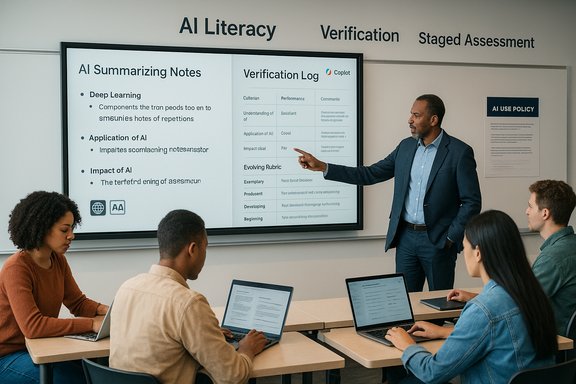
- Declare and document: include an explicit AI-use policy clause on every syllabus that specifies permitted tools, required disclosures, and whether AI-assisted work must be annotated or accompanied by a verification log.
- Redesign assessment: favor staged, process-based evidence (draft logs, annotated AI outputs, oral defenses) over single-shot, high-stakes take-home products.
- Teach AI literacy: embed short modules on prompt design, hallucination detection, bias awareness and verification workflows into existing courses or orientation sessions.
- Choose vetted tools: prefer campus-provisioned, enterprise-tenanted tools that carry non-training assurances and clear retention policies.
- Protect equity: ensure AI-enabled supports (translation, captioning, alternate formats) are available equitably and accompanied by scaffolds that build domain knowledge and language proficiency.
- Invest in faculty time: provide protected redesign time, peer coaching, and short applied PD with follow-up coaching to translate knowledge into classroom practice.
Conclusion
The advance of generative AI into the lecture hall and the lab is not a single event but a multi-year transformation in pedagogy, procurement, and professional practice. UW–Madison’s approach — provisioning enterprise tools such as Microsoft Copilot, experimenting with course‑grounded NotebookLM instances, and publishing practical guidance for instructors — illustrates the managed-adoption model many universities now prefer. Faculty accounts from classrooms show clear student benefits in accessibility and practice, but they also underline persistent risks: hallucinations, cognitive shortcutting, and inequitable access.The decisive question for higher education is not whether AI will arrive — it already has — but whether institutions will use this moment to teach how to use AI well. That means redesigning assessments to reward verification, investing in faculty development, and treating AI literacy as integral to the curriculum. When those pieces come together, universities can claim more than accommodation; they can claim leadership in shaping a new era of learning where AI amplifies human judgment rather than replacing it.
Source: The Daily Cardinal ‘A new era of learning’: Professors grapple with AI in the classroom
