

Veseris’ move from spreadsheets and green‑screen ERP to a modern Dynamics 365 backbone transformed a fragmented distribution business into a more accurate, auditable, and scalable operation—cutting manual work, halving shipment frequency on key transfer orders, and putting inventory, pricing, and tax controls squarely inside a single system that can grow with the company.
Veseris is a specialty distributor that serves pest control, turf, and vegetation professionals across North America and the Caribbean. The business operates dozens of physical locations—distribution hubs, hybrid centers, and retail “ProCenters”—and sells controlled, often hazardous products that require licensed‑professional controls, precise shipping, and carefully managed pricing and rebates. When Veseris became a standalone company after being spun off from Univar Environmental Sciences, it faced an urgent systems challenge: the parent’s legacy green‑screen ERP was being retired, and Veseris had a tight window to select and implement a new enterprise platform while the newly independent business continued to operate. The key operational pain points were mostly manual: finance activity (AR/AP/reporting) ran largely in spreadsheets, multi‑jurisdiction tax compliance was fragile, warehouse inventory counts and transfers were error‑prone, and pricing rules—vendor‑specific rebates and promotions—were managed outside a central ledger. Those constraints capped growth: in a low‑margin distribution market, increasing price wasn’t a viable strategy; only volume and operational efficiency could improve margins. Independent reporting and partner materials confirm the fast timeline and the urgency Veseris faced when separating from Univar, with implementation work described as an aggressive, high‑stakes migration off legacy systems to cloud ERP and related Microsoft services.
Veseris’ implementation demonstrates that a well‑executed transition to Dynamics 365 (Finance + Supply Chain), supplemented by analytics and ISV integrations, can transform a distribution business that once depended on spreadsheets and legacy green‑screen systems into a data‑driven, auditable, and more profitable operation. The real work—sustained data governance, operational discipline, and rigorous AI controls—begins after go‑live, and the company’s next phase (demand planning and Copilot pilots) will be an important test of how automation and analytics scale responsibly in a regulated distribution business.
Source: Microsoft Veseris delivers essential pest management products accurately and efficiently with Dynamics 365 | Microsoft Customer Stories
 Background
Veseris is a specialty distributor that serves pest control, turf, and vegetation professionals across North America and the Caribbean. The business operates dozens of physical locations—distribution hubs, hybrid centers, and retail “ProCenters”—and sells controlled, often hazardous products that require licensed‑professional controls, precise shipping, and carefully managed pricing and rebates. When Veseris became a standalone company after being spun off from Univar Environmental Sciences, it faced an urgent systems challenge: the parent’s legacy green‑screen ERP was being retired, and Veseris had a tight window to select and implement a new enterprise platform while the newly independent business continued to operate. The key operational pain points were mostly manual: finance activity (AR/AP/reporting) ran largely in spreadsheets, multi‑jurisdiction tax compliance was fragile, warehouse inventory counts and transfers were error‑prone, and pricing rules—vendor‑specific rebates and promotions—were managed outside a central ledger. Those constraints capped growth: in a low‑margin distribution market, increasing price wasn’t a viable strategy; only volume and operational efficiency could improve margins. Independent reporting and partner materials confirm the fast timeline and the urgency Veseris faced when separating from Univar, with implementation work described as an aggressive, high‑stakes migration off legacy systems to cloud ERP and related Microsoft services. Overview of the solution implemented
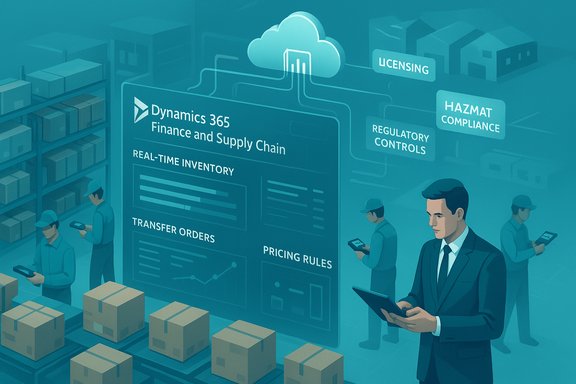
Veseris implemented a Microsoft stack centered on:- Dynamics 365 Finance (ERP core for financials)
- Dynamics 365 Supply Chain Management (warehouse and inventory)
- Power BI and Microsoft Fabric (reporting, historical data migration, and analytics)
- ISV integrations for pricing, transportation, and reporting (Flintfox, RateLinx/ShipLinx, deFacto)
- Mobile warehouse execution using handheld barcode scanners and the Dynamics 365 Warehouse Management mobile app
Key measurable outcomes reported by Veseris
- Elimination of many manual finance tasks and consolidated AR/AP/reporting inside Dynamics 365, reducing reliance on spreadsheets.
- Better tax compliance handling for multi‑state and multi‑country operations by bringing tax processes into the ERP.
- A reported 50% reduction in shipment frequency for consolidated transfer orders (reducing transport costs via better consolidation and automation).
- Real‑time warehouse visibility across 8,000+ SKUs and nearly 70 locations, with handheld scanners driving cycle counts and wave/label workflows to increase accuracy and throughput.
Why Dynamics 365 was the fit for Veseris
Veseris needed a cloud‑native platform able to:- Manage multi‑site inventory and inter‑warehouse transfers with detailed traceability and automated cycle counts.
- Store and control complex pricing rules, rebates, and vendor accruals at scale.
- Provide financial consolidation, regional tax handling, and auditable, real‑time reporting.
- Integrate with best‑of‑breed ISVs for transportation and pricing, and with Microsoft analytics tools for historical data cleanup and demand planning.
Technical architecture and integrations (practical detail)
Veseris’ implemented architecture is not a “pure” Dynamics out‑of‑the‑box story; it’s an integrated platform. Important technical elements included:- Dynamics 365 as the system of record for finance, inventory, and order management.
- Warehouse Management mobile app + handheld barcode scanners for real‑time transactional capture and automated cycle counts.
- Flintfox (pricing and promotions) to handle complex nationwide pricing, accruals and rebate calculations that would be error‑prone and unwieldy in spreadsheets.
- RateLinx / ShipLinx for transportation automation to measure and factor true cost‑to‑serve per order and to feed consolidated transfer shipping logic.
- deFacto (financial reporting) and Power BI backed by Microsoft Fabric for three years of transformed historical data and analytics/visualization.
- R&D pilots for Copilot and AI agents (an exploratory step toward exception management and inventory optimization).
What worked well — strengths and notable wins
- Cleaner master data, fewer exceptions. Bringing pricing, inventory, customer hierarchy, and licensing into one system reduced manual reconciliations and the friction of multiple spreadsheets. Consolidated AR/AP/reporting produced more trustworthy financial statements.
- Warehouse morale and throughput improved. Workers moved from paper‑driven pick/pack to handheld scanning and wave labels, which simplified daily operations, reduced mis‑picks, and increased shipping volume. Veseris’ business architects describe the warehouse teams as “happier” because work became more system‑driven and predictable.
- Realized transport savings through consolidation. By automating and consolidating transfer orders, Veseris reported a 50% reduction in shipment frequency for these internal moves—cutting freight cost and improving margins on low‑margin product flows. This sort of consolidation is an expected, measurable outcome of improved inventory visibility and planning.
- Regulatory and tax control. Moving licensing checks, hazardous‑goods handling, and multi‑jurisdiction tax logic into Dynamics 365 gave Veseris a stronger compliance posture and faster training/verification processes for customers.
- Analytics-ready data. Migrating three years of history into Microsoft Fabric and surfacing it in Power BI enabled demand planning pilots and performance dashboards—foundation work for predictive replenishment and improved service levels.
Risks, open questions, and what to watch for
While Veseris’ reported outcomes are strong, several operational and governance risks deserve attention:- Partner and delivery lineage needs clarification. Microsoft’s customer narrative lists Sikich as the partnering implementation firm; other vendor and partner accounts (published earlier in the separation timeline) identify integrators such as Velosio as involved in migration work. This discrepancy could reflect phased engagements, parallel vendor support, or simply differences in public reporting. Procurement teams should insist on a clear RACI (who‑did‑what) for migrations to ensure long‑term supportability, knowledge transfer, and SLA coverage. Treat such partner claims as part of the implementation project documentation until verified by contracts and post‑go‑live support plans.
- Data quality and master‑data debt. ERP automation magnifies the impact of poor master data. If SKU definitions, GL mappings, vendor master or customer hierarchies remain inconsistent, automation can create new failure modes (e.g., incorrect pricing, misallocated freight). Veseris’ success required cleaning critical master data and preserving manual controls until exceptions trended down. Any organization replicating this work must budget for data remediation and holdbacks during the pilot phase.
- Complex pricing and rebate accuracy. Flintfox or equivalent pricing engines are powerful, but they require rigorous reconciliation of vendor rebate terms and accrual logic. Mis‑applied rules can cause margin leakage or partner disputes. Finance should own detailed test matrices and monthly reconciliation processes for the first 6–12 months post‑go‑live.
- License and hazardous‑goods compliance is high stakes. Because Veseris sells regulated chemicals, operational errors can create legal exposure. Controls that gate sales to licensed professionals, record training, and ensure appropriate shipping modes must be audited regularly; embedding these checks into ERP flows reduces risk but increases the need for rigorous testing and documented workflows.
- AI & Copilot pilots carry governance and cost risk. Veseris is piloting Microsoft Copilot and AI agents for inventory exception management—promising, but also demanding strict governance: logging, human‑in‑the‑loop approvals, and model‑use policies. Enterprises must avoid delegating high‑risk write‑backs (payments, tax filings) to agents without multi‑party approvals. Consumption‑based Copilot costs also require forecasting and controls. These governance concerns echo broader enterprise guidance for Copilot adoption.
- Ongoing license and vendor lock‑in considerations. Heavy reliance on Microsoft’s Dynamics/Power/Fabric ecosystem, combined with specialized ISVs, creates a tightly coupled stack that is powerful but can increase lock‑in. Organizations should negotiate exit clauses, data export paths and object‑level extracts in supplier contracts.
Practical lessons for distribution CIOs and finance leaders
- Start with a readiness audit: inventory master data, GL mapping quality, vendor and customer records, and hazardous‑goods labeling. A short remediation sprint will pay dividends in automation accuracy.
- Pilot in a contained geography or a single product family. Measure transfer‑order reductions, pick/pack error rates, and AR/AP cycle times before scaling.
- Protect auditability: ensure all agentic or automated write‑backs (e.g., AP postings, rebate accruals) have audit trails and multi‑party approvals during initial rollout.
- Define partner responsibilities explicitly. For multi‑phase programs, document who owns go‑live, data migration, post‑go‑live support and knowledge transfer.
- Account for Copilot/agent costs: estimate message/per‑interaction usage and negotiate capacity packs or fixed consumption thresholds during pilots.
- Embed compliance tests for regulated products into acceptance criteria; pass/fail should be objective and testable.
Roadmap and what’s next for Veseris
According to Veseris’ public statements, the company is moving beyond stabilization toward demand planning, deeper analytics, and piloting Microsoft Copilot for intelligent exception handling and inventory optimization. These steps are the natural next phase after establishing transactional integrity and reliable master data. If executed with strong governance, they can improve fill rates, shorten lead times, and reduce working capital via smarter replenishment. From a program perspective, typical next milestones will include:- Demand‑planning pilots across high‑volume SKUs using Fabric data and Power BI insights.
- Expanded automation within supply chain orchestration (automated replenishment, smarter wave planning).
- Maturation of finance automation (faster reconciliations, close‑cycle reduction).
- Copilot‑enabled agent pilots focused on low‑risk tasks (reconciliation summaries, exception detection) before any write‑back to ledgers.
How to evaluate a similar ERP modernization (a concise checklist)
- Business case clarity: demonstrate how cost savings (freight consolidation, labor reduction) and revenue enablement (faster order fulfilment) offset project cost.
- Master data health: quantify the percent of SKUs, vendors and customers that meet data‑quality thresholds before go‑live.
- Pilot KPIs: pick 3–5 measurable outcomes (AR days outstanding, pick‑error rate, cycle‑count variance, transfer‑order freight per unit) and baseline them.
- Governance plan: include AI/Copilot guardrails, approval thresholds, role‑based access and audit logging.
- Partner SLA: require 12–24 month support commitments, documented runbooks, and knowledge transfer milestones.
Final analysis — strengths, realism, and cautions
Veseris’ story is a textbook case of modern ERP modernization for distribution firms: aggressive timeline, focused scope (finance, warehouse, pricing, shipping), and a pragmatic mix of Dynamics 365 core modules plus best‑of‑breed ISVs. The strengths are real and measurable—warehouse morale and accuracy gains, consolidated finance processes, clearer pricing and margin visibility, and demonstrable transport savings. These are capabilities that any distribution CIO should value. At the same time, vendors and CIOs should avoid two common mistakes: (1) underestimating the cost and time for master‑data remediation, and (2) over‑automating high‑risk financial or compliance actions without human oversight and strict audit trails. The Copilot and AI direction is promising, but organizations must pair pilots with governance, conservative thresholds for write‑backs, and carefully scoped ROI measurements before wide rollout. These guardrails reflect both Veseris’ cautious R&D posture around Copilot and broader enterprise guidance on AI in ERP environments.Veseris’ implementation demonstrates that a well‑executed transition to Dynamics 365 (Finance + Supply Chain), supplemented by analytics and ISV integrations, can transform a distribution business that once depended on spreadsheets and legacy green‑screen systems into a data‑driven, auditable, and more profitable operation. The real work—sustained data governance, operational discipline, and rigorous AI controls—begins after go‑live, and the company’s next phase (demand planning and Copilot pilots) will be an important test of how automation and analytics scale responsibly in a regulated distribution business.
Source: Microsoft Veseris delivers essential pest management products accurately and efficiently with Dynamics 365 | Microsoft Customer Stories
