

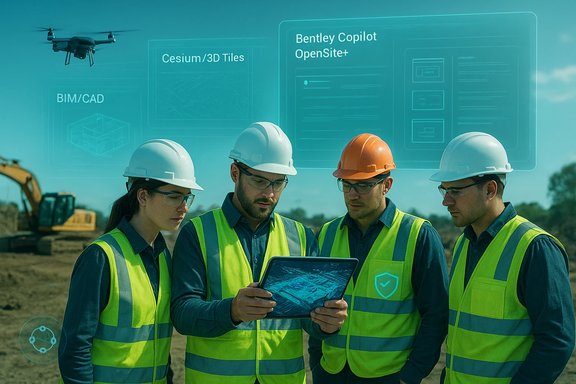
VHB and Bentley Systems have moved from cooperation to operational integration with a suite of AI-enabled tools that promise to close a practical “digital divide” between office engineering models and on‑site execution—delivering copilots, generative site design, and connected digital‑twin workflows that accelerate routine tasks while raising urgent questions about data quality, governance, and cyber resilience.
Background
VHB (Vanasse Hangen Brustlin), a major U.S. engineering and design firm, has been an early adopter and co‑developer of Bentley’s infrastructure AI initiatives—participating as a beta tester for Bentley’s OpenSite+ and publishing its own internal Copilot for Bentley tool that integrates with Bentley’s ecosystem. These moves position VHB as both a practitioner and a co‑innovator in the industry’s push to embed AI into everyday civil engineering workflows. Bentley Systems has steadily built an infrastructure AI platform stack—acquiring the leading 3D geospatial runtime Cesium in September 2024, advancing the iTwin digital twin platform, and packaging domain‑aware AI services such as Bentley Copilot and OpenSite+. Bentley frames these as engineering‑centric AI tools designed to preserve fidelity and traceability while automating repetitive tasks. Taken together, the VHB–Bentley activity is part of a broader industry pivot: integrate high‑fidelity engineering models (BIM/CAD), reality capture (drone & LiDAR), geospatial streaming (Cesium/3D Tiles), and AI‑powered assistants to shorten design cycles, reduce rework, and make on‑site decisions more data‑driven.Overview: What’s New and Why It Matters
The practical components
- OpenSite+ (Bentley): A generative AI‑assisted civil site design application that automates repeated site layout tasks and speeds iteration, now moving from limited availability to broader use in production workflows.
- Bentley Copilot and VHB’s Copilot for Bentley: Context‑aware assistants that surface documentation, run domain queries, and can assist with model manipulation or documentation retrieval inside collaboration apps such as Microsoft Teams. VHB has both used Bentley’s tools and contributed a custom Copilot variant for internal and partner use.
- iTwin + Cesium stack: Engineering‑grade digital‑twin alignment (iTwin) combined with Cesium’s high‑performance 3D streaming for large geospatial datasets—enabling synchronized office models and reality data at scale. The Cesium acquisition accelerated this capability.
How VHB and Bentley Are Integrating AI
From office models to field actions
VHB’s approach exemplifies the “digital coworker” model: AI is embedded as an assistant that reduces workflow latency and accelerates knowledge transfer across experience levels. VHB’s public posts describe a Copilot that answers technical queries, surfaces relevant Bentley documentation, and helps users troubleshoot common modeling tasks from within collaboration tools. This lowers the barrier for junior staff and frees senior engineers for higher‑value decisions. Technically, the integration stack works in three layers:- Data ingestion and reality capture: Drone photogrammetry, LiDAR point clouds, photos, and IoT telemetry are ingested and prepared for model alignment.
- Engineering alignment and analytics (iTwin): Engineering models (MicroStation, Revit, Civil 3D exports) are aligned with reality data and time‑series telemetry to create an auditable digital twin.
- AI‑powered workflows and copilots: Generative design, automated takeoffs, anomaly detection, and role‑based assistants operate on the aligned dataset, returning actionable outputs (design proposals, flagged clashes, progress forecasts) to office and field teams.
Verified Technical Claims and Dates
It’s critical for procurement teams and IT leads to have clear, verifiable baselines. The key public claims and verifications are:- Cesium acquisition by Bentley: Announced September 6, 2024; this acquisition folded Cesium’s 3D Tiles streaming and CesiumJS runtimes into Bentley’s iTwin roadmap. The merger is well‑documented in company releases and Cesium’s own announcement.
- OpenSite+ limited availability and Infrastructure AI initiative: Bentley publicly showcased OpenSite+ and broader Infrastructure AI ambitions during its Year in Infrastructure event and in press material, positioning the app as a generative AI tool for civil site design that can deliver large productivity gains when workflows and provenance are managed. Dates and product positioning are part of Bentley’s October 2025 communications.
- VHB’s beta and Copilot activity: VHB published a beta‑test announcement for OpenSite+ (April 18, 2025) and described its Copilot for Bentley tool in March 2025, confirming VHB’s early involvement in testing and operationalizing Bentley’s AI offerings.
Strengths: What This Integration Does Well
- Bridges model‑to‑field friction: Aligning iTwin with Cesium’s streaming and VHB’s Copilot reduces manual translation steps between design intent and construction execution, speeding decisions and enabling near‑real‑time reconciliation.
- Role‑specific productivity gains: Copilots and generative functions remove repetitive, time‑consuming tasks—quantity takeoffs, basic grading scenarios, and documentation retrieval—allowing engineers to focus on validation and exception handling. VHB’s internal reports emphasize these workflow speedups.
- Open standards orientation: The combined stack leans on open artifacts—3D Tiles, iTwin open APIs, and exportable model formats—reducing long‑term lock‑in risks compared with closed, proprietary silos. This openness is a strategic strength for interoperability across owners and contractors.
- Co‑innovation model: Early adopter firms like VHB gain influence on product evolution by contributing real workflows and use cases, which helps vendors build features that address actual office/field pain points rather than hypothetical scenarios.
Risks, Unknowns, and What to Watch
While practical benefits are compelling, several important risks and caveats must be managed deliberately.1) Data fidelity and provenance
A digital twin is only as reliable as its inputs. Poorly calibrated drone surveys, intermittent telemetry, or misaligned CAD/BIM imports will produce misleading analytics and AI recommendations. Projects must embed data‑quality gates, naming conventions, and survey cadences into the contract and technical plan. Otherwise, the so‑called productivity gains will be offset by rework and distrust of automated outputs.2) Governance, liability, and human sign‑off
When AI suggests design changes or schedule optimizations, procurement and contracting teams must define who holds legal responsibility. Engineering teams should retain explicit sign‑off authority for any safety‑critical or regulated design change. Procurement documents must require auditable provenance, confidence metrics, and sign‑off workflows for AI‑driven outputs.3) Cybersecurity and operational resilience
A consolidated twin that contains design intent, operational telemetry, and possible write‑back paths is an attractive target for attackers. Defense‑in‑depth, strict identity & access management, network segmentation between OT/IT domains, tamper detection for sensors, and robust incident response plans are essential. Treat twin platforms like critical infrastructure systems, not optional collaboration tools.4) Vendor lock and portability
Deep integration into a single platform—while convenient—creates migration friction. Contracts should insist on exportable data formats, documented APIs, and exit terms to avoid long‑term dependence that inflates lifecycle costs. Openness in the stack mitigates but does not eliminate migration risk.5) Overpromising and human factors
Technology alone does not guarantee better outcomes. Gains require process redesign, training, and cultural adoption. Failure to invest in these areas risks producing attractive visualizations with little operational impact. Early pilots should tie results to meaningful KPIs (e.g., survey time reduced, volume accuracy, schedule variance improvements).Unverifiable claims flagged
Some industry statements—particularly claims about installed base size or immediate ROI across heterogeneous projects—require independent verification. For example, reported deployment counts for certain Smart Construction programs warrant customer- or auditor-verified case studies before being accepted at face value. Practitioners should demand documented metrics from vendors and perform reference checks.Commercial and Market Implications
For owners and contractors
- Potential upside: Early adopters who pair clear KPIs and data governance with pilot projects can reduce rework, shorten handovers, and realize carbon savings through optimized earthworks. The commercial wins are most visible where cut/fill and progress measurement are high‑value activities.
- Investment reality: Realizing digital twin value requires budget for survey cadence, integration of legacy project controls, cybersecurity measures, and staff training. Owners should require vendors to demonstrate exportability and provenance as part of procurement.
For vendors and integrators
- Platform consolidation continues: Large platform vendors (Bentley, Hexagon, etc. are bundling geospatial, AI, and engineering workflows, which increases expectations on specialized vendors to either integrate with the platforms or offer clear niche value that complements them.
- Opportunity for ISVs and SIs: System integrators and ISVs that help translate legacy datasets into twin‑ready formats, implement secure edge/cloud architectures, and craft role‑specific copilots will find demand as firms scale beyond pilots.
Practical Recommendations: How to Run a Responsible Pilot
- Pick a measurable scope. Choose a single earthwork zone, a bridge rehabilitation, or an airport ramp where quantities and progress can be validated objectively.
- Define KPIs up front. Examples: percent reduction in survey time; accuracy delta in volume calculations; hours saved on quantity takeoffs; CO2 saved from optimized haul routes.
- Invest in data hygiene. Enforce naming conventions, survey cadence, sensor calibration, canonical ingestion pipelines, and metadata standards.
- Require exportability and provenance. Contracts should mandate open export formats, API documentation, and immutable provenance logs for AI outputs.
- Design governance & sign‑off. AI outputs must carry confidence scores and be routed through human sign‑off for any safety‑critical actions.
- Budget for cybersecurity. Include segmentation, identity, logging, and incident response in the project budget from day one.
- Start with co‑innovation. If possible, partner with your vendor for a co‑innovation pilot to shape features and gather measurable outcomes—VHB’s experience shows the value of being a co‑developer rather than a passive consumer.
A Closer Look: VHB’s Copilot and the End‑User Experience
VHB’s internal communications and public posts describe a “digital coworker” approach: copilots embedded in chat and collaboration environments reduce time spent searching documentation and troubleshooting common modeling problems. For firms adopting similar models, the immediate benefits are:- Faster onboarding: New hires get contextually relevant answers faster, reducing ramp time.
- Standardized practice: Copilots help enforce firm conventions and CAD/BIM standards by surfacing correct templates and examples.
- Productivity uplift: Routine tasks—publishing sheets, generating basic schedules, or producing standard notes—can be automated, freeing experienced engineers for exceptions and design decisions.
The Regulatory and Procurement Angle
Public owners and procurement teams must update bid documents and procurement templates to reflect the realities of twin‑driven projects. Recommended procurement clauses include:- Data portability and export clauses to avoid proprietary lock‑in.
- Provenance and audit trail requirements for AI and automated decisions.
- Security baseline and compliance checks for any SaaS or hybrid solution that will host design & operational data.
- Performance and measurement milestones tied to KPIs established in the pilot.
Conclusion
The VHB–Bentley story is not a single product release; it’s an early example of how engineering firms and platform vendors can co‑design AI capabilities to make infrastructure delivery faster and more data‑driven. The combination of OpenSite+, Bentley Copilot, iTwin, and Cesium creates a credible path from office models to field execution—one that promises real productivity gains when paired with rigorous data governance, cybersecurity, and contractual clarity. That potential comes with clear responsibilities. Firms must treat digital twins as operational systems: invest in data quality, insist on provenance and exportability, codify governance and sign‑off for AI outputs, and budget for cybersecurity and training. When those practices are in place, VHB’s experience demonstrates how a “digital coworker” can elevate an engineering workforce—turning thousands of hours of repetitive work into automated, auditable tasks while preserving human judgment for critical design decisions. The industry’s next phase will be judged not on aspirational demos but on verified pilots that publish KPIs, audited deployment counts, and reproducible case studies. Early adopters who demand those metrics and hold vendors to interoperable, auditable standards will realize the operational and sustainability benefits that AI promises—without surrendering control or opening new systemic risks.Source: Construction & Property News https://construction-property.com/v...-the-digital-divide-with-new-ai-integration/]
