

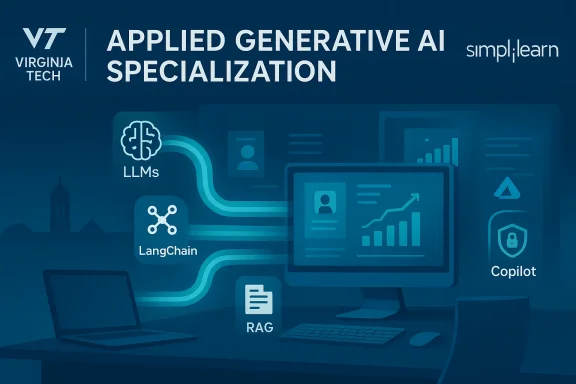
Generative AI training has moved from a niche upskilling topic to a mainstream workforce priority, and Virginia Tech’s new partnership with Simplilearn is a clear sign that universities and private education providers are trying to meet that demand together. The Applied Generative AI Specialization is designed to blend academic credibility with hands-on, job-ready training, focusing on AI literacy, LLMs, agentic frameworks, MCP, governance, and real-world applications. In a market where employers increasingly want people who can build, evaluate, and govern AI systems rather than simply talk about them, this kind of program lands squarely in the middle of the skills conversation.
The new specialization arrives at a moment when the AI education market is becoming more competitive, more crowded, and more strategically important. Simplilearn’s program page says the course is built to help learners “build production ready GenAI and Agentic AI apps,” with a 16-week live online format, 7+ projects, and a capstone that culminates in a portfolio-ready deliverable. The page also lists a cohort starting in May 2026 and highlights exposure to tools such as Copilot, LangChain, Hugging Face, Azure AI Studio, OpenAI, and other widely used enterprise platforms. (simplilearn.com)
What makes this announcement notable is not just the subject matter, but the packaging. Virginia Tech Continuing and Professional Education is lending its brand to a program that sits at the intersection of technical training, workforce development, and professional credentialing. That matters because buyers of AI education are increasingly looking for signals of rigor, not just tutorials and tool demos. Virginia Tech’s continuing education arm also positions itself as a partner for programs that “transform individuals, organizations and communities through innovative learning experiences,” which helps explain why the university is willing to attach its name to a practical, career-oriented specialization.
The timing also reflects how rapidly Virginia Tech itself has been formalizing its approach to generative AI. The university has published guidance warning users not to share sensitive or high-risk data with public AI tools, and its TLOS resources note that Microsoft Copilot is currently the only generative AI tool broadly approved for faculty, staff, and students. In other words, Virginia Tech is not treating generative AI as a novelty; it is treating it as a governed capability that needs policy, training, and operational guardrails. That broader institutional stance gives the Simplilearn partnership more context than a simple co-branded certificate would have on its own.
There is also a competitive backdrop. Simplilearn has been active in the AI education space, and Virginia Tech has already been partnering on professional programs that incorporate generative AI elements, including a project management certificate that integrates GenAI content. This new specialization suggests a deeper push into a fast-growing category where universities can add trust and brand equity, while commercial training firms contribute scale, course production, and rapid curriculum iteration.
The partnership is also a reminder that higher education and private upskilling firms are converging on the same audience. Mid-career learners want flexible, outcomes-oriented programs with recognizable credentials, while universities want to stay relevant in an education market increasingly shaped by short-form, stackable learning. A joint badge from Virginia Tech and Simplilearn tries to satisfy both sides: the university gets visibility in a high-demand category, and the vendor gets institutional legitimacy. That is a very intentional positioning play. (simplilearn.com)
The market opportunity is substantial because AI hiring is still struggling with an execution gap. Many organizations want people who understand prompts, models, orchestration, and governance, but they do not have enough internal experts to train those workers. Programs like this are designed to act as a bridge. They are not trying to turn everyone into a research scientist; they are trying to convert practitioners into implementers.
That sequencing is important. Many AI learners get lost because they are dropped straight into tools without first understanding why different architectures exist. A curriculum that begins with foundational concepts and then introduces agentic frameworks, orchestration, and governance is more likely to produce graduates who can make tradeoffs. That is especially useful in enterprise settings, where latency, data governance, model selection, and cost control often matter more than flashy output.
The inclusion of both technical and governance modules is particularly wise. AI governance is no longer a compliance afterthought; it is becoming part of the design process. Learners who understand risk management, transparency, fairness, and regulatory constraints will be more useful to employers than learners who can only call APIs.
This matters because enterprise adoption is increasingly about workflow integration. An AI assistant that answers questions is useful, but an AI system that can retrieve context, trigger workflows, enforce rules, and hand off tasks is much more valuable. That is the promise of agentic frameworks, but it is also where complexity rises sharply. As a result, a course that teaches orchestration and integration protocols is probably better aligned with real enterprise demand than one centered only on prompt engineering. That distinction is becoming critical. (simplilearn.com)
By including MCP, the specialization is telling learners that the future of AI development is not isolated model calls. It is systems engineering, tool orchestration, retrieval, and controlled data access. That will be valuable for developers and consultants, but it should also resonate with product managers and technical leaders who need to understand where AI fits inside operational systems.
The optional Microsoft Azure AI Fundamentals and Copilot Foundations modules are a clue to this enterprise focus. These are not just random electives; they tie the program to tools many companies are already using or evaluating. The fact that the learning path also references Microsoft Learn content suggests a deliberate effort to anchor parts of the curriculum in official cloud and AI tooling ecosystems. (simplilearn.com)
The challenge is that many learners now expect AI training to be immediately useful. They want prompt libraries, deployment patterns, governance checklists, and portfolio-ready projects. A course like this can satisfy that demand only if the capstone and the applied assignments are tightly aligned with real business scenarios. That is where many AI programs succeed or fail.
The university’s broader AI activity also shows why continuing education is such a logical channel. Virginia Tech has run AI-related workshops, published notices on AI literacy for educators, and backed research and infrastructure efforts around generative AI. The professional education space lets the university translate that institutional experience into a revenue-generating and reputation-enhancing program for working adults.
The academic masterclass component likely serves that purpose as well. Even in a practical, vendor-led course, the presence of university instructors signals that the program is trying to preserve some scholarly depth. That matters because AI governance, ethics, and architecture are areas where context and nuance are essential.
The company’s page also reinforces the commercial logic. It emphasizes career services, 24/7 LMS access, flexible learning, and exposure to in-demand tools. Those features are meant to lower friction for adult learners who are balancing work, family, and training. In practical terms, this is the anatomy of a modern education product: credential, convenience, and career signaling all wrapped together. (simplilearn.com)
The financing options and installment plan are also important. They broaden the pool of potential students and make the product feel less exclusionary, which helps in a market where AI education is often perceived as expensive or elite. The result is a package that can serve both individual learners and corporate buyers.
The market is also being shaped by employer anxiety. Companies know they need AI fluency across departments, but they are still unsure which employees need deep technical training and which need literacy-level exposure. That uncertainty creates room for hybrid programs that teach both tool use and governance. The more clearly a course can map itself to job functions, the more likely it is to stand out.
This is where traditional higher education and private bootcamps can complement each other. Universities contribute theory, ethics, and brand trust. Training companies contribute pacing, production, and market responsiveness. The result can be powerful if both sides stay disciplined about quality.
Another concern is the classic challenge of applied AI education: too much tooling, not enough judgment. If students leave with surface familiarity but weak conceptual grounding, the program could produce confident beginners rather than effective practitioners. That is especially risky in a field where governance, privacy, and security failures can have real consequences.
The broader market will be watching how quickly the curriculum evolves. AI training now lives or dies on freshness, applicability, and employer trust. A program that can keep pace with model shifts, governance changes, and new deployment patterns will have a real advantage over static offerings.
Source: The AI Journal Simplilearn Partners With Virginia Tech to Launch Applied Generative AI Specialization | The AI Journal
 Overview
The new specialization arrives at a moment when the AI education market is becoming more competitive, more crowded, and more strategically important. Simplilearn’s program page says the course is built to help learners “build production ready GenAI and Agentic AI apps,” with a 16-week live online format, 7+ projects, and a capstone that culminates in a portfolio-ready deliverable. The page also lists a cohort starting in May 2026 and highlights exposure to tools such as Copilot, LangChain, Hugging Face, Azure AI Studio, OpenAI, and other widely used enterprise platforms. (simplilearn.com)What makes this announcement notable is not just the subject matter, but the packaging. Virginia Tech Continuing and Professional Education is lending its brand to a program that sits at the intersection of technical training, workforce development, and professional credentialing. That matters because buyers of AI education are increasingly looking for signals of rigor, not just tutorials and tool demos. Virginia Tech’s continuing education arm also positions itself as a partner for programs that “transform individuals, organizations and communities through innovative learning experiences,” which helps explain why the university is willing to attach its name to a practical, career-oriented specialization.
The timing also reflects how rapidly Virginia Tech itself has been formalizing its approach to generative AI. The university has published guidance warning users not to share sensitive or high-risk data with public AI tools, and its TLOS resources note that Microsoft Copilot is currently the only generative AI tool broadly approved for faculty, staff, and students. In other words, Virginia Tech is not treating generative AI as a novelty; it is treating it as a governed capability that needs policy, training, and operational guardrails. That broader institutional stance gives the Simplilearn partnership more context than a simple co-branded certificate would have on its own.
There is also a competitive backdrop. Simplilearn has been active in the AI education space, and Virginia Tech has already been partnering on professional programs that incorporate generative AI elements, including a project management certificate that integrates GenAI content. This new specialization suggests a deeper push into a fast-growing category where universities can add trust and brand equity, while commercial training firms contribute scale, course production, and rapid curriculum iteration.
Why This Partnership Matters
At a strategic level, the program signals that applied AI education is becoming a premium product. The industry no longer rewards only broad AI literacy. Employers are looking for professionals who can connect models to workflows, build retrieval-augmented systems, tune prompts, measure performance, and decide when a model should not be used at all. The specialization’s focus on agentic AI, governance, and implementation is therefore more market-aligned than generic “intro to AI” content. (simplilearn.com)The partnership is also a reminder that higher education and private upskilling firms are converging on the same audience. Mid-career learners want flexible, outcomes-oriented programs with recognizable credentials, while universities want to stay relevant in an education market increasingly shaped by short-form, stackable learning. A joint badge from Virginia Tech and Simplilearn tries to satisfy both sides: the university gets visibility in a high-demand category, and the vendor gets institutional legitimacy. That is a very intentional positioning play. (simplilearn.com)
The brand signaling is the point
In the professional education market, the name on the certificate matters almost as much as the syllabus. Virginia Tech brings academic credibility and public research association, while Simplilearn brings an existing commercial training engine and a large global learner base. The combination is likely meant to reassure employers that the training is neither purely academic nor merely vendor marketing.The market opportunity is substantial because AI hiring is still struggling with an execution gap. Many organizations want people who understand prompts, models, orchestration, and governance, but they do not have enough internal experts to train those workers. Programs like this are designed to act as a bridge. They are not trying to turn everyone into a research scientist; they are trying to convert practitioners into implementers.
- The value proposition is job relevance, not theory alone.
- The branding mix is designed to reduce buyer skepticism.
- The curriculum targets the “last mile” of AI adoption.
- The certificate is meant to function as a trust signal in hiring.
- The live-online format supports working professionals.
Curriculum Design and Pedagogical Approach
The curriculum leans hard into practical AI implementation. According to the program page, learners start with AI literacy and optional Python foundations, then move into generative models, LLM application development, agentic AI frameworks, image generation, and governance. The course structure includes modules on LangChain, RAG, benchmarking, fine-tuning, and the Model Context Protocol—all of which are timely topics for teams trying to build production systems rather than isolated demos. (simplilearn.com)That sequencing is important. Many AI learners get lost because they are dropped straight into tools without first understanding why different architectures exist. A curriculum that begins with foundational concepts and then introduces agentic frameworks, orchestration, and governance is more likely to produce graduates who can make tradeoffs. That is especially useful in enterprise settings, where latency, data governance, model selection, and cost control often matter more than flashy output.
The structure aims to move beyond experimentation
The course is built around live instruction, self-directed modules, and multiple projects, which means it is trying to combine academic pacing with professional flexibility. The page states that the program includes 50+ hours of live classes, 16+ hours of self-learning, and 7+ industry-focused projects, plus a capstone. Those numbers matter because they suggest the specialization is not a casual survey course; it is a structured training path with enough contact time to move beyond surface familiarity. (simplilearn.com)The inclusion of both technical and governance modules is particularly wise. AI governance is no longer a compliance afterthought; it is becoming part of the design process. Learners who understand risk management, transparency, fairness, and regulatory constraints will be more useful to employers than learners who can only call APIs.
- AI literacy gives learners a common vocabulary.
- LLM app development focuses on practical deployment.
- Agentic frameworks introduce orchestration and workflow design.
- MCP reflects the industry’s interest in standardized tool integration.
- Governance ties the whole system to enterprise responsibility.
Agentic AI, MCP, and the New Workflow Mindset
The strongest evidence that this specialization is trying to stay current is its emphasis on agentic AI and MCP. Those are not just buzzwords; they reflect a broader shift from single-turn AI interactions toward systems that can plan, call tools, manage state, and coordinate with other services. Simplilearn’s page specifically lists LangGraph, AutoGen, CrewAI, and MCP as part of the learning path, showing that the curriculum is trying to prepare learners for the emerging architecture stack around agentic applications. (simplilearn.com)This matters because enterprise adoption is increasingly about workflow integration. An AI assistant that answers questions is useful, but an AI system that can retrieve context, trigger workflows, enforce rules, and hand off tasks is much more valuable. That is the promise of agentic frameworks, but it is also where complexity rises sharply. As a result, a course that teaches orchestration and integration protocols is probably better aligned with real enterprise demand than one centered only on prompt engineering. That distinction is becoming critical. (simplilearn.com)
What MCP changes
MCP, or Model Context Protocol, is part of the push toward interoperable agent tooling and context sharing. Microsoft’s documentation for MCP tooling in Azure Cosmos DB describes it as a way for AI agents and agentic applications to interact securely with data through a standardized protocol. That framing highlights why MCP has become a talking point in applied AI education: it is not just about building a smarter chatbot, but about building a system that can connect to governed enterprise resources in a more consistent way.By including MCP, the specialization is telling learners that the future of AI development is not isolated model calls. It is systems engineering, tool orchestration, retrieval, and controlled data access. That will be valuable for developers and consultants, but it should also resonate with product managers and technical leaders who need to understand where AI fits inside operational systems.
- Agentic AI is about planning and action, not just generation.
- MCP suggests a push toward standardized integration.
- Tool orchestration will become a core enterprise skill.
- The curriculum is betting on workflow AI, not just chat interfaces.
- Students will need to think in systems, not prompts alone.
Enterprise Relevance vs. Consumer Appeal
From a consumer standpoint, the specialization is attractive because it promises a recognizable credential, flexible scheduling, and a fast path into an in-demand field. From an enterprise standpoint, the value is different: employers want staff who can prototype responsibly, build internal copilots, and understand governance constraints. The program appears to serve both markets, but its strongest case is for the enterprise learner who needs to apply AI in a business context. (simplilearn.com)The optional Microsoft Azure AI Fundamentals and Copilot Foundations modules are a clue to this enterprise focus. These are not just random electives; they tie the program to tools many companies are already using or evaluating. The fact that the learning path also references Microsoft Learn content suggests a deliberate effort to anchor parts of the curriculum in official cloud and AI tooling ecosystems. (simplilearn.com)
Consumer branding still matters
Even so, the consumer side should not be dismissed. Learners often choose programs based on the credibility of the institution and the promise of career outcomes. Simplilearn’s page says the program can prepare learners for roles such as Generative AI Developer, Agentic AI Specialist, AI Application Engineer, and LLM Engineer. Whether every student lands one of those titles is another matter, but the specificity helps the course feel career-directed rather than abstract. (simplilearn.com)The challenge is that many learners now expect AI training to be immediately useful. They want prompt libraries, deployment patterns, governance checklists, and portfolio-ready projects. A course like this can satisfy that demand only if the capstone and the applied assignments are tightly aligned with real business scenarios. That is where many AI programs succeed or fail.
- Enterprise buyers want risk-aware implementation.
- Consumer learners want career acceleration.
- Tool familiarity helps, but workflow understanding matters more.
- Role titles need to match actual market demand.
- The capstone must prove applied competence.
Virginia Tech’s Strategic Position
Virginia Tech is a fitting partner because it already has an institutional interest in AI literacy, governance, and applied innovation. The university has published guidance on responsible use of generative AI, and its AI Working Group has already produced a Responsible and Ethical AI Framework. That means the university is not entering this partnership blindly; it has a broader governance culture that aligns with the program’s emphasis on responsible deployment.The university’s broader AI activity also shows why continuing education is such a logical channel. Virginia Tech has run AI-related workshops, published notices on AI literacy for educators, and backed research and infrastructure efforts around generative AI. The professional education space lets the university translate that institutional experience into a revenue-generating and reputation-enhancing program for working adults.
A land-grant institution can play a workforce role
Virginia Tech’s land-grant identity gives it a natural mandate to support public-facing education and workforce development. That is not just branding language. It is part of why universities like Virginia Tech can credibly step into short-form professional education without seeming like they are abandoning their academic mission. In fact, the move can be framed as an extension of service.The academic masterclass component likely serves that purpose as well. Even in a practical, vendor-led course, the presence of university instructors signals that the program is trying to preserve some scholarly depth. That matters because AI governance, ethics, and architecture are areas where context and nuance are essential.
- Virginia Tech brings institutional legitimacy.
- Its AI governance work makes the partnership feel coherent.
- Continuing education is a natural vehicle for workforce impact.
- Academic masterclasses add intellectual weight.
- The university can extend its mission without launching a full degree.
Simplilearn’s Business Model and Market Strategy
For Simplilearn, this program is consistent with a broader strategy of attaching its delivery platform to recognizable institutions and employers. The company sells professional upskilling at scale, and partnerships with universities help convert that scale into trust. A university badge can be a powerful differentiator when learners are comparing dozens of AI courses that all promise the same basic outcome.The company’s page also reinforces the commercial logic. It emphasizes career services, 24/7 LMS access, flexible learning, and exposure to in-demand tools. Those features are meant to lower friction for adult learners who are balancing work, family, and training. In practical terms, this is the anatomy of a modern education product: credential, convenience, and career signaling all wrapped together. (simplilearn.com)
The pricing and access model are telling
The listed tuition of $2,995 places the program in the professional certificate tier rather than the mass-market self-study tier. That price point is high enough to imply seriousness, but low enough to stay accessible for many mid-career professionals or employer-sponsored learners. It is a familiar sweet spot in continuing education, especially for technology and management training. (simplilearn.com)The financing options and installment plan are also important. They broaden the pool of potential students and make the product feel less exclusionary, which helps in a market where AI education is often perceived as expensive or elite. The result is a package that can serve both individual learners and corporate buyers.
- The partnership boosts market credibility.
- The pricing supports both individual and employer-funded enrollment.
- Career services increase the perceived return on investment.
- The branded certificate is a selling point in a crowded field.
- Flexible delivery helps Simplilearn scale across geographies.
The Broader AI Education Market
This launch reflects a larger trend: AI education is fragmenting into layered products. There are quick-start courses for casual users, technical bootcamps for practitioners, and specialized professional certificates for people who want something more durable than a webinar but less intensive than a graduate degree. The Virginia Tech-Simplilearn course fits squarely in that middle tier, where many professionals are willing to pay for structure and recognition. (simplilearn.com)The market is also being shaped by employer anxiety. Companies know they need AI fluency across departments, but they are still unsure which employees need deep technical training and which need literacy-level exposure. That uncertainty creates room for hybrid programs that teach both tool use and governance. The more clearly a course can map itself to job functions, the more likely it is to stand out.
The winning programs will be workflow-oriented
The best AI training programs will likely be the ones that connect model capabilities to specific business tasks. That means explaining how to build a chatbot, yes, but also how to evaluate hallucination risk, design a human-in-the-loop process, and integrate AI into existing systems. Simplilearn’s curriculum appears to be trying to do exactly that through projects, capstones, and governance modules. (simplilearn.com)This is where traditional higher education and private bootcamps can complement each other. Universities contribute theory, ethics, and brand trust. Training companies contribute pacing, production, and market responsiveness. The result can be powerful if both sides stay disciplined about quality.
- AI education is becoming tiered and specialized.
- Employers want outcomes, not just exposure.
- Workflow integration is the new competitive edge.
- Governance is increasingly part of the job, not an add-on.
- Hybrid university-industry programs can fill a real market gap.
Strengths and Opportunities
The program’s biggest strength is that it is designed around a real market need rather than a generic technology trend. By centering LLMs, agentic AI, MCP, and governance, it addresses the skills employers are actually asking for as they move from experimentation to deployment. The Virginia Tech brand adds credibility, while Simplilearn provides the operational machinery to deliver the course at scale.- Strong alignment with enterprise AI adoption
- Credible co-branding with Virginia Tech
- Practical emphasis on projects and capstone work
- Coverage of agentic frameworks and MCP
- Governance content that reflects real-world risk management
- Flexible live-online format for working professionals
- Accessible financing compared with degree-level alternatives
Risks and Concerns
The biggest concern is whether the course can maintain depth while covering so many fast-moving topics. Generative AI changes quickly, and a curriculum that looks current today may feel dated if it is not refreshed often. There is also a risk that learners will overestimate the value of the badge if employers care more about demonstrable experience than training certificates.Another concern is the classic challenge of applied AI education: too much tooling, not enough judgment. If students leave with surface familiarity but weak conceptual grounding, the program could produce confident beginners rather than effective practitioners. That is especially risky in a field where governance, privacy, and security failures can have real consequences.
- Fast-changing tooling can make content stale quickly
- Badge value may be uneven across employers
- Broad curriculum may sacrifice depth in some areas
- Students may need more coding background than they expect
- Governance content can be hard to teach well in a short format
- AI hype could outpace actual job placement outcomes
- Enterprise buyers may want stronger proof of measurable competency
Looking Ahead
The next test for this specialization will be whether it produces learners who can actually build and govern AI systems, not just talk about them. If the projects are well designed and the capstone is genuinely portfolio-worthy, the program could become a useful model for university-industry collaboration in professional AI education. If not, it risks becoming another well-branded certificate in a crowded market.The broader market will be watching how quickly the curriculum evolves. AI training now lives or dies on freshness, applicability, and employer trust. A program that can keep pace with model shifts, governance changes, and new deployment patterns will have a real advantage over static offerings.
- Monitor whether future cohorts expand or revise the tool stack
- Watch for employer recognition of the Virginia Tech–Simplilearn badge
- Track whether agentic AI and MCP remain core curriculum themes
- See if the program produces visible alumni outcomes or case studies
- Watch for more university-private partnerships in applied AI training
Source: The AI Journal Simplilearn Partners With Virginia Tech to Launch Applied Generative AI Specialization | The AI Journal
