

Visa and OpenAI announced on June 10, 2026, in San Francisco that Visa payment capabilities will be integrated into ChatGPT and other OpenAI experiences, allowing users to link Visa cards so AI agents can initiate and complete purchases with merchant acceptance and user controls. The deal turns “AI shopping” from a clever recommendation layer into something much closer to delegated commerce. It also forces a harder question for users, banks, merchants, and IT departments: when a chatbot can buy, who is really holding the wallet?
The easy version of this story is that ChatGPT is getting a Visa button. That understates the shift. Visa is not merely appearing as another payment option at the end of a shopping flow; it is trying to become the trusted payment rail for agentic commerce, where software acts on a user’s instruction rather than waiting for every click.
That distinction matters because conventional checkout assumes a human is present at each meaningful step. The user searches, compares, adds to cart, reviews taxes and shipping, authorizes payment, and receives confirmation. In the model Visa and OpenAI are pointing toward, some of those steps can collapse into a conversation: “Find me a replacement laptop charger that arrives tomorrow and costs under $40.”
The promise is obvious. ChatGPT already acts as a research assistant, itinerary planner, meal planner, coding partner, and customer-support interpreter. Adding payment means OpenAI can move from answering intent to executing it.
But that is also why the story is bigger than consumer convenience. A payment credential inside a general-purpose AI assistant is a new trust boundary. For decades, the browser, the operating system, the card network, the bank, and the merchant each had relatively clear jobs. AI agents blur those lines by becoming the interface, the recommender, the negotiator, and now the purchasing delegate.
For shoppers, this could feel like a natural evolution. If ChatGPT can compare products, filter fake reviews, check delivery windows, and summarize return policies, then asking it to finish the transaction is not a wild leap. The friction point has always been payment, and Visa’s role is to make that last step feel less experimental.
For merchants, the shift is more unsettling. Search engines already mediate demand; marketplaces already own many customer relationships. An AI assistant that can recommend and buy may become an even more powerful gatekeeper, because it can collapse discovery, persuasion, and checkout into a single exchange.
That could be good for small merchants if the system genuinely routes purchases to any Visa-accepting seller. It could also be punishing if visibility depends on structured data feeds, ranking deals, inventory integrations, or whatever opaque rules AI platforms use to decide which products count as the “best” answer.
Tokenization is important because it reduces the blast radius of credential exposure. If the agent never sees the real card number, a compromised merchant or rogue integration has less to steal. If tokens can be scoped to merchants, categories, devices, or transaction limits, the payment network can enforce rules that the AI model itself should never be trusted to remember perfectly.
But tokenization does not answer the whole problem. The most interesting attacks will not necessarily be card theft. They will be instruction manipulation, malicious product listings, fake merchants optimized for AI ranking, prompt-injection attacks hidden in web pages, and social-engineering flows that persuade an agent to interpret a bad purchase as a valid one.
This is where Windows users and administrators should pay attention. The last decade of security taught everyone to distrust macros, unsigned binaries, browser extensions, and OAuth consent screens. Agentic payments create a parallel problem: authorization may be technically valid even when the chain of reasoning that led to it was poisoned.
A useful approval prompt must explain what the agent is buying, from whom, for how much, under what delivery terms, with what return policy, and why it selected that option. A useless one says, “ChatGPT wants to complete this purchase.” The difference is not cosmetic; it is the difference between informed delegation and ritualized consent.
There is also a tension between convenience and control. If every low-value transaction requires review, the agent is just a slower shopping cart. If too many transactions can be preapproved, the user is trusting a probabilistic system with financial agency.
Expect the first mainstream implementations to lean conservative. Spending caps, merchant categories, and explicit confirmations are not just safety features; they are adoption features. The payment networks, banks, and AI companies all know that a single viral story about ChatGPT ordering the wrong thing at scale could damage confidence far beyond one refund.
That ambition changes the business model debate. If an AI assistant recommends products, users will want to know whether those recommendations are organic, sponsored, commission-driven, inventory-driven, or influenced by platform partnerships. OpenAI has repeatedly tried to frame ChatGPT as answer-first rather than ad-first, but commerce tests that posture.
Visa’s presence may help because payment networks are not the same as retailers. Visa does not need ChatGPT to recommend one brand of paper towels over another. It benefits when transactions happen over its rails.
Still, commerce has gravity. Once a platform can influence purchase decisions, every merchant, advertiser, affiliate network, and marketplace will try to shape that influence. The question is whether OpenAI can build a shopping interface that users perceive as an agent for the buyer rather than a tollbooth for sellers.
That may be harder than it sounds. A human buying diapers, plane tickets, or groceries has patterns. An AI agent acting on behalf of that human may create different patterns: faster purchases, broader merchant discovery, unusual combinations of goods, and more transactions initiated from cloud infrastructure rather than a familiar browser session.
Visa can help normalize that signal if it gives issuers enough metadata. A bank may want to know that a transaction was agent-initiated, user-approved, tokenized, category-limited, and consistent with a delegated instruction. Without that context, banks may treat early agentic transactions as suspicious or, worse, approve them without understanding the new fraud surface.
Disputes will be the real stress test. If ChatGPT buys the wrong item because a product page was misleading, is that buyer error, merchant deception, platform failure, or ordinary card-not-present fraud? Consumers will expect refunds. Merchants will resist eating losses caused by an AI intermediary they did not design.
Many organizations already struggle with employees using consumer AI tools for work tasks. Add payment capabilities, and the risk expands from data leakage to financial commitment. A staffer with a company card and an AI agent could accidentally bypass approved vendors, negotiated pricing, software asset controls, or procurement review.
The policy response cannot simply be “ban it.” AI assistants are moving into browsers, productivity suites, operating systems, developer tools, and customer-service platforms. If payment delegation proves useful, employees will find sanctioned or unsanctioned ways to use it.
The better enterprise response is to define the boundaries early. Corporate cards may need agent-specific controls. Identity providers may need to distinguish human-initiated and agent-initiated purchases. Expense systems may need richer receipts that capture the prompt, approval, merchant, item, and policy checks performed before purchase.
Windows administrators have seen this movie before. Consumer convenience becomes workplace expectation, then workplace exception, then workplace dependency. The time to write policy is before the first finance-team dispute over whether an AI assistant had authority to buy something.
Microsoft has its own reasons to care. Copilot is being pushed across Windows, Microsoft 365, Edge, Azure, security tooling, and developer workflows. If OpenAI-linked commerce becomes mainstream, users will expect comparable functionality from other assistants, including those embedded in Windows experiences.
That creates a competitive and architectural dilemma. Should an operating-system-level assistant be able to initiate purchases? Should Edge mediate agentic checkout? Should Microsoft 365 Copilot be allowed to buy services or book travel under enterprise policy? These are not science-fiction questions once a major card network normalizes the idea that agents can transact.
For now, the Visa-OpenAI partnership is a marker: payments are moving closer to the AI interface layer. Microsoft, Google, Apple, Amazon, PayPal, Mastercard, Stripe, Shopify, banks, and enterprise procurement vendors will all have incentives to define their own version of that layer before someone else owns the user relationship.
This could reward merchants with clean data and punish those relying on dark patterns. An agent that can compare total delivered cost may be less susceptible to checkout surprises. An agent that can summarize return policies may steer users away from sellers with hostile terms.
Or the opposite could happen. Merchants may learn to manipulate agent ranking systems just as they learned search-engine optimization and marketplace gaming. Fake scarcity, synthetic reviews, adversarial page text, and hidden instructions aimed at AI crawlers could become normal parts of the commerce battlefield.
That is why payment security cannot be separated from information integrity. A perfectly tokenized payment can still complete a bad transaction if the agent’s perception of the merchant is compromised. The next generation of anti-fraud systems will need to evaluate not just the payment event but the informational path that produced it.
The strongest use cases are not glamorous. Reordering household staples, finding compatible replacement parts, booking routine travel within constraints, buying school supplies, or selecting a known brand at the lowest delivered price are all tasks where users may prefer delegation over browsing.
Accessibility is another overlooked angle. For users who struggle with complex checkout flows, small mobile screens, or hostile web design, conversational shopping could be liberating. The same is true for busy caregivers, small-business owners, and anyone managing repetitive purchasing decisions.
That is why the safety conversation must be practical rather than moralistic. People will use agentic payments if they save time and work often enough. The job of platforms and payment networks is not to lecture users out of delegation; it is to make delegation constrained, auditable, reversible, and understandable.
These questions sound mundane because they are. But mundane controls are what determine whether a powerful feature becomes trustworthy. Nobody wants to read a white paper before letting an assistant buy printer toner, but everyone wants the ability to stop, reverse, audit, and limit that assistant when something goes wrong.
OpenAI also has to solve the explanation problem. If ChatGPT chooses one merchant over another, users will expect a reason. If that reason is incomplete, biased, or influenced by commercial relationships, trust will erode quickly.
Visa, meanwhile, has to avoid becoming invisible in the wrong way. Payment networks usually prefer to be infrastructure: always present, rarely noticed. In agentic commerce, the payment layer may need to become more visible precisely because users need confidence that constraints are being enforced outside the model.
The first widely shared failure will matter. If an AI agent buys an expensive wrong item, the public may treat it as comic relief. If it buys from a scam merchant, leaks sensitive purchase intent, or creates a dispute between a customer, bank, and platform, regulators will pay closer attention.
That regulatory attention is inevitable. Payments are already heavily governed, and AI systems are increasingly scrutinized. Combining them invites questions about consent, liability, data retention, discrimination, consumer protection, and platform power.
The companies that win this market will not be the ones that make agents seem most autonomous. They will be the ones that make autonomy feel boringly safe. In payments, boring is a feature.
For home users, the first rule should be restraint. Do not give an assistant broad spending authority just because the setup screen makes it easy. Treat AI payment access like a debit card handed to a helpful intern: useful for bounded errands, reckless for open-ended authority.
For IT pros, the rule is visibility. If agentic purchases enter the workplace, they should do so with managed identities, corporate payment controls, audit trails, and procurement integration. Otherwise, organizations will discover the risk only after the expense report arrives.
For developers and merchants, the rule is readiness. Agent-readable commerce will reward clean metadata, reliable inventory, transparent policies, and payment flows that can distinguish legitimate delegated purchases from automated abuse. The web is about to get another non-human customer, and this one may actually pay.
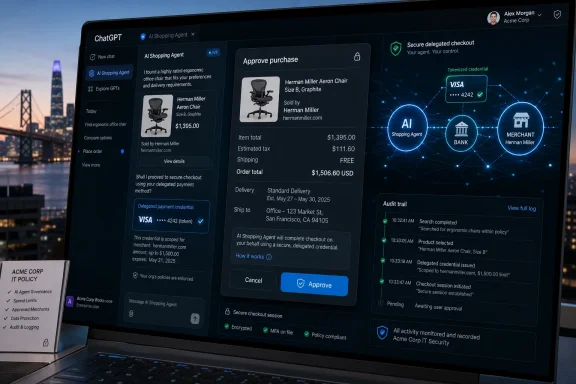 Visa Is Not Just Adding Checkout to ChatGPT
The easy version of this story is that ChatGPT is getting a Visa button. That understates the shift. Visa is not merely appearing as another payment option at the end of a shopping flow; it is trying to become the trusted payment rail for agentic commerce, where software acts on a user’s instruction rather than waiting for every click.That distinction matters because conventional checkout assumes a human is present at each meaningful step. The user searches, compares, adds to cart, reviews taxes and shipping, authorizes payment, and receives confirmation. In the model Visa and OpenAI are pointing toward, some of those steps can collapse into a conversation: “Find me a replacement laptop charger that arrives tomorrow and costs under $40.”
The promise is obvious. ChatGPT already acts as a research assistant, itinerary planner, meal planner, coding partner, and customer-support interpreter. Adding payment means OpenAI can move from answering intent to executing it.
But that is also why the story is bigger than consumer convenience. A payment credential inside a general-purpose AI assistant is a new trust boundary. For decades, the browser, the operating system, the card network, the bank, and the merchant each had relatively clear jobs. AI agents blur those lines by becoming the interface, the recommender, the negotiator, and now the purchasing delegate.
The Old Web Checkout Flow Starts to Look Like Legacy Plumbing
The web’s commercial architecture was built around pages, forms, and shopping carts. Even “one-click” checkout still depends on a merchant-controlled environment and a customer who can see the final order. AI commerce proposes a different shape: intent comes first, interfaces become negotiable, and merchants may have to serve agents as much as humans.For shoppers, this could feel like a natural evolution. If ChatGPT can compare products, filter fake reviews, check delivery windows, and summarize return policies, then asking it to finish the transaction is not a wild leap. The friction point has always been payment, and Visa’s role is to make that last step feel less experimental.
For merchants, the shift is more unsettling. Search engines already mediate demand; marketplaces already own many customer relationships. An AI assistant that can recommend and buy may become an even more powerful gatekeeper, because it can collapse discovery, persuasion, and checkout into a single exchange.
That could be good for small merchants if the system genuinely routes purchases to any Visa-accepting seller. It could also be punishing if visibility depends on structured data feeds, ranking deals, inventory integrations, or whatever opaque rules AI platforms use to decide which products count as the “best” answer.
Tokenization Is the Comfort Blanket, Not the Whole Security Model
Visa is emphasizing familiar security concepts: tokenized credentials, spending limits, merchant restrictions, and user approval requirements. That is sensible positioning. Consumers already understand, at least loosely, that Apple Pay and Google Pay do not hand raw card numbers to every cashier, and Visa wants the ChatGPT integration to live in that same mental category.Tokenization is important because it reduces the blast radius of credential exposure. If the agent never sees the real card number, a compromised merchant or rogue integration has less to steal. If tokens can be scoped to merchants, categories, devices, or transaction limits, the payment network can enforce rules that the AI model itself should never be trusted to remember perfectly.
But tokenization does not answer the whole problem. The most interesting attacks will not necessarily be card theft. They will be instruction manipulation, malicious product listings, fake merchants optimized for AI ranking, prompt-injection attacks hidden in web pages, and social-engineering flows that persuade an agent to interpret a bad purchase as a valid one.
This is where Windows users and administrators should pay attention. The last decade of security taught everyone to distrust macros, unsigned binaries, browser extensions, and OAuth consent screens. Agentic payments create a parallel problem: authorization may be technically valid even when the chain of reasoning that led to it was poisoned.
The Approval Prompt Becomes the New UAC Dialog
Microsoft learned the hard way that prompting users is not the same thing as protecting them. User Account Control improved Windows security, but it also trained millions of people to click through warnings they did not understand. AI payment approvals could follow the same path if they become noisy, vague, or frequent.A useful approval prompt must explain what the agent is buying, from whom, for how much, under what delivery terms, with what return policy, and why it selected that option. A useless one says, “ChatGPT wants to complete this purchase.” The difference is not cosmetic; it is the difference between informed delegation and ritualized consent.
There is also a tension between convenience and control. If every low-value transaction requires review, the agent is just a slower shopping cart. If too many transactions can be preapproved, the user is trusting a probabilistic system with financial agency.
Expect the first mainstream implementations to lean conservative. Spending caps, merchant categories, and explicit confirmations are not just safety features; they are adoption features. The payment networks, banks, and AI companies all know that a single viral story about ChatGPT ordering the wrong thing at scale could damage confidence far beyond one refund.
OpenAI’s Commerce Ambition Is Becoming Harder to Dismiss
OpenAI has been edging toward commerce for some time. Product search, direct checkout experiments, payment partnerships, browser ambitions, and merchant integrations all point in the same direction. The company does not want ChatGPT to be merely a place where users ask what to buy; it wants ChatGPT to be a place where buying happens.That ambition changes the business model debate. If an AI assistant recommends products, users will want to know whether those recommendations are organic, sponsored, commission-driven, inventory-driven, or influenced by platform partnerships. OpenAI has repeatedly tried to frame ChatGPT as answer-first rather than ad-first, but commerce tests that posture.
Visa’s presence may help because payment networks are not the same as retailers. Visa does not need ChatGPT to recommend one brand of paper towels over another. It benefits when transactions happen over its rails.
Still, commerce has gravity. Once a platform can influence purchase decisions, every merchant, advertiser, affiliate network, and marketplace will try to shape that influence. The question is whether OpenAI can build a shopping interface that users perceive as an agent for the buyer rather than a tollbooth for sellers.
Banks Will Want the Fraud Controls Before They Want the Future
Card issuers live in a world of risk models, chargebacks, suspicious merchant patterns, and customer disputes. From that viewpoint, AI payments are not magic; they are another transaction channel with a strange new initiator. The bank still has to decide whether the purchase looks legitimate.That may be harder than it sounds. A human buying diapers, plane tickets, or groceries has patterns. An AI agent acting on behalf of that human may create different patterns: faster purchases, broader merchant discovery, unusual combinations of goods, and more transactions initiated from cloud infrastructure rather than a familiar browser session.
Visa can help normalize that signal if it gives issuers enough metadata. A bank may want to know that a transaction was agent-initiated, user-approved, tokenized, category-limited, and consistent with a delegated instruction. Without that context, banks may treat early agentic transactions as suspicious or, worse, approve them without understanding the new fraud surface.
Disputes will be the real stress test. If ChatGPT buys the wrong item because a product page was misleading, is that buyer error, merchant deception, platform failure, or ordinary card-not-present fraud? Consumers will expect refunds. Merchants will resist eating losses caused by an AI intermediary they did not design.
Enterprise IT Should See a Policy Problem Coming
For corporate environments, the most important version of this story is not a consumer asking ChatGPT to buy groceries. It is an employee asking an AI assistant to renew a SaaS subscription, order replacement hardware, book travel, buy cloud credits, or source a component from a new supplier. The moment payment enters the assistant, shadow procurement becomes easier.Many organizations already struggle with employees using consumer AI tools for work tasks. Add payment capabilities, and the risk expands from data leakage to financial commitment. A staffer with a company card and an AI agent could accidentally bypass approved vendors, negotiated pricing, software asset controls, or procurement review.
The policy response cannot simply be “ban it.” AI assistants are moving into browsers, productivity suites, operating systems, developer tools, and customer-service platforms. If payment delegation proves useful, employees will find sanctioned or unsanctioned ways to use it.
The better enterprise response is to define the boundaries early. Corporate cards may need agent-specific controls. Identity providers may need to distinguish human-initiated and agent-initiated purchases. Expense systems may need richer receipts that capture the prompt, approval, merchant, item, and policy checks performed before purchase.
Windows administrators have seen this movie before. Consumer convenience becomes workplace expectation, then workplace exception, then workplace dependency. The time to write policy is before the first finance-team dispute over whether an AI assistant had authority to buy something.
Microsoft Is Both Adjacent and Exposed
This is not a Microsoft announcement, but the Windows ecosystem cannot treat it as someone else’s story. ChatGPT runs on Windows desktops, inside browsers, through enterprise integrations, and alongside Microsoft’s own Copilot ambitions. If AI agents become payment-capable, the operating environment around them becomes part of the trust chain.Microsoft has its own reasons to care. Copilot is being pushed across Windows, Microsoft 365, Edge, Azure, security tooling, and developer workflows. If OpenAI-linked commerce becomes mainstream, users will expect comparable functionality from other assistants, including those embedded in Windows experiences.
That creates a competitive and architectural dilemma. Should an operating-system-level assistant be able to initiate purchases? Should Edge mediate agentic checkout? Should Microsoft 365 Copilot be allowed to buy services or book travel under enterprise policy? These are not science-fiction questions once a major card network normalizes the idea that agents can transact.
For now, the Visa-OpenAI partnership is a marker: payments are moving closer to the AI interface layer. Microsoft, Google, Apple, Amazon, PayPal, Mastercard, Stripe, Shopify, banks, and enterprise procurement vendors will all have incentives to define their own version of that layer before someone else owns the user relationship.
The Merchant Web Will Be Rewritten for Machines
If AI agents become serious buyers, merchants will optimize for them. That means product data, availability, shipping terms, return policies, warranties, reviews, and price changes will need to be machine-readable, trustworthy, and current. The messy human web will not disappear, but a parallel agent-readable web will become more valuable.This could reward merchants with clean data and punish those relying on dark patterns. An agent that can compare total delivered cost may be less susceptible to checkout surprises. An agent that can summarize return policies may steer users away from sellers with hostile terms.
Or the opposite could happen. Merchants may learn to manipulate agent ranking systems just as they learned search-engine optimization and marketplace gaming. Fake scarcity, synthetic reviews, adversarial page text, and hidden instructions aimed at AI crawlers could become normal parts of the commerce battlefield.
That is why payment security cannot be separated from information integrity. A perfectly tokenized payment can still complete a bad transaction if the agent’s perception of the merchant is compromised. The next generation of anti-fraud systems will need to evaluate not just the payment event but the informational path that produced it.
The Consumer Benefit Is Real, Which Makes the Risk Harder
It is tempting to dismiss AI shopping as another overhyped automation fantasy. That would be a mistake. Many people hate the modern shopping web: SEO spam, fake reviews, coupon traps, marketplace clones, subscription gotchas, and endless comparison fatigue. A competent agent that narrows choices and executes routine purchases could be genuinely useful.The strongest use cases are not glamorous. Reordering household staples, finding compatible replacement parts, booking routine travel within constraints, buying school supplies, or selecting a known brand at the lowest delivered price are all tasks where users may prefer delegation over browsing.
Accessibility is another overlooked angle. For users who struggle with complex checkout flows, small mobile screens, or hostile web design, conversational shopping could be liberating. The same is true for busy caregivers, small-business owners, and anyone managing repetitive purchasing decisions.
That is why the safety conversation must be practical rather than moralistic. People will use agentic payments if they save time and work often enough. The job of platforms and payment networks is not to lecture users out of delegation; it is to make delegation constrained, auditable, reversible, and understandable.
The Fine Print Will Decide Whether This Is a Feature or a Liability
The most important details are still implementation details. How does a user link a card? What must be confirmed every time? Can a user create per-agent budgets? Are there merchant allowlists and blocklists? Can parents restrict purchases? Can enterprises disable payment delegation entirely? Can banks show agent-initiated transactions clearly in statements?These questions sound mundane because they are. But mundane controls are what determine whether a powerful feature becomes trustworthy. Nobody wants to read a white paper before letting an assistant buy printer toner, but everyone wants the ability to stop, reverse, audit, and limit that assistant when something goes wrong.
OpenAI also has to solve the explanation problem. If ChatGPT chooses one merchant over another, users will expect a reason. If that reason is incomplete, biased, or influenced by commercial relationships, trust will erode quickly.
Visa, meanwhile, has to avoid becoming invisible in the wrong way. Payment networks usually prefer to be infrastructure: always present, rarely noticed. In agentic commerce, the payment layer may need to become more visible precisely because users need confidence that constraints are being enforced outside the model.
The First Real Scandal Will Set the Rules Faster Than the First Demo
New transaction systems often look safest in controlled demonstrations. The real world supplies the edge cases: ambiguous prompts, duplicate orders, unavailable inventory, substitutions, phishing storefronts, compromised accounts, family members using shared devices, and merchants that ship something technically compliant but practically useless.The first widely shared failure will matter. If an AI agent buys an expensive wrong item, the public may treat it as comic relief. If it buys from a scam merchant, leaks sensitive purchase intent, or creates a dispute between a customer, bank, and platform, regulators will pay closer attention.
That regulatory attention is inevitable. Payments are already heavily governed, and AI systems are increasingly scrutinized. Combining them invites questions about consent, liability, data retention, discrimination, consumer protection, and platform power.
The companies that win this market will not be the ones that make agents seem most autonomous. They will be the ones that make autonomy feel boringly safe. In payments, boring is a feature.
The Shopping Cart Is Becoming an Agent Contract
The practical message for WindowsForum readers is that this is not just another chatbot feature. It is a sign that the AI assistant is becoming a transaction surface, and transaction surfaces eventually require policy, logging, identity, and security models.For home users, the first rule should be restraint. Do not give an assistant broad spending authority just because the setup screen makes it easy. Treat AI payment access like a debit card handed to a helpful intern: useful for bounded errands, reckless for open-ended authority.
For IT pros, the rule is visibility. If agentic purchases enter the workplace, they should do so with managed identities, corporate payment controls, audit trails, and procurement integration. Otherwise, organizations will discover the risk only after the expense report arrives.
For developers and merchants, the rule is readiness. Agent-readable commerce will reward clean metadata, reliable inventory, transparent policies, and payment flows that can distinguish legitimate delegated purchases from automated abuse. The web is about to get another non-human customer, and this one may actually pay.
The Receipts From ChatGPT Will Tell Us What Changed
The Visa-OpenAI partnership is still early enough that users should separate announced capability from lived experience. The direction, however, is now clear: AI assistants are moving from advice to action, and payment is the action that makes everyone take the technology seriously.- Visa and OpenAI are building payment capability into ChatGPT-era agent experiences, not simply adding another branded checkout button.
- Tokenized credentials and spending controls reduce card-risk exposure, but they do not eliminate prompt manipulation, merchant fraud, or bad recommendations.
- Consumers should use narrow limits and explicit approvals before trusting an AI assistant with purchases.
- Enterprises should prepare policies for agent-initiated spending before employees connect company cards to consumer AI tools.
- Merchants will need cleaner product data and more transparent terms as AI agents become a new class of buyer.
- The biggest unresolved issue is liability when a purchase is technically authorized but practically wrong.
References
- Primary source: Computerworld
Published: Tue, 16 Jun 2026 20:25:22 GMT

ChatGPT will soon be able to shop with your Visa card – Computerworld
OpenAI has signed a partnership agreement with Visa. www.computerworld.com
- Independent coverage: NPR
Published: Tue, 16 Jun 2026 08:46:26 GMT

Visa and OpenAI integrate Visa's secure global payment directly into ChatGPT : NPR
Would you hand an AI chatbot your credit card? This week, Visa's deal with ChatGPT maker OpenAI became the latest step in the march toward a future where AI offers to shop on your behalf.www.npr.org - Related coverage: techradar.com

OpenAI signs major Visa deal — so AI agents will soon be able to make payments and purchases for you | TechRadar
OpenAI agents will soon be able to make Visa payments for youwww.techradar.com - Related coverage: wfdd.org

Visa and OpenAI integrate Visa's secure global payment directly into ChatGPT
Would you hand an AI chatbot your credit card? This week, Visa's deal with ChatGPT maker OpenAI became the latest step in the march toward a future where AI offers to shop on your behalf.www.wfdd.org - Related coverage: techxplore.com
- Related coverage: washingtonpost.com
- Related coverage: usa.visa.com

Visa Partners with OpenAI to Power the Next Generation of AI Commerce
New collaboration brings Visa’s global payment network to one of the largest AI platforms and aims to support seamless, secure transactions and broader AI-powered use cases across commerce environments supported by agents SAN FRANCISCO --(BUSINESS WIRE)--Jun.usa.visa.com - Related coverage: wunc.org

Visa and OpenAI integrate Visa's secure global payment directly into ChatGPT
Would you hand an AI chatbot your credit card? This week, Visa's deal with ChatGPT maker OpenAI became the latest step in the march toward a future where AI offers to shop on your behalf.www.wunc.org - Related coverage: the-journal.com
Visa plugs its payment network into ChatGPT, letting AI agents shop and pay for users
SAN FRANCISCO – Payments giant Visa said Wednesday that it has embedded its payment network inside of ChatGPT, empowering the chatbot to independently shop and complete transactions on behalf of its u...www.the-journal.com
- Related coverage: digitaltrends.com

OpenAI teams up with Visa to enable secure payments through AI agents - Digital Trends
ChatGPT could soon shop and pay for you thanks to a new OpenAI and Visa deal that brings secure agentic payments to AI experiences.www.digitaltrends.com - Related coverage: corporate.visa.com
Visa, OpenAI partner for next generation of AI commerce
New collaboration brings Visa’s global payment network to AI platformscorporate.visa.com
- Related coverage: pymnts.com

PYMNTS | Visa and OpenAI Unlock Agentic Commerce
Visa and OpenAI partnered to make it easier for developers and merchants to accept Visa payments initiated by artificial intelligence agents. www.pymnts.com
- Related coverage: greenwichtime.com
- Related coverage: the-independent.com

Visa plugs its payment network into ChatGPT, letting AI agents shop and pay for users | The Independent
Visa is embedding its payment network into ChatGPT, allowing the chatbot to shop and complete transactions for userswww.the-independent.com - Related coverage: axios.com

ChatGPT's Instant Checkout lets you shop in ChatGPT
The feature launches today with support for Etsy.www.axios.com
- Related coverage: tomsguide.com

ChatGPT is getting PayPal — here's how OpenAI is becoming an e-commerce giant | Tom's Guide
OpenAI is building on its partnership with PayPal; here's why that could revolutionize how you shop.www.tomsguide.com - Related coverage: nextepinvestimentos.com.br
OpenAI Scales Back Shopping Plans for ChatGPT — The Information
PDF documentnextepinvestimentos.com.br
- Related coverage: s205.q4cdn.com
OpenAI and PayPal Team Up to Power Instant Checkout and Agentic Commerce in ChatGPT 2025
PDF documents205.q4cdn.com
- Official source: help.openai.com

ChatGPT — Release Notes | OpenAI Help Center
A changelog of the latest updates and release notes for ChatGPT help.openai.com
- Official source: openai.com

OpenAI raises $122 billion to accelerate the next phase of AI | OpenAI
OpenAI raises $122 billion in new funding to expand frontier AI globally, invest in next-generation compute, and meet growing demand for ChatGPT, Codex, and enterprise AI.openai.com - Official source: cdn.openai.com