

Microsoft’s latest Visual Studio roadmap makes one thing clear: the IDE’s next act is an aggressive shift from assistant-style suggestions to agentic, context-aware automation that can plan, act, and persist across the entire software lifecycle — and Microsoft is explicitly wiring the platform to host multiple high-capability models (including GPT‑5‑Codex) while giving enterprises governance primitives through the Model Context Protocol (MCP).
Microsoft’s Visual Studio team published a monthly AI roadmap describing a fast-moving plan to make Copilot and the IDE itself an AI-first development environment. The roadmap lays out three parallel threads: richer, built-in and extension-provided AI agents that can run complex workflows; model diversification and routing (Auto Model and explicit support for GPT‑5‑Codex and other vendors); and a hardened Model Context Protocol (MCP) surface to bind models to enterprise data, tools, and governance. This is not a cosmetic Copilot update. The roadmap frames agents as first-class participants — entities that can operate concurrently, call tools, summarize histories, run tests, and even create or apply multi-file edits under human supervision. That distinction (agent vs. completion) is crucial: agents can orchestrate actions and maintain state over time, which changes both the productivity upside and the governance surface.
This triad is both powerful and risky. The productivity upside is real: faster triage, more capable multi-file refactors, improved test automation, and a planning-capable Copilot Chat. But the hazards — data governance, cost management, reliability, and extension compatibility — require deliberate operational controls that Microsoft is beginning to provide but that customers must enforce.
For Windows and .NET teams, the roadmap is an invitation: pilot thoughtfully, instrument everything, and prioritize governance. Done right, Visual Studio’s AI transformation will be a major force multiplier; done without controls, it will amplify existing engineering and compliance problems. The prudent path is measured adoption: adopt the new agentic capabilities where they provide clear, measurable ROI, and keep human-in-the-loop safeguards in place until the tooling and organizational practices mature together.
Source: Windows Report Microsoft Details Roadmap for Visual Studio, Featuring New Agents and GPT-5 Codex
 Background
Microsoft’s Visual Studio team published a monthly AI roadmap describing a fast-moving plan to make Copilot and the IDE itself an AI-first development environment. The roadmap lays out three parallel threads: richer, built-in and extension-provided AI agents that can run complex workflows; model diversification and routing (Auto Model and explicit support for GPT‑5‑Codex and other vendors); and a hardened Model Context Protocol (MCP) surface to bind models to enterprise data, tools, and governance. This is not a cosmetic Copilot update. The roadmap frames agents as first-class participants — entities that can operate concurrently, call tools, summarize histories, run tests, and even create or apply multi-file edits under human supervision. That distinction (agent vs. completion) is crucial: agents can orchestrate actions and maintain state over time, which changes both the productivity upside and the governance surface. What Microsoft announced (high-level)
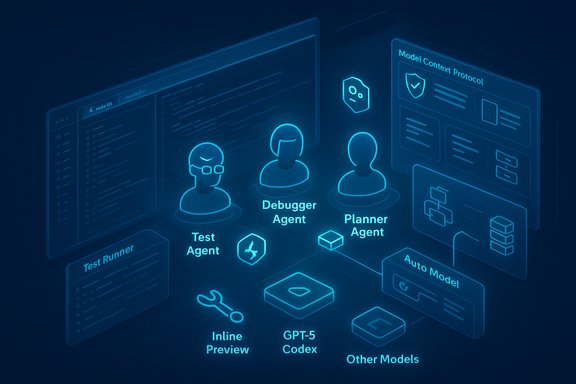
- New, built-in and custom AI Agents in Visual Studio, including a Test Agent and Debugger Agent, plus the ability for developers to author their own agents and run them concurrently.
- Expanded Copilot Chat capabilities: slash commands, better memory handling, dynamic tool calling, thread-history summarization, inline previews, and read-only options for collaborative workflows.
- Integration of GPT‑5‑Codex as a model option inside developer tooling (Visual Studio / Copilot surfaces), alongside Auto Model selection that will route the best engine for each task.
- Continued investment in the Model Context Protocol (MCP) with UX improvements, token optimizations, and a unified MCP server management interface to improve enterprise governance and performance.
Deep dive: Agents in Visual Studio
New built-in agents: Test Agent and Debugger Agent
The roadmap highlights Test Agent and Debugger Agent as first examples of agents designed to take end-to-end responsibility for discrete engineering tasks. The Test Agent is intended to generate and run tests, triage flaky suites, and propose fixes. The Debugger Agent can follow traces, replicate failure scenarios, and help isolate root causes by chaining tool calls and repository queries. These agents are described as capable of invoking external tools, running in sandboxes, and returning annotated results to the developer for review. Why this matters: test and debug workflows are prime candidates for automation because they are repetitive, stateful, and expensive in human time. If agents reliably triage failing tests and propose reproducible fixes with covered assertions, teams can reclaim hours of manual debugging. The flip side is obvious: allowing an autonomous process to change tests or code requires robust guardrails, traceability, and human-in-the-loop approval gates.Custom agents and concurrent runs
Beyond built-in agents, Visual Studio’s roadmap emphasizes user-created agents. Developers and orgs will be able to author agents with specialized system prompts, tool manifests, and MCP-advertised services so that teams can encode domain knowledge, runbook steps, or specialized CI tasks as reusable agents. Microsoft is testing concurrency — multiple agents running side-by-side and coordinating — which enables complex, parallel workflows (for instance, one agent running tests, another performing static analysis, and a planner agent reconciling results). The engineering reality: concurrency and agent-to-agent coordination are technically challenging. You need deterministic logging, resource isolation, conflict detection (e.g., two agents proposing overlapping code edits), and careful identity/billing controls. The roadmap mentions these needs and surfaces MCP and agent accounts/workspaces as part of the mitigation strategy.Copilot Chat: more than chat — a planning and collaboration hub
Slash commands, memory, and dynamic tool calling
Copilot Chat inside Visual Studio will gain practical UX features: slash commands for quick actions, improved memory handling for sustained context across sessions, and a more dynamic tool-calling mechanism so agents can invoke local or remote tools on demand. These upgrades aim to make chat sessions less ephemeral and more actionable — turning threads into executable plans that can be staged, previewed, and applied. Practical implications: developers will be able to maintain a running plan or task list in chat, ask for summaries, and let an agent proceed to run the next approved step. For teams, that means meetings and asynchronous coordination can be materially shortened — provided the system preserves clarity on who approved what and retains an auditable record of agent actions.Thread history summarization, inline previews, and read-only modes
A key productivity improvement is thread summarization (copilot can compress discussion history into a concise context), coupled with inline previews that show what changes an agent will propose before applying them. Read-only options let reviewers inspect outputs without risking accidental modifications. These are small but crucial features that turn a chat into a controlled change pipeline. These features also reduce friction for code review and compliance: previews and read-only views enable audit trails and allow security or legal stakeholders to review agent outputs before they enter CI/CD pipelines. That economic and governance benefit is why Microsoft pairs these UX features with MCP improvements and group-policy manageability.Model strategy: GPT‑5‑Codex, Auto Model, and BYOM
GPT‑5‑Codex surfaces in developer tooling
One of the most consequential announcements is the roadmap’s explicit inclusion of GPT‑5‑Codex as a supported model for Visual Studio chat/agent workloads. GPT‑5‑Codex is a coding-optimized variant from the GPT‑5 family that OpenAI and Microsoft have exposed through Azure AI Foundry and GitHub Copilot, respectively. In practice, that means Visual Studio users will be able to select Codex‑tuned models for repo-aware refactors, multi-file edits, and deeper reasoning tasks. Evidence and caveats: GitHub’s Copilot changelog and Azure AI Foundry posts indicate GPT‑5‑Codex is rolling out to paid Copilot tiers and is accessible in certain VS Code and Copilot surfaces. However, rollout is staged and enterprise admins may need to opt-in or enable policies before Codex becomes available in their tenants. Also, specific numerical claims (token windows, the extent of “seven-hour” autonomous runs, or vendor-reported success rates) should be treated as vendor-supplied metrics until independently validated in diverse production settings.Auto Model selection and multi-model routing
Visual Studio’s Auto Model feature will attempt to pick the best model for a given context: fast, lower-cost models for lightweight Q&A, and deeper reasoning models like GPT‑5 or Codex for multi-step refactors or heavy analysis. Microsoft is implementing server-side routing so the IDE remains responsive while the platform chooses the right engine and resource level. This removes model selection friction for developers while keeping the door open for admin-level control and BYOM (Bring Your Own Model) options. This router approach is sensible: different coding tasks have different latency, token, and accuracy trade-offs. The challenge for enterprise operators is visibility: teams should log which model served which action for auditability and reproducibility. Visual Studio’s roadmap suggests that telemetry and model-choice traces are part of the vision.Model Context Protocol (MCP): governance, performance, and scale
MCP’s role and the UX investments
MCP is becoming the central governance and integration layer for agents. It lets Visual Studio and Copilot Chat call out to MCP servers that advertise tools, knowledge sources, and resource descriptors in a standard way. The roadmap lists MCP elicitation support, group policy for MCP governance, a unified MCP UX, and Windows registry support for MCP as priorities — all intended to let enterprises register and control which MCP endpoints agents can consult. Why this is important: MCP lets agents reason over internal documents, APM traces, and custom tools while preserving enterprise control over data residency and access. It’s the plumbing that makes BYOM and agentic automation viable in regulated environments. However, it also increases surface area for misconfiguration; proper default-deny policies, telemetry, and consent flows are essential.Token optimization and performance tuning
Microsoft is also working on token optimization (prompt caching, tuned search calls, and prompt engineering) to reduce cost and latency for chat and agent experiences. Token economy is a real operational cost for teams that plan to run many automated agent flows, so improvements here directly impact adoption economics. The roadmap mentions explicit efforts to reduce token consumption and to optimize tool calls. Practical note: vendor-published token savings and latency improvements are promising, but teams should benchmark representative workloads to quantify actual cost savings given their unique repository sizes and test suites. Vendor numbers can be optimistic and depend on product surface and model variant.Real-world implications for developers and teams
Productivity wins
- Faster triage: Automated test generation and debugging loops can dramatically shorten the time from bug report to fix.
- Better multi-file edits: Agentic refactors and repo-aware Codex models reduce manual coordination and window-switching.
- Fewer context drills: Thread summaries and in-chat planning keep relevant context in one place and minimize repeated explanations.
Governance, security, and compliance risks
- Data exfiltration risk: Agents that can call external MCP endpoints or third-party models introduce pathways for sensitive data to leave tenant boundaries unless explicitly controlled.
- Automated mistakes: Agents can make widespread edits; human review gates, commit signing, and CI checks are non-negotiable.
- Cost and billing surprises: Auto model routing and long-running agent tasks can generate unexpected costs without consumption limits and visibility.
Strengths and notable engineering choices
- Holistic platform approach: Microsoft is not just adding an LLM; it’s building model routing, standard tool protocols (MCP), and UI affordances (previews, read-only) that together enable safer adoption.
- Multi-model flexibility: Supporting GPT‑5‑Codex, Anthropic Claude variants, and other models gives enterprises choice and reduces vendor lock-in in practice.
- Emphasis on auditability: Inline previews, read-only modes, and MCP-managed tool manifests show a product that understands the need for traceable automation.
Risks, gaps, and open questions
- Reliability and hallucinations: Even with Codex tuning, complex refactors and semantic changes can result in subtle bugs. Vendor metrics on hallucination reduction are encouraging but not definitive; independent validation and staged pilots remain essential.
- Token and cost modeling: Auto Model may hide complexity; teams need visibility into per-action model choice and chargebacks to avoid surprise bills. Vendor claims about token efficiency are promising but should be stress-tested with real CI workloads.
- Extension and ecosystem compatibility: Visual Studio’s richer AI architecture may require extension authors to update plugins. Early adopters should expect integration work and maintain Insiders channels for testing.
- Governance maturity: MCP is a strong start, but enterprises must still design role-based access, allow-listing, and human-in-the-loop checkpoints before pushing agents into production workflows.
Practical adoption checklist for teams
- Start with a narrow pilot: choose one repo and one agent (e.g., Test Agent for flaky-test triage). Validate outputs in a staging environment.
- Require human approval gates: no autonomous commits to production without a sign-off process and CI-enforced tests.
- Log model choices: record which model/variant handled each agent action for reproducibility and debugging.
- Configure MCP policies: enforce allow-lists for MCP endpoints, group-policy controls, and per-agent scoping.
- Monitor consumption: set budget alerts and per-agent quotas to avoid unexpected billing due to long-running tasks or deep reasoning runs.
Conclusion
Microsoft’s Visual Studio roadmap signals a decisive pivot: the IDE is becoming an AI-native environment where agents — not just completions — are central to developer productivity. The three pillars of this transition are clear: a richer agent model (Test Agent, Debugger Agent, and user-created agents), model diversification including GPT‑5‑Codex with Auto Model routing, and enterprise-focused governance via the Model Context Protocol.This triad is both powerful and risky. The productivity upside is real: faster triage, more capable multi-file refactors, improved test automation, and a planning-capable Copilot Chat. But the hazards — data governance, cost management, reliability, and extension compatibility — require deliberate operational controls that Microsoft is beginning to provide but that customers must enforce.
For Windows and .NET teams, the roadmap is an invitation: pilot thoughtfully, instrument everything, and prioritize governance. Done right, Visual Studio’s AI transformation will be a major force multiplier; done without controls, it will amplify existing engineering and compliance problems. The prudent path is measured adoption: adopt the new agentic capabilities where they provide clear, measurable ROI, and keep human-in-the-loop safeguards in place until the tooling and organizational practices mature together.
Source: Windows Report Microsoft Details Roadmap for Visual Studio, Featuring New Agents and GPT-5 Codex
