

Indigenous-led technology and transformation partner Gadali has become a notable case study in how AI can be used to solve a very old problem in a very new way: giving disability support workers more time with participants and less time buried in paperwork. In a project delivered with Microsoft Elevate, the company built an AI-powered Care App for Ability First Australia that replaces manual note-taking with conversational, speech-based input. The result is more than a workflow tweak; it is a signal that the disability sector is moving toward voice-first software designed around frontline realities rather than office assumptions. (abilityfirstaustralia.org.au)
Ability First Australia is no small pilot customer. It is one of the country’s largest not-for-profit strategic alliances in disability services, representing about $2 billion worth of support services for more than 92,000 people with disability, their families and carers. Its member organisations operate in every state and territory, which means any technology it adopts has to work across a broad and uneven operational landscape. That scale matters because care documentation is not a side task in disability support; it is a core part of compliance, continuity, and quality assurance. (abilityfirstaustralia.org.au)
The case for change is easy to understand. Disability service delivery is labour-intensive, highly distributed, and often constrained by staff shortages, multilingual workforces, and time pressure during shifts. If carers have to stop, find a keyboard, and type notes at every step, the administrative load competes directly with care time. In that context, the promise of speech-to-record, conversational capture, and automated report generation is not just convenience; it is operational leverage. (gadali.com)
Microsoft has been positioning AI and accessibility as linked priorities rather than separate programs. Its Microsoft Elevate initiative explicitly frames AI as a way to expand opportunity, strengthen institutions, and solve real-world problems, while its ANZ accessibility and disability-inclusion materials emphasize technology that helps organisations build workplaces that include every employee by design. That framing is important because the Ability First project sits at the intersection of accessibility, nonprofit impact, and partner-led implementation. (microsoft.com)
What makes the project especially interesting is the delivery model. Gadali describes itself as an Indigenous-led provider of AI-enabled and enterprise-scale solutions, with a product and services mix that includes app development, AI design sprints, and an Agent AI Accelerator. The company’s positioning suggests a strong emphasis on co-design and rapid delivery, and that is consistent with the structured consultation process described in the ARN report, which involved frontline workers through to executive leadership. (gadali.com)
This matters because disability care documentation is not merely descriptive. It affects handovers, risk management, incident tracking, service quality, and billing accuracy. If notes are incomplete or delayed, the downstream impact can ripple across rostering, funding, and participant continuity. That is why the promise of automated, compliant report generation is so consequential in this sector.
A successful deployment here could become a template for other care environments. Aged care, community health, and supported employment services all share the same tension between the need for records and the need for human presence. If the workflow is good enough for disability support, it may prove useful in adjacent care categories too. That is where the larger market opportunity sits. (microsoft.com)
This is also where Gadali’s delivery style appears to align with the outcome. Its own materials emphasize high-impact workshops, solutioning phases, and business value pilots, all of which fit a co-design-heavy program. In other words, the project reads like a practical extension of a delivery framework that already privileges speed, iteration, and user feedback. (gadali.com)
A structured consultation process also lowers implementation risk. If workers feel heard, they are more likely to adopt the system and less likely to route around it. In disability care, adoption is everything, because the best software in the world is useless if staff find it too slow in the middle of a shift. (gadali.com)
That strategic framing matters because the market for AI assistants is crowded and increasingly commoditized. What differentiates one project from another is often not the model, but the trust layer: governance, partner credibility, integration capability, and sector-specific implementation. Microsoft Elevate gives the project a stronger institutional narrative, while Gadali brings execution muscle and Indigenous-led positioning. (microsoft.com)
It also helps explain why this project should be read as more than a one-off innovation story. Microsoft is clearly investing in the idea that AI can drive measurable outcomes in underserved sectors, while also deepening partner-led delivery across the ecosystem. The Care App is therefore both a customer success story and a proof point for the broader Elevate strategy. (microsoft.com)
There is also a quality dimension. People often remember more nuance when they can narrate an interaction immediately, rather than reconstruct it from memory later. That should improve data freshness and reduce the vague, boilerplate note-writing that plagues many service systems. Better notes are not just longer notes; they are more actionable notes. (gadali.com)
Integration is the other quiet but critical improvement. Gadali says the app integrates with existing workforce systems, which means the value is not limited to a standalone interface. A genuinely useful care app has to fit into rostering, compliance, reporting, and service-delivery workflows, or it becomes another silo.
Of course, speech input is not a magic fix. Accents, background noise, and mixed-language workplaces can all create recognition problems, and those issues are often worse in real care environments than in demos. That is why any rollout like this needs rigorous testing across different speakers, shifts, and locations. The demo is never the deployment. (gadali.com)
Still, the inclusion upside is real. For some workers, voice input may be faster and less intimidating than written forms, especially in stressful moments. For organisations facing recruitment and retention pressure, tools that make the job easier can become a meaningful part of the employment proposition. (gadali.com)
It also matters commercially. Buyers in government, health, education, and care increasingly want vendors who can deliver technical outcomes while also aligning with procurement, diversity, and community goals. An Indigenous-led partner working alongside Microsoft gives Ability First a story that resonates both operationally and socially. (partner.microsoft.com)
There is a wider lesson here for the channel. The most effective partner ecosystems are no longer defined only by certifications and technical depth. They are also defined by trust, cultural competence, and the ability to co-design with communities that have historically been under-served by mainstream IT. (partner.microsoft.com)
This also fits a broader Microsoft pattern in Australia and beyond. Recent partner stories have repeatedly emphasized co-sell, AI productivity, and workflow transformation across sectors such as insurance, public services, and community organizations. The Ability First project is simply the care-sector version of that same strategic arc.
For enterprise IT teams, the key takeaway is that successful AI projects often start with a narrow but painful workflow. In this case, the workflow is shift documentation. Solve that cleanly, and the organization gains time, better data, and a better user experience all at once. That is the kind of AI business case boards understand. (gadali.com)
There is also a dignity angle. When a worker is not constantly breaking eye contact to write, the interaction feels more human. That can be especially important in disability care, where trust and rapport are central to service quality. Technology that fades into the background often has the biggest human payoff. (gadali.com)
Families may benefit too, even if indirectly. Cleaner documentation can mean better handovers, fewer misunderstandings, and a clearer record of what happened during a shift. Those are subtle gains, but in a sector where consistency can be hard to maintain, subtle gains can accumulate quickly. (abilityfirstaustralia.org.au)
Source: ARNnet Gadali and Microsoft Elevate called on for Ability First care app - ARN
 Overview
Ability First Australia is no small pilot customer. It is one of the country’s largest not-for-profit strategic alliances in disability services, representing about $2 billion worth of support services for more than 92,000 people with disability, their families and carers. Its member organisations operate in every state and territory, which means any technology it adopts has to work across a broad and uneven operational landscape. That scale matters because care documentation is not a side task in disability support; it is a core part of compliance, continuity, and quality assurance. (abilityfirstaustralia.org.au)The case for change is easy to understand. Disability service delivery is labour-intensive, highly distributed, and often constrained by staff shortages, multilingual workforces, and time pressure during shifts. If carers have to stop, find a keyboard, and type notes at every step, the administrative load competes directly with care time. In that context, the promise of speech-to-record, conversational capture, and automated report generation is not just convenience; it is operational leverage. (gadali.com)
Microsoft has been positioning AI and accessibility as linked priorities rather than separate programs. Its Microsoft Elevate initiative explicitly frames AI as a way to expand opportunity, strengthen institutions, and solve real-world problems, while its ANZ accessibility and disability-inclusion materials emphasize technology that helps organisations build workplaces that include every employee by design. That framing is important because the Ability First project sits at the intersection of accessibility, nonprofit impact, and partner-led implementation. (microsoft.com)
What makes the project especially interesting is the delivery model. Gadali describes itself as an Indigenous-led provider of AI-enabled and enterprise-scale solutions, with a product and services mix that includes app development, AI design sprints, and an Agent AI Accelerator. The company’s positioning suggests a strong emphasis on co-design and rapid delivery, and that is consistent with the structured consultation process described in the ARN report, which involved frontline workers through to executive leadership. (gadali.com)
Why This Matters for Disability Care
The disability sector has long been trapped between two equally important goals: spend more time with participants, and document everything properly. Those goals often collide in the last 15 minutes of a shift, when support workers are expected to remember details, write notes, and move on to the next task. A conversational app that captures information in real time changes that dynamic by moving documentation closer to the actual interaction. (gadali.com)The administrative burden problem
Administrative burden is not an abstract management complaint. It is a productivity drain that can create fatigue, reduce consistency in reporting, and increase the odds that important details are entered late or not at all. When support workers are non-native English speakers, manual documentation can become even more error-prone, especially under pressure. The Care App directly addresses that practical friction by allowing speech-based input and naturally captured notes. (gadali.com)This matters because disability care documentation is not merely descriptive. It affects handovers, risk management, incident tracking, service quality, and billing accuracy. If notes are incomplete or delayed, the downstream impact can ripple across rostering, funding, and participant continuity. That is why the promise of automated, compliant report generation is so consequential in this sector.
A successful deployment here could become a template for other care environments. Aged care, community health, and supported employment services all share the same tension between the need for records and the need for human presence. If the workflow is good enough for disability support, it may prove useful in adjacent care categories too. That is where the larger market opportunity sits. (microsoft.com)
The Co-Design Approach
The most encouraging part of the project is not the AI itself but the process around it. According to the reporting, the solution went through interviews and workshops involving frontline workers and executive leaders, which suggests the app was shaped by actual use cases rather than abstract product thinking. That is a meaningful distinction because poorly designed care software often fails at the interface level, not the backend.From executive intent to frontline reality
Enterprise software in care settings often fails when the people approving the budget are too far removed from the people using the tool. Co-design narrows that gap by surfacing daily habits, language patterns, and documentation shortcuts that a conventional requirements document might miss. In this case, that likely helped the team focus on conversational capture rather than forcing support workers into a rigid form-filling model. (gadali.com)This is also where Gadali’s delivery style appears to align with the outcome. Its own materials emphasize high-impact workshops, solutioning phases, and business value pilots, all of which fit a co-design-heavy program. In other words, the project reads like a practical extension of a delivery framework that already privileges speed, iteration, and user feedback. (gadali.com)
A structured consultation process also lowers implementation risk. If workers feel heard, they are more likely to adopt the system and less likely to route around it. In disability care, adoption is everything, because the best software in the world is useless if staff find it too slow in the middle of a shift. (gadali.com)
- Frontline input improves feature relevance.
- Executive alignment helps with governance and rollout.
- Early user feedback reduces rework.
- Multilingual workforce needs can be identified sooner.
- Real-world task flow beats hypothetical workflows.
Why Microsoft Elevate Is Relevant Here
Microsoft Elevate is built around the idea that AI should help communities, institutions, and learners, not just enterprise buyers. On its public pages, Microsoft says the program is meant to connect educators, nonprofit leaders, and learners with support that expands opportunity and solves real-world problems. That makes the Ability First deployment a natural fit: the customer is a nonprofit alliance, the use case is social impact, and the delivery relies on partner ecosystem expertise. (microsoft.com)Program framing and strategic signal
Microsoft’s accessibility and disability-inclusion materials in ANZ reinforce the same theme. The company links accessible technology to business value and points to programs that support Indigenous people and nonprofit communities. In practical terms, that means Microsoft is not just selling software; it is creating a policy and partner environment where accessibility-oriented solutions can be funded, piloted, and scaled. (partner.microsoft.com)That strategic framing matters because the market for AI assistants is crowded and increasingly commoditized. What differentiates one project from another is often not the model, but the trust layer: governance, partner credibility, integration capability, and sector-specific implementation. Microsoft Elevate gives the project a stronger institutional narrative, while Gadali brings execution muscle and Indigenous-led positioning. (microsoft.com)
It also helps explain why this project should be read as more than a one-off innovation story. Microsoft is clearly investing in the idea that AI can drive measurable outcomes in underserved sectors, while also deepening partner-led delivery across the ecosystem. The Care App is therefore both a customer success story and a proof point for the broader Elevate strategy. (microsoft.com)
- Microsoft Elevate gives the project institutional context.
- Accessibility is treated as a product and business issue, not a side feature.
- Nonprofit impact is built into the program’s design.
- Partner-led delivery reduces the burden on end customers.
- AI adoption is framed as community enablement rather than mere automation.
What the Care App Actually Changes
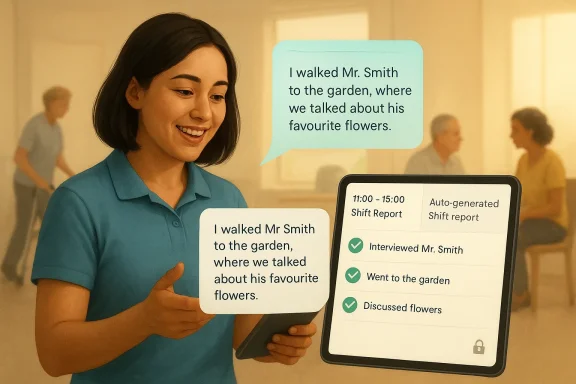
The most visible change is the move from manual documentation to conversational AI and speech-based input. Instead of having carers stop to write extensive notes, the app lets them capture interactions verbally, which can then be structured into shift reports. That sounds simple, but the shift from typing to speaking can save precious minutes across a long roster of support workers. (gadali.com)Speech first, keyboard second
Speech-first interfaces work best when the user is doing another job at the same time. In care settings, that is almost always the case. Support workers are moving, observing, reassuring, de-escalating, cleaning up, transporting, and helping with activities of daily living; the interface must serve the work, not interrupt it. (gadali.com)There is also a quality dimension. People often remember more nuance when they can narrate an interaction immediately, rather than reconstruct it from memory later. That should improve data freshness and reduce the vague, boilerplate note-writing that plagues many service systems. Better notes are not just longer notes; they are more actionable notes. (gadali.com)
Integration is the other quiet but critical improvement. Gadali says the app integrates with existing workforce systems, which means the value is not limited to a standalone interface. A genuinely useful care app has to fit into rostering, compliance, reporting, and service-delivery workflows, or it becomes another silo.
- Faster note capture during shifts.
- Less time spent on manual re-entry.
- Better consistency in report quality.
- Reduced cognitive load for staff.
- More time focused on participant support.
Language, Inclusion, and Workforce Reality
The multilingual workforce angle may be the most underappreciated part of the story. Ability First said it faced language barrier issues because a large proportion of carers are non-native English speakers. In that context, speech-based capture may help staff work in a more natural mode, especially if the app’s conversational design reduces the pressure to compose polished written English in real time. (gadali.com)Inclusion by design, not after the fact
This is where accessibility and workforce inclusion overlap. Software that assumes every worker is a native, fluent, keyboard-comfortable English writer is not neutral; it quietly excludes people. A voice-based care app can lower that barrier by letting staff document in the flow of work, although the quality of the transcription and downstream structure will still matter enormously. (gadali.com)Of course, speech input is not a magic fix. Accents, background noise, and mixed-language workplaces can all create recognition problems, and those issues are often worse in real care environments than in demos. That is why any rollout like this needs rigorous testing across different speakers, shifts, and locations. The demo is never the deployment. (gadali.com)
Still, the inclusion upside is real. For some workers, voice input may be faster and less intimidating than written forms, especially in stressful moments. For organisations facing recruitment and retention pressure, tools that make the job easier can become a meaningful part of the employment proposition. (gadali.com)
- Helps multilingual staff document more naturally.
- Reduces dependence on polished written English.
- May improve confidence during time-pressured shifts.
- Supports accessibility-focused workplace design.
- Requires robust transcription and QA controls.
Why Indigenous-Led Delivery Changes the Story
Gadali’s Indigenous-led identity gives the project a broader significance beyond software delivery. Microsoft’s partner-for-purpose materials explicitly include an “Empowering Indigenous People” stream, and that sits alongside its disability inclusion and nonprofit community efforts. In practice, this means the project is part of a wider ecosystem in which social impact, partner diversity, and technology deployment are increasingly linked. (partner.microsoft.com)Representation and capability
In the Australian market, Indigenous-led technology partners are still too often treated as symbolic choices rather than serious delivery organizations. This project pushes against that pattern by placing Gadali in the lead role for end-to-end design and app implementation. That is important because capability transfer and representation matter just as much as the final codebase. (gadali.com)It also matters commercially. Buyers in government, health, education, and care increasingly want vendors who can deliver technical outcomes while also aligning with procurement, diversity, and community goals. An Indigenous-led partner working alongside Microsoft gives Ability First a story that resonates both operationally and socially. (partner.microsoft.com)
There is a wider lesson here for the channel. The most effective partner ecosystems are no longer defined only by certifications and technical depth. They are also defined by trust, cultural competence, and the ability to co-design with communities that have historically been under-served by mainstream IT. (partner.microsoft.com)
Enterprise Implications
For enterprise buyers, this story should be read as a playbook for applied AI in regulated, high-touch services. It shows how AI can be deployed not as a flashy chatbot layer, but as a practical assistant to frontline workers. That distinction is critical because the best enterprise AI use cases usually replace friction, not people. (microsoft.com)Integration over novelty
The real enterprise value is in integration and governance. If a care app can capture voice notes, normalize them into structured reports, and plug them into existing workforce systems, it becomes a multiplier rather than a separate tool. That kind of architecture is more likely to survive procurement scrutiny and operational reality.This also fits a broader Microsoft pattern in Australia and beyond. Recent partner stories have repeatedly emphasized co-sell, AI productivity, and workflow transformation across sectors such as insurance, public services, and community organizations. The Ability First project is simply the care-sector version of that same strategic arc.
For enterprise IT teams, the key takeaway is that successful AI projects often start with a narrow but painful workflow. In this case, the workflow is shift documentation. Solve that cleanly, and the organization gains time, better data, and a better user experience all at once. That is the kind of AI business case boards understand. (gadali.com)
- Start with one high-friction workflow.
- Embed AI inside existing systems.
- Measure time saved and report quality.
- Treat governance as part of product design.
- Prioritize staff adoption from day one.
Consumer and Participant Impact
Even though this is an internal care workflow, the person who ultimately benefits is the participant receiving support. If carers spend less time typing and more time engaging, the quality of the interaction can improve in ways that matter deeply to individuals and families. Better documentation can also mean better continuity across shifts, which is often where service quality is won or lost. (abilityfirstaustralia.org.au)Better care, not just better code
It is easy to overstate the participant-facing effect of software. But in care environments, minutes matter, attention matters, and consistency matters. A system that helps staff remember the details of a conversation accurately can support more personalised and safer care over time. (gadali.com)There is also a dignity angle. When a worker is not constantly breaking eye contact to write, the interaction feels more human. That can be especially important in disability care, where trust and rapport are central to service quality. Technology that fades into the background often has the biggest human payoff. (gadali.com)
Families may benefit too, even if indirectly. Cleaner documentation can mean better handovers, fewer misunderstandings, and a clearer record of what happened during a shift. Those are subtle gains, but in a sector where consistency can be hard to maintain, subtle gains can accumulate quickly. (abilityfirstaustralia.org.au)
- More attentive worker-participant interactions.
- Better continuity between shifts.
- Fewer missing or delayed notes.
- Improved confidence for families and carers.
- Higher likelihood of consistent service delivery.
Strengths and Opportunities
The biggest strength of this project is that it solves a real, painful problem instead of chasing AI novelty for its own sake. It also benefits from a clear partner structure, a meaningful social context, and a customer base large enough to make the result worth studying closely. The opportunity now is to turn a promising application into a repeatable model for the care economy. (abilityfirstaustralia.org.au)- Clear operational pain point in documentation and reporting.
- Strong customer scale through Ability First’s national alliance.
- Voice-first design suits busy frontline environments.
- Multilingual workforce support may improve adoption.
- Indigenous-led delivery strengthens trust and representation.
- Microsoft Elevate backing adds strategic credibility.
- Reusable template for other care and nonprofit settings.
Risks and Concerns
The main risk is that the system may work well in controlled settings but struggle in the unpredictable noise and pace of real-world care delivery. There is also the usual AI risk of transcription errors, compliance issues, and overconfidence in automation. If the underlying workflows are not rigorously governed, the app could create new mistakes even as it reduces manual work. (gadali.com)- Speech recognition errors in noisy environments.
- Accent and language diversity complicating accuracy.
- Privacy and consent requirements around recorded interactions.
- Integration complexity with legacy workforce systems.
- Adoption resistance if the app slows workers down.
- Overreliance on automation for compliance-sensitive notes.
- Change management fatigue across distributed teams.
Looking Ahead
The real test is whether Ability First can convert this deployment into measurable gains in time saved, note quality, and staff satisfaction. If it can, the project will become a strong reference case not just for disability care, but for any frontline service organisation struggling with documentation load. Microsoft will also want to see whether the combination of Elevate, partner delivery, and accessibility framing can scale across more nonprofit and community sectors. (microsoft.com)The next questions to answer
The next phase should be all about evidence, not hype. Organisations watching this rollout will want to know whether it reduces admin time, how it performs across different accents and languages, and whether it improves consistency in service records. They will also want to know whether the benefits hold up months after launch, once the novelty wears off and the software becomes just another part of the day. (gadali.com)- Does the app reduce reporting time per shift?
- How accurate is transcription across diverse speakers?
- What governance controls are in place for sensitive care data?
- Can the model scale to more providers and service types?
- Will workers actually prefer voice input over typing?
Source: ARNnet Gadali and Microsoft Elevate called on for Ability First care app - ARN
