

Vanguard’s S&P 500 ETF (VOO) and Invesco’s S&P 500 Equal Weight ETF (RSP) represent two straightforward ways to own broad U.S. large‑cap equity exposure, but they embody materially different philosophies: VOO is a low‑cost, market‑cap‑weighted S&P 500 tracker built for buy‑and‑hold investors, while RSP is a higher‑cost, equal‑weight “smart‑beta” alternative designed to reduce concentration in mega‑caps and tilt toward smaller, value‑like names. This feature compares risks, returns, structure, costs, and practical uses of each ETF, verifies the most important technical facts against issuer and market data, and offers an evidence‑based view on when each ETF is appropriate inside a diversified portfolio.
The S&P 500 index is the foundation of many U.S. equity allocations. Most investors access the index through market‑cap‑weighted funds that replicate the index’s weighted exposure to the largest companies. Vanguard’s S&P 500 ETF (VOO) is one of the lowest‑cost, largest such vehicles and emphasizes minimal tracking error and fee efficiency. Invesco’s S&P 500 Equal Weight ETF (RSP) takes the same 500 companies but assigns equal weight to each constituent, rebalancing quarterly to maintain parity. That equal‑weight approach intentionally reduces exposure to the index’s largest names and tilts the portfolio toward smaller, higher‑yielding, and historically more value‑oriented segments of the S&P 500.
For most retail investors building a simple, durable U.S. equity core, VOO is the efficient default. For investors worried about concentration risk or wanting to diversify the nature of their S&P exposure, RSP can be a disciplined satellite — ideally used inside tax‑advantaged accounts and sized to match tolerance for larger drawdowns and execution costs. Both choices should be validated against up‑to‑date factsheets and AUM/tracking data prior to trade. Vanguard’s published factsheet confirms VOO’s 0.03% expense ratio, and Invesco’s materials confirm RSP’s 0.20% total expense ratio and its quarterly equal‑weight rebalance methodology; independent market trackers corroborate AUM, liquidity, and volatility differentials cited above. Final action checklist:
Source: Intellectia AI https://intellectia.ai/news/stock/comparing-vanguard-sp-500-etf-and-invesco-etf-risks-and-returns]
 Background / Overview
The S&P 500 index is the foundation of many U.S. equity allocations. Most investors access the index through market‑cap‑weighted funds that replicate the index’s weighted exposure to the largest companies. Vanguard’s S&P 500 ETF (VOO) is one of the lowest‑cost, largest such vehicles and emphasizes minimal tracking error and fee efficiency. Invesco’s S&P 500 Equal Weight ETF (RSP) takes the same 500 companies but assigns equal weight to each constituent, rebalancing quarterly to maintain parity. That equal‑weight approach intentionally reduces exposure to the index’s largest names and tilts the portfolio toward smaller, higher‑yielding, and historically more value‑oriented segments of the S&P 500. What the numbers say: fees, assets, and basic specs
Expense ratios and fund size
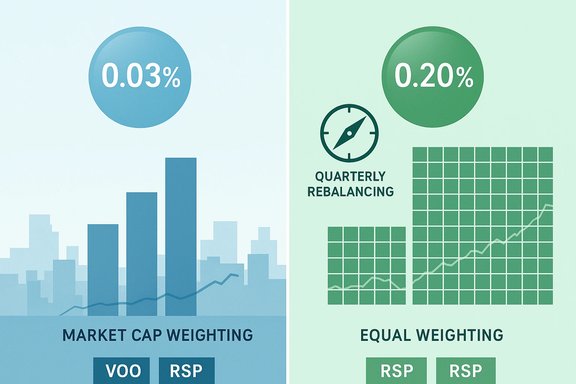
- VOO expense ratio: 0.03%, a headline low that favors long‑term compounding for buy‑and‑hold investors. This is Vanguard’s published figure on its fund hub.
- RSP expense ratio: 0.20%, materially higher than VOO because of index‑maintenance and higher turnover inherent to equal‑weight rebalancing. This is Invesco’s stated total expense ratio.
Assets under management and liquidity
- VOO manages hundreds of billions in assets and sits among the largest ETFs globally; its secondary‑market liquidity and narrow spreads make it attractive for both retail and institutional use. Market trackers and ETF aggregators report VOO AUM in the high hundreds of billions as of early January 2026.
- RSP is a well‑established smart‑beta ETF with tens of billions in AUM (roughly mid‑to‑high tens of billions around early January 2026), large enough for institutional use but meaningfully smaller than the biggest cap‑weighted S&P ETFs.
How weighting and rebalancing drive performance and risk
Market‑cap weighting (VOO)
- Market‑cap weighting gives larger companies larger index weights, producing a profile that tracks corporate earnings and market concentration dynamics. When mega‑caps (technology, AI beneficiaries, or other winners) outperform, cap‑weighted ETFs capture that outperformance with minimal turnover or rebmply follows the S&P 500 composition and requires low tracking maintenance.
- Lowest fee drag, minimal turnover, predictable tax characteristics.
- Often exhibits lower short‑term volatility than equal‑weight alternatives because of the stabilizing influence of mega‑caps.
- Exceptional liquidity for trade execution.
- Concentration risk — heavy exposure to the top few names can increase tail exposure to single‑name shocks even if index returns remain positive. Market flow dynamics can also magnify moves in top weights.
Equal weighting (RSP)
- Equal weighting allocates the same dollar weight to each of the 500 constituents and rebalances quarterly back to equal weights. This process introduces a systematic buy low / sell high tilt on rebalance dates and gives greater weight to smaller large‑cap names. In practice, RSP tilts toward size, value, and yield relative to the cap‑weighted S&P 500.
- Diversification away from mega‑cap concentration; can outperform when broad market breadth favors mid/smaller large‑caps or value‑oriented sectors.
- Historically higher dividend yield compared with cap‑weighted peers because smaller components often pay higher yields.
- Higher turnover and trading costs from quarterly rebalancing; these raise tracking error and tax drag relative to low‑turnover index funds.
- Higher volatility and deeper drawdowns at times because equal weighting amplifies exposure to smaller, more cyclical names within the S&P 500. Historical maximum drawdowns for RSP have been larger than those for typical cap‑weighted S&P ETFs.
Historical returns: what tilts have delivered
No single period tells the whole story; returns depend strongly on the market regime.- Over long periods RSP has sometimes outperformed the S&P 500 (and therefore cap‑weighted ETFs like VOO) due to its value and size tilt and the benefits of systematic rebalancing during mean‑reverting markets. Invesco’s performance summary of RSP highlights that equal‑weighting has the potential to outperform across full market cycles, though with higher volatility.
- VOO’s returns closely mirror the S&P 500 — when mega‑cap leaders such as the largest tech and AI beneficiaries lead the market, VOO benefits and typically shows smoother intra‑year performance due to concentration in stable or high‑momentum names. Market trackers show VOO’s 3‑ and 5‑year annualized returns remain competitive and are driven by the same handful of large contributors that dominate index gains.
- Equal‑weight strategies can outperform during breadth‑expanding rallies or when the market favors smaller large‑cap cyclicals. Conversely, in periods dominated by concentrated outperformance from a handful of mega‑caps, cap‑weighted VOO often outperforms RSP. Investors should treat historical outperformance as regime‑dependent rather than guaranteed.
Volatility, drawdowns, and downside behavior
- RSP has historically shown higher volatility and deeper maximum drawdowns than cap‑weighted S&P ETFs. Comparative analytics report higher rolling volatility for RSP and a larger historical peak‑to‑trough loss compared with VOO. That volatility is the tradeoff for the diversification and value tilt RSP provides.
- VOO’s volatility profile is typically lower, and maximum drawdowns track broad market selloffs rather than being amplified by the equal‑weight structure.
Taxes, turnover, and tracking error
- VOO: low turnover leads to predictable tax behavior and low tracking error. Securities‑lending revenues and dividend timing are straightforward because the fund simply mirrors the index. Vanguard’s fund architecture and scale help keep tax surprises small.
- RSP: quarterly equalization requires buying and selling many names, producing higher realized turnover and potentially greater taxable distributions for investors in taxable accounts. Invesco discloses RSP’s turnover and the fund’s methodology; potential investors should check recent factsheets for realized capital gain history before allocating taxable dollars.
When each ETF makes sense — practical allocation guidance
Use cases for VOO (Vanguard S&P 500 ETF)
- Core, long‑term U.S. equity allocation for retirement and taxable portfolios.
- Investors seeking minimal fees, low tracking error, and maximum liquidity for trading large blocks.
- Tactical allocations where tight spreads and deep liquidity matter (e.g., for rebalancing or for institutional trading).
Use cases for RSP (Invesco S&P 500 Equal Weight ETF)
- Investors concerned about mega‑cap concentration and wanting a single‑fund way to diversify away from the top S&P weights.
- Tactical overlay or satellite allocation to capture value/size tilts while keeping the S&P 500 stock universe exposure.
- Allocations inside tax‑deferred accounts where higher turnover and dividend distributions are less economically damaging.
- Core + satellite: use VOO as the core (e.g., 70–90%) and add RSP as a satellite (10–30%) to reduce concentration risk without dramatically increasing fees and volatility.
- Equal‑weight sleeve: for investors who want a structural equal‑weight bias, consider a dedicated allocation to RSP (20–40%) but size it according to risk tolerance and time horizon.
- Rebalancing discipline: if you hold both, rebalance annually to avoid over‑trading arbalances of RSP.
Fees vs. active implementation costs: how to think about the 0.17% gap
The headline fee gap (VOO 0.03% vs RSP 0.20%) must be weighed against expected return premium and implicit implementation costs:- If you expect RSP’s equal‑weight tilt to add me differential over your holding period (after taxes and trading costs), RSP may be justified.
- If you expect concentration in the largest mega‑caps to continue delivering outsized returns, VOO’s lower fee will compound into materially better investor outcomes over time.
- Realized outcomes depend on market regime, rebalancing execution, and tax treatment. Historical backtests show periods where RSP outperforms by enough to cover the higher fee — and periods where it underperforms. Investors should be explicit about their regime expectation and horizon.
Operational considerations and liquidity mechanics
- Trading spreads & market structure: VOO benefits from the deepest spreads and greatest intraday liquidity among S&P ETFs, an advantage for high‑frequency traders and large institutional executions. RSP trades at sufficient volume for most retail and many institutional needs but its spreads are typically wider than VOO’s. Use limit orders for large blocks and consider VWAP execution for institutional sizes.
- Product architecture: SPDR and other legacy structures differ from modern open‑end ETF implementations in how dividends and securities lending are treated; fund structure can influence small but real differences in net returns across long horizons. Recent market commentary has tracked a migration to lower‑cost wrappers as issuers cut fees and compete on core ETF offerings — a structural backdrop relevant to any S&P ETF decision.
Key risks to monitor
- Concentration reversal: If a handful of mega‑caps that have driven recent returns suffer material setbacks, cap‑weighted VOO will face direct pain; equal‑weight RSP may cushion relative performance but still decline on broad market weakness.
- Rebalancing & liquidity risk: RSP’s quarterly rebalances may occur at times of thin liquidity or market stress, inflating realized transaction costs versus backtests that assume ideal execution.
- Fee compression and product competition: issuers continually adjust fees; the optimal product today (by fee or liquidity) can change if issuers further compress fees or consolidate offerings. Industry flow shifts in recent years have favored lower‑cost wrappers, influencing where liquidity pools land and which ETFs are most practical for large trades.
- Tax unpredictability: realized capital gains from RSP rebalancing are possible and can surprise taxable investors if not anticipated. Check the fund’s realized gains history and prefer tax‑efficient placement.
Decision framework — choosing between VOO and RSP
Follow this step‑by‑step decision process:- Clarify objective: Is your goal low‑cost core exposure, or do you want to actively reduce concentration and tilt toward value/size?
- Set time horizon: Equal‑weight premiums historically require multi‑year horizons to manifest; short horizons amplify rebalancing and tax drag.refer RSP inside tax‑advantaged accounts; favor VOO inside taxable accounts if tax efficiency is paramount.
- Size and liquidity needs: for very large trades, VOO’s tighter spreads and deeper liquidity make it preferable.
- Implementation: if you want the equal‑weight tilt but dislike RSP’s cost/turnover, consider a partial allocation to RSP or use factor ETFs that offer lower turnover exposures.
Conclusion — a pragmatic view for WindowsForum readers
Both VOO and RSP have legitimate places in modern portfolios. VOO is the go‑to choice for core, low‑cost, tax‑efficient S&P 500 exposure with the deepest liquidity and the lowest fee drag. RSP is a purposeful tactical or strategic alternative for investors who want to reduce mega‑cap concentration, gain a value/size tilt, and accept higher volatility, higher fees, and higher turnover in exchange.For most retail investors building a simple, durable U.S. equity core, VOO is the efficient default. For investors worried about concentration risk or wanting to diversify the nature of their S&P exposure, RSP can be a disciplined satellite — ideally used inside tax‑advantaged accounts and sized to match tolerance for larger drawdowns and execution costs. Both choices should be validated against up‑to‑date factsheets and AUM/tracking data prior to trade. Vanguard’s published factsheet confirms VOO’s 0.03% expense ratio, and Invesco’s materials confirm RSP’s 0.20% total expense ratio and its quarterly equal‑weight rebalance methodology; independent market trackers corroborate AUM, liquidity, and volatility differentials cited above. Final action checklist:
- Verify the current expense ratio and AUM on the fund factsheet before allocating (figures change over time).
- Put taxable placement and rebalancing policies in writing before buying RSP.
- If concentration risk is a primary concern, quantify top‑10 weights in your existing S&P exposure and size a satellite RSP allocation to achieve your target de‑concentration.
Source: Intellectia AI https://intellectia.ai/news/stock/comparing-vanguard-sp-500-etf-and-invesco-etf-risks-and-returns]
