

The Welsh Government’s use of Microsoft Copilot in a review tied to the closure of Industry Wales has exposed a familiar but still unresolved problem: public-sector AI can be operationally useful and politically explosive at the same time. What makes this case especially consequential is not simply that Copilot was involved, but that the review’s findings helped set in motion a chain of institutional dissolutions affecting aerospace, automotive, technology, and net-zero coordination in Wales. The result is a dispute that reaches far beyond one body’s winding down and into the heart of how governments should use AI when jobs, strategy, and accountability are on the line. Wales may now become a case study in what happens when process looks automated, decisions look opaque, and trust collapses before the paperwork is even published.
Industry Wales was never just another advisory group. Created in 2013, it was designed to give Welsh industry a structured bridge to government, especially in sectors where long-term coordination matters more than short-term announcements. That mission mattered because aerospace, automotive, and technology ecosystems depend on stable relationships, trusted forums, and repeat contact between firms and officials, not one-off consultations.
The body’s role also reflected a broader policy reality in Wales: industrial strategy is often built through intermediaries rather than direct state command. Organizations like Industry Wales help translate between government ambition and business capability, making them especially important in sectors where supply chains, export markets, and skills pipelines are tightly linked. When such an intermediary disappears, the vacuum is not symbolic; it is operational.
According to the reporting summarized in the WinBuzzer piece, the Welsh Government informed Industry Wales in January 2025 that it would face review, later announced in August 2025 that the body would close, and then publicly confirmed the dissolution in October 2025 while also noting a grant of £837,000 for 2025-2026. By March 31, Industry Wales is expected to cease to exist, taking with it related bodies including Technology Connected, the Welsh Automotive Forum, and Aerospace Wales.
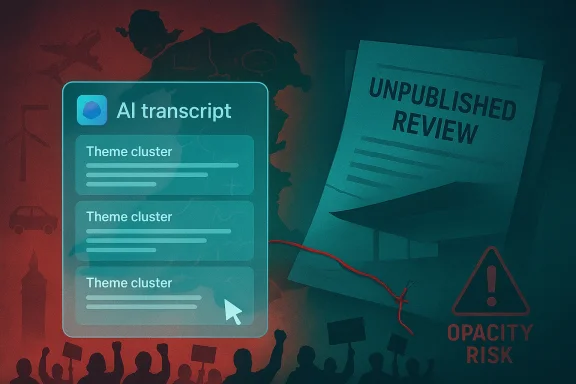
The political sensitivity comes from the fact that the review behind that decision remains unpublished. That leaves outsiders unable to see the evidence base, the weighting of the interviews, the assumptions behind the conclusions, or whether the government’s own summary is a fair representation of the process. In public administration, opacity is already risky; opacity paired with AI is much harder to defend.
If that account is accurate, the government is trying to draw a line between clerical assistance and substantive judgment. In theory, that line is defensible. In practice, however, thematic grouping is not politically neutral, because the structure of an evidence summary can strongly influence what decision-makers believe the evidence says.
The government’s argument appears to rest on a narrow definition of decision-making. That may satisfy a technical audit, but it does not fully answer the governance question. In public life, influence matters almost as much as authorship.
Ridgway’s criticism is not that AI was present in the workflow at all. His concern is that a consequential decision was based on material processed through a tool he believes is incapable of exercising the kind of judgment required for a closure review. He also suggested that findings should have been returned to the board for validation before being distilled into recommendations.
Ridgway also told the committee that the review omitted board-backed recommendations and that, while interview evidence supported retaining a Wales-specific organization, the conclusion favored redirecting companies to UK-wide industry bodies. If that is an accurate reading, then the review was not merely descriptive; it was directional. In other words, the way evidence was processed may have mattered as much as the evidence itself.
The absence of the review also creates a legitimacy problem for all sides. Supporters of the closure cannot point to a transparent evidence record. Critics cannot directly test whether the AI played a minor operational role or a more consequential analytical role. The result is a vacuum that invites the worst assumptions from everyone involved.
That tax is especially high when the subject is closure rather than expansion. People are more likely to accept AI-assisted drafting for routine reports than for decisions that end an organization’s existence. The more consequential the outcome, the more transparent the method must be.
Technology Connected is especially notable because it had operated for 25 years under its former identity as ESTnet and helped run Wales Tech Week, which drew more than 4,000 visitors in 2025. The Welsh Automotive Forum also reportedly faces closure after more than two decades of work. Once those organizations are gone, the state cannot assume the same informal networks will simply reappear in a new form.
This is why the closures matter more than they might first appear. Governments can reorganize structures on paper, but local industries often need continuity in tone, personnel, and trust. If the closure interrupts that continuity, the cost may show up later in weaker engagement and slower coordination.
The Welsh case lands at a moment when Microsoft itself has been warning users not to trust Copilot in Excel for tasks requiring accuracy, citing hallucination risk. That warning does not directly prove error in the Welsh review, but it does weaken any instinct to treat Copilot output as inherently authoritative. A vendor’s own cautionary language should be read as a reminder, not as a footnote.
That distinction matters because institutions sometimes confuse organizational convenience with governance adequacy. If an AI tool speeds up review production, that is not proof the review was better. It may simply be faster to reach a conclusion that should have been slower and more carefully interrogated.
The political risk for ministers is straightforward: if they appear evasive, the narrative shifts from “AI-assisted review” to “AI-assisted closure with weak accountability.” That is a damaging frame because it implies the administration outsourced not just clerical tasks but the credibility of a major decision. Public confidence tends to collapse quickly when a government seems unwilling to explain its own methods.
The better political strategy would normally be publication, explanation, and a plain acknowledgment of boundaries. If Copilot was only used for transcription and clustering, the government should be able to show that without fuss. The fact that it has not yet done so makes the dispute look worse than the technology itself might justify.
The challenge for governments is that AI adoption is often incremental while accountability is binary. A tool can begin as a transcription aid, drift into theme extraction, and end up exerting interpretive influence without any explicit decision to “let AI decide.” That gradual creep is precisely why oversight has to be designed in from the beginning.
That does not mean public bodies should avoid AI altogether. It means they need stronger controls than they would use for a draft press release or internal note-taking. The more consequential the report, the more plainly the methodology should be documented.
That matters in a competitive environment where companies already face pressure from energy costs, labor shortages, export volatility, and shifting industrial policy across the UK. Wales does not have the luxury of treating industrial coordination as optional. If anything, smaller economies need these connective bodies more than larger ones because they have fewer alternative pathways.
Their closure raises a hard question: what replaces that function? A generic central office may not have the sector-specific credibility or local knowledge to do the same job. If the replacement is thinner, then the closure may save administrative complexity while adding economic complexity elsewhere.
It also creates an opportunity for Wales to lead on AI transparency rather than trail behind it. Governments that define careful boundaries early can avoid later scandals, and this case offers a very visible chance to do that. The public debate may be uncomfortable, but it could still produce better practices.
There is also a reputational risk for Microsoft, even if the company had nothing to do with the policy outcome itself. When government users attach Copilot to contentious decisions, the tool becomes a proxy battleground for trust. If the public starts associating Copilot with hidden process, that is not ideal for any enterprise AI platform trying to sell reliability.
The wider next step is policy learning. Welsh and UK public bodies should treat this as a warning that AI in sensitive reviews must be documented with unusual care. It is no longer enough to say a tool helped with notes or themes; institutions must explain how that assistance was constrained, reviewed, and audited.
Looking further ahead, this case may shape how public bodies structure future reviews in at least one of three ways: more explicit human sign-off, stronger publication norms, or stricter bans on AI use in quasi-judicial or strategic closure decisions. Which of those emerges will depend on whether the current dispute is treated as a governance lesson or merely a communications headache.
In the end, this is not really a story about one AI tool or one review. It is a story about how governments explain themselves when technology enters the room, how much trust they deserve when they do not publish the full record, and whether the institutions that connect industry to state power can survive decisions made in the shadows. The answer in Wales will matter far beyond one March deadline.
Source: WinBuzzer Welsh Government Used Microsoft Copilot for Review That Closed Industry Wales
 Background
Industry Wales was never just another advisory group. Created in 2013, it was designed to give Welsh industry a structured bridge to government, especially in sectors where long-term coordination matters more than short-term announcements. That mission mattered because aerospace, automotive, and technology ecosystems depend on stable relationships, trusted forums, and repeat contact between firms and officials, not one-off consultations.The body’s role also reflected a broader policy reality in Wales: industrial strategy is often built through intermediaries rather than direct state command. Organizations like Industry Wales help translate between government ambition and business capability, making them especially important in sectors where supply chains, export markets, and skills pipelines are tightly linked. When such an intermediary disappears, the vacuum is not symbolic; it is operational.
According to the reporting summarized in the WinBuzzer piece, the Welsh Government informed Industry Wales in January 2025 that it would face review, later announced in August 2025 that the body would close, and then publicly confirmed the dissolution in October 2025 while also noting a grant of £837,000 for 2025-2026. By March 31, Industry Wales is expected to cease to exist, taking with it related bodies including Technology Connected, the Welsh Automotive Forum, and Aerospace Wales.
The political sensitivity comes from the fact that the review behind that decision remains unpublished. That leaves outsiders unable to see the evidence base, the weighting of the interviews, the assumptions behind the conclusions, or whether the government’s own summary is a fair representation of the process. In public administration, opacity is already risky; opacity paired with AI is much harder to defend.
What the Government Says Happened
The Welsh Government’s position is that Copilot played a limited and mostly mechanical role in the review process. A spokesperson said the tool was used to produce “full, accurate and unbiased transcripts” of interviews and to analyze and group comments into themes, while officials handled the detailed analysis and drafting. That is a crucial distinction, because it frames Copilot as a transcription and categorization aid rather than a decision-making engine.If that account is accurate, the government is trying to draw a line between clerical assistance and substantive judgment. In theory, that line is defensible. In practice, however, thematic grouping is not politically neutral, because the structure of an evidence summary can strongly influence what decision-makers believe the evidence says.
Why “Just Transcription” Is Not Always Just Transcription
A transcript is not the same thing as a conclusion, but it can still shape the conclusion. Once interview responses are grouped into themes, some issues become prominent while others fade into the margins. That means a tool that organizes evidence may still exert real influence over the final recommendation, even if no machine ever “decides” anything in the strict sense.The government’s argument appears to rest on a narrow definition of decision-making. That may satisfy a technical audit, but it does not fully answer the governance question. In public life, influence matters almost as much as authorship.
- Transcription is usually low-risk when faithfully recorded.
- Theme grouping can shape the framing of the evidence.
- Framing affects which issues appear urgent or marginal.
- Urgency often drives political action more than raw data does.
- An unpublished review makes independent verification difficult.
- The more consequential the decision, the stronger the audit trail should be.
Why Keith Ridgway Objected
Industry Wales chair Professor Keith Ridgway’s testimony before the Senedd committee is the most direct challenge to the government’s position. He said he was alarmed when he saw that the review referenced Microsoft Copilot as being used to evaluate interview returns, and he argued that AI should not have been relied upon to perform that role. In his words, it was “just wrong.”Ridgway’s criticism is not that AI was present in the workflow at all. His concern is that a consequential decision was based on material processed through a tool he believes is incapable of exercising the kind of judgment required for a closure review. He also suggested that findings should have been returned to the board for validation before being distilled into recommendations.
The Accountability Gap
That objection goes to the core of public-sector legitimacy. A board can be asked to provide evidence, but it should not feel as though evidence is transformed elsewhere into a final narrative without a clear human checkpoint. When that checkpoint is missing, stakeholders naturally ask whether the process respected institutional knowledge or bypassed it.Ridgway also told the committee that the review omitted board-backed recommendations and that, while interview evidence supported retaining a Wales-specific organization, the conclusion favored redirecting companies to UK-wide industry bodies. If that is an accurate reading, then the review was not merely descriptive; it was directional. In other words, the way evidence was processed may have mattered as much as the evidence itself.
- Ridgway’s argument centers on judgment, not just technology.
- He says the board should have validated the findings.
- He believes the review underweighted Wales-specific institutional needs.
- The critique implies a process failure, not only a communications failure.
- The unpublished status of the review amplifies skepticism.
- The controversy is about accountability as much as AI.
The Unpublished Review Problem
One of the most damaging elements in this story is that the review still has not been published. That means the public cannot see the interview questions, the response set, the Copilot prompts, the theme labels, or the government’s own final interpretation of the evidence. In a normal controversy, publication might resolve some of the dispute; in this case, non-publication keeps the dispute alive.The absence of the review also creates a legitimacy problem for all sides. Supporters of the closure cannot point to a transparent evidence record. Critics cannot directly test whether the AI played a minor operational role or a more consequential analytical role. The result is a vacuum that invites the worst assumptions from everyone involved.
Why Transparency Matters More When AI Is Involved
AI systems do not just accelerate work; they can also obscure it. When human staff summarize interviews manually, the path from raw testimony to final report is at least traceable in principle. When an AI assistant helps group comments, the process becomes harder to inspect unless the institution deliberately documents every step. Without that documentation, AI creates a credibility tax that governments must pay later.That tax is especially high when the subject is closure rather than expansion. People are more likely to accept AI-assisted drafting for routine reports than for decisions that end an organization’s existence. The more consequential the outcome, the more transparent the method must be.
- Public scrutiny is stronger when a body is being dissolved.
- AI-assisted theme extraction requires auditability.
- An unpublished report prevents outside verification.
- Hidden methodology invites allegations of bias.
- Transparency is easier to promise than to reconstruct after the fact.
- Stakeholder trust erodes quickly when evidence is not shared.
The Chain Reaction Across Welsh Industry Bodies
Industry Wales is not disappearing in isolation. According to the reported timeline, the closure cascades into Technology Connected, the Welsh Automotive Forum, and Aerospace Wales. That is significant because those groups are not interchangeable communications shells; they are sector-specific connective tissue built over years, often with relationships that are difficult to reproduce quickly.Technology Connected is especially notable because it had operated for 25 years under its former identity as ESTnet and helped run Wales Tech Week, which drew more than 4,000 visitors in 2025. The Welsh Automotive Forum also reportedly faces closure after more than two decades of work. Once those organizations are gone, the state cannot assume the same informal networks will simply reappear in a new form.
The Loss Is Institutional, Not Just Administrative
What disappears here is not only a logo or a line item. Sector liaison bodies often hold the memory of past projects, supplier relationships, regional strengths, and policy dead ends. They know who to call, what prior funding pathways worked, and where industry trust was won or lost. That institutional memory is hard to replace with a generic centralized office.This is why the closures matter more than they might first appear. Governments can reorganize structures on paper, but local industries often need continuity in tone, personnel, and trust. If the closure interrupts that continuity, the cost may show up later in weaker engagement and slower coordination.
- Technology Connected has deep historical roots in Wales’s tech ecosystem.
- Wales Tech Week served as a visible convening platform.
- The Automotive Forum has long supported sector coordination.
- Aerospace Wales provides specialized industry linkage.
- Institutional memory is an asset that disappears slowly and painfully.
- Rebuilding trust usually takes longer than shutting a body down.
Microsoft Copilot and the Governance Debate
Copilot is central to the controversy because it embodies a larger shift in office AI: from writing assistance to workflow assistance and, increasingly, to analytical scaffolding. That makes it useful, but also risky. When governments adopt it in sensitive processes, they are not just buying productivity; they are implicitly testing the boundaries of algorithmic judgment.The Welsh case lands at a moment when Microsoft itself has been warning users not to trust Copilot in Excel for tasks requiring accuracy, citing hallucination risk. That warning does not directly prove error in the Welsh review, but it does weaken any instinct to treat Copilot output as inherently authoritative. A vendor’s own cautionary language should be read as a reminder, not as a footnote.
What Copilot Can and Cannot Do
Copilot can assist with drafting, transcription, summarization, and pattern extraction. It can reduce the burden of sifting through large volumes of interview notes and help surface recurring issues. It cannot, however, independently validate policy priorities, weigh competing strategic interests, or understand the political significance of closing an industry body in a devolved economy.That distinction matters because institutions sometimes confuse organizational convenience with governance adequacy. If an AI tool speeds up review production, that is not proof the review was better. It may simply be faster to reach a conclusion that should have been slower and more carefully interrogated.
- Copilot is useful for organizing information.
- It is not a substitute for policy judgment.
- Pattern detection is not the same as strategic evaluation.
- Hallucination risk makes validation essential.
- Speed can hide weak reasoning.
- The tool’s capability should define the workflow, not the other way around.
Political Fallout in the Senedd
The controversy has already reached the political arena, where Senedd members are treating the matter as a test of governmental seriousness. Tom Gifford reportedly described the AI use as “bonkers,” a blunt reaction that suggests the issue has traction beyond specialist governance circles. That kind of language matters because it frames the episode not as a narrow technical dispute but as a political judgment on judgment itself.The political risk for ministers is straightforward: if they appear evasive, the narrative shifts from “AI-assisted review” to “AI-assisted closure with weak accountability.” That is a damaging frame because it implies the administration outsourced not just clerical tasks but the credibility of a major decision. Public confidence tends to collapse quickly when a government seems unwilling to explain its own methods.
The Cost of Defensiveness
Defensiveness is dangerous in cases like this because it invites scrutiny of everything adjacent to the main issue. Once stakeholders start asking why the review was unpublished, they also ask who wrote the prompts, who approved the methodology, whether interviewees knew how their answers would be processed, and whether the board ever got a fair chance to challenge the conclusions. Each answer can open another question.The better political strategy would normally be publication, explanation, and a plain acknowledgment of boundaries. If Copilot was only used for transcription and clustering, the government should be able to show that without fuss. The fact that it has not yet done so makes the dispute look worse than the technology itself might justify.
- Political scrutiny expands when process is unclear.
- Blunt opposition language shapes media framing.
- Evasion increases suspicion around method.
- Publication can reduce uncertainty if done fully.
- Committees want evidence, not abstractions.
- Accountability is the central issue, not vendor branding.
Public Sector AI and the New Normal
This story fits into a wider pattern across the public sector: governments increasingly want the gains of AI without the reputational cost of seeming to hand decisions over to machines. That tension is not unique to Wales, but the Industry Wales case gives it a very visible industrial-policy context. AI is no longer just a productivity tool in the background; it is now entering high-stakes administrative workflows.The challenge for governments is that AI adoption is often incremental while accountability is binary. A tool can begin as a transcription aid, drift into theme extraction, and end up exerting interpretive influence without any explicit decision to “let AI decide.” That gradual creep is precisely why oversight has to be designed in from the beginning.
What Responsible Use Should Look Like
A responsible public-sector AI workflow should be built around transparency, human review, and auditable boundaries. Officials should know exactly what the tool did, what it did not do, and where human judgment entered the process. In sensitive reviews, especially those involving closures or service redesign, that bar should be higher still.That does not mean public bodies should avoid AI altogether. It means they need stronger controls than they would use for a draft press release or internal note-taking. The more consequential the report, the more plainly the methodology should be documented.
- Define the task the AI is allowed to perform.
- Record who approved AI use and why.
- Document prompts, outputs, and human edits.
- Separate transcription from interpretation.
- Publish the methodology where possible.
- Keep final accountability with named officials.
- AI use should be proportionate to the decision at hand.
- Human sign-off must be explicit and traceable.
- Sensitive reviews need stronger disclosure.
- Tool output should be logged, not assumed.
- Public trust depends on explainable process.
- The standard should be higher for closures than for routine admin.
Industry Wales and the Economic Stakes
The closure of Industry Wales is not a symbolic retirement of an outdated body; it has real implications for regional economic coordination. Sectors such as aerospace and automotive depend on supplier networks, skills planning, and government liaison that are both technical and relational. If those bridges disappear, firms may still operate, but they do so with less coordinated support.That matters in a competitive environment where companies already face pressure from energy costs, labor shortages, export volatility, and shifting industrial policy across the UK. Wales does not have the luxury of treating industrial coordination as optional. If anything, smaller economies need these connective bodies more than larger ones because they have fewer alternative pathways.
Sector Bodies as Economic Infrastructure
It is easy to underestimate industry forums because they do not build factories or launch products. But they often help make the rest of the system work. They can reduce friction between firms and ministers, identify emerging skills gaps, and turn isolated business concerns into structured policy dialogue.Their closure raises a hard question: what replaces that function? A generic central office may not have the sector-specific credibility or local knowledge to do the same job. If the replacement is thinner, then the closure may save administrative complexity while adding economic complexity elsewhere.
- Sector forums are coordination infrastructure.
- Their value is often invisible until they vanish.
- Smaller economies rely heavily on intermediary bodies.
- Industrial policy works better with feedback loops.
- Replacing trust is harder than replacing a budget line.
- Loss of liaison capacity can slow strategic response.
Strengths and Opportunities
The immediate strength of this story is that it has forced a serious conversation about how AI is actually used inside government, not how vendors market it. It has also exposed the importance of documenting AI-assisted workflows in public-sector decisions, which could improve governance if the Welsh Government or other administrations respond constructively. If handled well, the controversy could become a catalyst for clearer rules, stronger auditing, and better public explanation.It also creates an opportunity for Wales to lead on AI transparency rather than trail behind it. Governments that define careful boundaries early can avoid later scandals, and this case offers a very visible chance to do that. The public debate may be uncomfortable, but it could still produce better practices.
- Forces a real discussion about AI accountability.
- Highlights the need for published methodology.
- Encourages stronger governance standards for public reviews.
- Could improve future procurement and documentation practices.
- Raises awareness of AI’s interpretive, not just clerical, role.
- May push Welsh institutions toward clearer disclosure norms.
- Offers a chance to rebuild trust through transparency.
Risks and Concerns
The biggest risk is that this becomes a precedent for opaque AI-assisted decision-making in government. If a public body can use AI in a review that leads to closure and still avoid publishing the underlying report, other institutions may conclude that similar opacity is acceptable. That would be a dangerous lesson because it normalizes low-transparency automation in high-stakes settings.There is also a reputational risk for Microsoft, even if the company had nothing to do with the policy outcome itself. When government users attach Copilot to contentious decisions, the tool becomes a proxy battleground for trust. If the public starts associating Copilot with hidden process, that is not ideal for any enterprise AI platform trying to sell reliability.
- Opaque AI use could become normalized in government.
- Public trust may erode if the report stays unpublished.
- Staff morale can suffer when institutions are dissolved without clarity.
- Sector disruption may outlast the administrative transition.
- Vendors risk being implicated in political disputes.
- The process could be seen as bypassing local expertise.
- Similar cases may prompt resistance to AI adoption.
Looking Ahead
The immediate next step is publication. If the Welsh Government wants to reduce the heat around this episode, it will need to release the review, clarify exactly what Copilot did, and explain who made the substantive judgments. Without that, the story will remain a live controversy rather than a resolved administrative decision.The wider next step is policy learning. Welsh and UK public bodies should treat this as a warning that AI in sensitive reviews must be documented with unusual care. It is no longer enough to say a tool helped with notes or themes; institutions must explain how that assistance was constrained, reviewed, and audited.
Looking further ahead, this case may shape how public bodies structure future reviews in at least one of three ways: more explicit human sign-off, stronger publication norms, or stricter bans on AI use in quasi-judicial or strategic closure decisions. Which of those emerges will depend on whether the current dispute is treated as a governance lesson or merely a communications headache.
- Publish the review and methodology.
- Clarify Copilot’s exact role in processing evidence.
- State who approved the AI workflow.
- Explain how human review was performed.
- Set a formal policy for AI use in sensitive reports.
- Reassess how sector bodies are replaced or consolidated.
- Improve transparency before future closures are considered.
In the end, this is not really a story about one AI tool or one review. It is a story about how governments explain themselves when technology enters the room, how much trust they deserve when they do not publish the full record, and whether the institutions that connect industry to state power can survive decisions made in the shadows. The answer in Wales will matter far beyond one March deadline.
Source: WinBuzzer Welsh Government Used Microsoft Copilot for Review That Closed Industry Wales
