

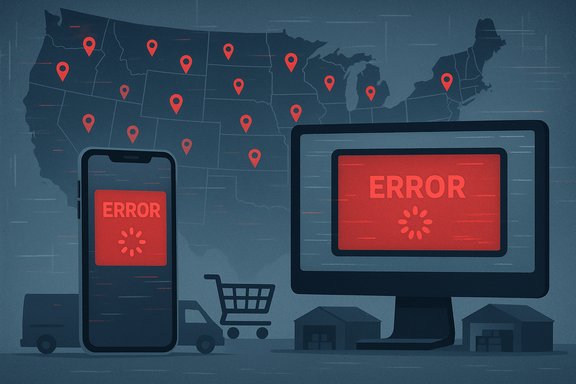
On Tuesday morning thousands of Walmart customers found themselves locked out of the retailer's digital storefronts as both the Walmart mobile app and Walmart.com experienced a widespread interruption that spiked user reports and disrupted grocery orders, deliveries and checkout flows across the United States.
The disruption began in the early hours and quickly registered as a major incident on outage-tracking services, with several reports peaking in the thousands within a short window. Most user complaints identified the mobile app as the most affected surface, with a significantly smaller — but still consequential — fraction of users reporting problems on the desktop website and checkout systems.
Retailers of Walmart’s scale rely heavily on digital channels not only for direct e-commerce revenue but also for orchestrating in-store pickup, delivery logistics, driver routing and point-of-sale integrations. When the app and web storefront are unavailable, the impact cascades across ordering, fulfillment and last-mile delivery operations in real time. That systemic fragility is what turned a customer-facing outage into an operational headache for store teams and delivery drivers as well.
Source: Bloomberg.com https://www.bloomberg.com/news/arti...rs-report-outage-for-mobile-and-web-services/
 Background
The disruption began in the early hours and quickly registered as a major incident on outage-tracking services, with several reports peaking in the thousands within a short window. Most user complaints identified the mobile app as the most affected surface, with a significantly smaller — but still consequential — fraction of users reporting problems on the desktop website and checkout systems.Retailers of Walmart’s scale rely heavily on digital channels not only for direct e-commerce revenue but also for orchestrating in-store pickup, delivery logistics, driver routing and point-of-sale integrations. When the app and web storefront are unavailable, the impact cascades across ordering, fulfillment and last-mile delivery operations in real time. That systemic fragility is what turned a customer-facing outage into an operational headache for store teams and delivery drivers as well.
What happened: the observable facts
- The first wave of user reports began early in the morning. Outage monitoring services and social media showed a rapid surge in complaints concentrated around app logins, crashes at app launch, account authentication failures and checkout errors on the website.
- The majority of reports pointed to the mobile app as the most heavily impacted surface, with the website and checkout pages also affected for many users.
- Complaints were not limited to shoppers: employees and third-party delivery drivers reported issues accessing backend tools used for pickup confirmations and delivery acceptance, compounding fulfillment delays.
- Issues declined over time as engineering teams worked to restore services; users and retailer support channels later reported partial or full recovery for many customers, though some nodes and driver-facing tools reportedly continued to show residual problems for a period after the initial spike.
Why major retail outages matter: immediate impacts
An outage like this has layered consequences:- Customer experience: Interrupted checkouts, cancelled grocery pickup slots and failed payments create immediate friction and dissatisfaction. For shoppers planning last-minute purchases or relying on timed grocery deliveries, the outage can be more than an inconvenience — it can be an acute disruption to daily life.
- Fulfillment and logistics: When driver apps or pickup scheduling tools are down, drivers cannot accept new offers or confirm deliveries, and stores may be unable to see incoming pickup orders. That creates backlogs, missed windows and increased manual workload for store staff.
- Revenue and conversion: Even short interruptions reduce conversion rates. For large-scale retailers, minutes of downtime translate into measurable revenue losses and potential long-term erosion of digital loyalty.
- Operational risk: Customer support and in-store staff typically see surges in inbound contacts; meanwhile, SRE and platform teams face pressure to restore service without introducing regressions.
- Reputational risk: High-profile outages draw media attention and social amplification, particularly when they occur during busy retail periods or around holidays.
What could cause a simultaneous mobile and web outage?
No single public statement from the company provided a definitive root cause at the time the platform was recovered, and that absence of an official explanation means any technical diagnosis offered here is informed speculation grounded in industry patterns. These are the scenarios experienced operations teams see most often when both app and website flows fail concurrently.1. Centralized API or authentication failure
Modern retail apps and websites usually depend on the same set of backend APIs: product catalogs, user authentication, cart & checkout services, recommendation engines and payments gateways. If a core service (for example, an authentication provider, central API gateway or database cluster) becomes unresponsive or throttled, both the mobile and web clients will surface errors.- Why it fits: simultaneous failures across client types suggest a shared backend dependency.
- Why it may not fit: if only certain geographic regions were affected, that would point to edge network or CDN problems rather than a global backend failure.
2. Configuration or deployment regression
A bad configuration change or a faulty software deployment can accidentally break service. Examples include an incorrect routing rule, a malformed environment variable, a feature flag gone wrong or an API schema change that clients cannot handle.- Why it fits: routine deployments can and do introduce regressions that cascade through multiple services.
- Why it may not fit: robust deployment practices (canary releases, progressive rollouts) are designed to catch this early; if those practices were in place and adhered to, the outage window might have been smaller.
3. CDN, DNS or certificate problems
When content delivery networks (CDNs) or DNS records misconfigure or when TLS certificates expire or are rolled incorrectly, both web and mobile clients can fail to connect properly.- Why it fits: CDNs and DNS affect traffic routing to backend services and static content, impacting both channels.
- Why it may not fit: CDN and DNS issues often produce regional symptoms and can be detected quickly with external monitoring.
4. Third-party service disruption
Retailers outsource many functions — payment processing, identity providers, analytics, or third-party search — and a dependency outage at a vendor can break upstream flows.- Why it fits: third-party faults are common, especially when the downstream application tightly couples critical flows to external endpoints.
- Why it may not fit: large retailers tend to have redundancy and failover handling for many essential vendor services, though that is not infallible.
5. Capacity or DDoS-style overload
An unexpected surge in traffic (organic or malicious) can overwhelm rate limits, API servers or databases, causing cascading failures that hit both app and site.- Why it fits: peak traffic windows or coordinated traffic spikes can reveal capacity blind spots.
- Why it may not fit: DDoS mitigation and auto-scaling reduce this risk, though they can be outmaneuvered or misconfigured.
6. Security incident or ransomware
A deliberate compromise or ransomware event can force services offline while teams isolate and remediate the incident.- Why it fits: some outages are defensive — organizations take systems offline to stop propagation.
- Why it may not fit: most public reports of outages explicitly mention suspected security incidents if that is the case; absence of such claims reduces confidence in this hypothesis but doesn’t eliminate it.
How to read the signals: what the pattern suggests
The incident’s pattern — a rapid spike in user complaints concentrated on the mobile app with secondary website issues and downstream effects on driver and pickup tools — aligns best with one of two scenarios:- A shared backend API failure or gateway outage that prevented authentication, cart or checkout flows, thereby breaking both app and web clients; or
- A deployment/configuration regression in a central service used by multiple client types, which propagated fast because of the scope of the service.
What happened operationally (based on observable behaviors)
- Support channels reported high volumes of tickets and social posts across platforms.
- Some stores and driver-facing systems saw degraded functionality, which points to backend orchestration issues rather than an isolated storefront UI bug.
- Recovery occurred within hours for many users, although some drivers and employees reported lingering issues in certain localities.
- Customer-facing guidance promoted standard client troubleshooting while backend teams worked on systemic restorations.
Risk assessment and downstream consequences
Even when resolved, outages leave residual costs:- Lost sales: short-lived but high-volume outages reduce same-day conversion and may push time-sensitive purchases to competitors.
- Customer churn: recurring outages or perceptions of unreliable digital experience accelerate churn among convenience-focused customers.
- Operational backlog: order processing and driver routing backlogs create ongoing labor costs and customer service escalations.
- Regulatory risk: in certain contexts (financial systems, health-related deliveries), interruptions can trigger compliance scrutiny.
- Security exposures: incomplete or hurried recoveries can leave temporary misconfigurations that expose data if not checked by a comprehensive post-incident review.
What Walmart and similar retailers should do next (technical and operational checklist)
- Conduct a thorough post-incident review (PIR) with timelines, change logs, root-cause analysis and mitigations.
- Validate and rehearse rollback paths and ensure canary/progressive rollout policies are enforced across deployment tooling.
- Increase observability coverage for the most critical shared services: auth, API gateways, checkout/payment flows and driver APIs.
- Implement clear multi-vendor redundancy strategies for third-party dependencies and verify failovers regularly.
- Harden communication plans: publish timely status updates via a public status page and social channels to reduce uncertainty and repeated support requests.
- Run capacity and chaos engineering experiments to exercise limits and test failure modes in a controlled environment.
- Publish a transparent summary to customers after the PIR, including root cause and remediation steps, to restore trust.
For customers: practical guidance during an outage
- Try basic client-side steps first: restart the app, clear app cache, reinstall the app, or use a private browsing session on the website.
- If you have a time-sensitive order, contact customer support early and preserve any order confirmation emails or screenshots for escalation.
- For recurring problems after a declared recovery, try switching networks (e.g., cellular vs. Wi‑Fi) — sometimes DNS or local cache issues persist longer than backend fixes.
- Be cautious about reusing payment tokens if the app logs out repeatedly; verify bank/credit account activity if you see suspicious transactions, and follow standard fraud precautions.
Broader implications for retail digital strategy
This outage is another reminder that modern retail depends on software reliability as much as it relies on supply chain and brick‑and‑mortar operations. A few strategic lessons emerge:- Software is supply chain: outages affect inventory flow, pickups and last-mile delivery. Retailers must treat code and API availability as integral to physical operations.
- Observability and SRE matter: investment in distributed tracing, real‑time error budgets and automated rollback tooling pays off during incidents.
- Customer communication is the front line: a clear, honest status page and proactive messages reduce speculation, mitigate reputation damage and lower support burden.
- Vendor risk is enterprise risk: even large retailers can be tripped by a third-party provider; contractual SLAs and tested failovers are essential.
- Resilience testing should be continuous: chaos engineering and capacity stress testing expose hidden dependencies before customer-facing windows.
What this means for enterprise IT teams
- Treat cross-team dependencies as first-class citizens in runbooks and incident playbooks.
- Ensure SLOs and error budgets are meaningful and tied to business outcomes (e.g., pickup confirmation latency).
- Automate incident detection and customer-facing message templates to reduce time-to-acknowledgement.
- Conduct tabletop drills with store operations, logistics, SRE and customer support to practice coordinated responses.
What we still don’t know — and why that matters
Because there was no immediate public root-cause statement explaining the technical failure in authoritative detail, several questions remain open and should be answered in a formal post-incident report:- Was the outage initiated by an internal code change, an external vendor disruption, or an infrastructure fault?
- Which specific subsystems (authentication, API gateway, payment processors, CDN, DNS) failed or were implicated?
- Were canary and rollback processes exercised and did they function correctly?
- What are the concrete mitigations to prevent recurrence?
Final analysis: strengths, weaknesses and key takeaways
- Strengths observed:
- The engineering teams were apparently able to restore many services within a limited window, indicating operational capability to respond under pressure.
- Public-facing support channels provided standard troubleshooting advice to users, which helped some customers recover quickly.
- Weaknesses revealed:
- The lack of an immediate, detailed public incident statement increases reputational risk and leaves customers guessing about the safety of their accounts and orders.
- The fact that driver and store backends were affected highlights single points of failure in downstream operational tooling that should have additional redundancy.
- Key takeaway:
- Digital outages at scale are not just an IT problem — they are a cross-functional operational risk that requires the same strategic attention retail leaders give to inventory, logistics and store operations. The interplay between code, cloud infrastructure and physical retail must be governed by robust resilience engineering, vendor risk management and clear customer communication.
Short-term recommendations for Walmart and peers
- Publish a clear post-incident timeline and root-cause summary once available.
- Prioritize fixes that isolate driver/store systems from customer-facing web and mobile outages where possible.
- Run an immediate audit of recent deployments and third-party vendor health during the incident window.
- Strengthen the public status page and commit to real-time updates in future incidents to maintain trust.
Conclusion
This outage underscores how dependent everyday retail has become on networks, APIs and cloud orchestration. When those systems fail, the effects ripple from consumers and store staff to drivers and supply chains, creating a visible and painful business interruption. The technical details of this particular incident remain to be confirmed by a full post-incident report; until that report is published, any single-cause diagnosis would be premature. What is clear, however, is that the modern retail stack must be engineered for failure — not merely to recover from it — and that transparent, timely communication is the most effective tool to limit reputational damage when outages occur.Source: Bloomberg.com https://www.bloomberg.com/news/arti...rs-report-outage-for-mobile-and-web-services/
