

The Walrus’s latest “Weekly Quiz” bundles a surprising randge of beats — from microbiology and pipelines to parental rights and the creeping presence of generative AI in law — and, taken together, the collection reads less like a light quiz than a compact dossier on three converging forces shaping public life: science that migrates from bench to bedside, infrastructure whose costs and politics ripple outward, and algorithmic tools that are already rewiring legal practice. This feature unpacks the quiz’s core claims, verifies the key facts where possible, and offers a critical, evidence‑forward appraisal of what those claims mean for readers concerned with public policy, worker rights, and the rise of “machine‑made law.”
The compact format disguises substantive claims that deserve verification. This article verifies those claims, cross‑references them with independent reporting and academic literature where possible, and flags areas where the evidence is ambiguous or evolving. The goal is to provide WindowsForum readers a disciplined, journalistically rigorous take that translates the Walrus’s cultural framing into policy, technical, and human‑rights implications.
That said, the evidence base is mixed. Randomized controlled trials (RCTs) of FMT for IBS have produced heterogeneous results: some trials report symptomatic improvement, while others — including double‑blind, placebo‑controlled studies — have failed to replicate benefits or have shown effects of uncertain magnitude. The strongest recent observational reports show meaningful improvements in sleep indices and mood after WMT or FMT, but those studies often suffer from small samples, short follow‑up windows, and variable control of confounders such as concurrent psychiatric care, medication changes, and placebo effects.
Source: The Walrus Weekly Quiz: Microbes, Maternity Leave, and Machine-Made Law | The Walrus
 Background
What the quiz covers and why it matters
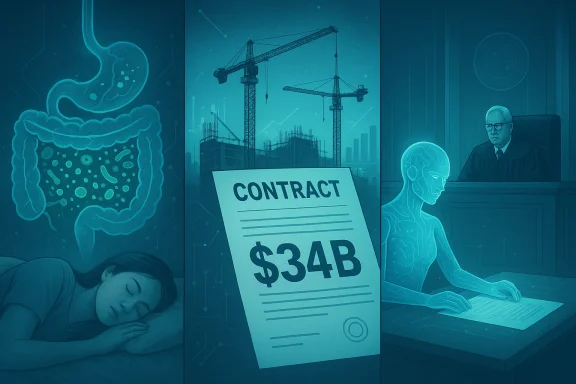
The week’s quiz selects four short items from the magazine: an exploration of the gut microbiome’s relationship to sleep and ageing; a reminder of how expensive pipeline infrastructure can be, using the Trans Mountain Expansion (TMX) as an example; a clearheaded explanation of the legal reality around termination during pregnancy or maternity leave in Canada; and a look at how generative AI tools have proliferated in the legaltech sector. Each item is short, quiz‑friendly, and anchored to a stronger, underlying feature story — but the quiz’s real value is how it strings disparate technical and social debates into a single, accessible moment.The compact format disguises substantive claims that deserve verification. This article verifies those claims, cross‑references them with independent reporting and academic literature where possible, and flags areas where the evidence is ambiguous or evolving. The goal is to provide WindowsForum readers a disciplined, journalistically rigorous take that translates the Walrus’s cultural framing into policy, technical, and human‑rights implications.
Microbes and Sleep: the microbiome‑brain axis in practice
What the quiz claims
The Walrus summary highlights research linking the gut microbiome to sleep and ageing, and points to fecal microbiota transplantation (FMT) studies in people with irritable bowel syndrome (IBS) as some of the strongest evidence that altering the microbiome can improve sleep.Verification and context
The claim is rooted in a growing body of research on the microbiota–gut–brain axis, a multidisciplinary field showing plausible biological pathways by which gut microbes can influence central nervous system functions — including sleep, mood, and cognition. Peer‑reviewed clinical work and observational studies report associations between gut dysbiosis, sleep disturbance, and psychiatric symptoms in people with functional gastrointestinal disorders. Small, open‑label studies and some prospective cohorts have observed improvements in sleep quality, mood, and anxiety after FMT or more refined “washed” microbiota transplantation (WMT) in patients with IBS or inflammatory bowel disease (IBD).That said, the evidence base is mixed. Randomized controlled trials (RCTs) of FMT for IBS have produced heterogeneous results: some trials report symptomatic improvement, while others — including double‑blind, placebo‑controlled studies — have failed to replicate benefits or have shown effects of uncertain magnitude. The strongest recent observational reports show meaningful improvements in sleep indices and mood after WMT or FMT, but those studies often suffer from small samples, short follow‑up windows, and variable control of confounders such as concurrent psychiatric care, medication changes, and placebo effects.
Strengths of the argument
- Biological plausibility: Mechanistic research supports routes (immune signalling, short‑chain fatty acids, neurotransmitter precursors) through which the microbiome could modulate sleep and mood.
- Convergent signals: Multiple small trials, observational studies, and a growing literature on microbiome‑sleep correlations provide convergent, if not definitive, evidence.
- Clinical relevance: For people with IBS or IBD, improvements in sleep are clinically meaningful because sleep loss worsens pain perception, mood, and quality of life.
Limits and risks
- Heterogeneous evidence: RCT results are mixed, and small, unblinded studies are vulnerable to bias.
- Safety and standardization: FMT/WMT protocols vary, donor screening is critical, and long‑term safety data are incomplete.
- Overpromising: Presenting FMT as “proof” that microbes directly control sleep risks overselling preliminary science to patients seeking easy fixes.
Bottom line
The Walrus’s characterization — that IBS‑centred FMT experiments are among the stronger pieces of evidence linking microbiome change to sleep — is defensible if framed carefully. The evidence is promising but not conclusive; FMT/WMT remains investigational for sleep improvement in many settings, and clinicians and patients should treat early findings as hypothesis‑generating rather than definitive therapy recommendations.One more pipeline won’t save us: the Trans Mountain cost lesson
What the quiz claims
The quiz references the Trans Mountain Expansion and asks about its construction cost, giving C$34 billion as the correct figure.Verification and context
The TMX project has been a high‑profile case study in cost escalation for public infrastructure. Official filings and multiple independent news outlets report the project’s budget creeping into the low‑to‑mid‑C$30‑billion range, with a widely cited estimate of about C$34 billion following updates in 2023–2024. That number reflects the long history of delays, expanded scope, complex Indigenous negotiations, and pandemic‑era impacts on labor and supply chains.Why the number matters
- Fiscal scale: C$34 billion is not just an accounting figure; it represents a major allocation of public and quasi‑public capital that will shape tolls, user charges, and the balance sheets of parties who shoulder project risk.
- Policy trade‑offs: The project crystallizes a broader debate about whether heavy public spending on fossil fuel infrastructure is compatible with climate commitments and long‑term economic resilience.
- Political signal: The cost overrun narrative frames debates about government competence, procurement practice, and the role of Indigenous co‑ownership and consultation.
Strengths and weaknesses of the Walrus framing
- Strength: The quiz uses TMX as a concise example of how infrastructure costs can balloon, which is a legitimate public‑interest lesson.
- Weakness: Cost headlines alone can obscure nuance on how tolling, contractual risk allocation, or long‑term contractual commitments alter who ultimately pays and why the project persisted despite overruns.
Bottom line
The C$34‑billion figure is a defensible, reported estimate and an effective shorthand for the scale of government investment and risk. The broader lesson — that single infrastructure projects can carry outsized fiscal and political consequences — is sound. Readers should, however, watch tolling outcomes and long‑term commercial arrangements to understand who bears the eventual economic burden.Yes, you can be fired during maternity leave — and why the law is messy
What the quiz claims
The Walrus item states that in Canada an employer can terminate someone “without cause” during pregnancy or parental leave, and that whether that termination violates law often turns on the Canadian Human Rights Act and provincial human rights legislation (for example, the Ontario Human Rights Code for provincially regulated employees).Verification and context
This is an accurate distillation of Canadian employment law in practical terms. Employment standards statutes (provincial or federal, depending on sector) protect the right to take pregnancy and parental leaves and impose reinstatement or return‑to‑work obligations in some contexts; human‑rights law protects pregnancy and family status as grounds on which employment decisions cannot be discriminatorily taken. Still, the law allows terminations for legitimate non‑discriminatory business reasons — including without‑cause layoffs or downsizing — and employers sometimes use those routes during protected leaves. Remedies can include human‑rights complaints, wrongful‑dismissal claims, and, in certain cases, re‑instatement or damages.Strengths and risks of the framing
- Strength: The quiz conveys the uncomfortable fact that legal protections are not absolute guarantees of job security once employers perform careful legal framing of a termination.
- Risk: The nuance that leaves and human‑rights protections can provide strong remedies — including reinstatement or enhanced damages in some provinces — is easily lost in a short quiz item.
Practical takeaways
- Document the timing and communications surrounding any termination while on leave.
- Seek early legal advice; human‑rights tabulations, employment standards timelines, and common‑law wrongful‑dismissal remedies interact in complex ways.
- Employers who terminate employees on leave without a legitimate, documented business reason are exposing themselves to costly litigation and reputational risk.
When evidence can be deepfaked: the rise of generative AI in legaltech
What the quiz claims
The Walrus cites an inventory from June 2025 that counted 638 generative‑AI legaltech tools — a figure used to illustrate the sheer quantity of commercial products available to lawyers and litigants.Verification and context
Market mapping projects and legaltech trackers corroborate rapid growth in generative‑AI legal products. One prominent mapping effort reported a census in mid‑2025 compatible with the Walrus’s figure, and subsequent quarterly updates showed the total product placements climbing further into the 700s by late‑2025. These vendor counts reflect an ecosystem that includes general‑purpose large language model (LLM) wrappers, verticalized contract‑analysis engines, AI assistants for legal research, and specialized workflow automations.Why the count matters
- Access and inequality: The proliferation of paid, enterprise‑grade legal AI risks deepening divides between well‑resourced firms that can buy expensive, integrated tools and self‑represented litigants who depend on free or consumer‑grade assistants.
- Governance and ethics: Rapid proliferation outpaces standardized evaluation frameworks, posing real questions about accuracy, bias, provenance, and auditability.
- Practice transformation: Law firms are deploying these tools for discovery, contract drafting, and due diligence; the aggregate effect on billable hours, quality control, and ethical duty is material and immediate.
Strengths and limitations of the Walrus claim
- Strength: The Walrus correctly signals the scale and momentum of generative‑AI adoption in legaltech.
- Limitation: Vendor counts are a moving target; how many “tools” exist depends on inclusion criteria (product placements vs. vendors vs. feature flags), and many offerings are narrow, duplicative, or pre‑release.
Key technical and ethical risks
- Hallucination and admissibility: Generative models produce plausible but potentially false assertions; when these feed legal filings or evidence summaries, courts must decide how to treat model provenance and reliability.
- Asymmetric access to advanced tools: Paid tools with proprietary models give repeat players tactical advantages in speed and depth of analysis.
- Regulatory blind spots: Practice rules, confidentiality obligations, and discovery expectations are struggling to catch up with AI‑assisted workflows.
Cross‑cutting analysis: what the Walrus quiz gets right and where it shuts down the conversation
Notable strengths
- The quiz selects compact, high‑impact facts that open doors to deeper debates: experimental therapeutics, the political economy of infrastructure, worker protections, and AI’s legal footprint.
- Its choices reflect good editorial judgment — the items are timely and culturally illustrative without being trivial.
- The pieces are readable and accessible, making complex issues approachable for general audiences.
Areas requiring extra care
- Evidentiary nuance: Scientific claims (microbiome → sleep) need clear qualifiers; small‑sample interventions can be hyped beyond their methodological limits.
- Statistical drift: Vendor counts and cost figures change quickly; a static quiz should explicitly date the figures it uses.
- Legal complexity: Short takes on employment law can inadvertently under‑inform workers about remedies and statute of limitations — a problem when readers seek immediate help.
Practical recommendations for readers and practitioners
For clinicians and patients interested in microbiome therapies
- Treat FMT/WMT for sleep or mood improvement as emerging and experimental outside specific clinical protocols.
- Seek care in clinical trial settings or specialist centres that perform rigorous donor screening and follow‑up.
- Ask about trial design, control groups, and long‑term safety monitoring before consenting to any microbiome intervention.
For policy watchers and taxpayers concerned about large projects
- Watch tolling determinations and contractual risk allocations to see who bears overruns.
- Demand transparent reporting on project governance, Indigenous partnership terms, and environmental mitigations.
- Consider opportunity costs; large public capital projects should be assessed against alternative investments in clean energy and resilience.
For employees and advocates dealing with maternity leave terminations
- Document all communications and request written rationales for any termination.
- Consult labour standards offices and human‑rights commissions promptly; timelines can be strict.
- Consider both statutory remedies and common‑law wrongful‑dismissal claims when evaluating options.
For lawyers, IT teams, and courts facing generative AI
- Adopt vendor evaluation checklists that include provenance, logging, and red‑team testing for hallucinations.
- Preserve audit trails and human‑in‑the‑loop checkpoints where AI outputs inform filings or client advice.
- Advocate for disclosure protocols that make AI use transparent in submissions and evidence handling.
Machine‑made law: the deeper implications
The Walrus’s quiz item about legaltech captures an underappreciated structural dynamic: generative AI is not merely a productivity bolt‑on; it is reconfiguring knowledge labor, access to justice, and evidentiary practice. That reconfiguration has distinct dimensions:- Automation of routine legal work will compress time and cost for tasks like document review, but it will also concentrate strategic advantage in firms that integrate proprietary stacks with in‑house data and standards.
- Information asymmetry will grow if advanced, validated models remain locked behind enterprise contracts while pro se litigants have access only to consumer tools with weaker accuracy and no formal accountability.
- Adjudicative strain will increase as courts confront synthetic evidence, unverifiable model provenance, and submissions drafted or polished by AI without clear attribution. Judges and clerks will need training, and evidence rules may require technical updates.
Conclusion
Small, well‑chosen facts from a weekly quiz can be a gateway to large public debates. The Walrus’s selections this week succeed in spotlighting three fault lines — science in translation, fiscal and political cost of infrastructure, and the rapid commercialization of legal AI — that intersect in consequential ways. Each item is, on its own, defensible; each also demands context, careful caveats, and active public judgement.- The microbiome → sleep link is plausible and supported by emerging clinical signals, but it remains an active research frontier where randomized evidence is mixed and safety/standardization matters.
- The Trans Mountain cost headline (C$34 billion) is a reliable symbol of how infrastructure projects can overwhelm original estimates and reshuffle fiscal priorities.
- The legal reality that employees can be terminated during pregnancy or parental leave — subject to human‑rights scrutiny and provincial/federal statutory regimes — is sobering and legally accurate.
- The inventory‑scale growth in generative legal tools underscores a near‑term inequality in legal capability and an urgent need for governance, transparency, and public‑interest countermeasures.
Source: The Walrus Weekly Quiz: Microbes, Maternity Leave, and Machine-Made Law | The Walrus
