Waratek’s Locker promised a practical "bring your own security" (BYOS) approach for Java applications on Microsoft Azure — a lightweight, JVM‑embedded container that applies Runtime Application Self‑Protection (RASP) policies without touching application code — and while the idea remains compelling, the claims require careful scrutiny and real‑world validation before enterprises treat it as a silver bullet.
Cloud adoption shifted the security conversation from perimeter defenses to runtime protections that follow applications wherever they run. Runtime Application Self‑Protection, or RASP, is one of those approaches: it embeds security inside the application runtime so protections execute where code actually runs. That model allows defenses to observe the live data flow through an app and block attacks in real time, rather than relying solely on static scanning or network filters. Industry analysts characterize RASP as a security control capable of both controlling application execution and detecting/preventing real‑time attacks, which is the premise under which Waratek positioned its Locker offering. Waratek introduced Locker as an Azure Marketplace offering at Microsoft TechEd Europe in Barcelona. The product was marketed as a secure container built into the Java Virtual Machine (JVM) that bundles Apache Tomcat with Waratek’s runtime protection so organizations could "bring their own application security controls to Azure." The company framed this as a BYOS model that keeps enterprise security policies portable across cloud environments. At a high level, Locker addressed a persistent cloud security problem: organizations want the agility and scale of Azure, but they also want predictable, application‑centric defenses that neither require code changes nor risk introducing new operational complexity. Waratek’s thesis was that performing security inside the JVM — where the app actually runs — lets defenders observe and control behavior at the point of execution, enabling mitigations for SQL injection, abnormal file access, unexpected network calls, and exploits in third‑party libraries. To understand Locker’s intended role, it helps to see it in the broader Azure context: Microsoft has invested heavily in infrastructure‑level security for Azure, but cloud customers still shoulder responsibility for application logic, secrets, and configuration. The BYOS model aims to close that gap by giving teams application‑level controls that travel with their code, complementing platform protections already provided in Azure.
In summary, Waratek Locker and the BYOS RASP model articulate a clear improvement in cloud application security by placing defenses inside the application runtime and offering portable policy controls for Azure deployments. The concept is sound and fills a genuine gap between platform security and application logic. Enterprises should pilot the technology, independently verify performance and functional claims, and integrate RASP into a broader defense‑in‑depth program rather than relying on it as a single point of protection.
Source: BetaNews Bring your own security approach protects Azure cloud apps
 Background
Cloud adoption shifted the security conversation from perimeter defenses to runtime protections that follow applications wherever they run. Runtime Application Self‑Protection, or RASP, is one of those approaches: it embeds security inside the application runtime so protections execute where code actually runs. That model allows defenses to observe the live data flow through an app and block attacks in real time, rather than relying solely on static scanning or network filters. Industry analysts characterize RASP as a security control capable of both controlling application execution and detecting/preventing real‑time attacks, which is the premise under which Waratek positioned its Locker offering. Waratek introduced Locker as an Azure Marketplace offering at Microsoft TechEd Europe in Barcelona. The product was marketed as a secure container built into the Java Virtual Machine (JVM) that bundles Apache Tomcat with Waratek’s runtime protection so organizations could "bring their own application security controls to Azure." The company framed this as a BYOS model that keeps enterprise security policies portable across cloud environments. At a high level, Locker addressed a persistent cloud security problem: organizations want the agility and scale of Azure, but they also want predictable, application‑centric defenses that neither require code changes nor risk introducing new operational complexity. Waratek’s thesis was that performing security inside the JVM — where the app actually runs — lets defenders observe and control behavior at the point of execution, enabling mitigations for SQL injection, abnormal file access, unexpected network calls, and exploits in third‑party libraries. To understand Locker’s intended role, it helps to see it in the broader Azure context: Microsoft has invested heavily in infrastructure‑level security for Azure, but cloud customers still shoulder responsibility for application logic, secrets, and configuration. The BYOS model aims to close that gap by giving teams application‑level controls that travel with their code, complementing platform protections already provided in Azure.How Waratek Locker works
JVM‑embedded container architecture
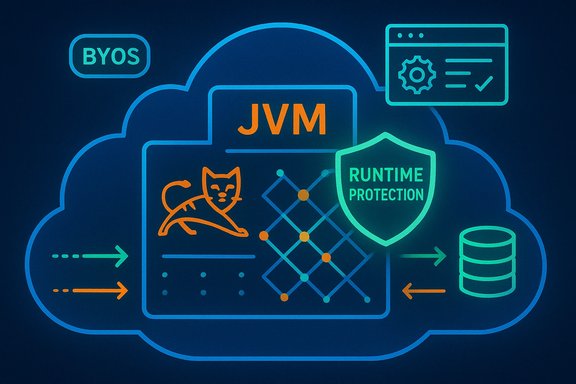
Waratek designed Locker to run inside the JVM rather than as an external network filter or separate VM. From that vantage point, Waratek's agents intercept API calls and JIT (just‑in‑time) compiled code paths to trace how untrusted input flows through the application at runtime. This gives the product real‑time visibility into potentially risky operations (database queries, file system access, outbound sockets) and the ability to enforce rules immediately. Multiple independent writeups from the time describe the same architecture and the rationale for JVM integration. The Locker container bundled Apache Tomcat (version 7 in the initial product literature) together with Waratek’s RASP engine. That packaging provided a turn‑key container image that enterprises could deploy into Azure without refactoring their applications. The goal was to simplify adoption: drop in the container, configure rules, and the runtime protection begins inspecting requests and blocking suspicious operations.Rule engine and policy model
At the heart of Locker is a rule‑based engine that administrators can manage remotely. The vendor shipped preconfigured rules to:- Restrict applications to required file paths and network endpoints
- Block common injection patterns and malformed SQL operations
- Quarantine or block sensitive operations triggered by anomalous behavior
Attack surface coverage
Waratek claimed that Locker protects against a broad class of threats, including:- Exploits that target vulnerabilities in third‑party libraries
- SQL injection and data flow abuse
- Abnormal file manipulation or unauthorized reads/writes
- Unexpected outbound network connections
Deployment, management, and operational model
BYOS — Bring Your Own Security
Waratek marketed Locker under the BYOS umbrella: customers retain policy control and can apply their own application security posture even when the application lives on Azure. This is an attractive notion for enterprises that require consistent controls across on‑premises and cloud deployments. The BYOS model is especially useful when organizations are constrained from changing application code or when rapid mitigation is needed for discovered vulnerabilities.Administration and policy lifecycle
Waratek exposed a portal and rule wizard tools for policy creation and lifecycle management. Administrators could create rule sets, assign them to applications, and deploy updates without recompiling or restarting apps in many cases. The product documentation described step‑by‑step flows for policy creation, rule assignment, and application binding, indicating this was part of the operational intent rather than an afterthought.Trial, packaging and marketplace availability
At launch, Waratek offered Locker through Azure Marketplace and touted free trials and rule‑creation tooling for customers to author custom rules. Contemporary reporting and vendor pages confirmed trial availability and a Marketplace listing, making experimentation relatively straightforward for cloud teams. Later Waratek product evolution (AppSecurity, Waratek Patch, etc. shows the company continued to expand runtime protection features and virtual patching capabilities.Strengths: what Waratek Locker realistically delivers
- Application‑centric protection: Because Locker runs in the JVM, it sees the same data and execution context as the application, enabling defenses that network devices cannot. This can reduce false positives and allow more surgical blocking.
- No code‑change deployment: The promise of layering security without altering application code is compelling for legacy applications or high‑availability services where code churn is risky. Waratek’s documentation and press coverage confirm the agentized, jar‑drop deployment model.
- Rule‑driven virtual patching: Waratek’s virtual patching concept lets operators mitigate known vulnerabilities at runtime until a physical patch can be applied. This approach reduces attack windows and is particularly useful for large estates with slow upgrade cycles. The vendor later formalized this capability as Waratek Patch.
- Portable enterprise security: Packaging a Tomcat image with runtime guards creates a portable unit that can be redeployed across Azure subscriptions or even other cloud environments, delivering consistent security controls. This portability supports BYOS goals.
Risks, limits, and claims that require verification
Performance and "no overhead" assertions
Vendor messaging often implied minimal performance impact, an important selling point for runtime protection. However, claims of zero or negligible overhead should be validated with independent benchmarks. RASP agents that instrument the runtime necessarily add CPU and memory cost, and the exact impact depends on workload, rule complexity, and traffic patterns. Independent performance testing is essential before wide rollout; enterprise teams should measure latency, throughput, and resource usage in production‑like conditions. Contemporary reporting acknowledged the "lightweight" goals but also differentiated containers from full virtualization rather than proving absolute zero overhead.Coverage gaps and blind spots
Running inside the JVM provides visibility over Java code paths, but it does not magically cover the entire application stack. Native libraries, out‑of‑process components, C/CPP extensions, or sidecar services are outside the JVM's instrumentation boundary. Additionally, obfuscated or dynamically generated code paths can evade some instrumentation strategies. Security teams must map the full runtime surface and ensure critical operations occur within instrumented processes. Failure to do so creates blind spots where attackers can pivot.False positives, business disruption, and policy drift
Any enforcement engine that blocks behavior risks disrupting legitimate business workflows if rules are over‑broad. Waratek’s model alleviates some of this with preconfigured rules and a portal for policy lifecycle, but organizations must still implement staged rollouts, simulation modes, and rapid rollback processes. Operational readiness — training security and development teams to interpret events and tune rules — is a critical success factor.The "guarantee" problem and third‑party claims
Vendor statements that a virtual patch "cannot be exploited" or that the container “guarantees” no application breakage are marketing claims that require careful legal and technical scrutiny. Those assurances may be framed in marketing copy, but in practice the complexity of enterprise applications means regressions and edge cases are possible. Independent testing, liability language, and staged pilots should inform any high‑risk adoption.Dependency on correct rule authoring
The RASP model’s effectiveness depends on accurate rules authored by security teams. Poorly written rules can underprotect critical flows or block legitimate operations, and rule sprawl can degrade performance. Waratek supplied a rules wizard and examples, but organizations must invest in rule governance to maintain security posture over time.How Locker compared to other options (then and now)
- Network WAFs and API gateways
- Strengths: Broad HTTP/transport‑level protections; central location for egress/ingress policies.
- Weaknesses: Cannot see in‑process data flows, taint tracking, or method‑level misuse. RASP fills that visibility gap. Observers at the time noted that RASP complements rather than replaces network defenses.
- Static and dynamic analysis (SAST/DAST)
- Strengths: Find coding errors and vulnerabilities before deployment.
- Weaknesses: Static tools miss runtime context; dynamic testing is limited by test coverage. RASP acts as runtime insurance in production to catch exploit attempts that pre‑deployment tests missed.
- Instrumentation/Tracing tools (APM)
- Strengths: Performance observability and tracing for debugging.
- Weaknesses: Not designed to enforce or block malicious behavior. RASP augments observability with enforcement capability inside the application runtime.
Operational checklist and best practices for deploying JVM RASP in Azure
- Start with a pilot: Deploy Locker or any RASP agent in a non‑production environment that mirrors production traffic to measure performance and refine rules.
- Use staged enforcement: Begin in monitoring or alerting mode before enabling blocking to avoid production disruptions.
- Create rule governance: Establish a central policy owner, change control, and a documented review cadence for rules.
- Integrate with CI/CD: Feed runtime findings back into the development pipeline so recurring issues are fixed at the source.
- Measure overhead: Record baseline latency, CPU, and memory metrics and monitor them continuously after deployment.
- Map the attack surface: Identify non‑JVM components and ensure complementary protections are in place for anything outside the agent’s purview.
- Maintain a rapid rollback plan: If a rule produces unacceptable business impact, be prepared to revert quickly.
- Validate vendor claims: Ask for independent benchmarks, or run your own load tests under realistic conditions. Vendor statements are a starting point, not a substitute for validation.
Vendor evolution and what it means today
Waratek’s product roadmap and later releases show continued emphasis on runtime remedies and virtual patching; the company also evolved products around automated patching and modernization features that allow older Java deployments to inherit newer JVM benefits without code changes. That trajectory — from Locker to AppSecurity and Waratek Patch — reflects market demand for runtime mitigation and faster remediation cycles. Enterprises evaluating solutions today should map each vendor’s current capabilities, support lifecycles, and roadmap to their long‑term cloud strategy. Be cautious when interpreting older press releases or conference announcements as current capabilities; product names, supported versions, and technical architectures change over time. Validate a vendor’s current documentation and release notes before making procurement decisions. Waratek’s documentation and support notices demonstrate active product maintenance and lifecycle planning, which is a positive sign for enterprise buyers.Final assessment: where Waratek Locker adds value — and where it needs proof
Waratek Locker captured an important design point: protecting applications where they execute — inside the JVM — and giving enterprises portable policy controls to run on Azure. The BYOS model is attractive because it recognizes that cloud infrastructure controls are necessary but not sufficient for application‑level risk. Early reporting, vendor docs, and later product evolution consistently show the same core capabilities: JVM instrumentation, rule engines, virtual patching, and a containerized delivery option. However, several practical caveats remain:- Performance claims require independent validation. Every runtime protection adds cost; plan benchmarking and stress tests.
- Operational discipline is mandatory. RASP only works as well as your rules and governance program; the human element — rules authoring, drift control, incident triage — drives success.
- Don’t treat RASP as a one‑stop fix. Continue secure development practices, vulnerability management, identity and secrets hygiene, and network protections. RASP should be integrated into a layered defense.
In summary, Waratek Locker and the BYOS RASP model articulate a clear improvement in cloud application security by placing defenses inside the application runtime and offering portable policy controls for Azure deployments. The concept is sound and fills a genuine gap between platform security and application logic. Enterprises should pilot the technology, independently verify performance and functional claims, and integrate RASP into a broader defense‑in‑depth program rather than relying on it as a single point of protection.
Source: BetaNews Bring your own security approach protects Azure cloud apps